The pilot’s voice comes over the PA, asking passengers and flight attendants to prepare for the final approach.
If I’m reading, I close my book. If I’m resting, I open my eyes. If the window shade is down, I raise it. From the moment of the pilot’s announcement until the wheels touch the runway, and the force from the plane’s thrust-reverse system pushes me back against my seat, I will keep watch out the window.
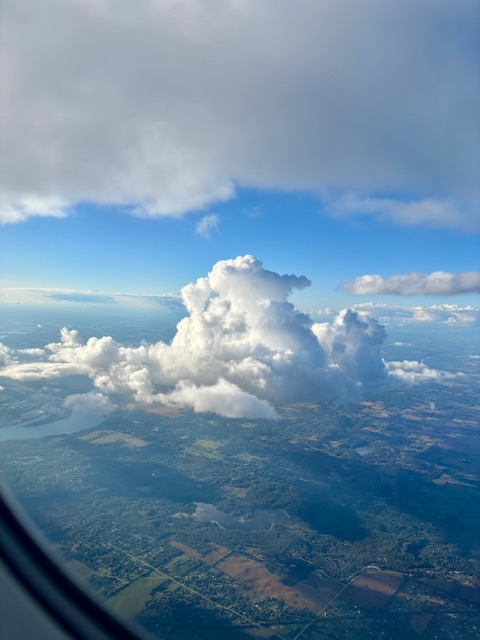
Out the window I’m met by thick, irregular shaped clouds spattered through the Midwestern skies over Minneapolis-St. Paul and its suburbs. I have a window seat. I always try to have a window seat. Considering I don’t like to be boxed into a space, this is unusual for me. But instead of feeling claustrophobic and trapped, I’m comforted by the world outside the window, even if I’m thousands of feet above the earth. The pilot asks passengers to fasten their seatbelts, stow their trays, and return their seats to an upright position. Flight attendants make their final walks up and down the aisle.

My love of the window seat on a plane began as a young child. I would fly with my father, who had a private pilot’s license. Over the years he owned a series of mostly single-engine airplanes, so every seat had a window. If my mother wasn’t on the plane, and she rarely was, I rode in the front passenger seat. Views surrounded me. Flying north and south across Wisconsin, I was mesmerized by patchworked parcels of land seamed together with ribbons of road. Rivers meandered and lakes nestled in the landscape. Houses and buildings, cows and horses looked like toys left behind by children. And I liked to imagine the cars and trucks had been wound by hand and set upon the roads. Every time I flew with my father and he landed the plane and shut it down, he’d declare, “Cheated death again.”

Our approach into Minneapolis-St. Paul International Airport is a series of wide turns creating the illusion we are flying in slow motion as we descend through billowy clouds. The plane banks, then banks again. Each turn provides a view of the earth below then a view of the clouds above. I’m transcended. I’m fearless. I don’t worry about the plane falling from the sky. I’m not watching out the window in a hope to divert disaster. I’m watching out the window because I’m enchanted by the most beautiful final approach I think I’ve ever experienced. I’m not worried about the landing. If something goes wrong, I’ve had a seat to a stunning view after a lovely trip to Scotland.
As a child, I knew planes crashed, but I never worried when my father flew his small plane. I took my first commercial flight when I was seventeen, a trip to Europe with other students and chaperones. I don’t remember being afraid. But by the time I was in my early twenties, commercial flying scared me. There was a spate of commercial crashes from the 1970s through the 1980s. And there was the echo of my father’s words, “Cheated death again.”
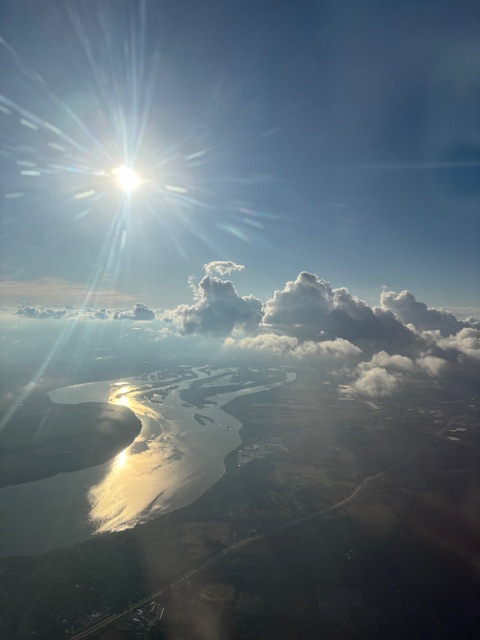
On one of the plane’s banks, I see a shimmering steel-colored river reflecting the sun and clouds. I wonder if it’s the Mississippi or the Minnesota. In a final crescendo, the sky has become a cobalt blue, and shades of industrial gray dance across the land and river.
In my 20s, 30s, and 40s, I avoided commercial flying. I rarely traveled to see my family because it meant getting on a jet. When I did agree to fly to see my parents or siblings, dread stalked me. In the weeks and days before my flight, I’d wake in the middle of the night certain my plane would crash. My dread inflated like a balloon until I thought it would burst. Then my departure date would arrive, and I’d head to the airport. Caught up in waves of people coming and going, I, too, would become excited to be going somewhere. My fear would dissipate. I’d board the plane, buckle my seatbelt, open a book, and read. When the plane started moving, I’d look out the window. (Most crashes happen on takeoffs and landings.) I’d watch the plane roll down the runway, lift off the ground, and clear its controlled airspace. Then, and only then, I’d return to my book.
As we near the runway cleared for our landing, I know the plane is traveling at speeds faster than I ever drive, but that’s not how it feels from the air. I’m suspended in time and space. I realize I’m not in a hurry to land. I’d like to ask the pilot to go around one more time. I have just returned from Scotland, home to some of the world’s most beautiful scenery. But the views on this final approach rival the scenes of Scotland, not because they are similar, but because they are so different. I’m home. In my Midwestern part of the United States. A land with its own innate and man-made beauty.
By the time I was in my late twenties, my fear of flying spread to small planes like my father flew. After I married and had children, my father would fly his small plane from Arizona to Wisconsin every summer. He’d attend the Experimental Aircraft Association show in Oshkosh, visit friends in southern Wisconsin, then fly into the Bong Airport in Superior. He’d call me from the air, and I’d load my children and dogs into the car and meet him at the airport. I’d help him tie down his plane, a ritual we completed many times when I was young. At some point during his visit, he’d take my boys and me for a flight. At first, I was okay with this, but as each year passed, my fear of flying in a small plane surpassed my fear of flying in commercial jets. I knew the statistics. Small private planes were more dangerous. At least, with my children in the plane, he didn’t say, “Cheated death again.”
The flight attendants have all taken their seats. Our Delta Flight 1127 levels, ready for landing. I don’t experience a moment of panic.
Last February Delta Flight 4819 landed upside down on a runway in Toronto. No one died. My mother, who knew I’d be flying Delta to Scotland, lost no time in phoning to tell me about the inverted landing. “It’s comforting to know, “I replied, “that I’ve chosen an airline whose pilots know how to land a jet upside down.”
Up until our final descent, the jet engines droned quietly. But now just before we land, pilots adjust flaps and slats to increase drag in order to slow the plane even more. A loud rumble fills my ears. The wheels of the plane hit the ground and the spell is broken. The pilots reverse thrust and a deafening roar assaults my ears, and I’m pressed into the back of my seat.
One year, before my father came to visit, I asked my sister to tell him that I didn’t want to go up in his plane anymore. That I couldn’t handle the weeks of anxiety before the flight. My father came and went and never mentioned a plane ride. Later, on another one of his visits, he told me about a friend of his who had flown for years for work and for recreation. “Gary,” Dad said, “can no longer get on a plane, private or commercial.” I stood at my kitchen sink washing dishes, my back to my father. I didn’t turn around. He continued, “Gary said he’s flown for decades without an accident, and he feels he’s used up all his luck.” (Gary felt his time for “cheating death once again” had run out.) I said nothing, and my father said nothing else. I believe he told me this story because he knew I had a fear of flying, and this was his way of saying he understood. One of his occasional moments of empathy.
I still won’t get on a private plane, but I don’t worry about flying commercially, or take offs, or landings any more. My father’s refrain, “cheated death again,” doesn’t play through my head. Perhaps because I’m of a certain age, I’ve come to realize it’s a waste of energy, worrying about something I can’t control. Sometimes the only way to get somewhere is to fly. My mother can’t fly anymore but there are places she’d like to go. Her world has shrunk. Perhaps one day, I won’t be able to fly anymore either, so I’ll go while I can. And instead, I’ll fret about getting stranded in an airport or worse, getting stranded in a plane on the tarmac.
We taxi up to the gate, our plane is an hour late getting in (some mechanical thing in Boston), but I still have plenty of time to catch the airport shuttle for home.










 Writing Near the Lake