The John C. Gale Boardwalk, part of the Taiga Boardwalk built in autumn 2023
Last week I took my four grandkids to the Sax-Zim Bog in Toivola, Minnesota, appropriately located on Owl Avenue. (It’s a good place to see northern owls.) The drive from my house was one hour and four minutes. (Thank you, GPS.) The grandkids brought library books and their adventure bags, which are filled with postcards, maps, compasses, binoculars, auto bingo, bird books, and other adventuresome stuff. We weren’t one minute from my house when the three youngest grandkids took up an intense game of auto bingo, searching for cows, horses, ambulances, no parking signs, and billboards. However, by the time we were far enough out of the city to see cows and horses, the bingo game had blown over.
Of course, there is always one grandkid who wants to know: How far? How many more miles? Are we halfway there yet? Have you ever been here before?
We arrived at the bog’s parking lot about eleven o’clock. It was 52 degrees and sunny, with a slight breeze — perfect weather for walking through an old bog. But we were glad we’d worn sweatshirts over our T-shirts.
The Sax-Zim Welcome Center was closed, but we met a volunteer coming out of the building who looked like part of an illustration from a Jan Brett book. He kindly answered my questions about the trails because we wanted to walk on the new Taiga Boardwalk built last autumn.
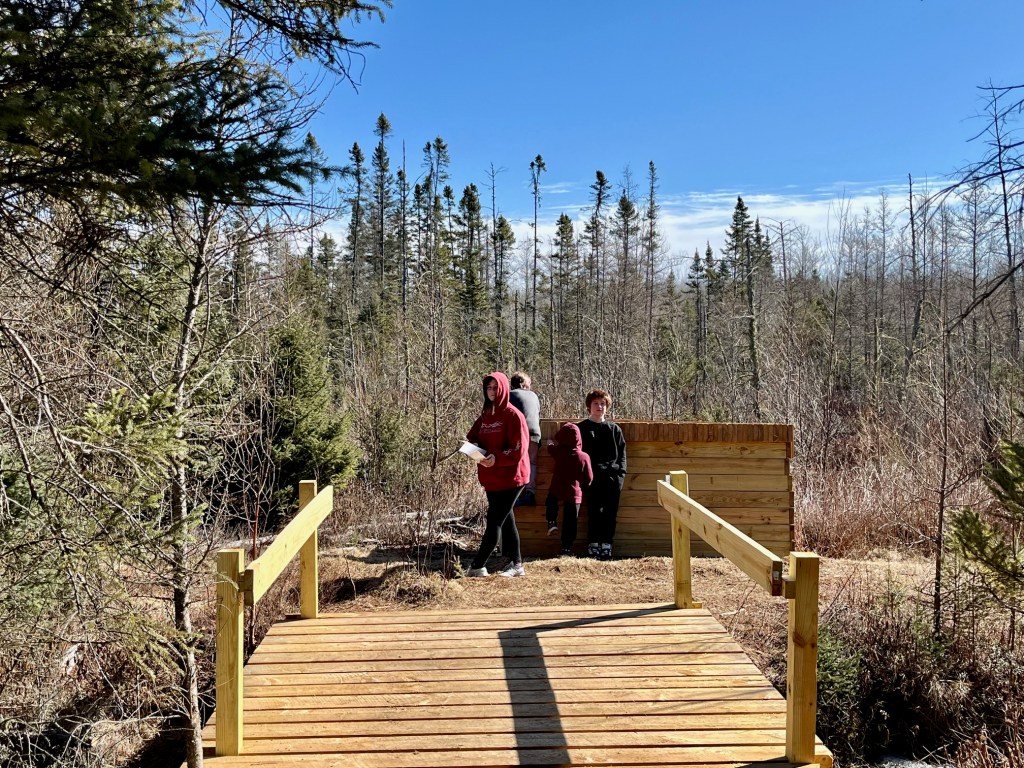
Grandkids on the Taiga Boardwalk
Shortly after we started down the trail, a loud clattering commenced. I wondered, “What kind of bird is that?” Then I discovered two chattering squirrels chasing each other up and down tree trunks and across fallen logs at breakneck speeds like a pair of NASCAR racers. “Those are fox squirrels,” Michael, 10, said. “My grandma has them at her house.” His other grandparents live in rural central Minnesota. But, according to a post on the Friends of Sax-Zim Bog Facebook page, we most likely saw Red Squirrels. They are highly territorial, and one of them probably invaded the other’s space, which would explain their loud scolding sounds and serious chasing behavior. Whether fox squirrels or red squirrels, they were fun to watch.
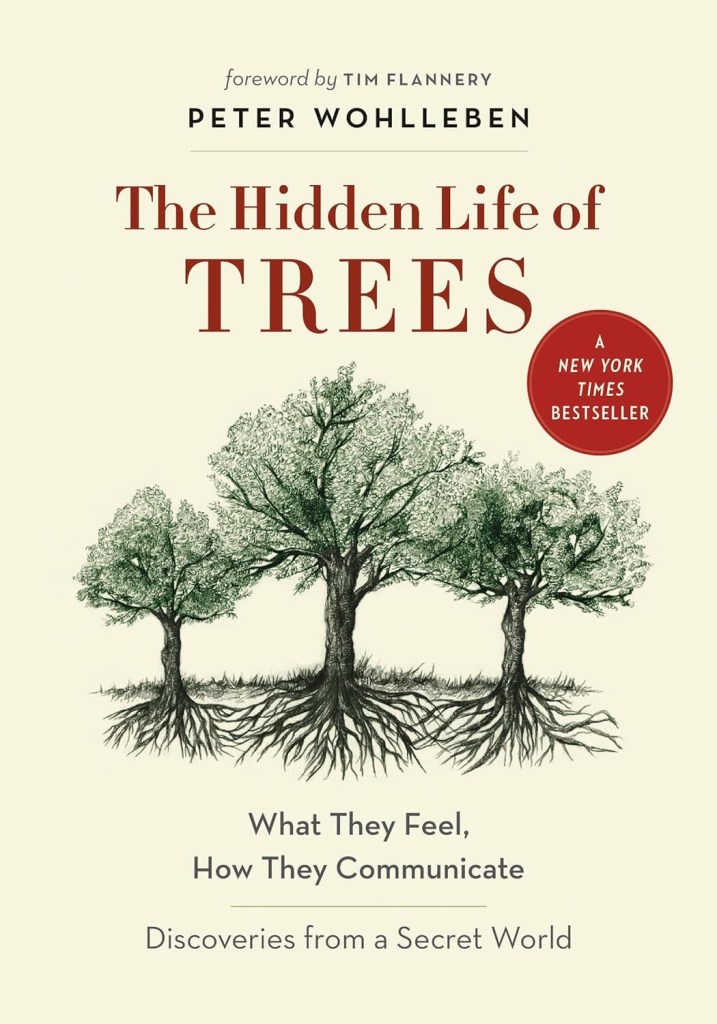
As we walked through the bog’s forest, I thought about The Hidden Life of Trees by Peter Wohlleben, a book I recently finished reading. I learned a lot about trees and forests. True forests are diverse and interconnected in an amazing cycle of life and death, filled with competitiveness and cooperation, and home to a large variety of insects, animals, and other plants. Forests grown for harvesting are nothing of the sort.
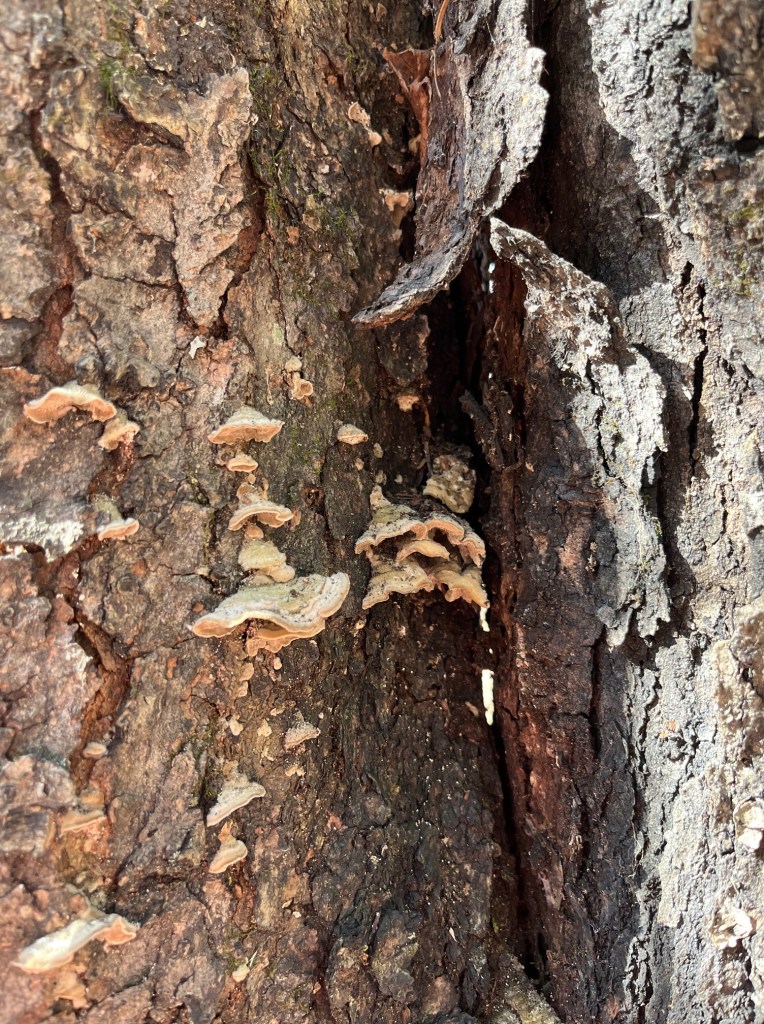
A tree near the end of its standing lifeClose up of same tree: the fungi have arrived
Walking along the trails of the bog, we saw different species of trees. New trees, only inches tall, grew under the branches of old trees. Unless the old tree dies, most, or perhaps all, of the baby trees we saw won’t make it to adulthood. Some standing trees looked nearly dead, waiting for their turn to fall to the forest floor. Tree trunks that had already fallen lay on the ground in different stages of decay, providing habitat for other creatures.
Steeped in tranquility, the breathless silence of the bog held no traffic or city noise. No planes droned overhead. Occasionally, the peaceful quiet was accompanied by the chirps and calls of birds and squirrels, which like the silence, belonged to the forest.
The Taiga Boardwalk loop is short, but it’s not meant for serious hiking. It’s a trail where visitors take their time, stopping to look for birds and animals who are masters at blending into the forest. When we finished the Taiga trail, we weren’t ready to leave the bog, so we walked a different, smaller loop. We still didn’t wanted to leave, so we walked the Taiga again.
On our second trip around the Taiga trail, Evan, 7, got down on his hands and knees, peered through the slats on the boardwalk, and said, “I see why they built this. There is water down there.” I’d told them the boardwalk was built to help keep people’s feet dry.
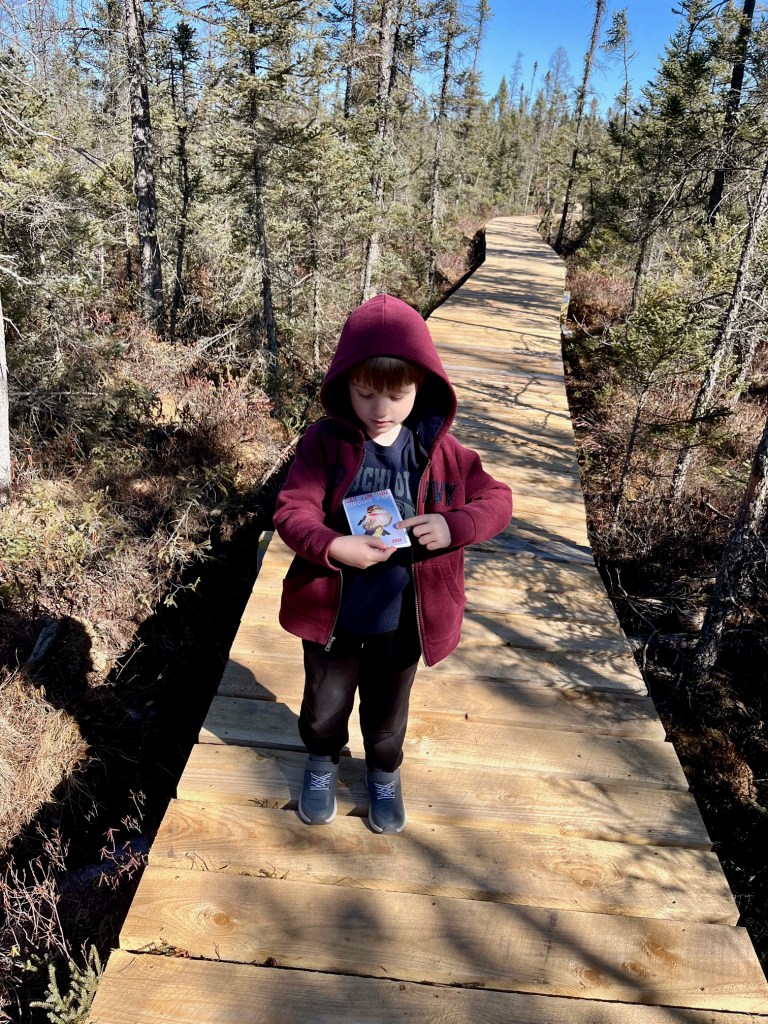
Charlie points at the common redpoll on the cover of his trail map. He said he just saw one, and he might have. Before we left the bog, another volunteer told us a redpoll had been spotted that morning.
We didn’t see any owls, but in addition to the red (or fox) squirrels, we saw chickadees, and Clara,12, spotted a black-back woodpecker.
After we finished walking the trails, my youngest grandson Charlie, 5, gave me a hug. “Do you know why I gave you a hug?” he asked. He didn’t wait for an answer. “I gave you a hug because you brought me to this bog.” I think Charlie felt what I felt: a pervasive peacefulness. As I walked through the bog, I felt a sense of increasing serenity. In The Hidden Life of Trees, the author mentions studies that show people have reduced stress levels after walking through old-growth forests. I have no data to prove that is what happened to me, but I certainly felt calmer than when I’d arrived.
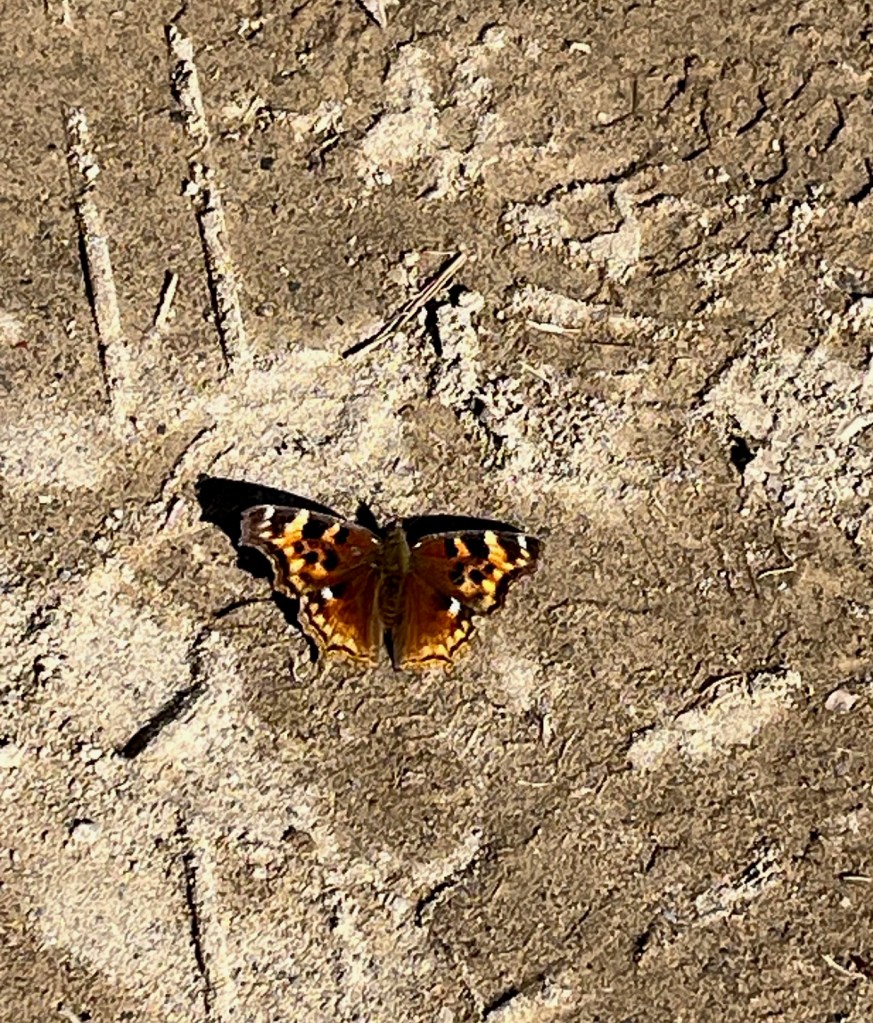
Holding our trail maps, Sax-Zim Bog calendars, and warm memories, we got in the van and buckled up. I was about to start the engine when Clara pointed out her window and said, “There’s a butterfly in the parking lot.”
The butterfly, a Compton Tortoiseshell, sunning itself before the pickup entered the lot.
Having recently finished reading Bicycling with Butterflies by Sara Dykman, I had to get out of the van and have a look. As I was snapping pictures of the butterfly, which wasn’t moving much, a red pickup truck pulled into the lot. The only open space for the truck to park happened to be where the butterfly was resting, and the driver wouldn’t have been able to see it. Squashed butterfly, I thought. I walked toward it, and it fluttered a few feet, but in the wrong direction. Coming from another angle, I walked toward it again, and it flew another few feet, but this time it landed out of harm’s way.
The red truck parked without crushing the butterfly. Perhaps it wouldn’t have needed me to save it. Maybe it wouldn’t have been run over, and it would have flown away from the truck instead of into it. But I’m glad I didn’t leave the butterfly’s destiny to fate.
The grandkids and I left the bog and headed back to the city. As I drove down the county roads, they flipped through their calendars, enjoying pictures of the beautiful wildlife who make their homes, for at least part of the year, at the Sax-Zim Bog.
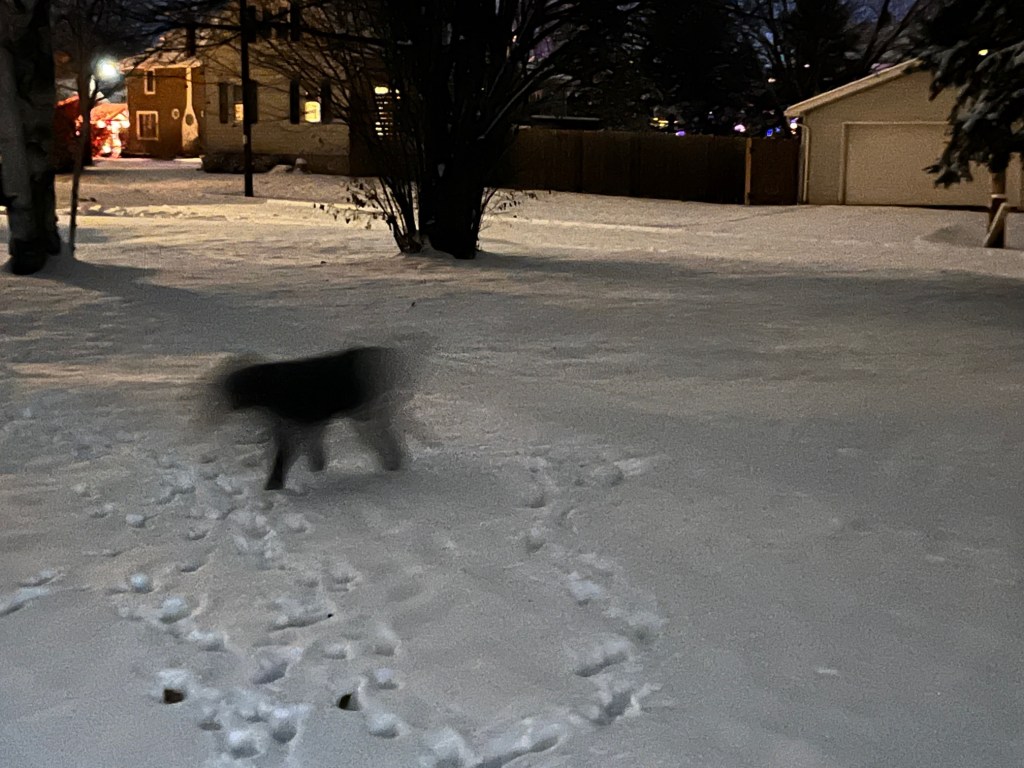
Ziva, November 29, 2022, home after our evening walk
Snow began falling around 8:00 a.m. today. The forecast predicted a trace to one inch, but it snowed all day, and four fluffy inches covered the ground, roads, trees, and cars. Snow can be that way, making weather forecasters look foolish.
This isn’t the first snow of the year, but today’s snow has a good chance of staying on the ground, making it a white Christmas. That’s why I call it the first real snow of the year.
I loved snow as a child, and I haven’t grown old enough yet to resent or fear it. The first real snowfall of the year evokes childhood memories of snowballs, snowmen, snow forts, and sledding. Swaddled in snow pants, jackets, hats, scarves, and mittens, our joyful shouts, squeals, and laughter bounced off the trees and houses.
I love to walk my dogs, Ziva and Cabela, in the evening after a fresh snowfall when the air is still. My dogs love the first real snow too. They prance. They stuff their noses in the snow, tossing it in the air or eating it. Sometimes the snow tickles their noses, and they sneeze. Even Cabela, who’s now fourteen-and-a-half, becomes youthful. When they were puppies, the first snowfall of the year gave them the crazies. They pounced and dashed and rolled in it, creating doggie snow angels. They reminded me of a gaggle of children unleashed into the first good snow of the year.
Perhaps snow sparks something primal in my dogs and myself, something that lights up ancient places in our brains, something that is more complex than our happy memories of youthful frolics in the snow.
Yesterday, my dog Ziva and I walked a different direction, not to seek adventure but to find warmth. Every block we put between us and Lake Superior meant more houses to deflect the wind coming off the lake. It helped, but not much. When a cold wind rumbles off the lake, it finds you.
On our walk I saw a long-stemmed rose, and my first impulse was to smell it. Because you should stop to smell the roses, even when it’s 28 degrees and overcast and the sky is sprinkling snowflakes like salt from a shaker. The rose smelled sweet, like the roses my nana grew in the front of her 900-square-foot home, the smallest house by far on her street. Nana prized her roses and tended them with great care. They signaled that she, too, was a lady, even in her tiny home. Her long-stemmed, red roses announced that she had left behind her childhood of deep poverty and great difficulties.
My next impulse was to take a picture of the rose, which looked remarkably good. Amazing because this week’s basket of weather contained strong winds, drenching rains, and even some snow.
But sometimes survival is about luck.
This rose was blessed because its owners planted it in front of their house which works as a shelterbelt, saving it from the worst of the icy winds and horizontal rains that blow off the lake. It was fortunate because it bloomed at the end of a long stem, keeping it off the ground where colder air settles. It was spared because this week’s snow was light and melted quickly, postponing it’s red, velvety petals from freezing and turning brown.
It’s 23 degrees this morning, so the rose’s good fortune won’t hold much longer. But with care and some luck, new roses will bloom again next year.
Bogey, my mother’s dog, loves Lake Michigan, so this afternoon I took him to Harbor Springs, a small summer town snuggled up along the eastern shore of the lake. It’s Bogey’s favorite place to walk. He knows when he is going to Harbor. The only place he loves more is a pet store, where he tries to shoplift anything he can fit into his mouth.
First, we stopped at his favorite clothing store. He got lots of hugs from a woman who works there, but she was out of dog treats. He kept holding up his paw and pleading, but only received another hug and another apology. He was clearly disappointed, reminding me of a little boy who tells his great-aunt, “But I wanted a toy train, not fuzzy footie pajamas.”
After we left the store, Bogey enjoyed his water-view walk. He sniffed the grass, did his business, and watched a pair of ducks swim along a beach. Dogs get over disappointment quickly.
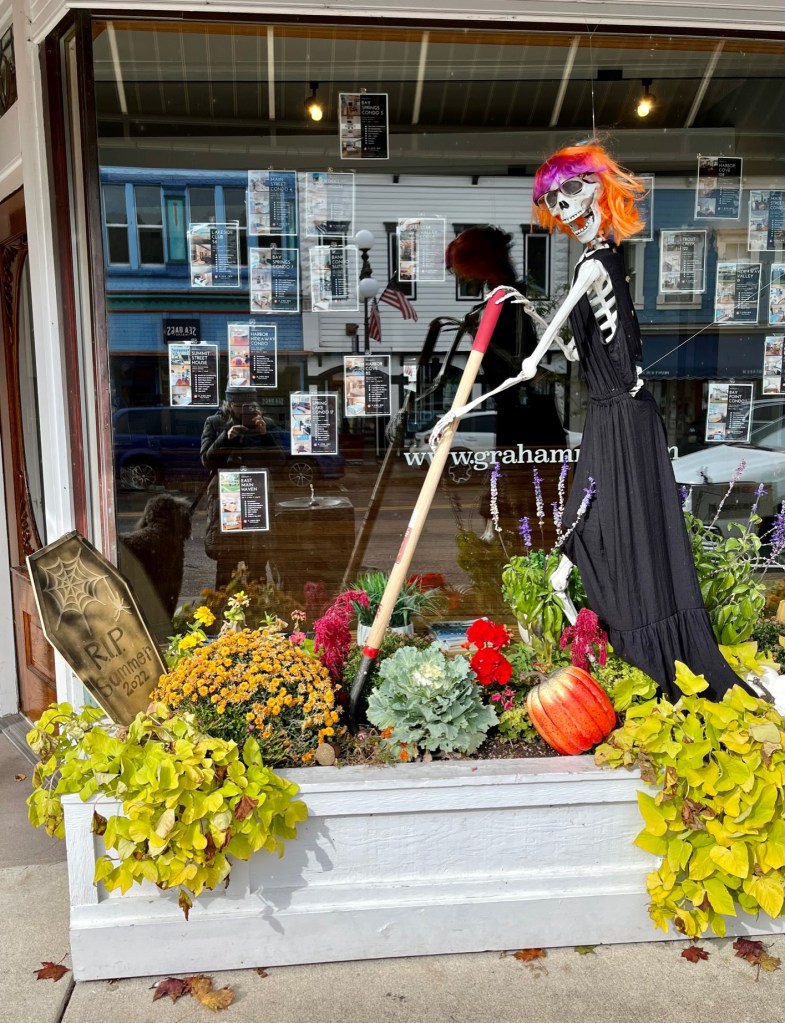
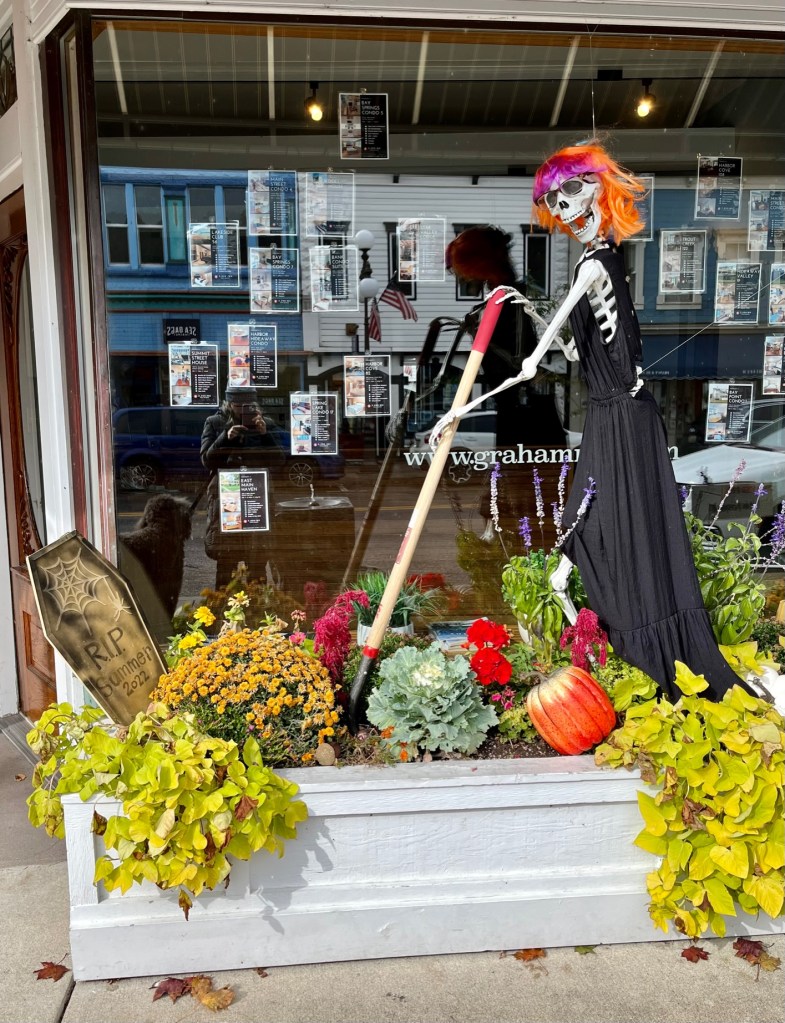
My favorite! The headstone reads: RIP Summer 2022
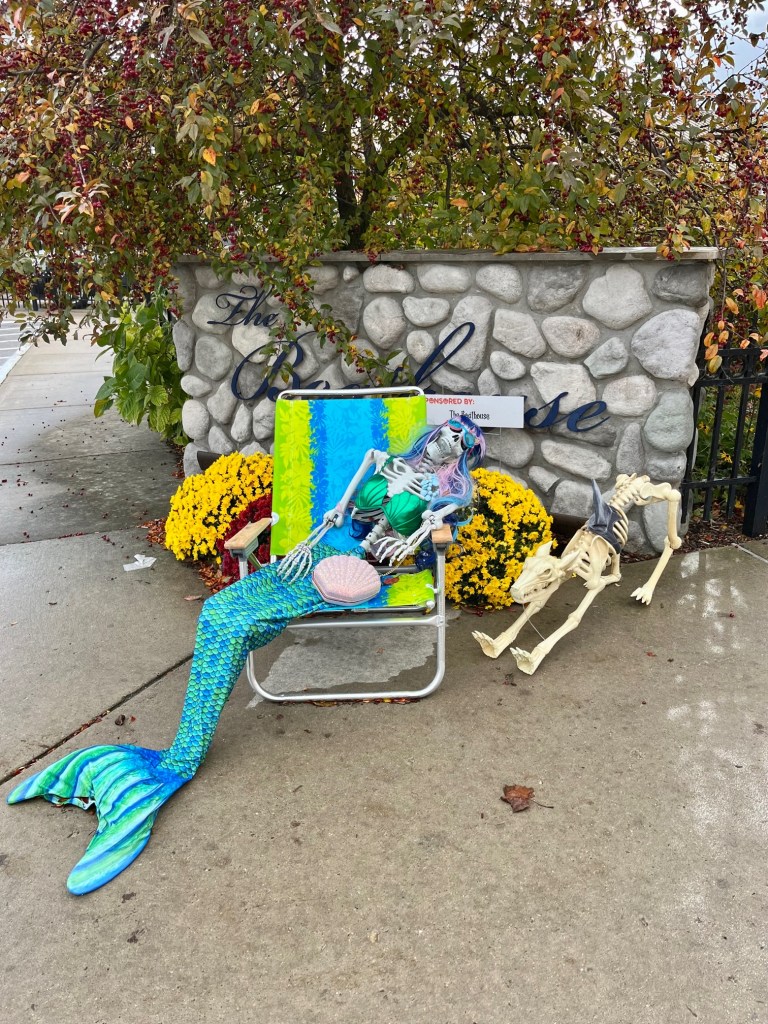
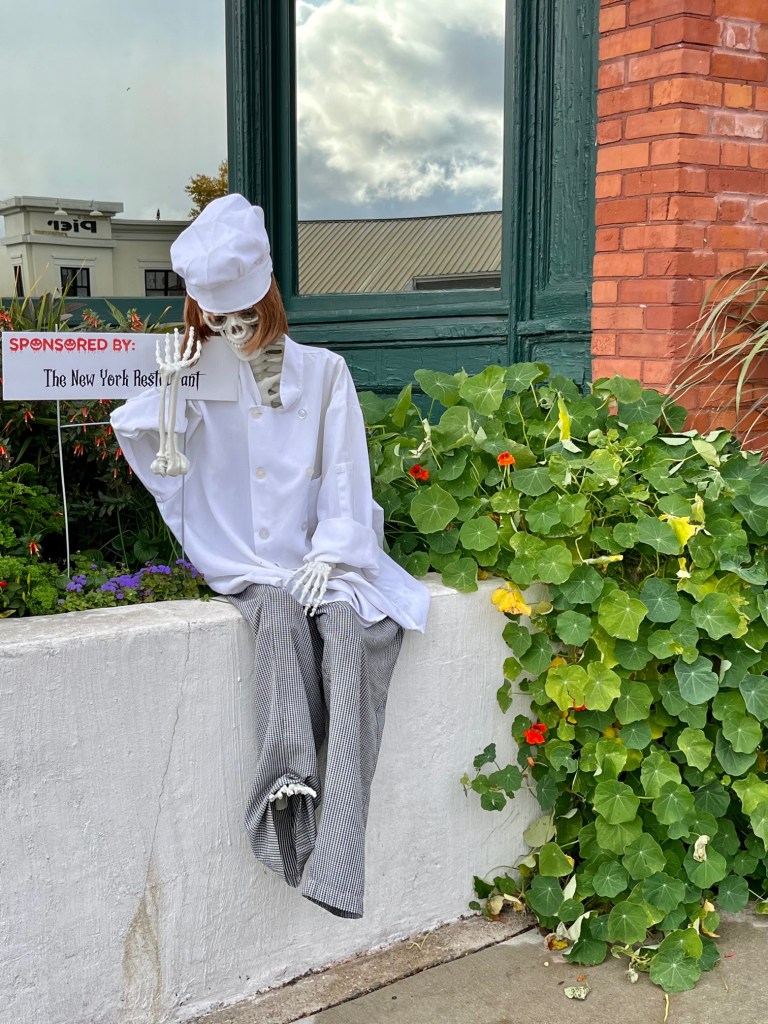
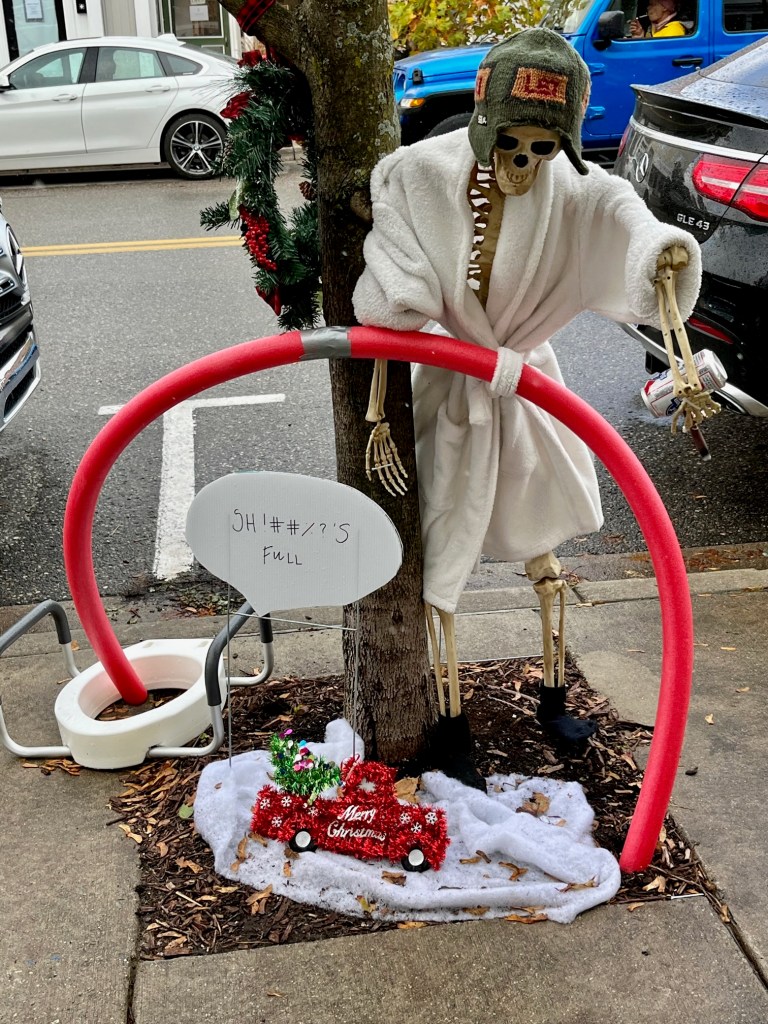
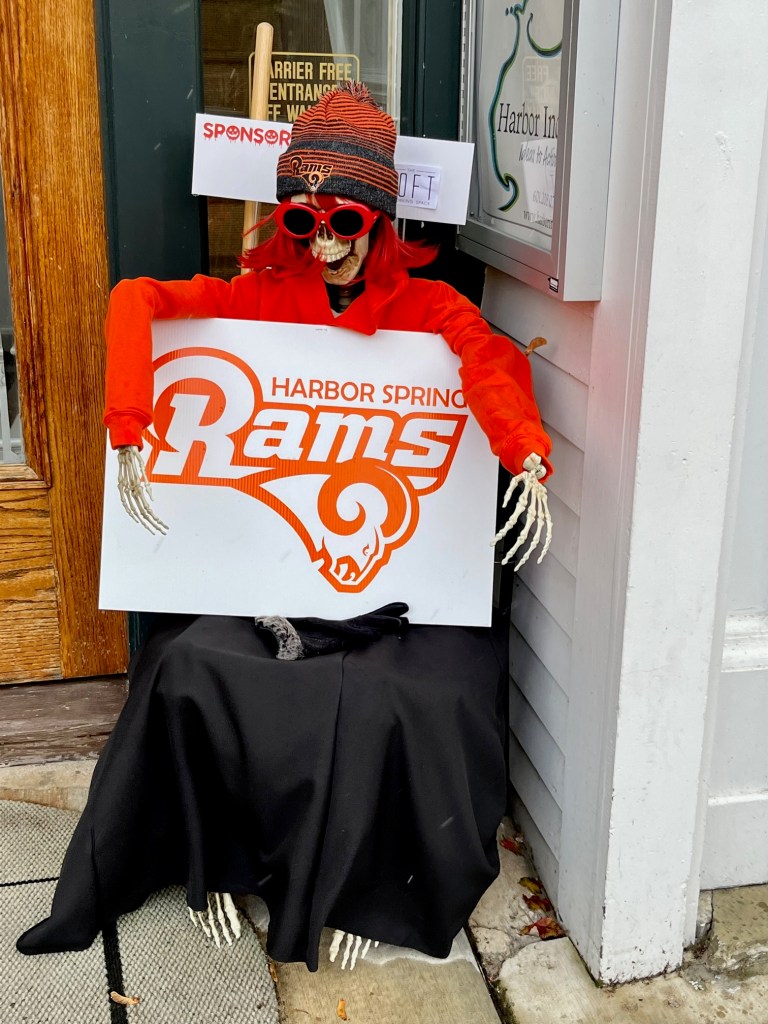
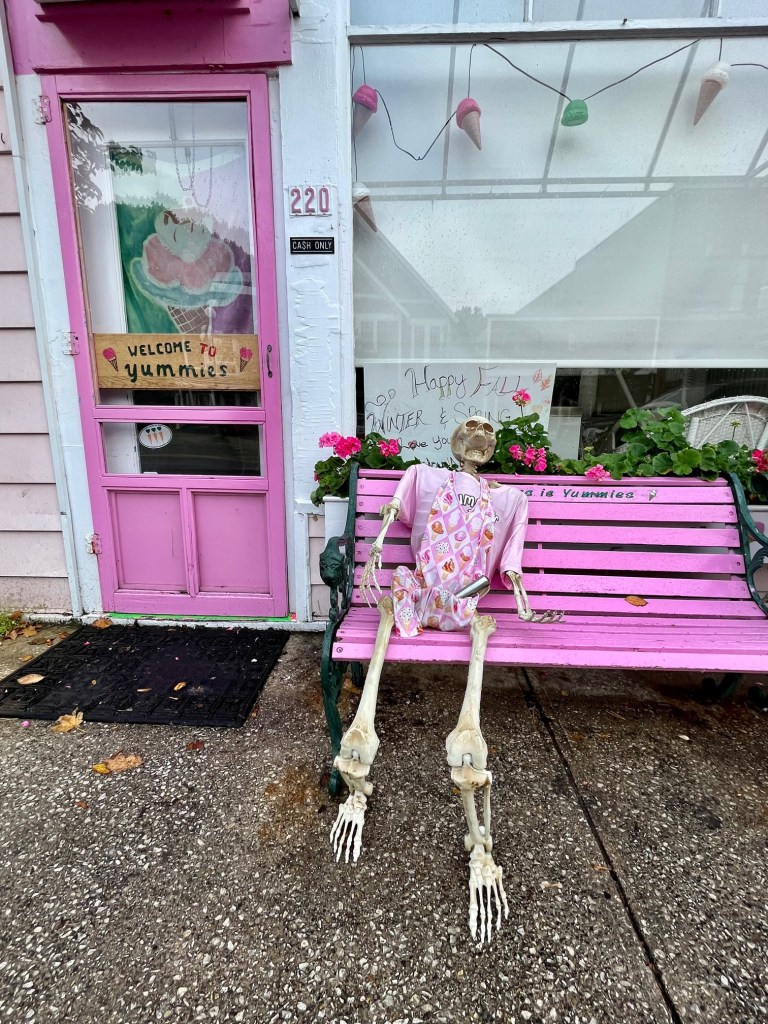
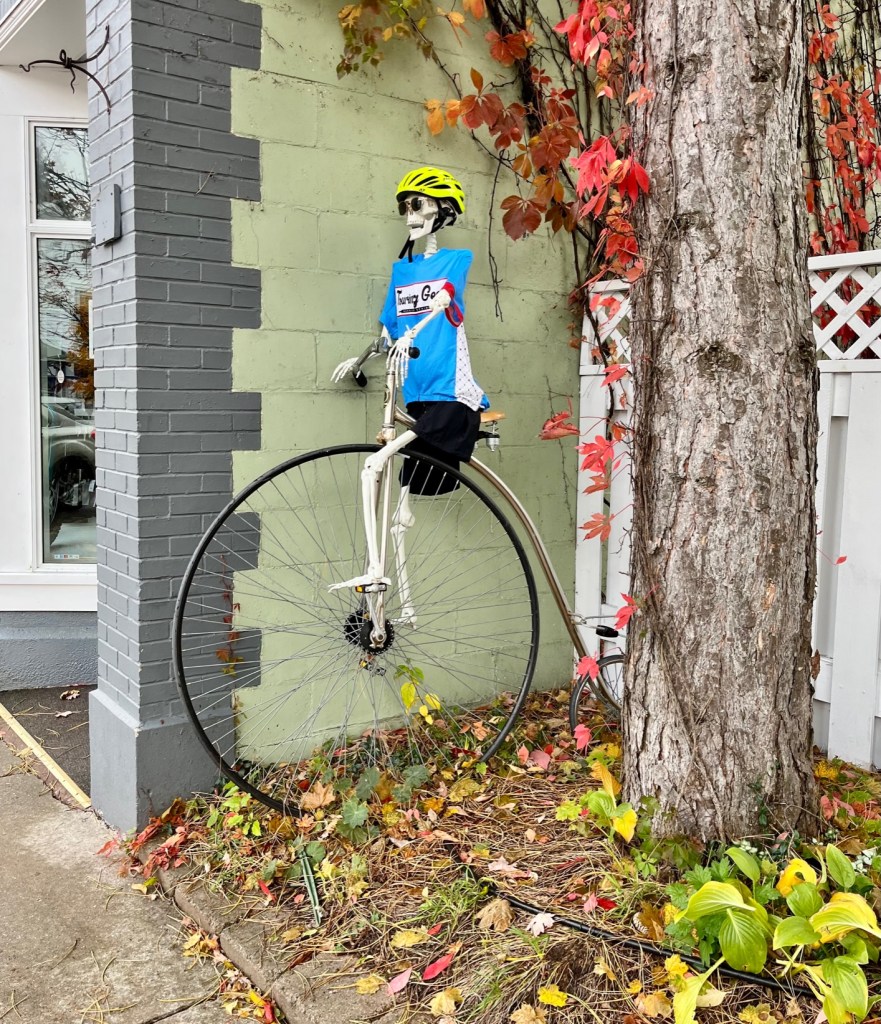
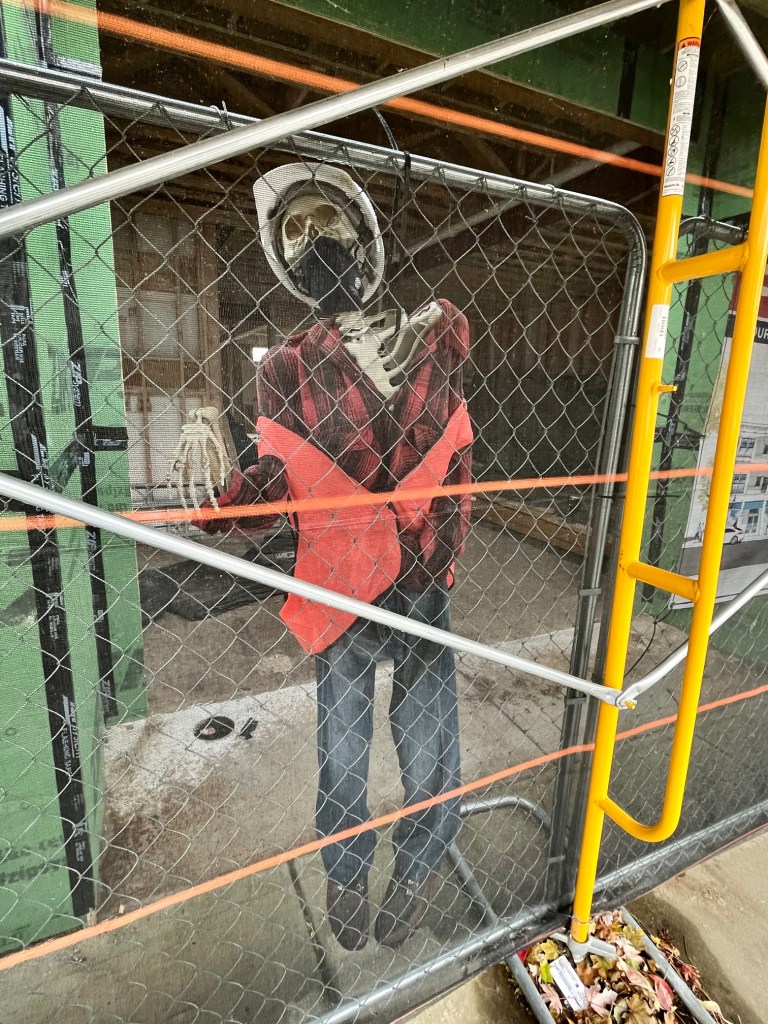
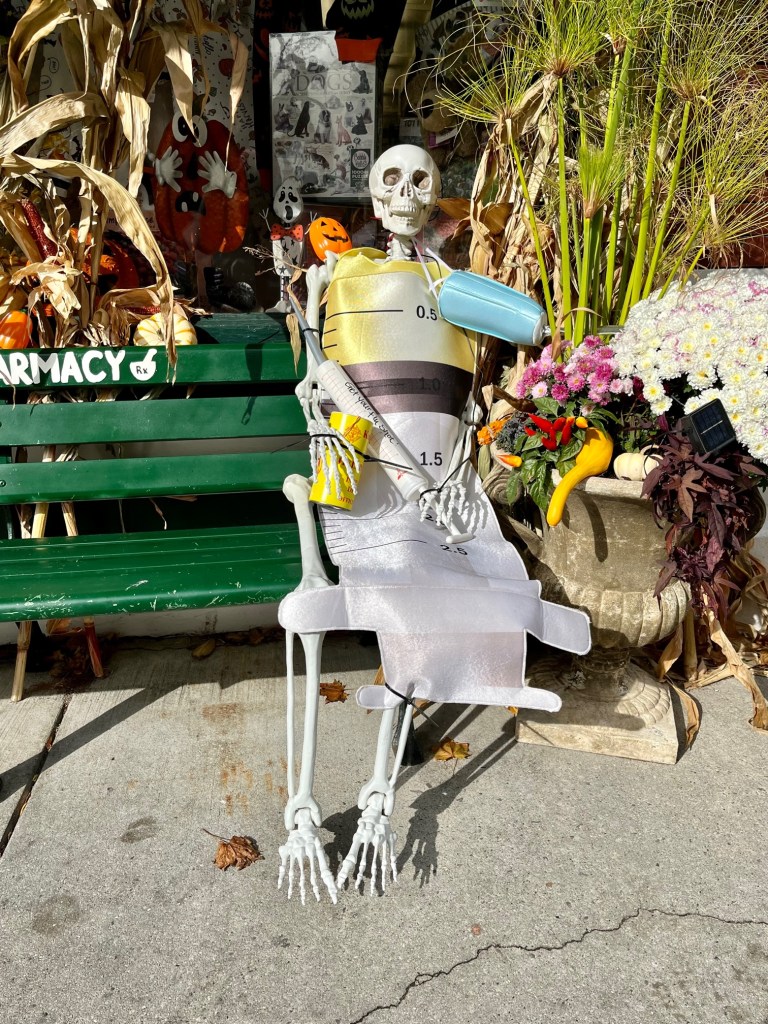
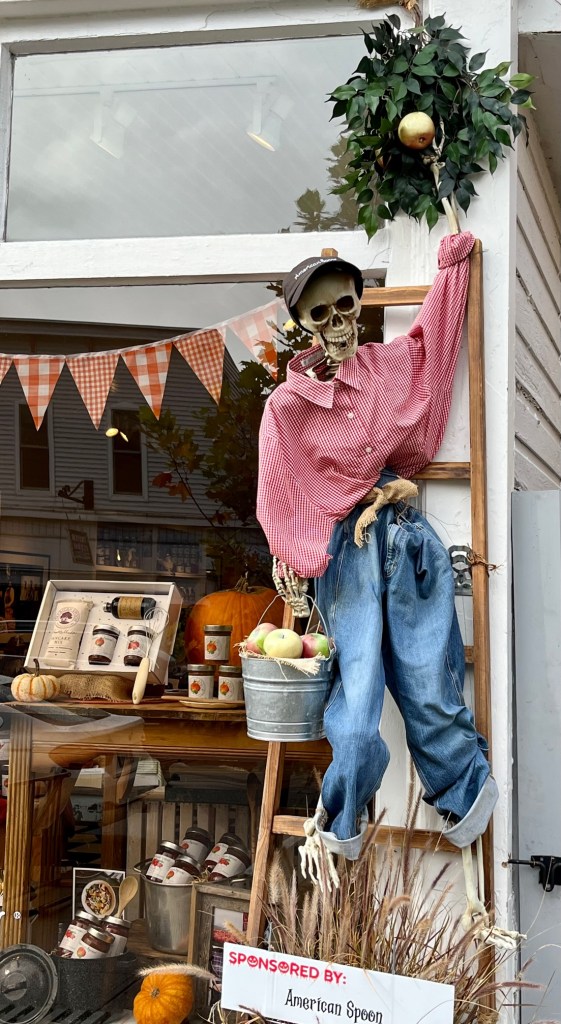
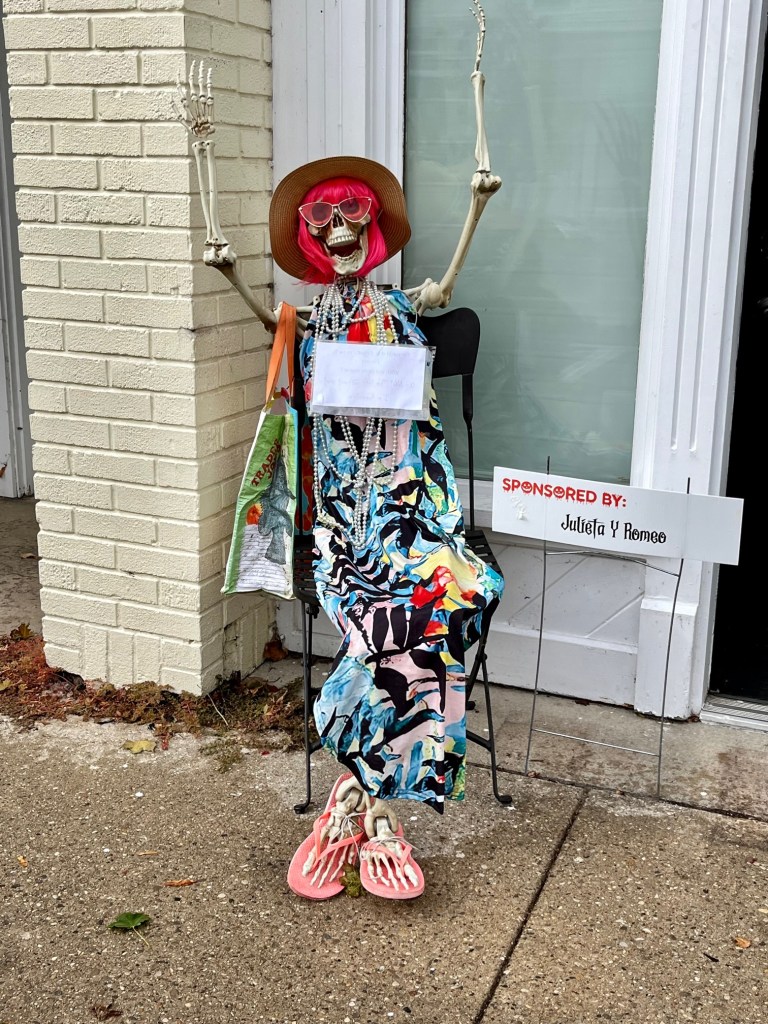
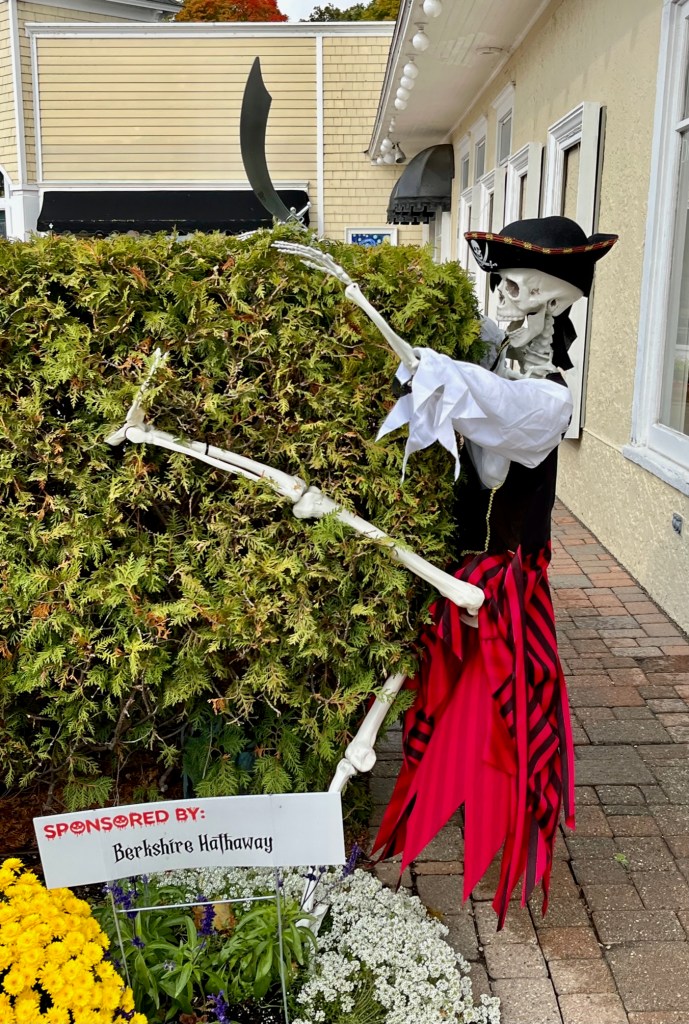
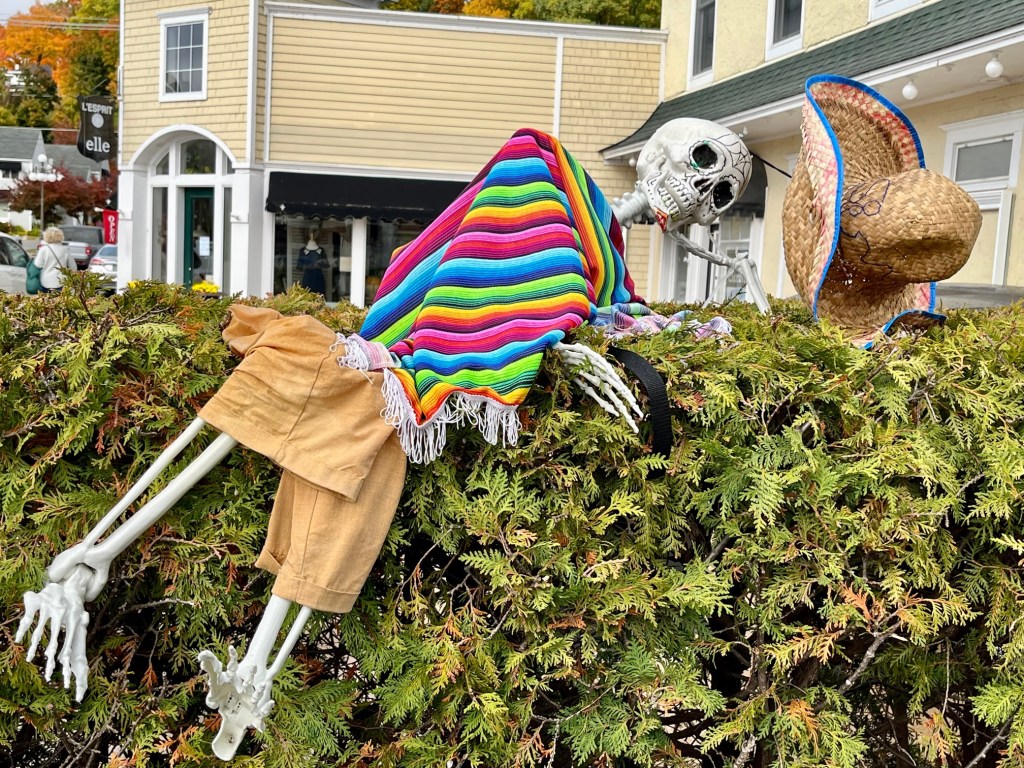
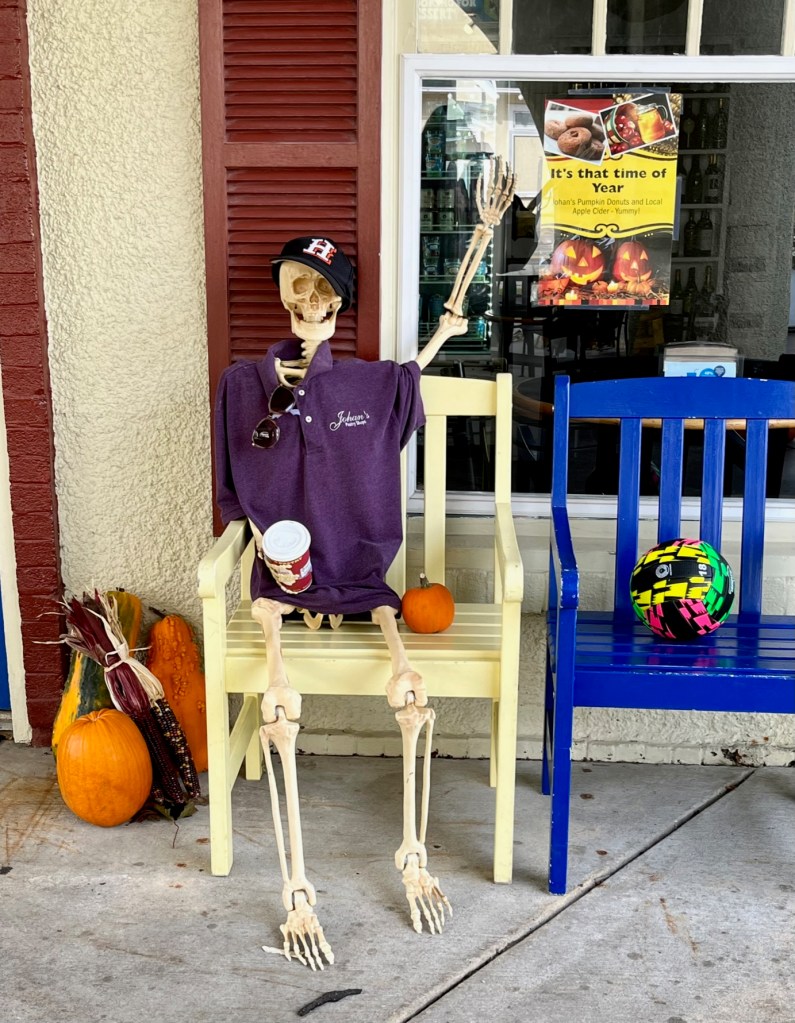
Next, we headed back to Main Street, where I noticed boney visitors who’d stopped by Harbor Springs dressed for Halloween. Bogey had to wait for me while I walked up and down the sidewalks and photographed twenty-seven snappily-dressed skeletons. I know I didn’t get pictures of all the skeletons, but I had fun trying to find as many as I could. Excitement lurked on every block and around every corner. Costumed skeletons have become a Harbor Springs Halloween tradition. And this year there are seventy-five skeletons creaking about.
Tonight the wind howls off Lake Michigan, and it’s raining in spurts. In the hours before dawn, snow is expected before turning back to rain. The National Weather Service has issued a wind advisory. And I wonder how the skeletons will stay warm in all this weather–they don’t have any meat on their bones.
Yesterday, Ziva, Bogey, and I went for our first walk at 8:00 a.m., our second walk at 1:30 p.m., and our last walk at 4:30. We let the 20-mph winds off Lake Michigan push us down the road, until we had to turn around, then we leaned into the wind and pretended we were walking to school, uphill, in a snowstorm, for five miles. A bit histrionic but fun.
Ziva’s and Bogey’s ears flapped and fluttered in the wind, but my ears were tucked under my stocking cap. I liked stocking caps when I was a girl who played in the snow, but when I turned thirteen, I wouldn’t wear a hat in winter, no matter how cold it was. I wasn’t going to mess up my hair. Instead, I arranged my long, not-so-thick hair over my ears, trying to keep them warm.
Now I have four favorite knit stocking caps, and when it’s cold, I wear one. I even have a knit hat with earflaps that ties under my chin. I’m not letting my head or ears freeze. My nana always told me, “Keep your head and your feet warm, and the rest of you will follow.” I think about her when I put on a stocking cap and a pair of wool socks. Nana repeated her “warm head, warm feet” advice to me a lot when I was a foolish, hatless teenager, dashing through cold winter days.
One of my granddaughter’s leaf creations, October 2020
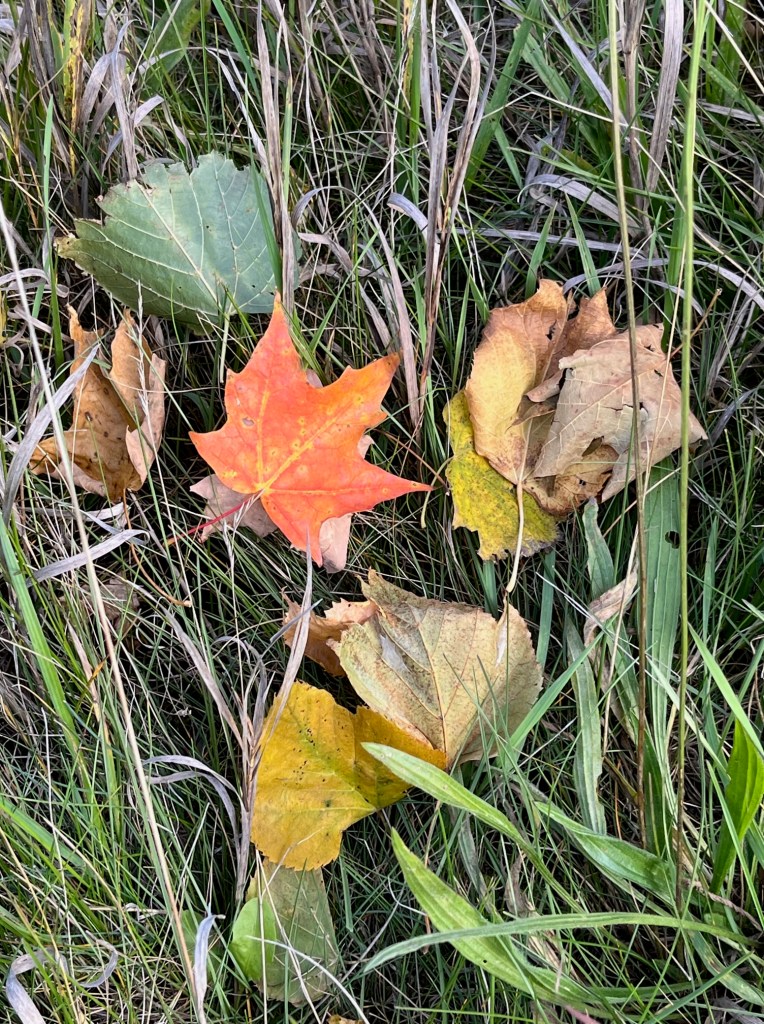
Yesterday’s picture theme: autumn-colored leaves. I took oodles of photos of newly fallen leaves because I could see that each one was unique, deserving to be photographed. If my granddaughter had been with me, she would’ve collected the leaves, oohing over each one, handing them to me to hold as she collected more to use in art projects.
Around 9:00 p.m., I took the dogs out in the yard for their last potty break of the day. The swirling wind whipped up a smorgasbord of scents, stirring something primal in Ziva and Bogey. They sniffed the air and the ground, weaving in and out of bushes, looking for little critters. Under the full moon, they chased each other, zooming in circles, like a couple of young pups with the crazies. Autumn makes me feel that way too.
Overlooking Lake Michigan on our morning walk
Moonlight in Michigan (The sky around the moon was much darker, but this is how my phone camera interpreted the light.)
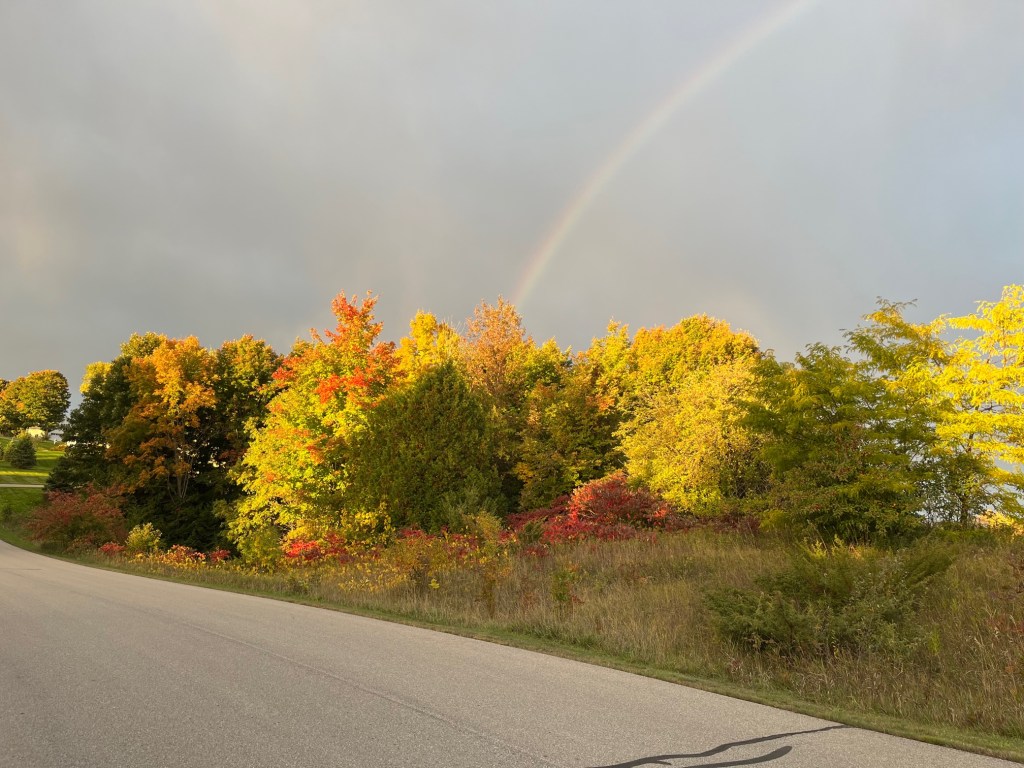
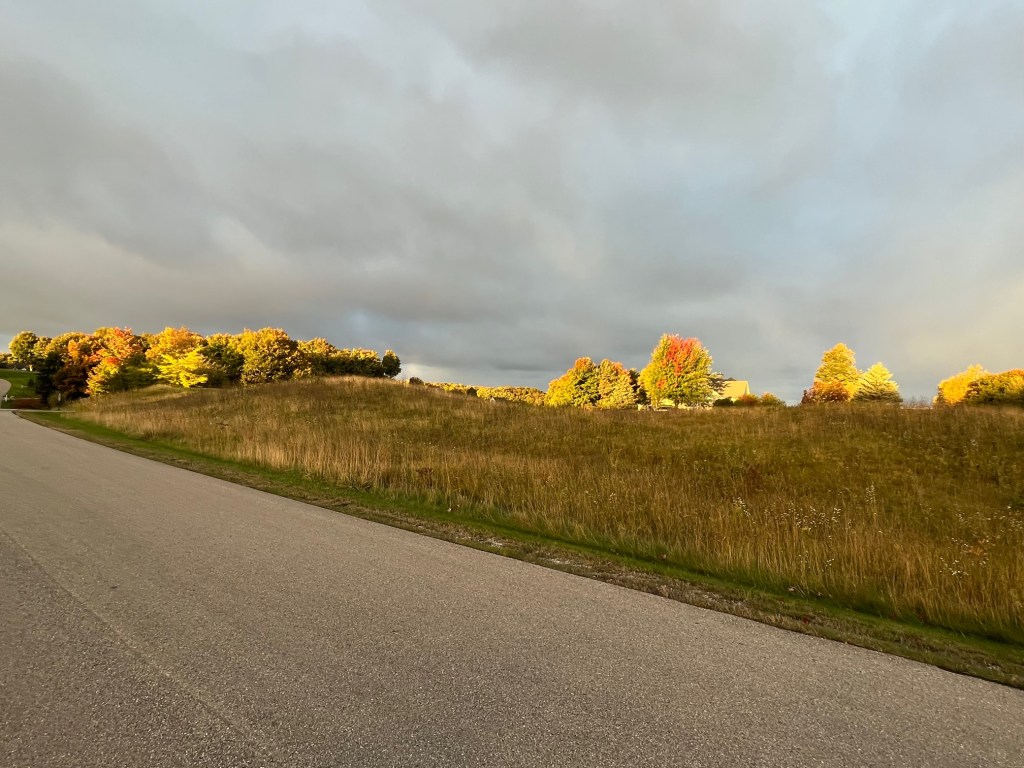
When I walked Ziva and Bogey this morning shortly after sunrise, the sky was a jumble of dark clouds and bright blue patches. The sun illuminated gold, orange, and red leaves, giving the impression they were lit from within. Of course, the dogs had to wait while I snapped pictures, and I never tire of taking pictures of trees dressed in fashionable autumn colors. When the dogs became impatient, I reminded them that I spend lots of time waiting for them while they smell blades of grass, tree trunks, and mailbox posts.
Finally, we turned down another road, and I spotted part of a rainbow. Out came my camera phone, again. As I alternated between walking and taking pictures, the rainbow became an arch, one end appearing to dip into Lake Michigan and the other end appearing to stand in a field about a half-mile away, giving the impression that if the dogs and I set off across the field, we would find the end of the rainbow with a leprechaun and a pot of gold.
Standing on a fieldDipping into Lake Michigan
As a child, I knew about leprechauns who guarded their gold at the end of the rainbow from people who tried to steal it. My sisters and I fantasized about finding the rainbow’s end and the leprechaun with his riches, but we knew it was a folktale.
If the tale had been true, I’d have picked the leprechaun over the gold, which I knew meant wealth, but only in the way a six- or seven-year-old understands wealth. Besides, I lived in a comfortable home with plenty of food in the cupboard. But a leprechaun was a magical two-foot-high man with orange hair, dressed in green, smoking a pipe, and speaking with an Irish brogue. According to folklore, if we would’ve caught a leprechaun, he would’ve granted us three wishes in exchange for his freedom.
This morning while walking on the country road, watching the rainbow form a half circle through the sky, I wished that the fields and trees in this enchanted place would stop disappearing. In the eight years I have been visiting my mom, ten new homes have been built, and each one stands on an acre of land. Each new house means a loss of trees and fields. A loss of habitat for birds, bees, butterflies, and small critters that I don’t see, but the hawks who perch in the trees are evidence of their existence.
Today, looking at the rainbow arching over the still undeveloped fields, I don’t wish for gold or to meet a magical leprechaun protecting his stash. I imagine a leprechaun at the end of today’s rainbow protecting a field, keeping it safe for insects, birds, and small critters, and I wish that each homeowner in this neighborhood would leave a strip of field along their lot lines.
When I take my grandkids for a walk, they stroll and run along the city sidewalks, and with a child’s imagination, they turn each walk into an adventure. On an outing last October, they each picked a small bouquet of dandelions, Indian paintbrushes, and tiny yellow flowers from lawns overdue for a trim.
After we returned home, I put each child’s bouquet in its own bud vase and placed them around my kitchen. My five-year-old grandson had a prolific bouquet, so his vase stood on the kitchen table. By the next afternoon, the dandelions and Indian paintbrushes boarded themselves up like roadside stands at the end of the season, and the tiny yellow flowers discarded their petals like ticket stubs after a rock concert. I tossed the bouquets.
The flowers my sister sent.
A couple of days later my sister sent me a large yellow, orange, and red autumn-themed bouquet of flowers, a mix of daisies, a rose, and a sunflower. I placed it on the kitchen table.
Two days later my grandkids returned to visit. My five-year-old grandson walked by the large bouquet on my kitchen table, paused, then said, “I guess my flowers really grew.”
I gave him the facts—his flowers had died and were thrown in the garbage; these flowers were from my sister. He moved on and played with blocks on the living room floor.
Later I told my sister about his belief that his flowers had grown into the bouquet she’d sent. She hoped I hadn’t told him the truth, but I had. I’d been the Grinch before his heart grew, Scrooge before the Christmas ghosts visited, Joe Friday with the cold, hard facts.
Instead of entering my grandson’s world where it was possible for a handful of tiny flowers to grow into a substantial bouquet of large flowers, I used words like died and garbage. I’d become the eight-year-old neighbor boy who told me and my sister when we were five and four years old that there was no Santa Claus. I can still see him standing at the side of his house telling us Santa wasn’t real. My sister and I argued with him, but he clung to his story. We tried to believe after that, but we couldn’t—not even when our mother assured us the boy was wrong and Santa was real.
But if I’d gone along with Evan’s belief that his flowers had grown, he would’ve bragged to his older siblings, who would’ve set him straight.
He would’ve come back and asked, “Nana, did my flowers really grow big?”
If I’d said, “Yes, they did,” he would’ve doubted me, weighing what I said against what his siblings said, just like my sister and I weighed what my mother said about Santa against what the boy next door said.
If I’d said, “No, they didn’t,” he would’ve asked, “Then why did you say they did?”
But I still felt bad—I’d squelched a magical moment for him and replaced it with reality.
But the five-year-old wasn’t done. A couple of weeks later, he asked me, “Nana, did my flowers at least get big before they died and you threw them away?”
With the Grinch, Scrooge, and Joe Friday as my wingmen, I explained, “The type of flowers you picked don’t get any bigger than when you picked them. But they’re beautiful flowers and an important part of nature even if they’re small.”
However, if he ever asks me if Santa is real, I’m going to lie through my teeth and say, “Yes, he is.”
[Bloganuary wants to know. It’s the WordPress blog prompt for January 20, 2022. The blog prompt actually asked me to choose my favorite photo ever. I have too many favorites, so I picked one of my favorites from 2021.]
Foreground to background: Evan, Clara, and Michael. Not pictured: me pushing Charlie in his stroller and walking my two dogs, Cabela and Ziva
This photo, taken April 14, 2021, is one of my favorites. My grandchildren love to go for a walk, so on days when they come to my house, we often stroll around the neighborhood.
Evan holds a grabber, and you can’t see it, but Michael carries a plastic grocery bag filled with trash and another grabber. In the spring our walks become garbage patrols. The snow has melted, and hidden wrappers, disposable cups, bottles, cigarette butts, and the odd mitten or piece of clothing dot the landscape.
My grandkids blurt exclamations of joy when they spot a piece of garbage. It’s an accomplishment. I know how they feel. When we were children, my sisters and I pulled a red wagon down our country road and picked up garbage. We were influenced by Lady Bird Johnson’s “Keep America Beautiful” campaign. We didn’t have grabbers, so we used our hands. Things were tougher when my generation was young. (As we age, we enter the I-walked-to-school-in-blinding-snow generation.)
I love walking with my grandkids. But before I took this idyllic photograph, pandemonium ruled, as it does before every walk. Once we decide to go, strategical planning and the ensuing chaos from working that plan almost swamp me. Everyone needs to go to the bathroom, including me. “There are no porta potties on the walk,” I say. I check Charlie’s diaper. We dress for the weather, and during the winter that means helping two toddlers into snow pants, jackets, boots, hats, and mittens. I put leashes on the dogs, who plead to be included, and I stuff poo bags in my jacket. It sounds simple, but understand that all four grandkids and both dogs are moving targets. Just as we are about to exit the house, one of my grandkids usually utters, “I think I have to go to the bathroom, again.”
At this point I think to myself, “Eisenhower had it easy–he only had to organize D-Day.”
However, once we hit the paved trail, serenity settles in, and my grandkids race each other, hunt for garbage, climb trees along the boulevard, and play games with rules only they know. Watching them, my memory of the pre-walk havoc fades. These walks will become cherished memories for my grandkids and me.
I love earrings. Before the pandemic began, I wore them almost every day. But I stopped going to work during the pandemic, so I stopped wearing earrings every day. Sometimes days or weeks went by without giving them a thought.
But occasionally earrings gave me a nudge because it would suddenly occur to me that I’d better wear a pair before the holes in my ears closed up. More than once, I had a tough time pushing a hoop or post into the hole in my ear. I’ve always worn small lightweight earrings, so I have tiny holes in my ears.
This morning I put on earrings because I wanted to forget about the ups and downs of COVID-19.
I’ve decided to wear a different pair of earrings for thirty days, and tell a story about each pair. I’m not sure I have thirty pairs. (I’m very particular about my earrings.) But if I don’t, I’ll re-wear a pair. And that’s okay because some of my earrings have more than one story.
Day 1—Earrings from Coronado Island, California
I bought these gold-toned earrings with aquamarine-blue crystals on Coronado Island from a boutique jewelry shop owned by the artist who created them. I was drawn to this exquisite pair because my birthstone is aquamarine.
A couple of years after I bought them, I lost one. I wasn’t wearing the clear rubber backings, and the earring slipped out of my ear without me feeling it or hearing it. I still imagine its voiceless descent and landing, most likely on a sidewalk in Northfield, Minnesota.
I was staying at Carleton College, attending a week-long training, and I’d been walking around Northfield. After I discovered the earring was missing, I walked up and down every city block that I’d walked on earlier and some others just in case. For hours, I retraced my steps over and over. I didn’t find my earring.
Using the internet, I found the phone number for the jewelry shop on Coronado Island. The owner answered the phone. I told her about my earrings, my favorite pair. I asked if she had another pair I could buy. She offered to make me a new earring at no charge. She had me send her the remaining earring so she could match the crystal and setting sizes.
A month later, my old earring arrived with its new mate.
I’ve never again worn them without their clear rubber backings. I still have both earrings.
I’ve never forgotten the kind jeweler, who must have also known the sadness of losing a cherished earring. I hope she’s still creating jewelry.
I’d like her to know that I still think of her kindness every time I wear the earrings.























 Writing Near the Lake