My story collection has a title! I’ll debut the cover when that is done.
In February 2027, the University of Wisconsin-Stevens Point will publish my collection of short stories through Cornerstone Press, their university press. I’m excited, and nervous, and grateful. This is my first book, and like a first-time parent, I’m not sure what to expect, so I gather information. I talk to other writers who have published books. I attend book launches and author talks. I read blogs and articles and attend seminars about how to nurture a book in the world.
When Cornerstone accepted my manuscript, my publication date was more than two years away. But now it’s about fifteen months away, and if there is one thing I know about time — it’s how quickly it flies. I need to promote my book, and for that it needs a title.
When I submitted my collection in November 2024, it was called Fishing Around in the Dog Days of Summer, after one of the stories in the book. I chose the title for a couple of reasons. First, I really like its eponymous story about two young sisters with a tenuous relationship who go crayfishing on a hot, humid August day. Second, all the characters in my short story collection are fishing around for something they want. They each dip a line in the murky waters of their lives during their own dog days, hoping to catch something they long for.
But as much as I liked my original title, I began to feel it was too long and would be hard for people to remember. And I worried if the cover depicted a fishing scene along with the title, potential readers might think all my stories were about fishing.
I looked at my table of contents and considered other story titles. “Silent Negotiations” jumped out at me. It’s short and easy to remember, and it’s another story I really like. In 2020, it won second place in the Hal Prize Fiction Contest. (So, I feel the title has good mojo.) In the story a couple who have been married over forty years renegotiate the parameters of their marriage during a disagreement. Each spouse speaks their mind, but only to a point. The rest of their negotiations are silent, yet significant. The characters in my other stories are like the old married couple in “Silent Negotiations.” They all want something. They all talk to each other, but they leave things unsaid. And what is left unsaid, changes who they are with one another and themselves.
After I decided to change my title to Silent Negotiations, I asked my writing friends and readers what they thought. They had all read my stories several times, so I knew they would be good judges as to whether or not the new title would be a good fit for the collection. They all loved Silent Negotiations.
Last weekend I attended the Wisconsin Writers Association Conference in Stevens Point. The Cornerstone Press editors were there too. I talked to Dr. Ross Tangedal about using Silent Negotiations as my title. He liked it too, and so did his student editors.
My book has an official title!
Now, I’m excited to see some cover designs. Before I know it, Silent Negotiations will be out in the world.
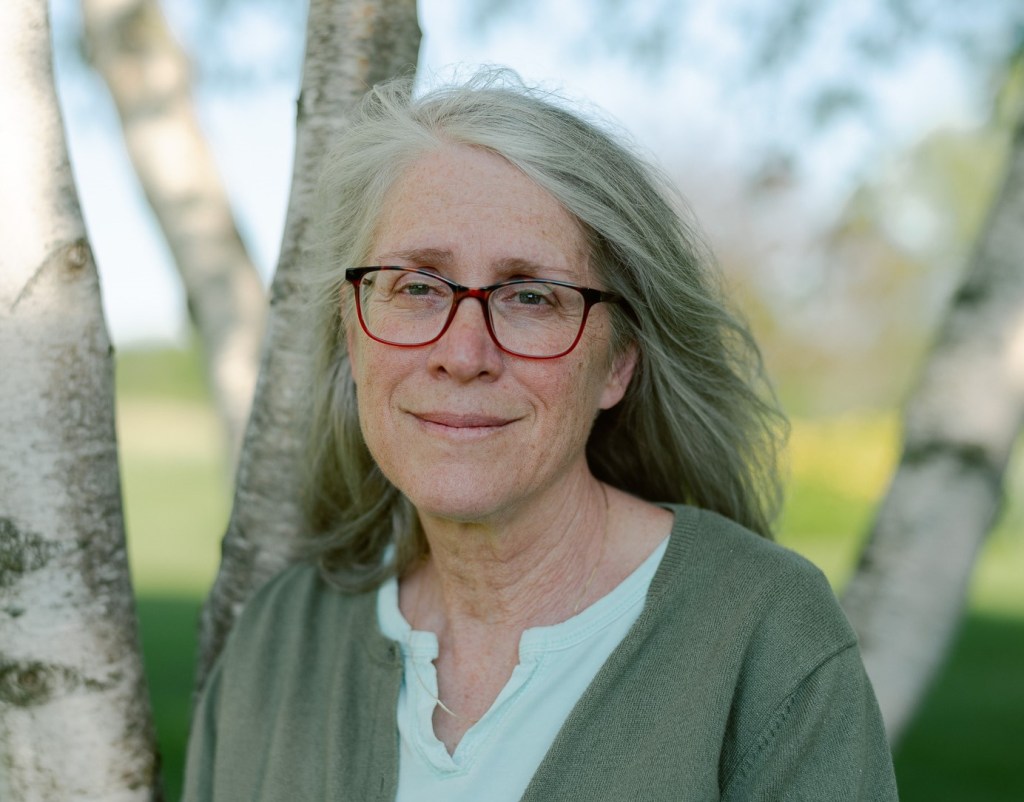
I’m hoping to use this picture for my author photo. Photo credit: Max Youngquist
Today I went to the Monarch Festival hosted by Duluth Monarch Buddies (DMB) because I want to plant pollinator gardens. But I also went because I wrote an article about DMB, and I promised the organization’s president I would come. (To read my article, click here, and turn to page 22.)
What a thrill to see my article front and center on the welcome table!
The Festival was held at the First United Methodist Church, which we locals call “The Coppertop Church” because it has a magnificent copper-topped roof. (If you want to view the locally-famous roof, click here.)
On my way into the Monarch Festival, I passed a table with pamphlets and brochures. And in the center of the table was a copy of Northern Wilds magazine opened to the page with my article. Wow! I was excited and touched. I told the woman seated next to the table, “I wrote this article.” In my right hand, I carried three copies of the magazine to give to DMB board members. One for the president, one for the vice president, and one for the secretary.
Once inside, I reintroduced myself to the president and gave her a copy of the magazine. I’d met her last summer, and I’d spoken to her on the phone this spring. She gave me a wide smile and a big hug. She asked if she could take my picture while I held the magazine open to my article. She made me feel like a celebrity. I already knew she liked the article because I had her read it for accuracy before I sent it off to my editor in April. I wanted the facts about monarchs, pollinators, and DMB to be correct. But seeing the article in print with photos is different than reading it in a word document. She was ecstatic, thanking me and telling me it was wonderful. This made my whole day because I worked hard to make the article interesting and informative.
She introduced me to someone who was filming the event for the local public TV station. She thought he might be interested in interviewing me, but he wasn’t. This wasn’t disappointing in the least because I don’t like talking to TV cameras. (Although, I would’ve done it because I’m trying to be braver about public speaking.)
The Monarch Festival was wonderful. I talked to people who are passionate about helping monarchs and bees. I learned more about planning my own pollinator gardens. I listened to the featured speaker talk about using drones to count milkweed plants in order to monitor pollinator habitats.
On my way out of the Festival, the woman seated by the table in the entry said, “I’m going to read your article later.” Talk about leaving on a high note.
It warmed my heart to know that the people I wrote about enjoyed my article, and I felt proud to represent pollinators who make our world a sustainable place.
Today was sweet because writing is hard. It’s frustrating to hear the words in my head, yet know as I endeavor to put them on paper, it will feel as if I’m searching for them in a mist. Usually, this is how each piece I write begins. But somewhere along the way, as I revise and revise, and if I’m lucky, the words fall into place. And if I’m very lucky, someone loves what I’ve written.
I scored information, seeds, a butterfly sticker, and a card.
When I told my husband I was dedicating my book to him, he said that I should dedicate it to our dog Ziva. She logged a lot of hours with me while I wrote.
In February 2027, my first book, a collection of short stories, will be published by Cornerstone Press, which is run by the University of Wisconsin-Stevens Point. Yay! (Imagine an emoji of happy, dancing feet here.)
I spent five years working on my collection of short stories. Every time I submitted a story to a journal or a contest, I sent a bio. In each bio I started writing: She is currently working on a collection of short stories. Because I wrote this in my bios, I kept writing short stories. After all, I didn’t want people to think my words were fluff. For me writing and submitting to journals was scary enough, but the idea of getting a book published was scarier. So, every time I wrote the words: She is currently working on a collection of short stories, I eased my way through my fears. Putting it in words over and over made it less intimidating and eventually kind of like saying, Yeah, I’m going to get my nails done on Saturday.
I also told myself if I finished enough stories to have a book-length collection, then I would have met my goal. I had done what I said I would do — write a collection. That didn’t mean the stories had to be published. Right? For me, the idea of getting published was terrifying. I worried about everything. Will people like my stories? Will anyone read my book? Will I have book signings and be the only one there? Will anyone buy my book? Will people like me? What if I mess up when signing someone’s book? Can I use an erasable pen? I waffled so much over whether or not to submit my short story collection to publishers that I could have become my own Waffle House franchise.
At the end of 2023, I had enough stories, but not enough courage. Then I discovered the Iowa Short Fiction Award and the Flannery O’Connor Award for Short Fiction sponsored by the University of Georgia Press. These contests are for emerging authors. I entered both of them. I didn’t believe I stood a chance of winning anything, and that made submitting my stories to them less nerve-wracking. But I took each entry seriously. I read all my stories out loud and silently, again and again. I had my readers rank which ten stories they believed were the strongest so I could place them at the beginning, middle, and end of my collection. I didn’t win anything in either contest. But after I sent my collection off to the Iowa contest, I started writing in my bios: She recently completed her first short story collection and is querying publishers.
After receiving rejections from the Iowa and Georgia presses, I waffled some more. I think I might have driven a few people crazy with my waffling. And I’m so grateful that none of them told me to shut up and go away.
I was still waffling away, when I attended the Wisconsin Writers Association Conference in October 2024. While I was there, a few things happened that gave me a shove. First, I met Lan Samantha Chang, a wonderful writer who is also the director of the Iowa Writers’ Workshop. She was one of the guest speakers, and she talked about the scariness of writing and putting one’s work out into the world. And I thought, If Chang, an accomplished writer, can be scared, I can be scared. Next, I listened to a panel of three publishers speak about their presses and submission processes. Afterward, I introduced myself to the publisher of Cornerstone Press. I told him I enjoyed listening to him and the rest of the publishers. Then I said the words, “I have a collection of short stories that I’m going to submit to Cornerstone Press.” To which he said, “I look forward to reading them.”
I had done it. I had said the words out loud. At that point I knew I would have to submit my collection because I didn’t want the publisher to think my words were fluff.
I’m still scared of all that other stuff, but I’m going to take it one fear at a time. I can handle one fear at a time.
I didn’t write my collection of stories in vacuum. I owe a lot of gratitude to so many people and organizations.
I want to thank everyone who spent any amount of time reading my stories and giving me feedback. You were always helpful.
I want to thank the people who follow my blog and would read my stories when I posted a link to where they had been published. Your positive comments meant the world to me.
I want to thank the following organizations: Lake Superior Writers, Red Oak Writing, Wisconsin Writers Association, and Write On, Door County. These organizations were a lifeline during COVID. They pivoted to Zoom classes and gatherings that gave me and others a place to connect and be writers. They are all wonderful organizations for writers who want to learn more about their craft and spend time with other writers.
I want to thank all the writers, famous and not famous, whose works I have read and who have inspired me to be a better writer. There are so many talented writers, most of whom will never be household names.
Nellie “Bly” ponders an important question regarding investigative journalism: “Isn’t it time for lunch?”
On October 10, my grand-dog Nellie, whom I like to refer to as Nellie “Bly,” went on assignment with me. I was working on an article for Northern Wilds magazine. Our mission was to interview one bookstore owner in Two Harbors, Minnesota, and one bookstore manager in Grand Marais, Minnesota, and to take photos. Nellie Bly was game. (Although, if she had been given a choice, she would have rather chased small game instead of facts.)
Going on a reporting job with a dog is fun, but it requires more time. We were gone for over six hours. In addition to doing interviews and snapping photos, our assignment included four walks, a lunch break, and a supper break.
Nellie waited in the van while I did the hard-boiled investigative work inside the bookstores, asking the managers about the history of each bookstore and which books they anticipated would be hot for the holidays. Good investigative journalism means I had to ask the tough questions too, such as “What is your favorite holiday book? and “Do you have any holiday traditions involving books?” Of course, in the name of gathering evidence, I bought some books at each store.
Nellie got paid in food and treats. However, when I ate my Happy Meal for lunch, she made it clear that she wanted to exchange her bowl of dried kibble for my cheeseburger. And when I had my six-inch sub for supper, she again made it clear she wanted to swap her bowl of kibble for my sandwich. There were no trades. I told her life in the field as a reporter is filled with sacrifices.
Perhaps, if this article goes over well, it will lead to a TV series, where I travel the country, reporting on independent bookstores, asking probing questions about each bookstore’s origins and what’s selling well, all while spending my writing paycheck on books. Maybe Nellie Bly would like to be my assistant. We could travel in a RV with a driver so I could read and she could look out the window. I can hear Nellie now — trying to negotiate a better meal deal and asking for top billing in the credits. With her good looks, she would be the star of the show in no time anyway.
[To read my article click here: Northern Wilds, pages 14-15.]
I love the title of this book because it plays two ways. When I decided to reread the book, I bought my own copy.
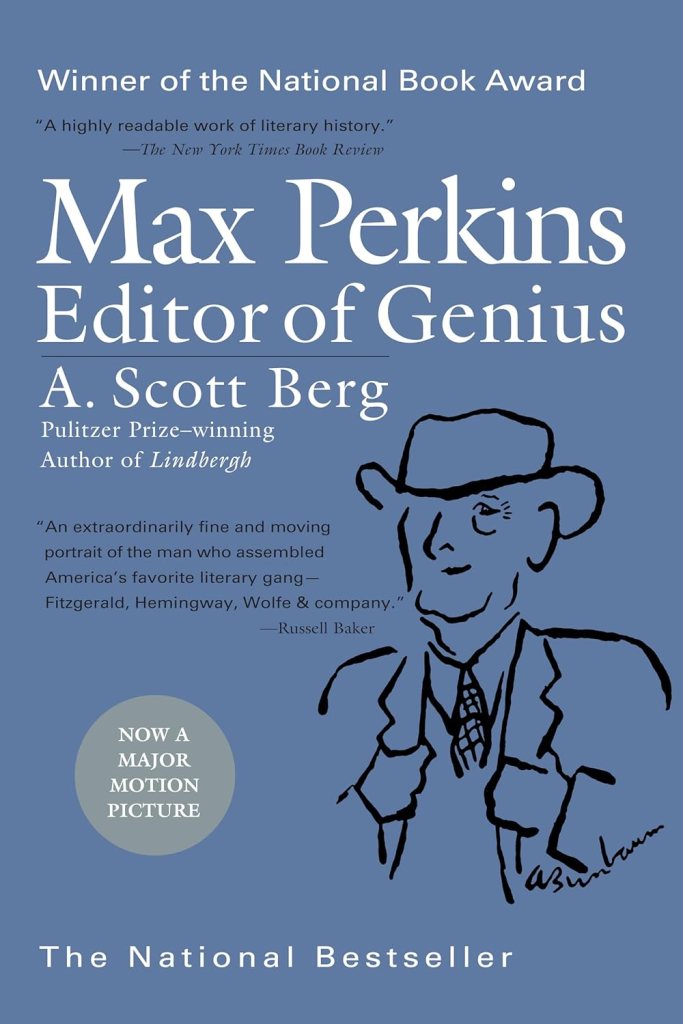
The first time I read Max Perkins: Editor of Genius, I did so because in the spring of 2019 my writing friend Milan suggested that I read it. He said it was a wonderful book. Then he kept following up with the question, “Have you read Max Perkins: Editor of Genius yet?” I felt bad when I had to admit that once again I hadn’t. So, in late fall I borrowed the book from the library and started reading it.
I did indeed love the book, but I never got the chance to talk about it with Milan.
Milan and I met through our local writers’ association, to which we both belonged. Before COVID the association held a gathering once a month at a local coffee house. As a person who was new to the world of writing, it was a great place for me to be in 2019. Not only did I receive lots of good advice, but it was a joy to be with fellow writers.
Every month the usual cast of writers, like me, showed up, and others came when they could. Milan came often. His enthusiasm for being with writers showed in his kindness, his warm smile, and easy laughter. He loved to talk about ideas, writing, social issues, education, and even his pickup truck when I wanted advice about trucks. Born in France, Milan had immigrated to the United States with his mother when he was a young teenager. He had written a fascinating memoir, Ma’s Dictionary: Straddling the Social Class Divide, about his life. He had a book deal with a French publisher, so at the time I met him he was translating his memoir into French, his native language.
Milan and me at the coffee house on a Saturday morning, 2019
Milan became my mentor. He asked to read my short stories, and he gave me encouraging feedback via email, which often arrived at three or four in the morning because that is the time of day when he worked on translating his memoir into French. It was always fun to wake up in the morning and find an email from him. Even nicer — he asked me for feedback on an essay he was writing.
The second week of December in 2019 was the last time I heard from Milan. I had sent him feedback on his essay, but he didn’t respond. Over the next couple of weeks, I sent two more emails but received no answer. That wasn’t like Milan. I figured maybe he had traveled to France for the holidays or maybe he had lots of company. I tried not to think about the fact he might be seriously ill or that perhaps he had died. I had never met any of Milan’s family, and other than email, I had no way to contact him.
On January 14, 2020, I sent Milan another email but again received no response. I started checking the online obituaries every few days. Perhaps that sounds morbid, but if Milan had died, I wanted to know. In March his obituary posted. He had died on March 6, 2020, at the age of 78. I’m assuming because of the time lapse between his last email to me and his death that he’d become seriously ill before he died.
I had known Milan for almost a year. We saw each other about once a month at the coffee house gatherings. And I had attended a couple of community outreach discussion groups he had facilitated regarding his memoir and the social issues it touched upon. After reading about his passing, I was so sad. I’d lost a friend, a fellow writer, and a mentor. Milan had once said that he loved to visit with me because I could talk about ideas. It was such a nice compliment. Talking about ideas was also one of the reasons I enjoyed his company so much.
I finished reading Max Perkins: Editor of Genius shortly before Milan died, but we would never talk about the book. I would never know why he liked it so much or why he kept insisting I should read it. Instead, the book became an unfinished conversation between Milan and me.
I recently reread the book about Max Perkins. My second reading of the book was prodded by a conversation with someone about a well-known writer (who was five years old when Perkins died) and his strained relationship with his editor. At the heart of the conversation was the question: How much can an editor intercede in a piece of writing before a line is crossed and the work becomes not just the writer’s but rather almost a collaboration? This conversation reminded me of the working relationship Thomas Wolfe had with his editor Max Perkins.
Because A. Scott Berg had access to hundreds of letters between Wolfe and Perkins, he was able to write about their often-tumultuous writer-editor relationship. In his book, Berg details the massive manuscripts Wolfe presented to Perkins, and Perkins’s long hours of work with Wolfe to pare them down into manageable books. (Perkins always stated that any suggestions he made to Wolfe were always subjected to Wolfe’s complete approval.)
Berg also included the opinions of some literary critics who believed Wolfe should be able to revise his own work from a rough draft into a cohesive and readable novel without extensive help from an editor. And because Wolfe couldn’t seem to do that, the critics had questions about his overall abilities as a novelist. Eventually, this caused a rift between Wolfe and Perkins, with Wolfe leaving Scribner’s for another publishing house and a new editor. Wolfe wanted to prove the critics wrong.
It’s commendable that Berg never takes sides on either the question of Wolfe’s writing ability posed by literary critics or Perkins’s role in readying Wolfe’s work for publication. Instead, Berg presents Wolfe’s and Perkins’s letters, the accolades and criticisms by others, and the events of Wolfe’s leaving Scribner’s without interjecting his own point of view. It’s up to the reader to form an opinion. I’m sure Milan would have liked to discuss Wolfe and Perkins.
I can’t say for certain what else Milan may have liked to discuss, but I’m sure there would have been lots. Berg’s book is well researched and well written. He does an excellent job of presenting information about Perkins and the many writers Perkins worked with, such as F. Scott Fitzgerald, Ernest Hemingway, Thomas Wolfe, Nancy Hale, Marjorie Kinnan Rawlings, Taylor Caldwell, and other fine writers of the 1920s through the 1940s, many of whom are still well known today.
I wish I would have read Berg’s book when Milan first suggested it to me. We would have liked talking about Max Perkins and the many writers he worked with during his editing career. I miss Milan, and I miss the conversations we never had.
[In 2016, A. Scott Berg’s book was made into a movie called Genius. I haven’t seen the movie, but it has some A-list actors in it. I don’t always like seeing movies based on factual events because Hollywood favors dramatic scenes over reality, but I might make an exception and watch this movie because it appears to stick to the facts better than some biographical dramas. However, overall critics panned the movie, so maybe I won’t. For information on the movie’s historical accuracy, click on Genius: History vs. Hollywood. For a synopsis of reviews by movie critics, click on Genius (2016 film).]
My favorite photo: Ziva and me, Petoskey, Michigan. Photo by Max Youngquist, July 2024
A week ago I wrote a blog titled “Writing and Waiting.” I was inspired to write the blog because a short story of mine was a finalist in the Wisconsin People & Ideas magazine, and I was beyond anxious while waiting to hear if it would win anything. I was so excited and nervous. Over the last few years, I have read many of the awesome short stories that have won or placed in the contest, and to have my story be one of the nine finalists this year was thrilling. And even though I was disappointed not to win anything, I’m so honored that the judges liked my story enough to make it a semi-finalist and then a finalist.
While driving over to my mother’s in Petoskey, Michigan, on July 1, I learned that my story had been chosen as a semi-finalist. And even if it was counting my chickens before they hatched, I worried about having a decent author’s photo, just in case my story won something. Before this I had wanted an updated photo because the photos I have been using for bios are candid photos taken by my husband, a stranger at a writing conference, and my granddaughter.
My nephew, who is a wonderful photographer, was also visiting my mother. So, after I arrived at Mom’s, and after I said hello to everyone and gave everyone a hug, I asked him if he would take some pictures of me after supper. He’s a big supporter of my writing. Shortly after we ate and finished up the dishes, he walked back into the kitchen with his 35mm camera slung around his neck. “Aunt Vickie, are you ready to have your picture taken?” He loves any excuse to take photos.
We went out into my mother’s beautiful yard. The sun, nearing the end of its day, created a magical light. We included my dog Ziva in some of the photos because she wasn’t letting me leave the house without her. She seemed to know she was part of a special moment. Even when my nephew took photos of just me, Ziva stood next to me.
Before the photo session, Max talked about taking more photos of me in different settings around Petoskey. After the photo session, I so loved the photos he had taken that I told him we didn’t need to go anywhere else or take any more photos. I don’t like having my photo taken, and I often feel that photos of me don’t turn out well. So, I felt lucky to have a lot of great photos to choose from. And I reasoned that if Max took more photos, I would have too many choices.
Even though my short story didn’t end up winning or placing in the contest, every time I look at the photograph of Ziva and me, I’m filled with love and peace. It reminds me of my kind and talented nephew Max and my loving and loyal dog, Ziva.
And I’m enjoying a sense of calm now because it’s at least a month or more before I expect to hear from other editors about other stories and essays I submitted this spring. As those deadlines approach, I plan to stay cool, calm, and collected. As if!
Me in Petoskey, Michigan. Ziva is on my right, next to my side. I selected this photo too because I figured it’s good to have one without the family pet. Although Ziva and I agree that having her in the photo with me makes me look better. Photo by Max Youngquist, July 2024
More about the Wisconsin People & Ideas writing contest . . .
I’m looking forward to reading the stories written by the 2024 winners. (Click here for their bios.) I have read the stories of past winners, all of which are wonderful. But there are three stories that stick with me. All three of the stories, besides being beautifully written and thematically rich, have at least one character that is unforgettable. I’ve listed the stories alphabetically by author’s last name because it’s so hard for me to pick a favorite. You can read the stories by clicking on these links:




 Writing Near the Lake