My First Book!

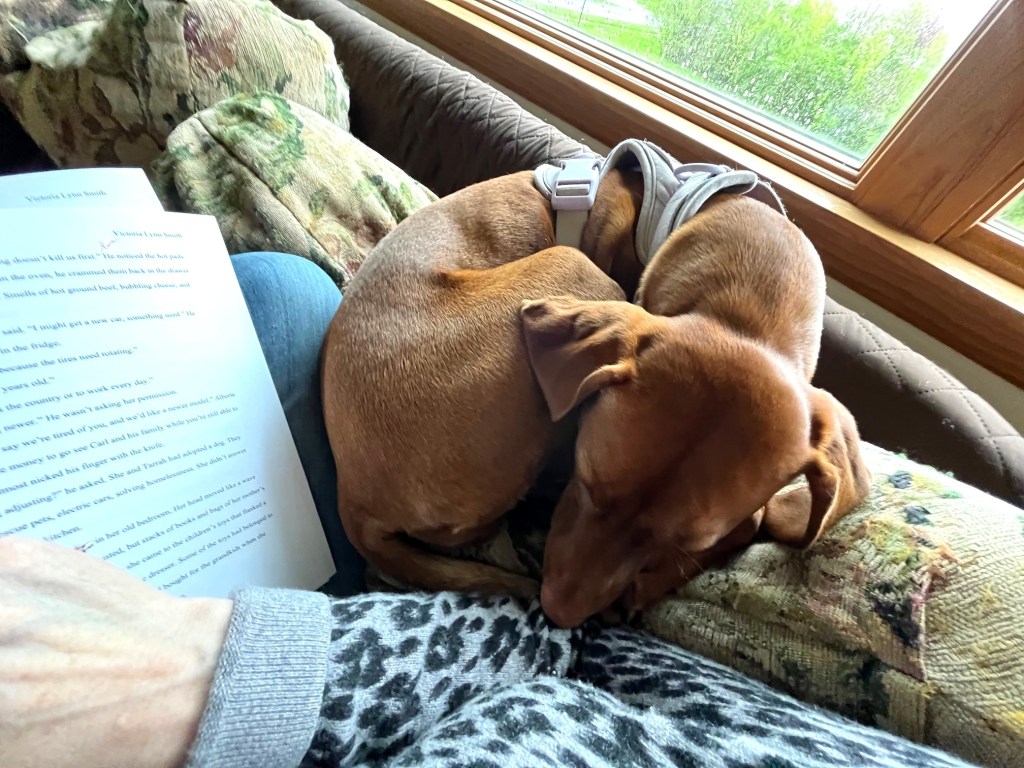
When I told my husband I was dedicating my book to him, he said that I should dedicate it to our dog Ziva. She logged a lot of hours with me while I wrote.

In February 2027, my first book, a collection of short stories, will be published by Cornerstone Press, which is run by the University of Wisconsin-Stevens Point. Yay! (Imagine an emoji of happy, dancing feet here.)

I spent five years working on my collection of short stories. Every time I submitted a story to a journal or a contest, I sent a bio. In each bio I started writing: She is currently working on a collection of short stories. Because I wrote this in my bios, I kept writing short stories. After all, I didn’t want people to think my words were fluff. For me writing and submitting to journals was scary enough, but the idea of getting a book published was scarier. So, every time I wrote the words: She is currently working on a collection of short stories, I eased my way through my fears. Putting it in words over and over made it less intimidating and eventually kind of like saying, Yeah, I’m going to get my nails done on Saturday.

I also told myself if I finished enough stories to have a book-length collection, then I would have met my goal. I had done what I said I would do — write a collection. That didn’t mean the stories had to be published. Right? For me, the idea of getting published was terrifying. I worried about everything. Will people like my stories? Will anyone read my book? Will I have book signings and be the only one there? Will anyone buy my book? Will people like me? What if I mess up when signing someone’s book? Can I use an erasable pen? I waffled so much over whether or not to submit my short story collection to publishers that I could have become my own Waffle House franchise.

At the end of 2023, I had enough stories, but not enough courage. Then I discovered the Iowa Short Fiction Award and the Flannery O’Connor Award for Short Fiction sponsored by the University of Georgia Press. These contests are for emerging authors. I entered both of them. I didn’t believe I stood a chance of winning anything, and that made submitting my stories to them less nerve-wracking. But I took each entry seriously. I read all my stories out loud and silently, again and again. I had my readers rank which ten stories they believed were the strongest so I could place them at the beginning, middle, and end of my collection. I didn’t win anything in either contest. But after I sent my collection off to the Iowa contest, I started writing in my bios: She recently completed her first short story collection and is querying publishers.

After receiving rejections from the Iowa and Georgia presses, I waffled some more. I think I might have driven a few people crazy with my waffling. And I’m so grateful that none of them told me to shut up and go away.

I was still waffling away, when I attended the Wisconsin Writers Association Conference in October 2024. While I was there, a few things happened that gave me a shove. First, I met Lan Samantha Chang, a wonderful writer who is also the director of the Iowa Writers’ Workshop. She was one of the guest speakers, and she talked about the scariness of writing and putting one’s work out into the world. And I thought, If Chang, an accomplished writer, can be scared, I can be scared. Next, I listened to a panel of three publishers speak about their presses and submission processes. Afterward, I introduced myself to the publisher of Cornerstone Press. I told him I enjoyed listening to him and the rest of the publishers. Then I said the words, “I have a collection of short stories that I’m going to submit to Cornerstone Press.” To which he said, “I look forward to reading them.”

I had done it. I had said the words out loud. At that point I knew I would have to submit my collection because I didn’t want the publisher to think my words were fluff.

I’m still scared of all that other stuff, but I’m going to take it one fear at a time. I can handle one fear at a time.

________________________________________________________________

Acknowledgments

I didn’t write my collection of stories in vacuum. I owe a lot of gratitude to so many people and organizations.

I want to thank everyone who spent any amount of time reading my stories and giving me feedback. You were always helpful.

I want to thank the people who follow my blog and would read my stories when I posted a link to where they had been published. Your positive comments meant the world to me.

I want to thank the following organizations: Lake Superior Writers, Red Oak Writing, Wisconsin Writers Association, and Write On, Door County. These organizations were a lifeline during COVID. They pivoted to Zoom classes and gatherings that gave me and others a place to connect and be writers. They are all wonderful organizations for writers who want to learn more about their craft and spend time with other writers.

I want to thank all the writers, famous and not famous, whose works I have read and who have inspired me to be a better writer. There are so many talented writers, most of whom will never be household names.

Nellie “Bly” on Assignment with Me — Something Published, “Creating Holiday Traditions with Books”

Nellie “Bly” ponders an important question regarding investigative journalism: “Isn’t it time for lunch?”

On October 10, my grand-dog Nellie, whom I like to refer to as Nellie “Bly,” went on assignment with me. I was working on an article for Northern Wilds magazine. Our mission was to interview one bookstore owner in Two Harbors, Minnesota, and one bookstore manager in Grand Marais, Minnesota, and to take photos. Nellie Bly was game. (Although, if she had been given a choice, she would have rather chased small game instead of facts.)

Going on a reporting job with a dog is fun, but it requires more time. We were gone for over six hours. In addition to doing interviews and snapping photos, our assignment included four walks, a lunch break, and a supper break.

Nellie waited in the van while I did the hard-boiled investigative work inside the bookstores, asking the managers about the history of each bookstore and which books they anticipated would be hot for the holidays. Good investigative journalism means I had to ask the tough questions too, such as “What is your favorite holiday book? and “Do you have any holiday traditions involving books?” Of course, in the name of gathering evidence, I bought some books at each store.

Nellie got paid in food and treats. However, when I ate my Happy Meal for lunch, she made it clear that she wanted to exchange her bowl of dried kibble for my cheeseburger. And when I had my six-inch sub for supper, she again made it clear she wanted to swap her bowl of kibble for my sandwich. There were no trades. I told her life in the field as a reporter is filled with sacrifices.

Perhaps, if this article goes over well, it will lead to a TV series, where I travel the country, reporting on independent bookstores, asking probing questions about each bookstore’s origins and what’s selling well, all while spending my writing paycheck on books. Maybe Nellie Bly would like to be my assistant. We could travel in a RV with a driver so I could read and she could look out the window. I can hear Nellie now — trying to negotiate a better meal deal and asking for top billing in the credits. With her good looks, she would be the star of the show in no time anyway.

[To read my article click here: Northern Wilds, pages 14-15.]

Writing and Waiting

Walking through Tom’s Logging Camp on Friday was a delightful diversion from waiting.

Children wait a lot. They wait for a parent to come home or to pick them up after a soccer practice or a dance class. They wait for a sermon to end or for Christmas morning to finally arrive. They wait for each birthday, and cherish the moment when they can add the half year to their age because their big day is that much closer. They wait for the bell to ring, dismissing fifth-hour study hall, so they can walk down the hall and hope that today when they encounter the seventh-grade classmate they are hopelessly in love with, their eyes will meet in a moment of magic. Learning to wait when one is a child is good preparation for having to wait as an adult. Because having to wait is not something a child can outgrow.

And writers wait. We wait for an idea to run with. We wait for the next time we can sit down to write. We wait for readers to give us feedback. We wait to hear from editors who will accept or decline our stories, essays, or poems. We wait to learn the results from writing contests. Once our work is accepted, we wait for our pieces to be published. We wait to see if we’ve been accepted for a writer’s residency. We wait for phone calls from our computer techs who tell us we can pick up our computers.

My parents taught me the art of waiting, which is probably how most of us learn to wait.

When I was a child, under the age of eleven, my father kept an airplane at the Hales Corner Airport, in Franklin, Wisconsin. My sisters (one thirteen months younger than me and the other four years younger) and I often went to the airport with my father. He would get the urge to work on his plane or hangout with other pilots, shooting the breeze about flying and planes — much like when I’m compelled to write or when I crave the company of other writers, so I can shoot the breeze about writing and books.

Unless my sisters and I were going on a flight with my father, we weren’t invited into the hangar. He would tell us to wait in the car, that he’d be back soon. It was never soon. He would crank down the windows, but heat stacked up in the car anyway, making us too warm. In addition to being bored beyond belief and hot, we became irritated. Our definition of soon was clearly at odds with his definition. We had a tipping point at which we risked his anger and got out of the car. But we never entered the hangar to ask him when we were going home. By a young age, we had learned this simply wasn’t to be done. This is partly why I can wait for months and months to hear from editors without contacting them, even when they’ve stated, “If you don’t hear from us after six months, please feel free to contact us.” I may never hear from them, and still they will most likely never hear from me. Those editors are in a hangar, and I’m not going in there.

At the airport my father always parked close to a tall metal pole topped with a bright orange windsock. The pole was surrounded by green grass, which was encircled by a ring of rocks, all the size of small dogs curled up for a nap. We would climb over the rocks and sit in the grass and watch the windsock as it shifted above us. The cooler air and freedom from the car helped, but our boredom and irritability soon returned. Eventually, our father would come out of the hangar. He might say a few terse words about us sitting around the pole instead of inside the car, or not. But either way we knew better than to ask him, “What took you so long?”

My ability to wait quietly doesn’t mean that waiting to hear about something I’ve submitted is easy. Far from it. I can pace with the best of the tigers. I perform menial tasks to pass time, but I end up feeling like I’m swimming in a pool filled with Salvador Dalí’s melting watches. As a projected date of a notification nears, I check my email incessantly. One moment, I convince myself that no one will ever be interested in publishing my work again. The next moment, I daydream that I’ve won a contest or that an editor has so loved my work, they gush about it, using bouquets of purple prose and ask, “Can you send us more?” (Yeah, Walter Mitty lives inside of me.)

When I first started submitting my work and received rejections, I was convinced I must be a lousy writer. I contemplated doing something easier — maybe washing windows on tall buildings, even though I’m terrified of heights. Then an editor sent me a rejection saying she had almost selected my flash fiction piece but had decided to hold off. She would keep it on the back burner but probably wouldn’t end up using it. It was an encouraging rejection, so I kept writing. A month later, she notified me that she had decided to print my story after all. Perhaps, I thought, I can write.

I keep submitting and mostly receive rejections. But I get just enough acceptances. So, like my old dog who hangs around the kitchen, hoping at any moment that she will get a treat, I keep checking my email, hoping at any moment I might receive an acceptance.

I get so bad about checking my email that I don’t open it if I’m working at my computer, I leave my phone in another room, and I make deals with myself. If I write for thirty minutes, I can check my email. After I walk the dog, I can check my email. After I finish all the dishes, I can check my email. After I’m done having coffee with a friend, I can check my email. If I go an hour without checking, I pat myself on the back, then hurry to check my email. The only reason I will confess this is because I’ve read essays written by other writers who admit they repeatedly check their email, especially when they know the date of an editor’s announcement is imminent. And if a writer submits enough pieces, there is always an announcement coming soon.

I often think of my mother when I’m waiting for an email from an editor. Before I learned to drive, I relied on my parents to drop me off and pick me up from school events, a job that fell mostly to my mother, who was always late. And there were no cell phones. To ease my worry while I waited, I played little games: If I counted to sixty, then she would come, then maybe one hundred, then perhaps fifty. I alternated that game with a counting-the-cars game: the tenth car on the road would be hers, then maybe the sixth car, then perhaps the eighth car.

For me, to write is to submit, and to submit is to wait. I find the more I submit, the easier waiting becomes because without waiting too long, I can look forward to (or be disappointed by) an email from an editor. But I check my email even more — a random reinforcement schedule is an effective motivator. If I have only a few submissions on the loose, it’s easier to ignore my email — at least until a notification date approaches.

I’m currently a finalist in a writing contest and waiting to hear if I’ve won anything. I have a short story set in 1860 entered in a historical fiction contest. My short story collection, which I entered in a contest, is hopefully being read and passed along to the next round. I’m waiting for an anthology of essays to be published because I have an essay in it. I have a short story under consideration for a British journal, and an essay under consideration for yet another British journal. I have a flash fiction piece entered in a regional contest. I’m hoping to hear about two articles I pitched to a local publication.

And so, I wait. I don’t sit next to a windsock. I don’t count seconds in my head or cars on the road. Instead, I push myself to keep writing. To get out into the world. To read a good book. To hear an author speak. To have coffee with friends. To go to lunch with my husband. To take my grandkids to Tom’s Logging Camp where we can look at old logging tools, feed ravenous trout and goats, and be ignored by an uppity llama who isn’t hungry.

And I silently thank my parents for making me wait around when I was a child.

Today after I post this blog, I’ll check my email. Then after I clean the bathroom, I’ll check my email. I have guests coming for dinner, and after they leave, I’ll check my email. (Perhaps, my parents didn’t make me wait long enough before exiting the hangar or picking me up from school.)

The calming beauty of nature

Dating a Short Story

My office, the scene of tumultuous writing relationships

About a month and a half ago, inspired by a picture, I wrote a rough draft of a short story. About 2,300 words long, it had a nice beginning, a muddled middle, and an abrupt non-ending. I saved the story and closed the file. The story and I needed space from each other.

So, I wrote some blogs. I did minor revisions on a historical short story. I beta read a novel. I read some books. I played games with my grandchildren. I walked my dog. I watched TV. I cleaned the house.

That’s usually how it is for me at the beginning of a short-story relationship. I fall in love with an idea, which lives in my mind. I see a story with layered meaning, engaging characters, and a compelling plot. However, the vision in my head becomes incomplete and fragmented on the paper. Something gets lost in translation, and at this point, I’m never sure if I will ever meet the story I became infatuated with. It’s rare that a story and I click right away, so in the beginning, I often don’t name a story, just in case things don’t work out.

For a while, a rough draft and I will ignore each other. Then, if it’s meant to be, the story starts whispering in a corner of my mind. It nudges me when I’m drifting off to sleep. Before I open my eyes in the morning, I feel it staring at me. At this point, it’s all low-level noise. But if the story cares, it keeps calling to me, getting louder and louder, until the only way I can pacify it is to pull it up on my computer screen and spend time with it. My inspired-by-a-photo story is one of those types of stories — one that starts to follow me around.

So, last Saturday morning I returned to the story and spent hours with it. When I took my dog for a walk in the afternoon, I called a friend, who also writes. “I’m working on a story I started six weeks ago,” I told her. “It’s been painful.”

“It hurts?” she asked. I imagined her eyebrows pitching upward along with the sound of her voice.

“Yes,” I said, “I’m at the beginning stages of writing the story. I don’t know if it’s going to work or not, and that’s painful. If I can make the story work, then the revising and editing parts become fun.”

The painful phase happens almost every time I write a short story. My head spins. I crave chocolate. I check my email every five minutes. And I make excuses to leave my desk. But I’ve learned the only thing I can do is to keep returning to my story, to keep pushing forward. Sometimes after months of intermittently returning to a story again and again — trying to find a way into it, through it, or out of it — I get lucky, and my story seems to write itself. But this isn’t really true: It’s the time and work I’ve put in that suddenly makes the story feel like it’s flowing from my fingers. But not every short story I draft has a fairy tale ending. Some stories and I never see each other again, or after months of trying, we call it quits.

Last Saturday with my story felt like a bad date, and I reached a point where I had to bail. I left my office feeling I had wasted hours but determined to try again the next day.

On Sunday, I went back to the story. Back to tweaking the first couple pages, then getting up to do something, then back to the first couple pages, so I would know where I was at. Then up again. Then back to the first couple of pages. Who was I fooling? It was easier to spend time with my story’s charming beginning and overlook its flawed messy middle and nonexistent ending.

But I kept at it because when I’m writing, I consider banging my head against the wall to be part of my creative process.

After bumbling along with the story for a couple of hours on Sunday — I had been wrestling with the narrator’s voice and the story’s tense — an idea occurred to me. I revised the first few paragraphs, giving the narrator a distinct voice that seemed to fit the story’s theme and fix the tense problem at the same time. We’ll see.

For now, the story and I plan to keep seeing each other. We have coffee together in the mornings, before I pick up my grandchildren from summer school. Sometimes in the afternoon if my grandchildren are playing quietly, I sneak into my office and spend extra time with the story.

The relationship is progressing in a positive direction, but I’m not ready to declare it a love match, and the story remains unnamed. It could still turn out to be yet another frog that won’t become a prince.

(By the way, there is no reason to tell my short story that I hung out with a blog today.)

The photo that inspired my latest precarious relationship!

Short Story Club Idea for Writers or Nonwriters Who Love Literature

Delicious coffee cake paired with a cherry blossom latte from our favorite coffee shop. Note the wonderful cherry in the cup.

During COVID, I joined a book club at the library. We met in the evening once a month on Zoom instead of the library. It was the first and only book club I’ve ever belonged to, and it was perfect for the times. Because lockdowns meant I couldn’t work, I had extra time on my hands. I tried to write, but I was too anxious to produce much of anything. But I could read, so I looked forward to each Zoom gathering and the chance to meet with fellow readers who also loved to discuss books. At the end of each discussion, it was nice to “leave the meeting” and not have to get in my car and drive home. Best of all, I felt that reading and discussing books would help me grow as a writer, even if I couldn’t write. Later, I would hear other writers talk about their struggles to write during COVID. But when the lockdowns ended and the book club returned to meeting at the library, I dropped out.

I missed talking about books with fellow readers, but I also wanted something that was more focused, tailored to me as a short story writer. Then, I read an article by an essayist who said she and a couple of her fellow essayists liked to read the same essays written by well-known writers and discuss them. They looked at tense, point of view, structure, pacing, use of literary devices, and anything else they wanted to discuss. I attended writing webinars where instructors used mentor texts to model whatever writing technique they were teaching. I came up with an idea: Why not a short story club? One that would focus on the writer’s use of all the literary techniques in a writer’s toolbox.

So, I talked to a friend of mine who used to teach AP English. Because I knew he loved to discuss literature and because he was a busy guy, I figured he’d love the idea of a short story club. He did.

We take turns choosing a short story and meet up every five to six weeks at a local coffeehouse. We discuss anything and everything about the writer’s techniques. I learn a lot and my hope is that I will become a better short story writer. (Maybe I should call this my Coffeehouse MFA.) I know that much of what we discuss will end up in my writer’s toolbox, perhaps to be incorporated in some manner in one of my future stories. My friend hopes to write when he retires, so he is adding to his toolbox too.

If you want to form your own short story club, here are some ideas to get you started:

  • Take turns picking the short story. Be adventurous. Cover different time periods and genres and cultures. If someone ends up not liking a story, at least it’s not a whole book.
  • Read the story at least twice. I read a story a few weeks before we meet up, then again a day or two before our meeting.
  • Make a paper copy of the story so you can annotate, highlight, and underline. (My colored erasable ink pens get a workout!)
  • Meet up at a local coffeehouse, so no one has to worry about hosting (or cleaning his or her house or baking the treats).
  • Make time to visit before and after you discuss the short story. It’s fun to catch up with friends.
  • Depending on the size of your group, allow an hour to an hour and a half.
  • My short story club consists of two people, but you can go bigger.

Short stories we’ve read so far:

“Sonny’s Blues” by James Baldwin, “Virgin Violeta” by Katherine Anne Porter, “The Third Thing That Killed My Father Off” by Raymond Carver, “The Wilderness” by Ray Bradbury, “Tomorrow in Shanghai” by May-Lee Chai, “A Trifle from Life” by Anton Chekhov, and “Warpath” by Jeffrey Masuda.

***

My two favorite books from my book club days:

A five-star book

Red at the Bone by Jacqueline Woodson. Shortened synopsis from Amazon: As the book opens in 2001, it is the evening of sixteen-year-old Melody’s coming of age ceremony in her grandparents’ Brooklyn brownstone. . . . But the event is not without poignancy. Sixteen years earlier, that very dress [now worn by Melody] was measured and sewn for a different wearer: Melody’s mother, for her own ceremony — a celebration that ultimately never took place. Unfurling the history of Melody’s family – reaching back to the Tulsa race massacre in 1921 — to show how they all arrived at this moment, Woodson considers not just their ambitions and successes but also the costs, the tolls they’ve paid for striving to overcome expectations and escape the pull of history.

For an informative podcast (and to wonder, Why isn’t this taught in school?) listen to Blindspot’s Tulsa Burning. Listen to the podcast first. If you understand the horror of what happened in Tulsa, you will have a greater appreciation for Woodson’s powerful novel.

Also, a five-star book

It Takes One to Know One by Isla Dewar. My reading of this book was a happy, very happy accident. The book I was supposed to read was It Takes One to Know One by Susan Isaacs, which is a crime thriller. I didn’t make note of the author’s name, so when I ordered the book, I bought the wrong one — a wonderful mistake.

I loved Dewar’s take on the title. Her book is downright funny, even though the humor sometimes comes from a place of sadness and longing. The book is not a crime novel, but there are some small mysteries that need unraveling. Dewar is a Scottish novelist, and authors from the British Isles do the type of humor I like so well. Perhaps living on small islands in very changeable weather, and being surrounded by eerie and unearthly beautiful landscapes, and being subjected to numerous invasions and attempted invasions since the Roman Empire, makes one cultivate a sly, irreverent sense of humor in order to appear unflappable.

My son, who rarely reads fiction, read this book and laughed out loud. My daughter-in-law also loved it.

Listening to Oliver Twist While Driving across the Upper Peninsula of Michigan, and Other Thoughts about Charles Dickens

I listened to this recording. Flo Gibson did an excellent job.

I recently drove to Petoskey, Michigan, to see my mother, then five days later drove back again. I always listen to books on CD when I drive to my mother’s. I visit my local library and check out more books on CD than I will need for the round-trip ride because on rare occasions, I start listening to a book and either I don’t like it or I don’t like the reader’s voice. Because I specifically wanted to listen to Oliver Twist, I played that first. I liked the reader’s voice, which was a perfect pairing for such a tale as Oliver’s story. And, I liked the Dickens novel well enough, so I kept listening.

During my twenties I read mostly British literature written before 1900 — Dickens, Daniel Defoe, George Elliot, Thomas Hardy, Jane Austen, William Makepeace Thackeray, Sir Arthur Conan Doyle, and the Bronte sisters, among others. I like to refer to that as my “early Brit-lit phase.”

Oliver Twist has many of the elements found in the Dickens novels that I so enjoyed when I read them in my twenties. The secondary characters are interesting, quirky, and sometimes so delightfully nasty that I truly enjoy their downfall. The plot threads are complex and engaging — twisting, turning, separating then rejoining, surprising me, yet making me sigh, “But of course!” There are the Dickensian themes of poverty, cruelty, and snobbery. The heroes have to rise above their circumstances, like poverty or the sins of others, which they are blamed for and held in contempt for, even though they’ve had no part in the events that have befallen them. And, of course, there are the good-natured, kindly characters who help along the way. But in Oliver Twist, the good, especially the women, are portrayed as sainted angels upon the earth — too good to walk upon the lowly soil. But thankfully, for the long-suffering Oliver, it’s beneficial they do because they are able to discern in Oliver all that is noble and good and become his staunch allies. (I guess one sainted person can always recognize another.)

I didn’t, however, like Dickens’ portrayal of Fagin, the criminal ringleader. Fagin is Jewish, and Dickens hammers that point over and over again, continually referring to Fagin as the Jew, rarely using his name Fagin. It wasn’t necessary to describe the character as Jewish because Fagin’s religious or ethnic background has no bearing on the story. It’s a racist stereotype.

On the other hand, Dickens’ novels often exposed the wretched conditions faced by the poor. I was struck by the theme of poverty in Oliver Twist and how relevant it is today. Characters could be arrested for sleeping in doorways. Adults and children in the workhouses and poorhouses were overworked, underfed, and mistreated by the people who ran those “charitable” institutions. The poor were labeled lazy and stupid, and believed to be one step away from a life of crime. By creating one narrative — that all poor people were undeserving — society could dismiss the poor with one wave of its hand and justify their mistreatment. With his fiction, Dickens spoke on behalf of the poor and forced Victorian society to face a harsh truth. But sadly, we haven’t come far. As I listened to Oliver Twist, it struck me that those same prejudices and stereotypes are still being repeated — this time about the poor and homeless in our current society.

I’ve read eight of Charles Dickens’ novels, and the one I rank as his best is Great Expectations, which was serialized from 1860 to 1861 in a weekly publication. The story of Pip and his rise and fall lacks the full-on sentimental mush found in Oliver Twist (although a bit of sentimentality can be found). Pip is a much more complex character, whose desires and dreams get in the way of his own happiness and cause heartache to those he loves. Pip’s growth as a person and his final realization and acceptance of his faults is a much more nuanced and mature story than Oliver Twist, which was written and serialized from 1837 to 1839. I’ve read Great Expectations twice, and I’ve listened to it three times. Each time I revisit the novel, my appreciation for the genius of Great Expectations grows. I think Dickens was truly at the height of his story-telling prowess when he penned Pip’s story. I plan to read more of Dickens’ novels, so if I change my mind, I’ll blog about it.

Others choose A Tale of Two Cities as Dickens’ best, but not me. I tried reading that novel twice in my twenties and didn’t finish it either time. A few years ago, I started listening to it on tape. I thought I might appreciate it more as an older adult. Nope. I was ready to stop less than halfway through because my aging hadn’t improved the novel. But my son called one night when I was out walking my dogs, listening to A Tale of Two Cities. Turns out he didn’t like the novel either, but he read the whole book anyway. “Well,” I told him, “if you can take it, I can take it too.” And I finished listening to it. But I didn’t grow to like it. A couple of years ago I started reading The Old Curiosity Shop, but I couldn’t finish it. Partly because the character Daniel Quilp is the most evil and vile character I’ve ever come across in a book. (Granted I don’t read horror books or stories with serial killers.) And partly because I couldn’t stand the unrelenting suffering Little Nell faces.

But Dickens is one of my favorite authors. He is a master of dialogue, irony, humor, satire, social commentary, melodrama, metaphor, and characterization. His memorable characters spring to life from the pages of his books. This, along with his delectable plots and vibrant dialogue, makes his stories perfect for dramatization as miniseries and movies.

I also like The Pickwick Papers, David Copperfield, Hard Times, and A Christmas Carol, which I read or watch every Christmas. In a month or so, I want to listen to David Copperfield, which I read about forty years ago, because I have a copy of Demon Copperhead by Barbara Kingsolver on my to-be-read pile. I loved David Copperfield when I first read it. But I wonder — after reading it again — if I will I rank it with Oliver Twist or Great Expectations or somewhere in between.

***

If you’re a writer . . . you might want to read some Dickens to appreciate his characterization and dialogue. When it comes to creating characters, especially secondary ones, Dickens’ motto could be “Go bold or go home!” Characters like Uriah Heep (a bad guy) and John Wemmick (a good guy) capture the imaginations of readers. Reading Uriah Heep’s dialogue makes my skin crawl.

Dickens’ dialogue can be satirical, duplicitous, menacing, sentimental, comical, and heartfelt. Every time I read Great Expectations, I marvel at how Dickens distinguishes between Wemmick’s office and home personas. Wemmick’s transformation by degrees as he leaves his employer’s office and walks home is mesmerizing. Wemmick’s mannerisms, opinions, and especially his way of speaking undergo a radical change. Wemmick knows he must be one man at work, but that he can be another man at home.

Lay vs. Lie, Other English Language Difficulties, and Friendships

I love the encouraging signs that grace the walls of elementary classrooms.

This morning I woke with a fright. My eyes popped open, my lungs inhaled a small gasp, and my brain muttered, “Gotcha!” I’d suddenly realized that I’d probably used the wrong verb in a sentence in the blog I’d written and posted the night before. I’d written my dog Ziva laid on the floor, when I should’ve written my dog Ziva lay on the floor. (My snarky brain could’ve warned me last night while I was writing, but where’s the fun in that?)

Before my eyes could focus, before my head cleared, before I even made coffee, I googled lay vs. lie. I had indeed committed a verb-usage faux pas. And before I got up from the computer, I fixed the mistake in yesterday’s blog.

Lay vs lie is my nemesis. I should’ve double checked my usage (I always do). But when I wrote the sentence, and later reviewed the sentence, I was confident I’d chosen the correct verb. Confidence can be wonderful. I work hard on being okay with being confident. Telling myself — You can do this and It’s okay to believe you can do it. But when it comes to lay vs lie, I should’ve known that if I felt confident, it was fool’s gold. You’d think that as many times as I’ve looked up the difference between lay and lie, the answer would stick, but it doesn’t. My uncooperative brain refuses to record the information for future playback.

Why did I think laid was the correct choice? Because I thought about a T-shirt that a high school classmate used to wear that pictured a smiling egg lying in a nest, with a caption that read, You’d smile too if you’d just been laid! Well, the egg had been laid and was resting in the nest, so, of course, my dog laid on the floor because she was resting there. What I’d failed to consider was the egg had been laid by a hen, but no one laid my dog on the floor. She lay down all by herself.

My classmate wore that T-shirt to high school in the 1970s. For a long time, the double meaning of You’d smile too if you’d just been laid! escaped me. But it was the mid-1970s, and I went to a small rural-suburban high school. I’d wanted to ask my classmate what her shirt meant, but I was too afraid of sounding stupid. When I finally figured it out, I was glad I hadn’t asked. I would’ve been laughed at as the naive eleventh-grade girl who didn’t get a simple sex joke. This is also the reason, even decades later, I can still picture that classmate wearing that T-shirt.

I have a dear friend who struggles with lay and lie. She also confessed that effect and affect trip her up. “Hey,” I said, “me too.” And we were both English majors and English teachers. We don’t like to publicly admit that sometimes English grammar stumps us. When we make an error, we feel the shame more deeply. We see ourselves with red capital A‘s (for Abuser of Language) blazing on our chests. We hear people’s thoughts, “Egads! She was an English major and teacher?”

For years I avoided telling people I was an English teacher because I discovered this made them uncomfortable. Once a co-worker admitted to me that she was originally afraid to talk to me. She worried that if she used bad grammar, I would think poorly of her or even correct her. She told me she was relieved when I did neither. I told her that as an English teacher, I felt an extra sense of pressure to speak perfect English, and that if I didn’t, people would think poorly of me. We became good work buddies, speaking freely without fear of grammatical judgement.

I had another friend who struggled with the use of apostrophes in creating possessives. I remember the day I first met her in the law office where she worked as a paralegal. I’d just been hired as a second paralegal, and my new boss took me back to meet her.

“Sandi,” my boss said, “this is Vickie, the new paralegal. She was an English teacher.” I winced. I wasn’t sure why he’d felt the need to include that.

As soon as the boss walked away, Sandi said, “You might as well know right now, I struggle with using possessive apostrophes.”

I knew immediately Sandi was an extraordinary person — someone who was willing to lead with her grammatical weakness, and to a complete stranger who’d been identified as an English teacher! She was a woman who faced danger head on.

“I can never remember how to use lay and lie correctly,” I said. “And while we’re at it, effect and affect trip me up, too.”

Sandi laughed, a throw-your-head-back, deep-from-the-belly laugh. It was the beginning of a beautiful friendship that lasted until she passed away, leaving a hole in my heart.

Grammatical shortcomings make for better friendships than grammatical perfection.

But I still blush when I realize I’ve committed a grammatical error. I still had to correct yesterday’s blog before I could do anything else this morning.

And how’s this for confidence? I wonder if my correction: And to show her support, my dog Ziva lay on the floor and listened, is correct. (I’m using the past tense of to lie.)

I also struggle with restrictive and nonrestrictive clauses. What is your grammatical Achilles’ Heel?

My Beta Critics Take a Snooze

My granddog, Nellie
My dog Ziva

I’m reading through a manuscript of short stories, one hundred fifty-two pages, double-spaced, Times New Roman, one-inch margins. I’m reading each story out loud, listening to the beat of the words and the rhythm of the phrases and clauses. This is a good way to find discordant sentences. It’s also a good way to find typos, misused words, and missing words. It gives me more time to agonize over commas. Sometimes I add a few words or sentences because something needs saying, and other times I snip a word or two because I’ve been redundant. Or I snip a sentence or two or three or a whole paragraph because I’ve discovered they are little darlings masquerading as part of my story.

But I’ve read this manuscript out loud so many times that the changes I make now are miniscule. Yet, I’m reading it again, one more time to make sure. Before May 31, I will submit my manuscript to a contest for short story collections. I want it to be as error free as possible. I want each story to be the best that I can make it.

Yesterday evening I sat on the couch with my granddog, Nellie, who listened to me read. And to show her support, my dog Ziva lay on the floor and listened.

The dogs were a willing audience. After all, I’m the giver of treats and walks. And should I have gotten up from the couch, they wanted to be near in case I headed to the treat bowl or grabbed their leashes.

A friend of mine asked, “What did the dogs do when you read to them?”

“They fell asleep,” I said.

“Oh, no,” she laughed, “that’s not good.”

Yep, the dogs keep me humble. But their love is unconditional, especially when reinforced with treats. They are content to be with me, and I love reading to them. They are a kind, loving audience. They don’t care if I struggle with commas, words, rhythms, and little darlings. They don’t care what happens to my manuscript. (Although, if I put it on the floor, Ziva might shred it because she loves to shred paper.)

By the way, after reading one of my stories, I fell asleep too. Nothing like napping with dogs after a good story.

Something Published: “Margaret and Henry’s Dance” appears in the 2024 Freshwater Literary Journal, CT State Community College – Asnuntuck

My flash fiction story “Margaret and Henry’s Dance” appears in the 2024 Freshwater Literary Journal, which is published by Asnuntuck Community College in Connecticut.

I appreciate all the hard work and dedication of the Freshwater staff. I love that my story appears in a paper journal. It’s fun to hold a book that contains one of my stories or essays.

Although, the Freshwater Literary Journal is a print journal, they do have a way to read the stories and poems online. To read my story click here and click to page 146 or use the search icon and type in 146.

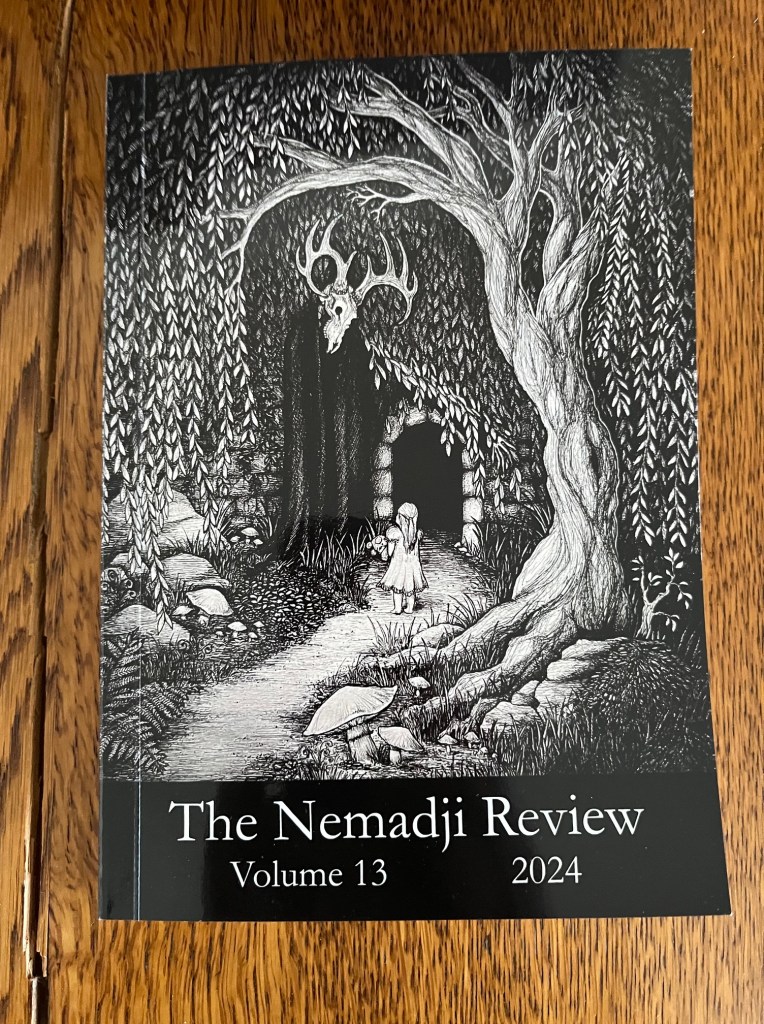
Something Published: “Dog Down the Stairs” appears in The Nemadji Review

This year’s theme was “Welcome to the 13th Floor.” The cover art titled Secret Tunnel of the Willow is by Amy Bates.

My flash fiction story “Dog Down the Stairs” was selected for the 2024 Nemadji Review, which is published by the University of Wisconsin-Superior. I’m so excited to be included in the Review because I graduated from the University of Wisconsin-Superior, a small but mighty force for liberal arts and education majors. Every time I walk onto the campus of my alma mater, happy memories flood my soul, and I feel as though I’m being hugged.

Last night the dedicated editorial staff of The Nemadji Review held a reading for the writers whose works appear in this year’s journal. What a delightful evening! Beautiful prose and poems were read by writers in a cozy and inviting auditorium filled with a supportive audience, followed by conversations with fellow writers while eating scrumptious treats. I had a brownie and a cookie!

I think I’m getting better at these readings. Before last night’s event, I read an essay at another journal launch in April. After I finished my five-minute reading and took my seat, I realized that I hadn’t had an “out of body” experience while reading. Before that, somewhere in the middle of a reading, fear would always take over, and I would become disconnected from the written word. I would no longer be able to put any emotion into the words because I would need all my energy to wade through my fear in order to finish reading. However, last night I did it again — I made it through my allotted reading time without having an “out of body” experience.

Maybe the brownie I ate before I read gave me courage. Or maybe I’ve come to realize the floor isn’t going to crack open and swallow me. Flying monkeys aren’t going to whisk me off stage. And my tenth-grade speech teacher isn’t going to present me with a grade.

I also think, because I keep reading in front of people, my flight or fight mode has relaxed. It’s decided there is no reason for concern. Best to save the adrenaline for real emergencies.

[To read my story click here, then scroll to page 94 of the journal.]

I forgot to have my friend take a photo of me reading. Perhaps that was a convenient-memory slip.