Kekekabic by Eric Chandler

Reviewed by Victoria Lynn Smith (This review was originally posted on Nov. 27, 2022.)

[To pre-order Chandler’s book click here: Finishing Line Press.]

Leo at Parent Lake in the BWCA

Kekekabic, Eric Chandler’s second book of poetry, will be released May 20, 2022. Prepublication sales for the book will run from January 18, 2022, through March 25, 2022. Chandler is the author of Hugging This Rock: Poems of Earth & Sky, Love & War (2017). He has won the Col. Darron L. Wright Award for poetry three times. His writing has been published in numerous journals and magazines.

Kekekabic combines prose and haiku in a poetry form called haibun. In 2018, Chandler wrote a poem after each of his workouts. His goal was “to pay attention to the world” during his workouts in the wilderness, in Duluth, and on the road as an airline pilot. In his introduction he states, “It’s a loss if skiing through the woods is just a workout. All these miles moving over the earth under my own power have meaning.” Chandler’s poems invite us to move over the world with him and share the meaning he finds as he runs, hikes, and cross-country skis.

On the cover of Kekekabic, Chandler’s dog, Leo, sits on the shore of Parent Lake in the serenity of the Boundary Waters Canoe Area (BWCA). Leo invites us to open the cover, read the poems, and reflect along with his hiking companion about being outside in nature. Chandler shares his wisdom about the outdoors in a haiku:

I think more people

should go outside. I think they’d

be much happier.

This resonates with me because on a bad day if I go outside, my spirits lift. Reading Chandler’s poems lifts my spirits too. Nature is an important theme in Kekekabic, and Chandler poems nudge us to go outside.

Chandler’s imagery appeals to the senses. About one of his runs, he writes, “The wind stacked the pack ice up at the fond du lac. The yellow sun sends a yellow stripe across the open water and it hits the shelf of ice and disperses. Brilliant sparkles randomly dot the expanse as the shards reflect the sun.” After a day on the Kekekabic trail, he writes, “Tail-slapping beavers sounded like full-grown men jumping into the lake.” Chandler’s poetic imagery will linger in our minds long after we close his book.

Leo joined Chandler on the five-day hike in the BWCA along the Kekekabic Trail. Chandler wrote a haibun for each day of the hike. The haiku he wrote on the fifth day—

The sound of peace is

my dog snoring on a rock

on a wild lakeshore

—mixes the wonder of nature and the joy of sharing it with family, which includes his dog. He writes of his daughter’s first time on cross-country skis: “I felt like my heart would explode due to an overload of blue kick wax joy, gliding through the trees in silence.” In another haibun Chandler recounts a run along Lake Superior with his son. They find a teddy bear on the path, and his son turns around and races back to where they had just run from to return the teddy bear to a child. Chandler’s poems remind us that small, quiet moments spent in nature with family are special.

Chandler studied the Japanese poet, Bashō, to learn about haibun. He quotes Bashō: “People often say that the greatest pleasures of traveling are finding a sage hidden behind the weeds or treasures hidden in trash, gold among discarded pottery.” In haibun that reflect Chandler’s workouts in large cities, he has taken Bashō’s words to heart—finding the sage, the treasures, and the gold among the grittiness and complexities of urban settings.

Some of Chandler’s haibun explore the theme of urban settings and nature colliding. In Fort Lauderdale as he runs, he notes “That crisp thread between the light blue of the sky and the dark blue of the water” in the distance. But as he observes the sky and water, he runs “Past the cigarette smokers. Past the marijuana smokers. Past the guy lifting dumbbells while he stands at the seawall, looking at the ocean while his car speakers thump.” He continues running down to the water where he concludes, “I got a moment’s peace and then found my way back to my room through the noise.”

Chandler’s poems written after running in cities, combine the beauty of nature and cityscapes with a harsher reality of urban landscapes, a comparison that invites us to think about people and nature as “reaching toward” one another. He writes, “Downwind now, I was struck that the world of man and the world of nature kind of reach toward one another at the border. The palm trees grow out of the sidewalk and the beach chairs cover the sand.”

In his haibun poems, Chandler encourages us to move through life with meditation and awareness. He encourages us to take journeys with family, friends, and our dogs, but also to take some journeys by ourselves. His poems inspire us to go outside and move through our world.

[For more information about Eric Chandler and his writing, click HERE to view his website, SHMOTOWN. Kekekabic will be available for prepublication sales at Finishing Line Press starting January 18, 2022, through March 25, 2022.]

What’s Next on My Reading List?

[Bloganuary wants to know. It’s the WordPress blog prompt for January 18, 2022. Click on blue lettering to connect to websites about the books, authors, and events mentioned.]

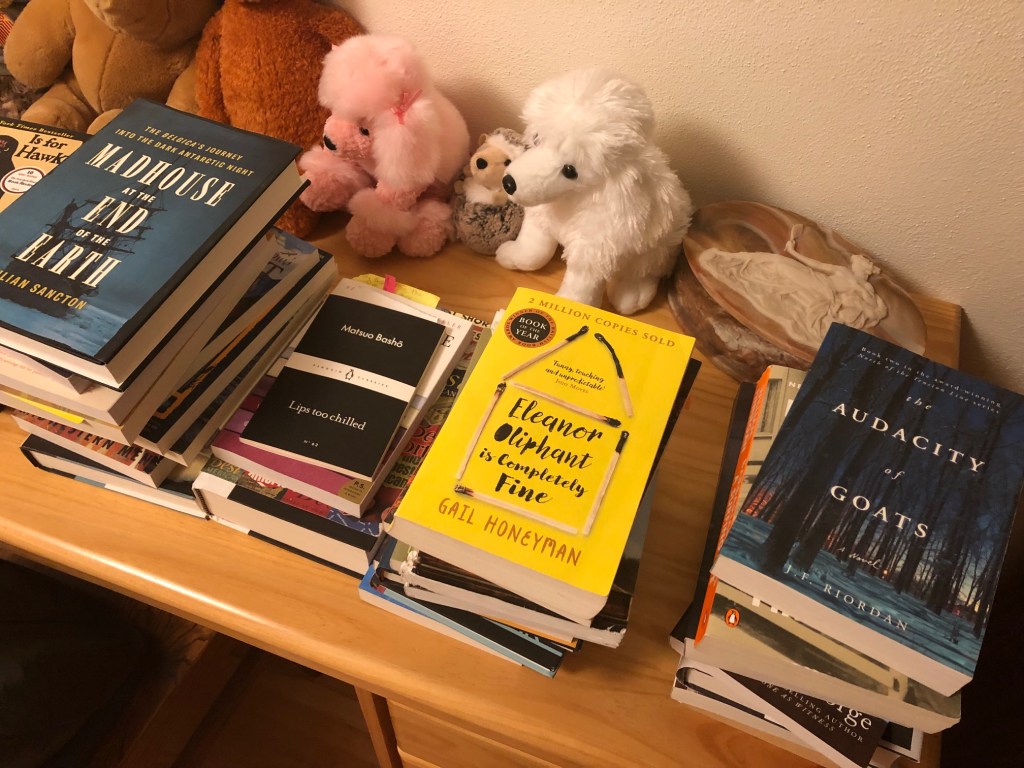
My non-writing desk

“What are you reading?” is one of my favorite questions. It gives me permission to talk about the books I’m reading and soon-to-be-read books that I have stacked on my non-writing desk, which functions as an extension of the nearby bookshelf. And, I love to hear about what other people are reading. It’s a good way to add more books to the stack on the desk.

I’m going to cheat a bit and answer this question two ways. First, I’ll discuss what I’m currently reading. Both books are my reward at the end of the day. I read the nonfiction book in front of the TV, so I don’t have to watch it. I like to sit in the family room with my husband in the evening, but our TV-watching tastes are not aligned. I read the fiction book in bed before I go to sleep. Second, I’ll discuss some books on my to-be-read list.

My current nonfiction read is Wicked River: The Mississippi When It Last Ran Wild by Lee Sandlin (2010). This is a beautifully written nonfiction book about the Mississippi River. The story starts in the 1700s, and I’m currently reading about events and life along the river in the 1800s. The Mississippi River, the star of the story, is complex and evolving, with a wide emotional range. The stories of the people who lived along the river and worked on the river are compelling too, but the Mississippi steals the show. I like this book because Sandlin’s writing is excellent and well researched. I’m learning so much about the river and how it worked and currently works as part of a large ecosystem throughout the middle of the United States. Unfortunately, I’m learning about how people have damaged that ecosystem. When I’m finished with Wicked River, it will have a permanent home on one of my many bookshelves.

My current fiction read is Saving the Scot by Jennifer Trethewey. It’s Book 4 in her Highlanders of Balforss series. I’ve read the other three books: Tying the Scot, Betting the Scot, and Forgetting the Scot. These books make me swoon, laugh, and cry, and I hold my breath during the engaging, suspenseful action scenes. Before I read these books, I hadn’t read a romance novel in over twenty years, and even then, I could count the ones I’d read on one hand. Trethewey’s books are different. True her characters are beautiful and handsome and brave and have fast-paced adventures on their way to true love. But her characters have human flaws and problems that make them endearing and relatable. And yes, the male characters do save the female characters. BUT the female characters save the male characters too. The females are intelligent, clever, resourceful, and brave, and they’re nobody’s doormat. The supporting characters are fully developed people, each with distinct personalities, who add to the enjoyment of Trethewey’s books. As a writer, I admire the storytelling and dialogue in these books. Her books entertain me and inspire me to be a better writer. After I die, my children will have to decide what to do with these books because I’m not giving them away.

Here are some books on my to-be-read list. I have lots of books that fit this category, but I’m going to limit my list to books that I plan to read in the very near future.

  1. We Were Never Here by Andrea Bartz. This book is first on my list because I checked it out from the library. It made my list because I heard the writer speak at a virtual Author Chat sponsored by Honest Dog Books. (Click here to view upcoming Author Chats, which you can listen to from home.) Bartz is originally from Milwaukee, and so am I. Her book was a Reece Witherspoon pick for August 2021. (I also read the Peter Ash series by Nick Petrie. I have one of his books in my stack. He’s a Milwaukee native too.)
  2. My Father’s Keep: A Journey of Forgiveness through the Himalaya by Ed Abell. This book made my list because I’ve met the author, I like reading books that combine adventure with self-discovery, and I had a difficult relationship with my father.
  3. Write Away: One Novelist’s Approach to Fiction and the Writing Life by Elizabeth George. I’m not a novelist, but I believe I can learn from George’s writing advice. This book made the list because I love George’s mystery series featuring Thomas Lynley. They are beautifully written: literary, suspenseful, and full of characters I care about.
  4. Lab Girl by Hope Jahren. Science is interesting, and I like memoir. I had a college professor who wanted to turn me into a biology major because I was so fascinated by my Intro to Biology course. I didn’t bite because I knew it would’ve been a mistake–the math would’ve doomed me. But I love reading about science, medicine, nature, and biology.
  5. Maggie Brown & Others by Peter Orner. This is a collection of short stories, a format that’s always appealed to me. I also write them, so I like to read short stories by other writers. I heard Orner talk at the Harbor Springs Festival of the Book in the fall of 2020. The festival is normally held in Harbor Springs, Michigan, but it was virtual in 2020. I like short story collections because I can read a story or two, read something else, and then read another story or two.

I’ll stop here because I need to go read something!

My writing desk

Today’s My Ideal Day

[Bloganuary wants to know. It’s the WordPress blog prompt for January 13, 2022.]

Senior Dog

Today was my ideal day. I took what it gave me because thinking about what my “most ideal day looks like” would’ve taken more creative energy than I wanted to spend. Besides, no day is ideal. I cherish the days my sons were born, but labor was tough. I have fond memories of my wedding. But I spent seven hours with over a hundred people, and I had to talk to all of them. Lovely people, but I’m an introvert—I was exhausted.

So today had its blessings—

My senior dog didn’t wake me at 4:00 a.m. to go outside. Once or twice a week she knocks on my door. She wants to go outside and pee. She doesn’t have opposable thumbs, so I get out of bed and turn the doorknobs for her. But this morning she let me sleep.

I wrote a shitty first draft of an essay this morning. When I started to slow down and think too much about finding the perfect word or writing a better sentence, I went all Anne Lamott on myself: Write don’t revise, get the thoughts on paper—all the thoughts, on the paper, now! Regardless of spelling, grammar, punctuation. Without care for lyricism or flow or insight. When I finished, I had almost 1,300 words. I can’t have more than 500 for the piece I want to submit. But I’ve got a chunk of wood to carve into a sculptured essay. (I hope.) I saved the file, feeling a little smug about all the crap I had on my shitty draft. I gave myself permission to not think about the essay until tomorrow.

I talked to a friend, my mother, my sister, and my nephew. Four conversations with people I love, but who don’t live in my house. I talked to a clerk at Honest Dog Books and ordered a book. The bookstore is an hour and a half away, but sometimes I order books from there because the clerk remembers me. The staff writes a note to me and tosses in a couple of paper bookmarks when they ship my order. The book I ordered is being shipped to my nephew. He’s getting an autographed copy of Writing Down the Bones by Natalie Goldberg. She visited Bayfield, Wisconsin, this summer, wandered into Honest Dog, and signed some of her books that were on the shelves. My copy of Writing Down the Bones is unsigned. But no day is perfect, not even an ideal day.

I put on a white turtleneck, a red winter-themed sweater, and a pair of garnet earrings someone gifted me. A couple of weeks ago, I decided I needed to stop wearing the same three turtlenecks my mother bought me in 2003. So, each day I find something in my closet that I haven’t worn for a while and I wear it. I do this even if I don’t leave the house, which is most days. Turns out I like dressing up a little to stay home. Reminds me of my nana wearing a house dress to do her laundry and scrub her floors. I did neither of those chores today. Those aren’t ideal-day activities.

I went to two coffee shops. Not to meet anyone. I don’t go inside places without a mask. I won’t eat or drink coffee in public spaces—I’m not removing the mask. I dropped off bookmarks and hung posters to advertise a writing contest. I bought two cupcakes to go in the first coffee shop, one for me and one for my husband. I ate mine as soon as I got home. I bought a mocha coffee to go in the second coffee shop. It paired nicely with my cupcake.

Wally

Wally, the brilliant squirrel who hacks my birdfeeders, stopped by to eat. He stood on the baffle, meant to keep him out of the feeder, and feasted on seeds. I washed dishes because it gave me an excuse to watch him steal bird food. Washing dishes isn’t ideal, but neither is looking at dirty dishes.

My senior dog needed to go to the vet for a shot. She’s had to go for a series of them. She wants to leave before we get in the door. But she’s always gracious to the vet and the assistants, who are kind and gentle with her and always say how much they love her.

I decided not to cook supper tonight. Leftovers are wonderful. But I made mashed potatoes for tomorrow’s homemade ham-and-bean soup that I’ll make in the morning.

Something I wrote yesterday made someone feel better. My husband loved the cupcake I brought home for him. My dogs enjoyed their evening walk.

It’s late and the house is quiet. I’m the only one up. The wind is howling outside, but I’m snug in my winter-themed sweater.

It wasn’t a perfect day, but it was my ideal day.

Tree Guy Update

Tree Guy waits for spring.

Yesterday, after reading my blog story “Tree Guy,” my sister implied—in a forthright manner—that I should look for Tree Guy’s other eye. She’s met him, and she likes him. She also lives in Tucson where she’d never have to brave subzero temperatures and dig in the snow for a cartoonish eye that a wayward squirrel kicked off a tree.

However, the cold snap broke yesterday afternoon, so I went outside. I figured it would be a lost cause, but I leaned over the deck railing. Tree Guy’s eye glared at me. It sat on a heap of snow as tall as the deck, so I leaned farther over the railing, trying to reach the eye. Then farther and farther. I was almost parallel to the earth, a teeter totter balanced on the railing. Then I realized I was attempting the same type of maneuver that caused my best friend to fall into a garbage can. A neighbor witnessed her graceful move and thought she was drunk. But she didn’t drink. She and I laughed a lot about that episode. I stood up, bent down, and reached through the spindles for the eye. I like to think my friend sent a message to me from Heaven in the form of a thought. That she saved me from tumbling over the railing and into the snowbank.

I rehung Tree Guy’s eye and noticed his nose was gone!

Why hadn’t I spotted his missing nose yesterday? Because Tree Guy’s bedroom eyes are more captivating than his Jimmy Durante schnoz. I’m sure the squirrels knocked the nose off too. I checked the top of the snow pile again but didn’t find it.

When my husband came home from work, I asked, “Last week did you say the tree’s nose was buried in the snow?” Turns out he’d said nose, not eye. When I walked outside yesterday, I only saw the eye was missing. I’d mixed up the details.

“Did you know one of the eyes had been knocked off?” No, he hadn’t. I didn’t tell him I’d mixed up the missing nose with the missing eye. I told him about finding the eye. I like to lead with my strengths, then stop talking.

I apologized to Tree Guy for neglecting to notice his missing nose. He told me not to worry. He still has his smile, and he appreciates having both eyes again.

He hopes to have his nose back in the spring. Maybe the world will smell better. Tree Guy knows how to play the long game.

Tree Guy

One-Eyed Tree Guy, January 2022

Tree Guy lost an eye during our last snowstorm, and by the time we noticed, it was buried under six inches snow. Neither my husband nor I were willing to dig in the snowdrifts around Tree Guy to find his eye because after the snow, Subzero Temperature blew in escorted by his companion Windchill. My husband declared, “We’ll find the eye in spring.”

Tree Guy as Old Man Winter

How did Tree Guy lose an eye during a lake-effect snowstorm? Maybe the wind blew it down, but most likely a squirrel knocked it off. Squirrels are the usual suspects, but have you ever tried to round them up for questioning? Because they run up and down his trunk, Tree Guy has had each of his eyes and his mouth knocked off numerous times over the years. My husband has reglued the mouth a few times, and last summer he gave it a new coat of paint. He takes good care of his tree buddy.

Michael, two, communes with Tree Guy, 2015

I didn’t want the maple tree by our deck to become Tree Guy. My husband pointed out the eyes and nose in a store and said, “Isn’t this neat? I think it’s really neat! We should get this!”

Evan, almost three, hugs Tree Guy, 2019

I didn’t think it was neat. I’m not a let’s-turn-our-trees-into-faces kind of person. He’d shown me these faces before, but never with such eagerness. It’s hard to resist youthful enthusiasm in an adult, and I had to admit this particular face did have a friendly, calm appearance. We struck a deal: the tree face could come home with us as long as it would be the only one in our yard. (A neighbor a couple blocks away had a face on every tree in her yard, and it was creepy.)

My in-laws with Tree Guy as Carman Miranda, 2008

My husband kept his word. Tree Guy wears the only face in our yard. Over the years his face has amused guests and bewitched our grandkids. He greets me every time I walk out the back door. His looks change throughout the year. In winter, snow and ice transform him into Old Man Winter. In summer with flowering plants hanging on each side of him, he becomes Carmen Miranda about to sing, “The Lady in the Tutti Frutti Hat.”

I hope we find his eye in the spring. But if we don’t Tree Guy will still be with us. Perhaps I can talk my husband into making a wooden eye patch for him, and he can become a pirate, ready to chant, “Yo, ho, ho, and a bottle of rum!”

What Makes Me Laugh?

Ziva, the poodle paper shredder. It’s never funny at the time. But tragedy plus time equals comedy.

Bloganuary is asking. It’s the WordPress blog prompt for January 7, 2022.

Lots of things make me laugh, and lots of things make me chuckle or grin. So, I’m setting the bar higher: What makes me laugh so hard that I can hardly breathe, that tears trickled down my cheeks, that I cross my legs tight, that I can’t stop laughing because everything becomes hilarious?

Very little.

I’m not a curmudgeon. I like humor. I watch a lot of comedy. I like reading humor. Satire is my favorite. I’m currently watching Upstart Crow on Britbox. The show is a parody and satire of Shakespeare and history and modern times all mixed up into one delicious, sinful sundae topped with the works. I chuckle and marvel at the brilliant wordplay and acting, but I pay close attention to the rapid-fire exchange of dialogue and that probably stifles unhinged laughter on my part.

I can’t remember any recent bouts of uncontrollable laughter. But I remember some past episodes. When I was about fourteen, my mom and I had an argument, so I stormed upstairs and refused to eat supper. She made me come back downstairs. My parents were getting ready to go out, so it was just us kids at the table. I was crying, and my mom was yelling.

My sister picked up the plastic milk carton, which was almost empty, drank the milk, then sucked the air from the carton, causing it to collapse inward. She pulled the carton from her lips, and said, “Good to the last drop!” I had just taken a swig of milk. Laugher and milk erupted from my mouth, spraying the table and my siblings. We laughed so hard. Mom yelled at us to stop, but that made us laugh harder. My dad told her, “Leave the kids alone,” and we laughed ourselves out in peace.

When I was about nineteen, I took my first communion at the Presbyterian church my grandparents belonged to. My grandmother played the piano and organ at the church. Almost no one was married or buried without her accompanying the event. The solemnity of the minister’s words about communion paired with the crackers and grape juice started me laughing. The more I tried to suppress it, the more I laughed—it was my Chuckles the Clown moment. My laughter so shocked me that I’ve never taken communion again.

The following are memorable works that reduced me to jiggling jelly:

Bud Abbot and Lou Costello performing their “Who’s on First” routine.

Carol Burnett playing Scarlet O’Hara in a parody of the curtains-to-dress scene from Gone with the Wind. (Burnett’s show cracked me up. I consider it the best comedy/variety show ever televised.)

Harpo Marx cutting a piece of material from the dress of a snooty customer in The Big Store.

Harpo and Chico Marx packing and unpacking clothes in a scene from A Night in Casablanca.

The final scene of Moonstruck when all the characters are gathered at the kitchen table. The movie is a wonderfully told yarn that culminates in a grand punchline during breakfast.

Anything written by Patrick F. McManus, Dave Barry, P.G. Wodehouse (especially the stories with Jeeves and Wooster) and Erma Bombeck, the first writer to make me laugh uproariously. I started reading her column when I was in middle school. I recently reread some of her work. She’s timeless.

Laughter is indispensable, so thanks for asking, Bloganuary! I smiled and chuckled while writing my answer.

Nana Kitty

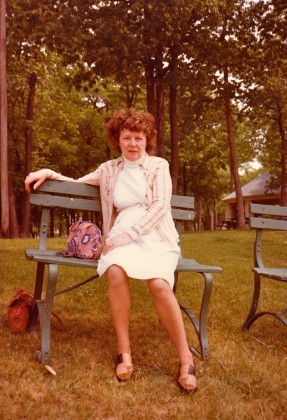
My nana died in 2003, but she still inspires me.

As a mother, Nana received mixed reviews from her children. But as a grandparent, Nana had a marvelous second act, a comeback. And isn’t that what being a grandparent is about? A do-over, a second chance, a revival?

Nana inspired me because she survived shit. Her father died of typhoid fever in 1921 when she was seven. He left behind seven children and a pregnant wife before the social safety nets of Franklin Roosevelt’s New Deal. Nana grew up poor and hungry. When she turned twenty-one in 1936, she voted for Roosevelt.

Nana Kitty is sitting on her mother’s lap. Mary and Joseph, Nana’s parents, would have two more children. But the eighth one was born after Joseph died from typhoid fever.

After she turned nine, she worked summers picking beans in the fields around West Bend, Wisconsin. When I was nine, I picked dandelions. Seven months after the stock market crash of 1929, she graduated from eighth grade. She yearned to go to high school, but her mother told her she had to work. Shortly before she retired from waitressing at sixty-eight, she applied to Milwaukee Area Technical College. She worked toward her GED, tutored students in math, and took college-level courses in English and psychology all at the same time. She was sixty-nine when she earned her GED. I was a college student.

Nana lived by one of her favorite maxims, “A penny saved is a penny earned.” On a low-come wage, she saved change until she and her first husband had enough money to move from their low-income neighborhood and buy their own home, the smallest house in a middle-class neighborhood. She wanted her children to have a better life than she had. She was widowed at forty-seven, but she worked hard to keep her house and pay off the mortgage.

Nana inspired me because she loved each of her seven grandchildren, which included my three cousins, with a passion. She forgave our mistakes and bad behavior and defended us against our common enemies—the parents. To her each of us was special and beautiful and interesting. She gave us lots of hugs, kisses, and Cracker Jacks. She played Button, Button, Who’s Got the Button? and Cat’s Cradle with us. She told us stories and sang to us. She danced with us in her kitchen. She loved Bobby Darin and 50s rock-n-roll. Her favorite dance was The Twist, which she danced at my wedding.

Nana always had time for a phone call. I memorized her number before anyone else’s. If I called and was upset, she listened. I once tested the limits of Nana’s ability to listen by following her around her house, describing the scene-by-scene detail of a movie I’d watched and loved. Like a typical ten-year-old, I thought every detail of a story was significant. At some point, I realized I was boring her and that she kept leaving rooms, hoping I wouldn’t follow. I began testing her limits. I waited for her to say, enough already. If she had, I wouldn’t have blamed her. But she didn’t. I’d love to say I have the same patience with my grandchildren when they prattle on about a movie or video game, but I don’t. I find a way to change the subject. But I didn’t admire Nana because she could do what I could do. I admired her because she could do what I couldn’t do.

Nana Kitty helping my sister and me (far left) with a puzzle. My cousin watches.

Nana loved me even when I behaved like a brat. When I was about eight, I wanted her to buy me a troll doll from a drugstore. I whined and cajoled and dropped a few tears until she folded. She took me back into the store and bought me the doll. She wasn’t happy. She couldn’t afford to be frivolous with her money. She bought us Cracker Jacks because they cost a quarter. The troll doll cost over a dollar. “You’d better not lose that doll,” she snapped. After we walked back to her house, I asked her for a comb and a few bobby pins. I spent the rest of the afternoon rearranging the troll’s purple hair in one hairdo after another. Nana was no longer angry with me. Over the years, I would tell her, “I still have the troll doll with the purple hair.” I wish I could still tell her I have it.

I live by many of Nana’s favorite sayings. (Although I didn’t warm to some of them until I was older.)

1. The early bird gets the worm. (I told her I didn’t want worms.)

2. Early to bed and early to rise makes a man healthy, wealthy, and wise. (I was a night owl.)

3. Silence is golden.

4. You win more flies with honey than vinegar. (I told her I didn’t want to be nice to people who were mean to me.)

5. If you can’t say something nice, don’t say anything.

6. A penny saved is a penny earned. (I’ve learned to be a better saver.)

7. Waste not, want not.

Nana’s birthday is January 22. If she were alive, she’d be 107 years old. Funny thing—sometimes, for a moment, I think, I should call Nana. And then I remember, she’s gone. So, I talk to her without a phone.

[Written in response to #bloganuary prompt #6: Who is someone that inspires you and why? For more information click on: Bloganuary.]

Christmas in Michigan–Christmas Day, Past and Present

December 25, 2021

Christmas Day Past—

My sisters, my brother, and I enjoy a visit from St. Nick. (I’m holding the present.) The cat was not a present. He was a stray we adopted and named George, after our grandpa.

After the longest night of the year loosened its grip and gave way to Christmas morning, my siblings and I had to wait for my parents to get up before opening gifts. Sometimes we snuck downstairs to peek at the tree surrounded by wrapped boxes then snuck back upstairs. This made waiting more difficult, but we knew that to open even one present before they got up would rob them of the joy of seeing our rapturous faces as we opened our gifts. We also knew we’d be in BIG trouble. It was always a late night for them. “The bundle of toys” they brought home in sacks needed to be wrapped and ribboned and tagged times four.

We were fortunate that Christmas morning never disappointed—not even the year my mother told me before Christmas that she couldn’t find Charlie McCarthy, the ventriloquist’s dummy I’d asked Santa for. She and I had to suspend our willing suspension of disbelief regarding Santa for that conversation. Turns out lots of aspiring ventriloquists had asked Santa for a Charlie McCarthy doll. My mother told me she’d try to get me one after Christmas. But even before Christmas morning, my shiny dream of becoming a ventriloquist lost its luster. I told her to forget Charlie.

My mother was good at buying gifts on behalf of Santa. Every year a smorgasbord awaited under our tree. We each received an outfit and a pair of pajamas. I loved going back to school after the holidays dressed in new clothes. And climbing into bed on Christmas night in a new pair of soft pajamas that were still fuzzy because they hadn’t been washed dozens of times was divine. We each received a special toy or two that we’d asked Santa for. He also brought us board games, art projects, and books. Santa wanted us to stay busy during Christmas break.

We had to open our gifts slowly because my father didn’t want to miss a single Kodak moment. He liked to take photos. When he got a Polaroid camera, we had near instant photo results, but this slowed down the gift opening because we were thrilled by watching ourselves materialize before our eyes.

Each of us had a spot on the floor to pile our gifts as we opened them. After all the gifts were opened, I felt like a princess with a pile of riches. I also felt guilty. The gifts my parents received took up little room on the coffee table in front of them, such a small cache of swag. But worst of all they hadn’t received one toy or game or art project. I’d contemplate all they’d given me in the name of Santa, then look at the gift I’d given them—always something handmade at school. A Christmas tree constructed from a toilet paper roll and cotton balls. An imprint of my hand in plaster of paris. A silhouette of my profile. A Styrofoam ball decorated with ribbon and sequins to hang on the tree. I didn’t buy my parents gifts until I turned sixteen and had a job and a driver’s license. It wasn’t until I was a parent that I understood it was more fun to see my children opening gifts, and that I treasured the gifts they made for me more than anything that came from a store.

Christmas Day Present—

On this Christmas morning the youngest one among us is 23. No one snuck out of bed to look at wrapped presents under the tree. (Maybe because they were stacked on a desk.) I got up early because my dogs wanted to go outside. No one was in a hurry to see what Santa brought. We ate breakfast and visited. My sister and one of her sons went to Mass at ten o’clock. No one minded. Waiting wouldn’t short-circuit our wiring. We didn’t open gifts until eleven-thirty.

My mother is still good at buying gifts, but no one pretended they were from Santa. I loved the warm shirt she bought me. I’m of the age where any object meant to keep me warm in the frozen North makes my heart toasty. She gave me a humorous book that pokes fun of British mysteries. I love humor and British mysteries. (Your Guide to Not Getting Murdered in a Quaint English Village by Maureen Johnson & Jay Cooper)

My nephew, distributing gifts off the desk. Bogey, before he gets his pink flamingo.

No one got toys—except Bogey, my mother’s seven-year-old poodle. My husband and I bought him a stuffed pink flamingo. He played with it and played with it, shaking it by the leg, tossing it in the air, and making it squeal. I think he looked at the gifts in front of us humans and felt sorry for us because not one of us had a stuffed toy with a squeaker. He’s too young to understand that not one of us wanted a squeaking flamingo. But we sure enjoyed watching him play with his new toy.

[Words in quotes are a nod to “A Visit from St. Nicholas.”]

Christmas in Michigan—A Tale of Two Eves

December 24, 2021, 10:30 p.m.

Christmas tree, 1966

The night before Christmas, when I was a child, I would gaze out a small rectangular window and scan the sky for Santa’s sleigh. I watched ’til I spotted a red flashing light tracking far above the snow-covered earth. I would declare it was Rudolph leading Santa’s sleigh. (But I knew it was an airplane “so lively and quick” headed to Billy Mitchell Airport ten miles away.) Pretending that Santa’s reindeer would soon be “prancing and pawing” on the roof, I’d snuggle under the covers and close my eyes. Sleep was elusive because visions of Christmas morning danced in my head.

In Michigan this Christmas Eve, before I drifted off to sleep, I read The Quiller Memorandum, a spy thriller from 1965. Quiller, a British agent, brings Nazis to justice and prevents Hitler-loving neo-Nazis from starting a war. None of the characters had twinkling eyes or merry dimples. Not a one “was chubby and plump” or “a right jolly old elf.” It didn’t matter—sleep wasn’t elusive. Because neither the Nazi-chasing agent nor visions of Christmas morning danced through my head.

Although, the idea of people idolizing a person with totalitarian aspirations, should give me something to dread.

[Words in quotes are a nod to “A Visit from St. Nicholas.”]

Christmas in Michigan—The Yipping

December 24, 2021, 9:00 p.m.

Cabela–not worried about roving bands of coyotes

All the light was behind me. A Christmas wreath strung with white lights and pinecones hung from the peak of the garage. Amber warmth from incandescent lights glowed through the living room windows.

In front of me darkness swallowed my poodles because their black and brown fur coats worked like camouflage against the snowless ground. I strained to keep an eye on each of them, and wished they were white poodles. Then I wondered if white poodles would disappear against snow-covered ground.

Loud yips came from over the distant hill. It sounded like dozens of puppies. But I knew it wasn’t. I thought about a kennel of huskies clamoring for food. But I knew there were no mushers in the neighborhood. I thought about the starving wolves in White Fang that stalk two mushers and their sled dogs, picking them off until only one man survives. But I knew that wolves need more territory than my mother’s neighborhood, even with its scattered woods and fields, could provide. Besides, wolves howl, bark, and growl. They don’t yip like a bunch of puppies.

The yips rose and fell in volume but didn’t stop. They didn’t come closer, but they didn’t retreat. I called my dogs and we went inside.

I told my mom about the yipping.

“Those are coyotes,” she said. “We have a lot of them this year.”

My mother lives on a golf course in a rural setting. I wondered if the coyotes used the cart path to move between the areas of woods and fields while hunting. Coyotes are exceedingly carnivorous. Besides wildlife they sometimes eat cats and dogs. My domesticated, spoiled, wimpy canines would be an easy meal for coyotes. But coyotes are wary of humans and avoid us. Which is good because I’m domesticated, spoiled, and wimpy.