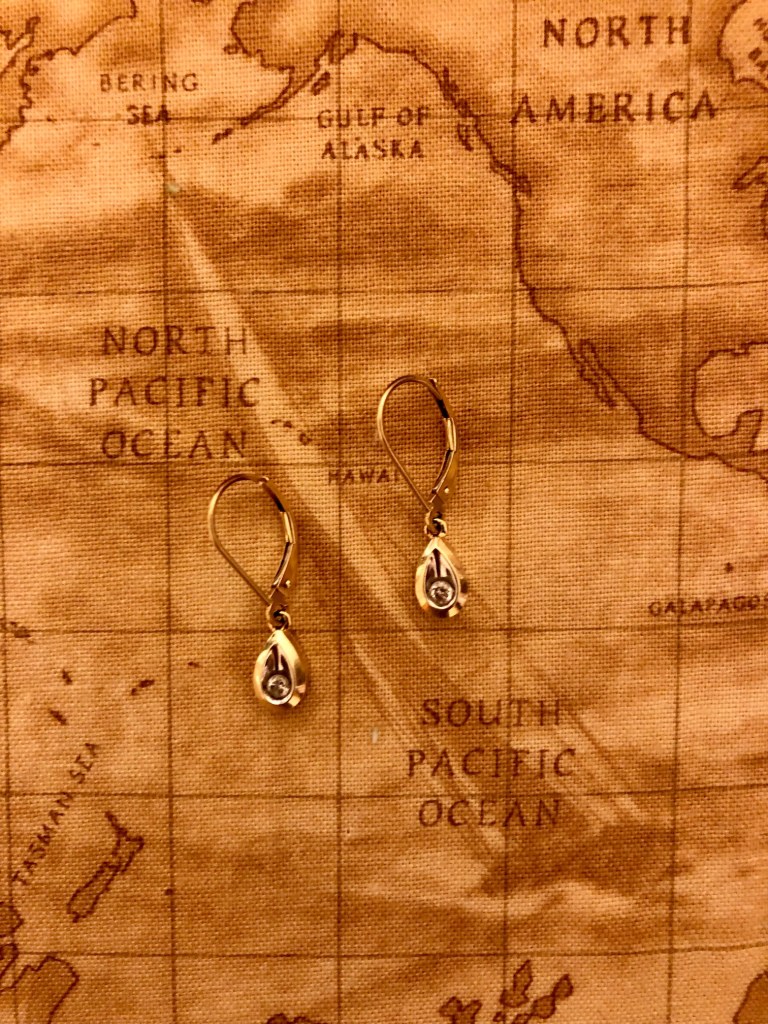
Day 6—Traveling Teardrop Earrings

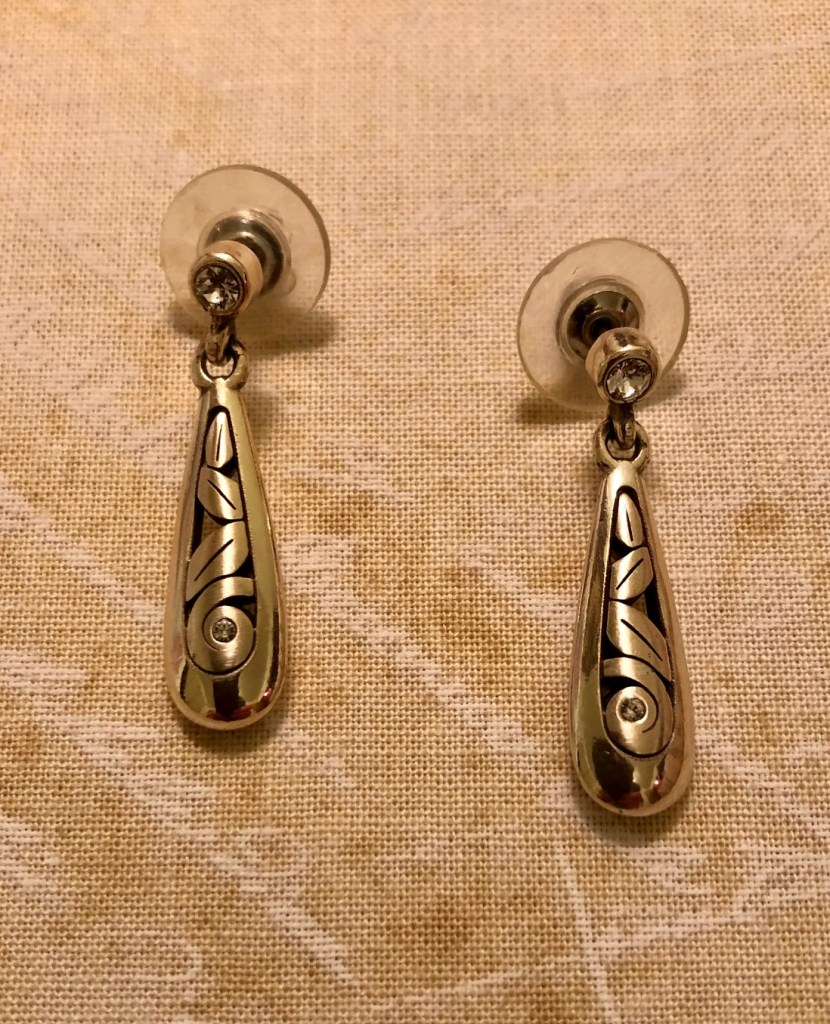
I bought these earrings in Tucson, Arizona, in 2003. I went with my husband and sons to visit my mother and stepdad in Phoenix and my father and siblings in Tucson.

These earrings have traveled to Rhode Island, Iowa, Illinois, North Dakota, Minnesota, Wisconsin, Indiana, Hawaii, and Canada. These are hockey earrings. They’ve seen my youngest son play lots of hockey games in many cities. I have a rule about jewelry when I travel—only one pair of earrings and one necklace. These are the earrings that almost always made the cut.

I’ve worn these earrings more than any other pair of earrings I own, so maybe that makes them my favorite pair. As my mother would say, “You can wear them with blue jeans or an evening dress.”

I wore this pair to Winnipeg, Canada, to a hockey tournament. On Saturday morning, I was waiting in the car for my husband to come out of the hotel, so we could head to the rink.

After he got in the car, he said, “Do you feel naked?”

“What?” I hadn’t forgot to put on my pants. (This was long before COVID-19 and pants-less Zoom meetings and endless jokes about people forgetting to wear pants.)

He laughed and asked again, “Do you feel naked?”

“What do you mean?” I asked.

He extended a closed fist toward me then opened his fingers. Nestled on his palm were my teardrop earrings.

“I thought you might want these, so you didn’t feel naked,” he said.

“Yes, thanks.” I lifted my earrings off his palm and leaned over to kiss him before dressing my bare earlobes.

He had remembered that I had once said I felt naked if I forgot to wear earrings when I left the house.

I’ve never forgotten that he remembered.

Day 5—Sleepy Thoughts on COVID and Earrings

I almost didn’t write today’s post about earrings. I received my COVID-19 booster yesterday evening at 5:15, and today I had aches, low-grade fevers, and major fatigue. Last March when I had my second shot, I was so tired for two days that even getting out of bed to go to the bathroom was exhausting. Today was better than last time, but I still needed four substantial naps. I tried to imagine what it would feel like to have a serious case of COVID.

I chose today’s earrings this morning but didn’t put them on until 6:15 this evening when I started writing this blog. I can’t wear earrings when I sleep.

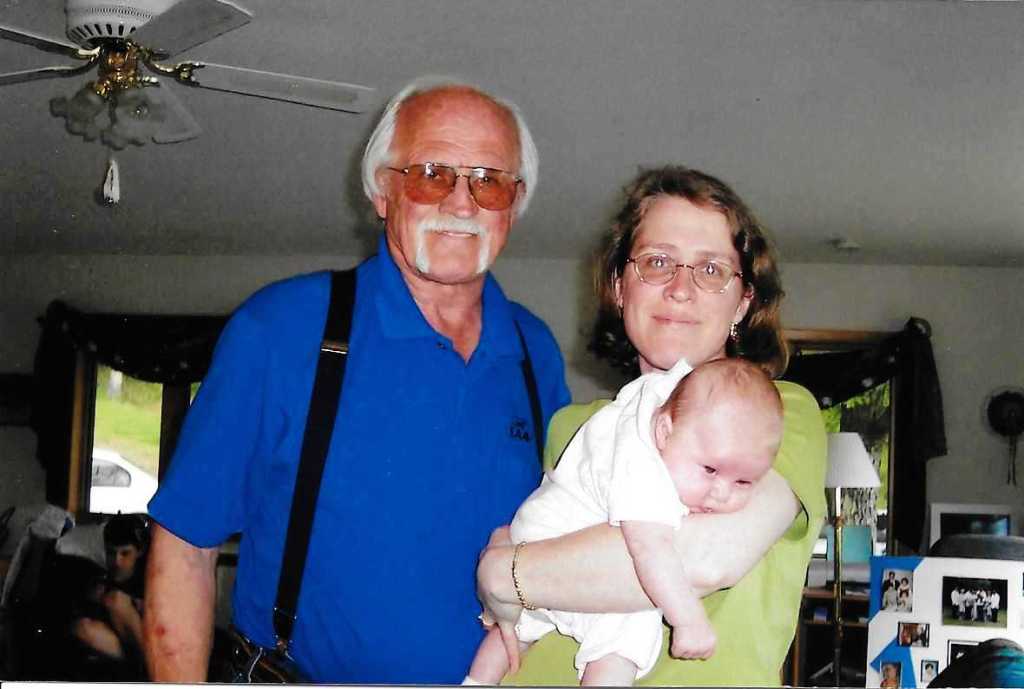
Today’s pair are Black Hills Gold, a pink-colored rose encircled by golden leaves. I bought them around 1990 with birthday money my father gave me. Every year he’d send me birthday money, and I’d buy something for myself. I couldn’t tell you what else I bought over the years, but I remember thanking him for these earrings.

My father passed away in September 2016 from a heart attack, but dementia had begun to stalk him. If he were alive, he’d be in a nursing home and probably isolated by surges of COVID.

My dad, me, and my cousin’s baby, May 2005

Yesterday on my way to the vaccine clinic, I listened to a story on public radio about sailors who are stuck on cargo ships that can’t get into port. And when they finally do, the sailors aren’t given shore leave because they aren’t vaccinated. The nightly news reports on hundreds of ships stalled in the ocean, but I haven’t heard them talk about the sailors on the ships.

The public radio journalist interviewed a maritime chaplain who comforts crew members stranded on ships. These people can’t see their families, can’t get off a ship to wire money home, can’t walk down a sidewalk. I’m embarrassed to say, I never thought about the people on those ships. One sailor’s wife is divorcing him because she hasn’t seen him in so long. These sailors don’t have the freedom to get off the ship, and they don’t know when they’re going home. I remembered a history lesson about the impressment of American sailors being one of the causes of the War of 1812. I wonder how little a sailor’s life at sea has changed over the last few hundred years.

When I arrived home, I told my husband, “I can’t believe I never thought about the people on those ships. How could I not think about them?” The focus is always on the cargo.

Today was a difficult day. Feeling lousy makes me feel blue, and I spent the day—when I was awake—close to tears.

But . . .

I’m thankful for my vaccines.

I’m thankful I remember the earrings I bought with birthday money from my father.

I’m thankful public radio aired a story about sailors stuck on ships.

I’m thankful that my biggest worry about COVID is being laid low by a vaccine.

Day 4—Earrings from a Cruise

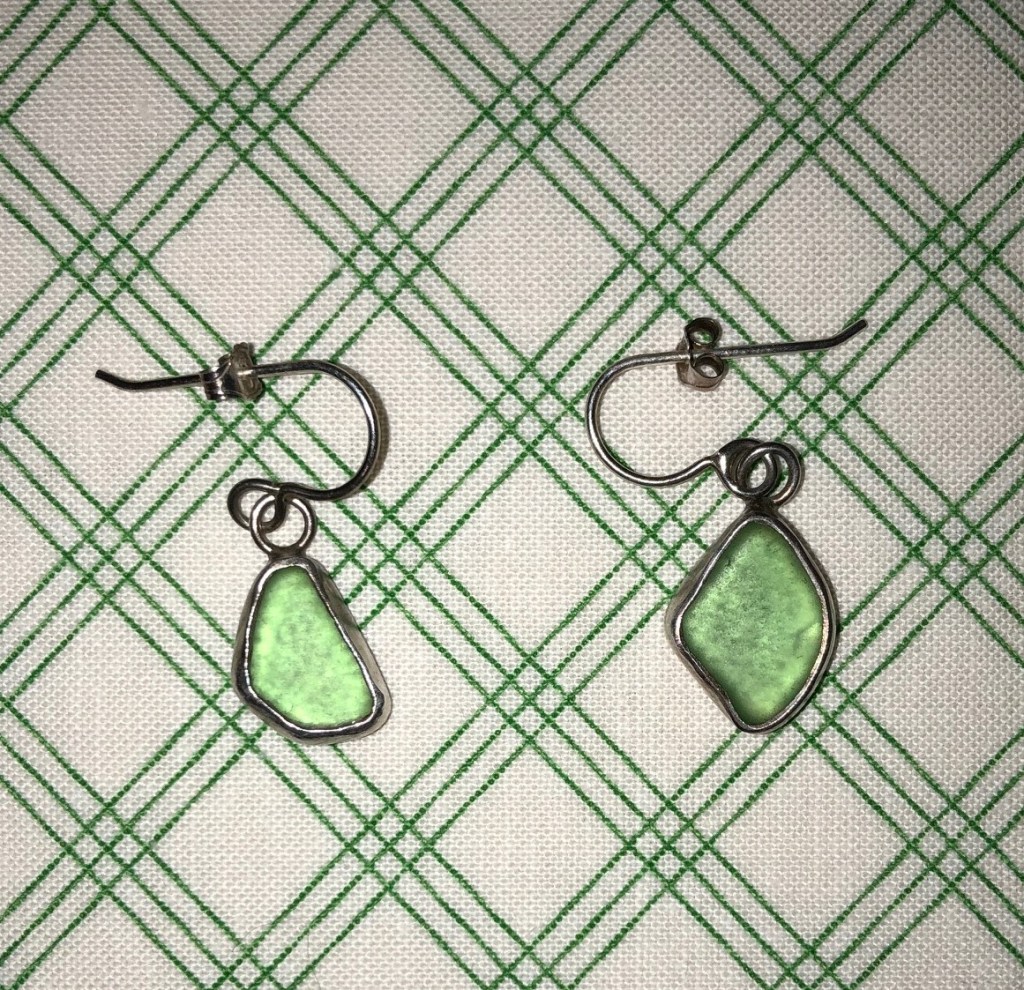
I didn’t take the Caribbean cruise; Sandi, my best friend, did. She bought these abalone shell earrings for me as a gift.

When the rectangles sway, iridescent, pale-green splotches catch light and pulsate across the surface of the earrings, giving the impression they light up from within.

I met Sandi, a paralegal, at a law office where I had taken a summer job. I had dreams of switching careers and becoming a paralegal. Eventually, I decided against the career change, but my friendship with Sandi lasted until she passed away fourteen years later.

The lawyer, who gave me a tour of the office on my first day, introduced me to Sandi, and told her I taught English. Her first words to me were, “I might as well tell you right now, I don’t understand that possessive apostrophe stuff.”

My first words to her were, “I struggle with affect and effect and avoid using either word. And I have to look up how to use lay or lie every time.”

Sandi and me, July 2017

We both laughed. My first thoughts were “I like this person, and we’re going to be good friends.”

There was so much coded in our first exchange of words: We wouldn’t lead with our egos; we’d help each other when needed; humor would prevail. It was the beginning of a beautiful friendship.

These earrings symbolize Sandi’s character. She pulsated kindness and humor and strength, which lit up from inside her.

Day 3—Earrings from My Younger Days

Today jewel-toned crystals of violet-purple, blue-green, and fuchsia-pink wrapped in faux-gold trim dangle from my earlobes.

In the 1990s, I wore these earrings with brightly colored clothes of purple, blue, and green. They complimented my hair, which was long and permed and dark-strawberry blond.

I’m not sure when I last wore them, but it’s been years. I stopped having my hair permed, my skirts got longer, and my earrings got shorter and less flashy. (Now, my hair is more gray than strawberry.)

I had other long, dangly earrings but a few weeks ago I gave them away because I didn’t wear them. Relics of my younger days, I tried to put these earrings in the give-away bag too, but I couldn’t. They’re beautiful, and I can picture the outfits they accessorized. I bought them to wear with a jade-green dress that ended in a swirling skirt. Some memories need a tangible object. I returned them to my jewelry box.

So, this morning I selected these earrings, chose a purple shirt, and twisted my long hair up in a clip. Today, I’m going to McDonald’s and the library—my earlobes are overdressed.

These earrings are probably out of style. But the reason I don’t wear them is because to me they feel too youthful. Fashion is regulated to age groups. Over the years I’ve heard women criticized for dressing too young for their age. Or too dowdy before their time. I’ve internalized many of those voices. And while I don’t think anyone is going to pass judgment on my earrings—unless I accessorize them with a miniskirt and tube top—the fashion-guru voice in my head says, Those earrings aren’t rockin’ it.

But I’m wearing them because they’re today’s story.

I saving them because they might be fashionable when I’m eighty.

Day 2—Second Choice Earrings, Circa 1985

My husband bought these earrings for me—sort of.

I had picked out a pair of small, thick gold hoops with a smooth surface.

The jeweler at our local mall knew what I wanted, so my husband picked them up and paid for them. Wrapped in shiny silver paper and a white bow, my husband presented them to me. Surprise! What nice earrings! Thank you!

The real surprise, however, came when I tried on the earrings. The thin wire threaded through my pierced ear with ease. Next, the wire was supposed to slip into a small hollow opening at the back end of the hoop. I tried for five minutes to get the slender wire into the opening and failed because I could not see behind my ear. Trying to use a mirror was hopeless.

“I can’t wear these,” I told my husband. “I can’t get them closed.”

I took them back to the jeweler, who said I could exchange them for another pair of earrings. So, instead of the sleek, smooth finished hoops I had liked, my second-choice earrings had a hammered finish I did not like. In addition, they were more expensive, although still in our budget.

My husband razzed me about pulling a bait and switch, so I could get a more expensive pair of earrings. I protested and explained again about not being able to close the first pair. “I’m kidding,” he said. I did not tell him that I did not like the second pair as much as the first pair. After all, they were a gift from him.

My husband and I have been married for thirty-six years, and I’ve had these earrings about that long. They are a pair of go-to earrings—the kind I can wear with any outfit. I have come to like them much better than the first pair I chose.

Thirty Days of Earrings

I love earrings. Before the pandemic began, I wore them almost every day. But I stopped going to work during the pandemic, so I stopped wearing earrings every day. Sometimes days or weeks went by without giving them a thought.

But occasionally earrings gave me a nudge because it would suddenly occur to me that I’d better wear a pair before the holes in my ears closed up. More than once, I had a tough time pushing a hoop or post into the hole in my ear. I’ve always worn small lightweight earrings, so I have tiny holes in my ears.

This morning I put on earrings because I wanted to forget about the ups and downs of COVID-19.

I’ve decided to wear a different pair of earrings for thirty days, and tell a story about each pair. I’m not sure I have thirty pairs. (I’m very particular about my earrings.) But if I don’t, I’ll re-wear a pair. And that’s okay because some of my earrings have more than one story.

Day 1—Earrings from Coronado Island, California

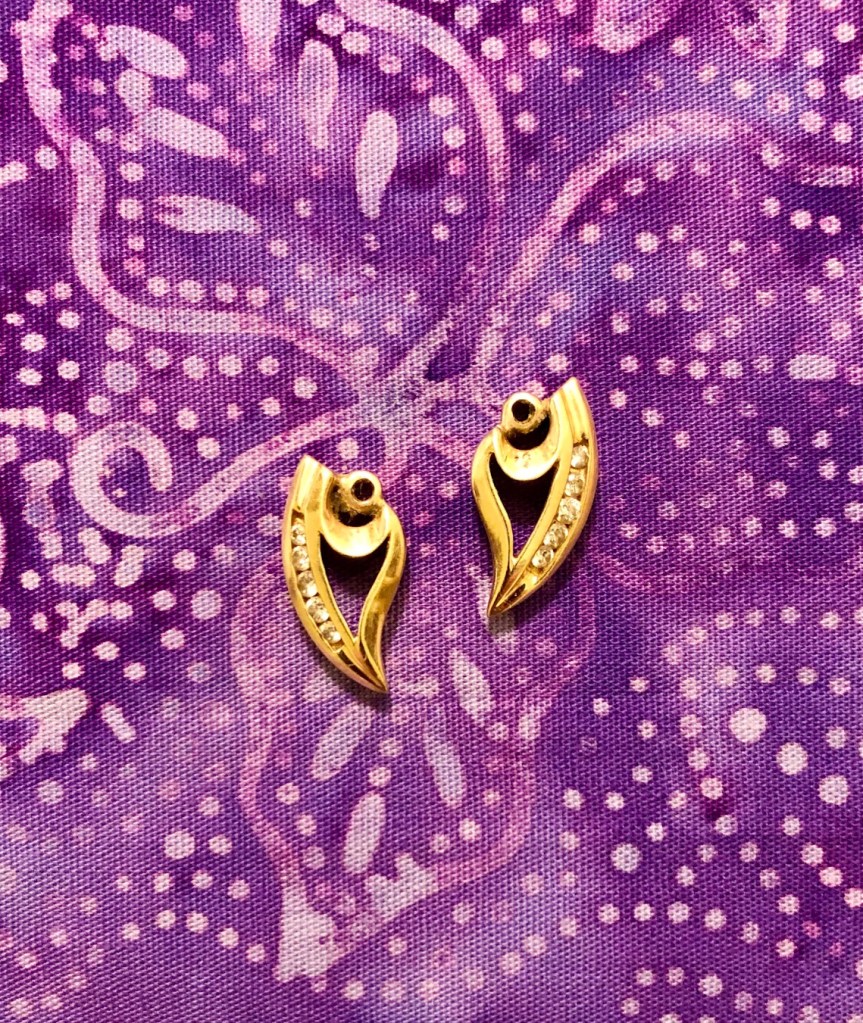
I bought these gold-toned earrings with aquamarine-blue crystals on Coronado Island from a boutique jewelry shop owned by the artist who created them. I was drawn to this exquisite pair because my birthstone is aquamarine.

A couple of years after I bought them, I lost one. I wasn’t wearing the clear rubber backings, and the earring slipped out of my ear without me feeling it or hearing it. I still imagine its voiceless descent and landing, most likely on a sidewalk in Northfield, Minnesota.

I was staying at Carleton College, attending a week-long training, and I’d been walking around Northfield. After I discovered the earring was missing, I walked up and down every city block that I’d walked on earlier and some others just in case. For hours, I retraced my steps over and over. I didn’t find my earring.

Using the internet, I found the phone number for the jewelry shop on Coronado Island. The owner answered the phone. I told her about my earrings, my favorite pair. I asked if she had another pair I could buy. She offered to make me a new earring at no charge. She had me send her the remaining earring so she could match the crystal and setting sizes.

A month later, my old earring arrived with its new mate.

I’ve never again worn them without their clear rubber backings. I still have both earrings.

I’ve never forgotten the kind jeweler, who must have also known the sadness of losing a cherished earring. I hope she’s still creating jewelry.

I’d like her to know that I still think of her kindness every time I wear the earrings.

Fish Drama in a One-Act Play

Homes and boats on Round Lake in Charlevoix, Michigan. Lake Charlevoix connects to Round Lake which connects to the Pine River Channel which leads to Lake Michigan.

Friday, July 30, 2021

I’m about to walk across the drawbridge in Charlevoix when I see a man and a woman standing along the Pine River Channel on the other side of the bridge. The pair are in their late 50s, maybe early 60s. He wears a fishing hat and clutches a fishing pole that’s arched over the water. He works to reel in a fish that fights to remain in the water. She wears a pastel-colored shirt and pair of shorts and clasps a fishing net that’s perpendicular to the water. She’s waiting to scoop up the fish once it has been reeled in, ending any chance it has of slipping back into the channel. They are a team.

I stop to watch the battle between man and woman and fish. In front of me, three young teenage girls have already stopped to watch. All of them wear their golden hair in braids. I walk forward a few steps so I’m even with them but keep my distance. I don’t want to break the spell. Their large smiles have pushed their cheeks into rose-colored apples and their eyes twinkle, telegraphing their joy. We all watch the man lift his pole and crank his reel. He’s playing with the fish, letting it wear itself out. We all watch the woman move the net closer to the water in anticipation, then watch her back away when the fish retreats.

The girls huddle together, like teenage girls do. Their hands are empty. The cellphones I expected to see in their palms, protrude from their pockets. Watching the fish action is better than Snapchat, TikTok, or Instagram. They’re immersed in this moment, no lenses between them and the man-woman-fish drama.

Suddenly the woman swoops the net into the water and pulls up the fish. The man bends down and unhooks it. As he slips his fingers through the gill and lifts the fish, the three girls applaud loudly and laugh joyfully. Unfortunately, the man and woman don’t hear the clapping because of the traffic noise and their position on the opposite side of the channel.

I cross the bridge and get a better look at the fish—it’s big, a keeper. The man and woman pack up their gear and their one-and-only, but good-sized fish. I know what he and the woman are having for dinner.

And I know what the three girls will talk about at dinner.

[More information about fishing the Pine River Channel and Round Lake area.]

Brownies the Size of Rhode Island Located in Charlevoix, Michigan!

Left side of mural

Friday, July 30, 2021

It was the last day of my second trip to Michigan since the pandemic started.

I wasn’t going to Charlevoix again because I’d already been there twice on Wednesday. I swear more people were walking or driving up and down Bridge Street than on the streets in Manhattan when my mom and I drove through there on a Friday afternoon in September 1986. (Seriously, this is almost not hyperbole.)

Bridge Street is aptly named. The Charlevoix Memorial Drawbridge spans the canal connecting Lake Charlevoix and Lake Michigan, and it opens and closes every half hour, backing up traffic for at least a couple dozen blocks.

Because it was my last day in Michigan, I decided to walk on the shores of Lake Michigan rather than hunt for parking spaces in Charlevoix, Petoskey, or Harbor Springs then weave in and out of pedestrians along the sidewalks. I’d done my shopping and didn’t need any more caramel corn, stationery, or books.

Between Petoskey and Charlevoix, I stopped at a couple of parks and hiked along Lake Michigan, taking pictures and getting my feet wet.

After I left the second park, I planned to return to my mom’s in Petoskey. But that meant crossing traffic that was heading west so I could go east. It would be clear one way, but never both ways at the same time. So, I headed west, planning to make a left-hand turn into a parking lot, then make a right-hand turn and head back to Petoskey.

Before I found a place to turn around, I was almost to Charlevoix. I decided to keep going.

Center of mural

I parked before the Charlevoix Memorial Drawbridge, my strategy to avoid the long line of cars waiting for the bridge to open and close every half hour.

I crossed the bridge on foot and walked to My Grandmother’s Table, a bakery, café, and coffee bar located just on the other side of the bridge. I’d thought about this small eatery when I’d made the decision to keep heading to Charlevoix. Along the inside wall of the café was a stunning mural, its color palate suggesting delicate confections and scrumptious food. If the desserts and food were only half as delectable as the mural, my money and time would be wisely spent.

Right side of mural

“I’m here for dessert,” I said to a man in a white chef’s coat, making an effort to speak to him and not to the mural to the right of me. At 2:30 in the afternoon, their dessert trays were mostly bare. A few cookies sat on two trays and one large brownie, the size of Rhode Island, sat on a third tray.

“This is the best brownie,” the man in the white chef’s coat said, pointing to the lone chocolate rectangle sitting on a white paper doily.

It was so big. “Can you cut it in half?” I asked. He looked perplexed. Maybe he hadn’t heard me because of the mask I was wearing. I asked again.

“Well—” he said, then stopped talking.

“I’d like to eat half today and the other half tomorrow.”

“Well—” he said again, struggling to find some words.

I thought, “How hard can it be to cut the brownie in half?” Halfway through that thought, I had a moment of clarity and added, “I want to buy the whole brownie. I’d just like it cut in half.”

“Oh, okay.” He smiled and put it on a plate. He’d thought I wanted to buy only half the brownie—silly man. He pointed to a space behind me. “You can cut it if you’d like. There are knives over there.”

I turned and had a moment of surrealism. I looked at a silverware caddy filled with utensils and straws. During the early days of the pandemic these caddies had been spirited away and hidden behind counters, so when I ordered takeout, I needed to ask for utensils or straws. Now, like indoor dinning, the caddies had reappeared. I grabbed a fork and a knife. I cut my brownie in half, and the chef wrapped a piece of plastic over my plate. Even though indoor dining was open, I walked outside and sat down in their outdoor eating area.

I enjoyed the best brownie I’ve ever eaten. I only ate half of it, so I could enjoy the other half the next morning as I drove back to Wisconsin.

I returned to the café to tell the man in the white chef’s coat that it was the best brownie. Again, I reminded myself to talk to the man, not the mural. I asked if I could take a picture of the mural on the wall. “Of course,” he said, and we both turned to look at it.

The German shepherd that made me do a double take

I aimed my phone at the mural, but stopped before clicking. A German shepherd lay on the black-and-white tiled floor. I moved my phone to look at him. The dog wasn’t real—it was part of the mural. But he looked so real, I thought, “If a patron dropped food on the floor, the dog would rise and gobble it up.” The dog was the only image on the whimsical mural that looked realistic. He was part of the painting, yet apart from the painting. He reminded me of myself during my trip in this pandemic—part of the world, yet apart from the world.

[The mural, 35 feet wide and 12 feet tall, was painted by Gary Markley, a local artist from Torch Lake, Michigan. He strived to recreate the painting as its original artist Anton Pieck (1895-1987) intended it. A Dutch artist, Pieck’s paintings have a Currier & Ives quaintness that depict 1800s European life. My Grandmother’s Table: Facebook Page. To see information about three charming, independently owned bookstores in Michigan, click on the name of each bookstore: Between the Covers in Harbor Springs, Round Lake Bookstore in Charlevoix, McLean and Eakin in Petoskey.]

American Dagger Caterpillar, Cute—Not Cuddly

American dagger caterpillar

I grabbed my phone and dashed outside to take pictures.

I didn’t need to be quiet or stealthy or dressed in camouflage. My prey wasn’t a squirrel or bird or bunny, and it was still there after I ran around the back of the house and entered the front yard.

I’d spotted the neon-yellow, fuzzy caterpillar with four black spikes through my kitchen window, a gateway to what I think of as an urban wildlife reserve in my front yard.

The caterpillar was oblivious to me while I snapped pictures. Next, I opened an app on my phone that lets me submit a picture of an animal, insect, or plant then identifies my subject. (This kind of stuff reminds me of watching Star Trek in the 1960s.)

My app revealed that the neon-yellow critter would become an American dagger moth. The moth’s markings are pretty—a symmetrical combination of geometrics and zigzags, but its coloring—shades of black to pale gray—give a gloomy, mysterious vibe. Cloak and dagger, I thought, imagining a tiny dagger concealed under the cloak of each wing.

I wondered, Why the name dagger? and What did it eat? and What ate it?

James Baker, Professor Emeritus of North Carolina State, explains the name dagger comes from the patterns on its forewings, which look like tiny daggers “if you have a good imagination.” I don’t see it, but I still think I’ve got a good imagination—remember my fantasy about moths concealing tiny daggers.

My research revealed it’s not a good idea to touch or pick up these fluffy caterpillars because they can cause skin irritations. I never contemplated picking it up. Doesn’t matter how adorable an insect is, I don’t touch it.

American dagger caterpillars eat the leaves of hardwood trees like maple, and there are three mature maples my yard. I couldn’t find any information about what eats the caterpillar. But after reading about caterpillars that sting or cause skin irritations, I’m guessing nothing does. It’s bright color and black spines serve notice to predators—danger, danger, warning—do not eat. However, bats and birds and lots of other critters eat American dagger moths in both its larvae and adult stages.

Research suggested that if you want to get rid of dagger moth caterpillars, brush them away with a broom or step on them (warning—not barefooted!) or treat your yard with a landscape insecticide. Given that dagger moth caterpillars rarely travel in marauding herds, this sounded like shooting a fly with a cannon or lighting a candle with a blowtorch or grating cheese with a chainsaw. People tend to see only one or two of them at a time. I’ve only seen one all summer.

A better idea is to understand the importance larvae and moths (and benign caterpillars) have in the food chain. A better idea is to live together with nature. A better idea is to abandon the idea of perfect lawns and landscapes sponsored by too many chemicals.

COVID Times: When a Root Canal Becomes a Social Outing

Paddle the Island 2021, the sign-up board

I needed a root canal.

It took one hour and fifty-two minutes from the moment I sat in the dentist’s chair to the time I got out of it. Not bad. Although, in that time I could’ve paddle boarded almost twice around Barker’s Island.

At first my dentist said he’d do a temporary root canal because it could take one to two months for me to see an endodontist who would do a permanent root canal. “You can’t have a toothache that long,” he said. I admired his philosophy about toothaches. A week had already been too long.

He drilled through my crown, surveyed the roots, and declared, “I can do this. It’s an uncomplicated root canal, but I don’t know until I see the roots.”

Besides presenting with cooperative roots, my other contribution during this procedure was holding my mouth open for almost two hours. But during another wave of COVID-19, I decided my trip to the dentist’s office should also count a social event for me.

My dentist is friendly, so between his wizardry with the dental tools, we chatted. I’m infinitely curious about almost anything involving tools. My dentist was happy to explain the procedure as he went.

So, I have root canal highlights to share. (Go ahead and make your oxymoron jokes.)

I liked the sound made by a drill small enough for Tom Thumb to use. The tiny drill, used for drilling into roots, held a thread-thin bit curled in a perfect spiral. It sounded like the hand-powered drill I use for minor jobs around the house. Both the dentist and his assistant were amused that anyone would find the sound of a dental drill pleasing. I got their point because it was the first dental drill I’ve liked.

There’s a drill bit called the White Shark. I didn’t need that one. Good thing. I saw Jaws as a teenager, and decades later I still have no desire to swim, surf, or sail in ocean waters.

There’s a drill bit called the X Bit. Rarely used, it’s for drilling into the jaw of a patient who isn’t getting numb using the normal techniques. My dentist doesn’t like to call it the X Bit because he thinks it sounds scary. Instead, he calls it “the fun drill” when he asks the assistant for it. I wondered if some patients might interpret “the fun drill” as verbal irony when they hear him request it. I didn’t need that one either. Double good thing. I saw too many Frankenstein movies as a child.

“Your tooth only has three roots; some teeth have four,” he explained.

“My tooth isn’t like Venice if it only has three canals,” I said.

He asked why.

“Because Venice has four canals,” I said.

“Really? I’ve never been to Venice.” He believed my three-canal line.

I couldn’t string him along, so I told him, “I making this crap up,” and we laughed like we were sitting on a patio with friends and family, drinking beer, and sharing funny stories. (Venice has 177 canals. I looked it up when I got home.)

After my roots were drilled clean of all dead and dying matter, he said, “Now I use Smear Gear to clean out any leftover debris from the canals.” The name Smear Gear (its real name) cracked me up. In word-association mode, I thought about childhood games of smear the guy with the football where we mercilessly tackled the person with the ball. No protective gear was used.

Next, he told me he had to fill my canals with a rubber from South America. (Its funny-sounding name didn’t stick in my brain.) At first, I thought he was joking, getting back at me for my four-canals-in-Venice joke, but it turned out he was serious.

“Tell me you use a tiny caulk gun to insert the rubber in the root canals,” I said. “That would be adorable.”

“Actually,” he said, “It looks like a tiny glue gun, and it heats up the rubber.”

Sure enough, when he used the rubber gun, it sounded like when I pump the trigger on my glue gun.

After my roots were filled, the dentist capped the hole in my tooth, checked my bite, and asked if I had any questions. I didn’t. The assistant removed my bib, raised the back of the dental chair, and said to call if I had any concerns. I said I would. The three of us said goodbye and wished each other a nice day.

My social outing was over.

But I’m having my teeth cleaned in November, and if the COVID numbers don’t drop, that will be my next big social shindig.