Yesterday, my dog Ziva and I walked a different direction, not to seek adventure but to find warmth. Every block we put between us and Lake Superior meant more houses to deflect the wind coming off the lake. It helped, but not much. When a cold wind rumbles off the lake, it finds you.
On our walk I saw a long-stemmed rose, and my first impulse was to smell it. Because you should stop to smell the roses, even when it’s 28 degrees and overcast and the sky is sprinkling snowflakes like salt from a shaker. The rose smelled sweet, like the roses my nana grew in the front of her 900-square-foot home, the smallest house by far on her street. Nana prized her roses and tended them with great care. They signaled that she, too, was a lady, even in her tiny home. Her long-stemmed, red roses announced that she had left behind her childhood of deep poverty and great difficulties.
My next impulse was to take a picture of the rose, which looked remarkably good. Amazing because this week’s basket of weather contained strong winds, drenching rains, and even some snow.
But sometimes survival is about luck.
This rose was blessed because its owners planted it in front of their house which works as a shelterbelt, saving it from the worst of the icy winds and horizontal rains that blow off the lake. It was fortunate because it bloomed at the end of a long stem, keeping it off the ground where colder air settles. It was spared because this week’s snow was light and melted quickly, postponing it’s red, velvety petals from freezing and turning brown.
It’s 23 degrees this morning, so the rose’s good fortune won’t hold much longer. But with care and some luck, new roses will bloom again next year.
My four grandkids come trick-or-treating this evening with their parents. A grim reaper, a Pikachu, a hamburger with the works, and a firefighter.
And then I hear a small doctor (or maybe he’s a nurse) who’s about five years old.
“Trick-or-treat,” says the wee medical professional dressed in blue scrubs, pinned with a name badge. He smiles and looks at me with anticipation, holding out a small white bucket. His mother is standing with my daughter-in-law.
“I don’t have any candy,” I say. I didn’t buy any because I decided not to pass out candy. What I have in the house are four plastic zip bags with small toys, fancy pens and pencils, and lip balm for my grandkids.
The wee medical guy repeats, “Trick-or-treat” because surely the lady who just told him she doesn’t have any candy is confused. It’s Halloween. There must be candy.
I go inside and grab the four bags of goodies for my grandkids. As I slip the goodies in their trick-or-treat bags, I keep apologizing for not having something for the wee lad in blue scrubs. His mother says that it’s okay and explains to him that the lady didn’t know he was coming.
The little boy’s cheeks quiver, the corners of his mouth tilt down, and tears fill his eyes.
I’m so sorry, I say again. It’s okay, the mom repeats.
But it’s not okay. He’s a little boy, maybe five. He doesn’t understand. It’s not okay that he’s left out. And he’s too young to understand that some lady doesn’t have candy or something for him. He has done his part. He is dressed up. He has said, Trick-or-treat. He has watched four other kids get a treat, but he is getting the trick.
I think about finding something for him. I think about my purse. I have things in my purse. It’s like Mary Poppins’s bag. But there is nothing fun in my purse for the little medical guy.
Because we’re all standing in my driveway, I think about my van. Bingo. I have toys in my van.
“Wait a sec,” I say. I open the sliding door and look at several small toys. I grab a Minion because when you wind it up and push down on its curl of hair, it vibrates. Perfect because the wee fellow in blue scrubs deserves something fun, something interactive, something to evaporate his tears before they slide down his cheeks.
I hold it in front of him and demonstrate how to make the Minion vibrate. I place the pulsating toy in his hands, and his face lights up, like I’ve just handed him a beautiful beating heart.
I back up several feet and tell my grandkids and little medical dude to line up so I can take their picture. This Halloween my annual picture will have five children in it. I want that sweet little boy to feel welcome, not left out, so I only take pictures of all the children together.
Later I look at the pictures. My four grandkids are smiling at the camera. But little medical guy? In every picture, he is holding the Minion cupped in his hands, smiling at it like it’s a newborn he just helped deliver. It’s Halloween, it’s a time of pretending, it’s sweet spooky magic.
I’m glad I keep stuff stashed in my van. Medical dude doesn’t know it, but when I look at the picture of him looking at his Minion treat, and I see his smile, it’s clear that he gave me the better treat.
There’s talk. Is the pandemic over? Are we still in the midst of the pandemic? Will COVID surge this winter? What about the rumors of a butter shortage?
I could do some research on the CDC website. Or the World Health Organization website. I could interview Dr. Anthony Fauci at the NIH. Or Surgeon General Vivek Murthy at the Department of Health and Human Services.
Instead my six-year-old grandson and I did some field research in a bathroom at a Cold Stone Creamery. Of course, we ate ice cream first–protocol, you know.
We spotted this toilet paper roll in the bathroom. My grandson asked why it wasn’t inside the holder. (He also asked why I was taking a picture of toilet paper.) I asked why it wasn’t locked up inside the holder.
During the beginning of the pandemic (a.k.a. The Great TP Shortage), this unsecured toilet paper might have been purloined. Don’t let the size of this roll make you think it would’ve been too big to steal. Sure, a person couldn’t slide it into a pocket. But it would fit in my purse, and there are women who carry bigger purses than me. Some people carry backpacks.
Our scientific research findings: The confidence displayed by the people who didn’t steal this roll indicates they believe The Great TP Shortage is over.
Later that afternoon my grandson took me to get the new multivariant COVID shot. On Sunday, I bought one pound of salted butter and one pound of unsalted butter. Now, it’s wait and see.
Bogey, my mother’s dog, loves Lake Michigan, so this afternoon I took him to Harbor Springs, a small summer town snuggled up along the eastern shore of the lake. It’s Bogey’s favorite place to walk. He knows when he is going to Harbor. The only place he loves more is a pet store, where he tries to shoplift anything he can fit into his mouth.
First, we stopped at his favorite clothing store. He got lots of hugs from a woman who works there, but she was out of dog treats. He kept holding up his paw and pleading, but only received another hug and another apology. He was clearly disappointed, reminding me of a little boy who tells his great-aunt, “But I wanted a toy train, not fuzzy footie pajamas.”
After we left the store, Bogey enjoyed his water-view walk. He sniffed the grass, did his business, and watched a pair of ducks swim along a beach. Dogs get over disappointment quickly.
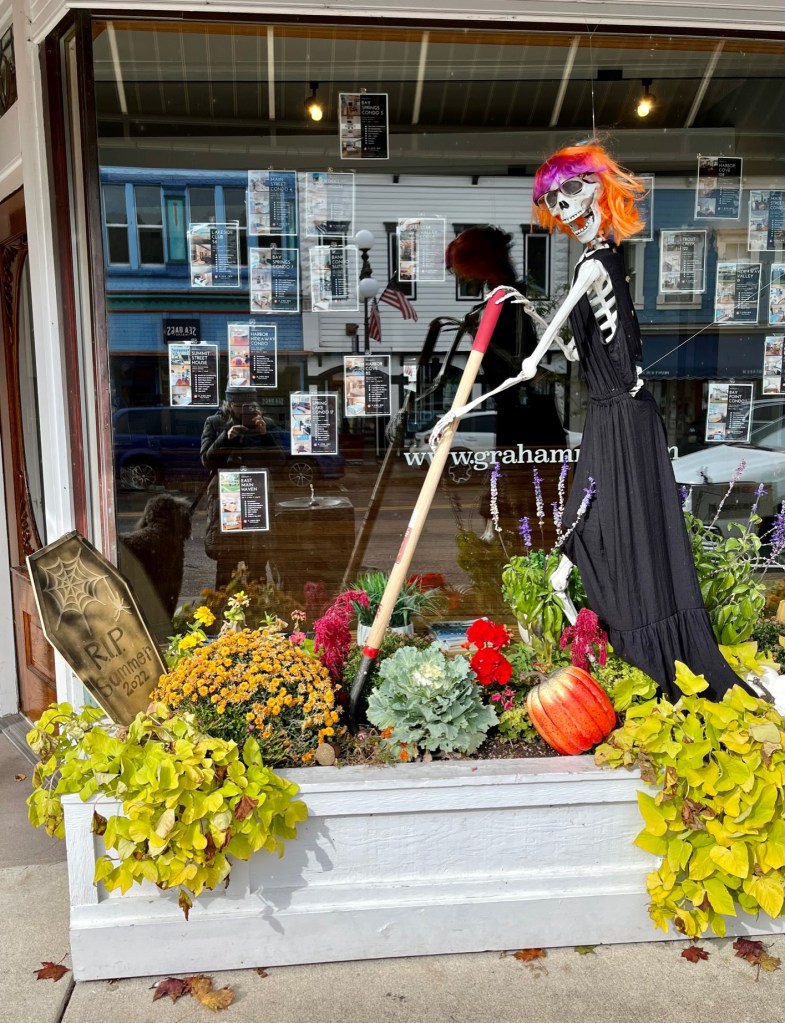
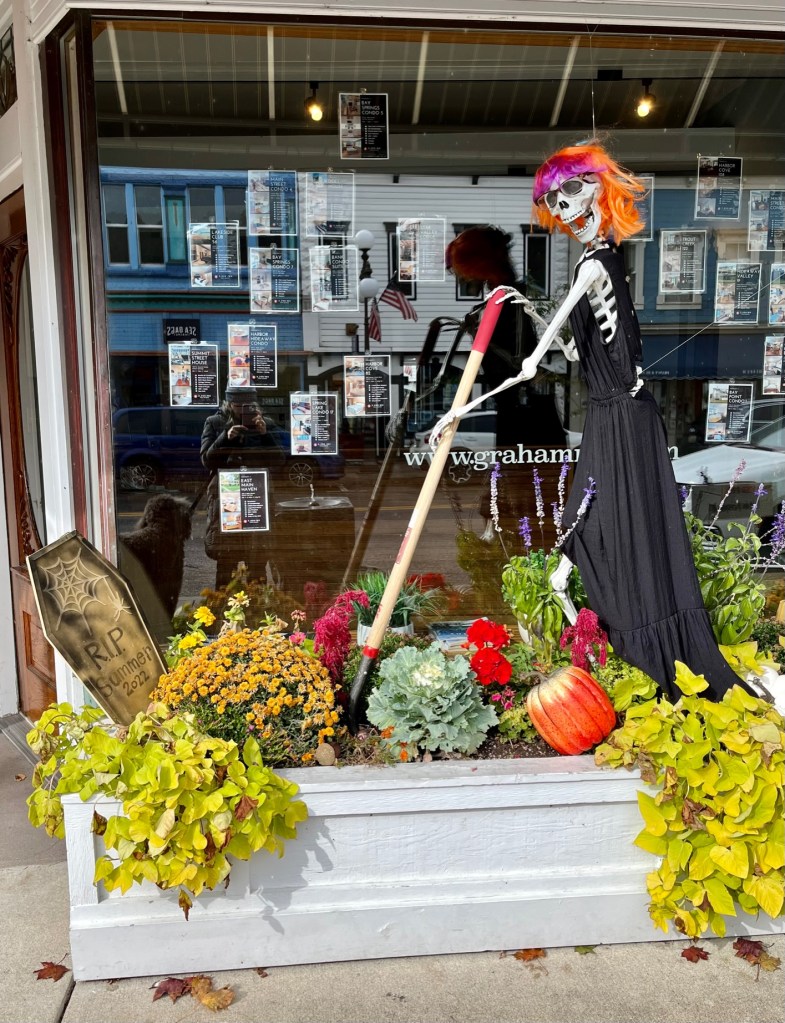
My favorite! The headstone reads: RIP Summer 2022
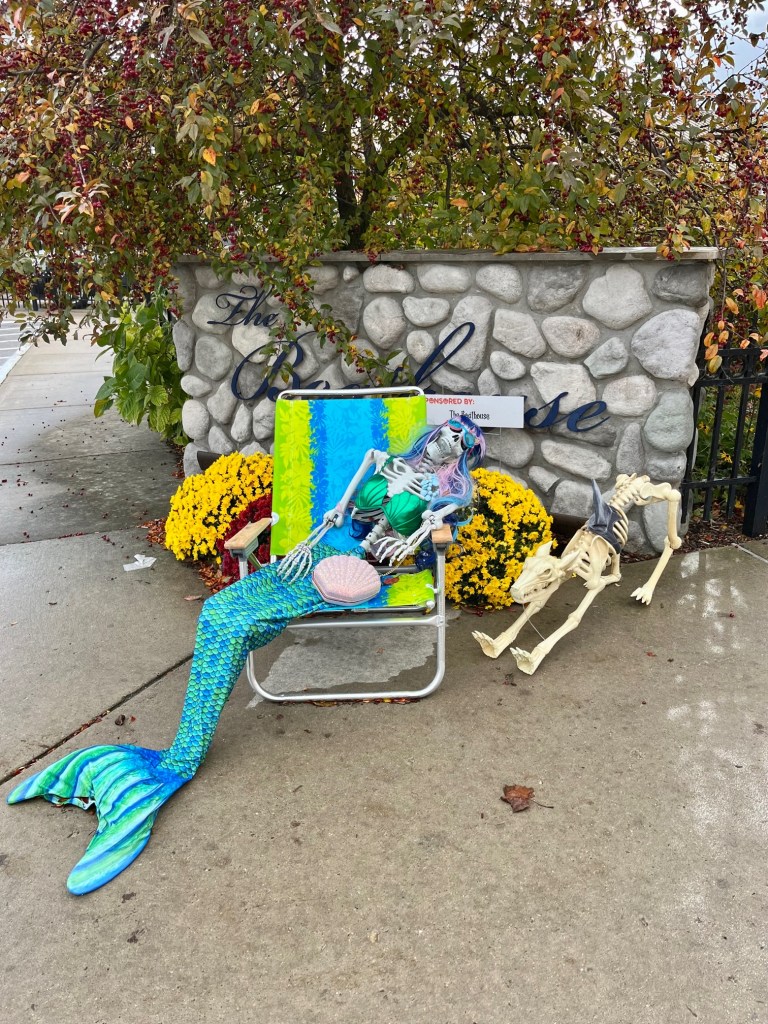
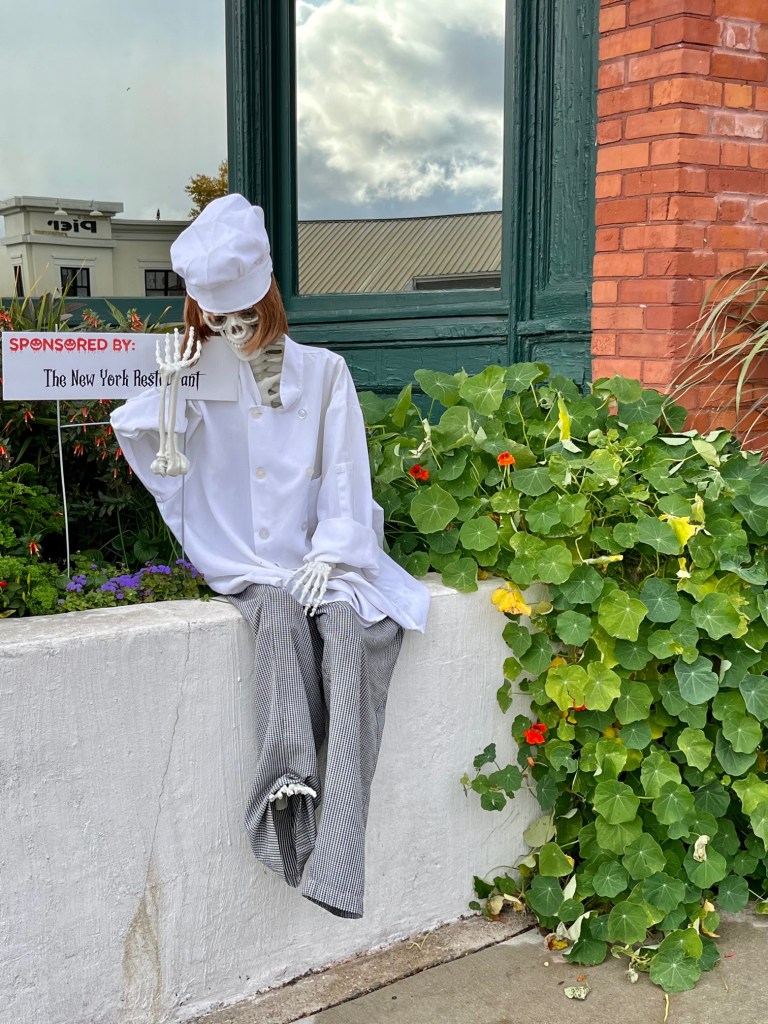
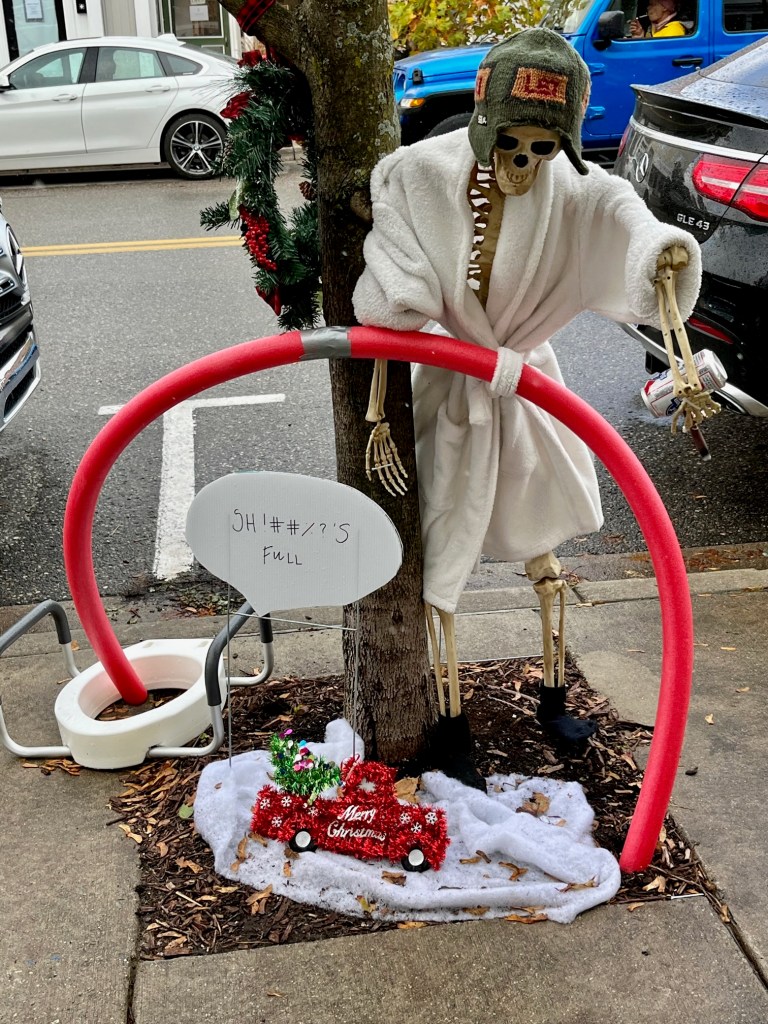
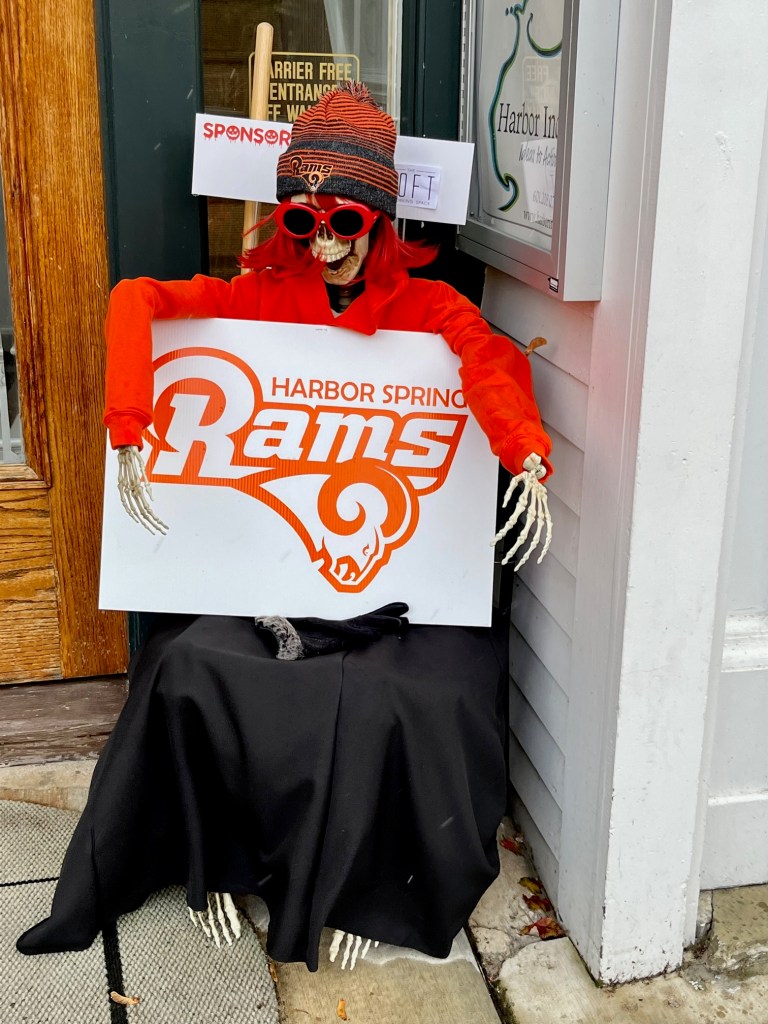
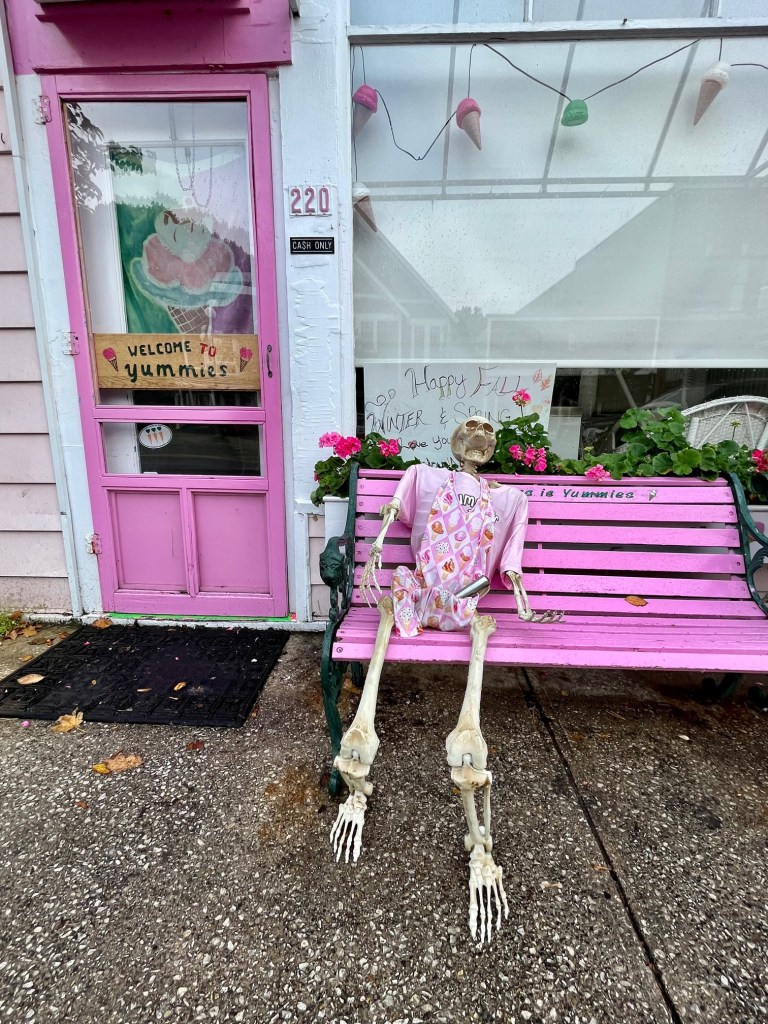
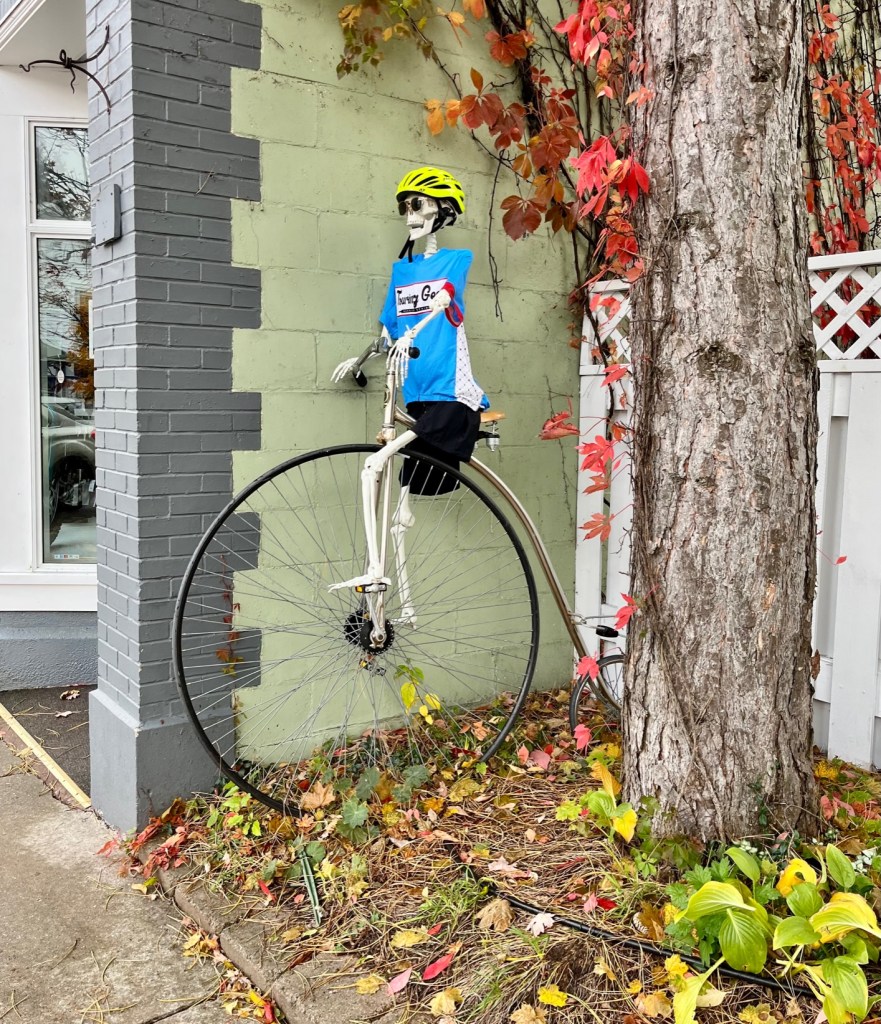
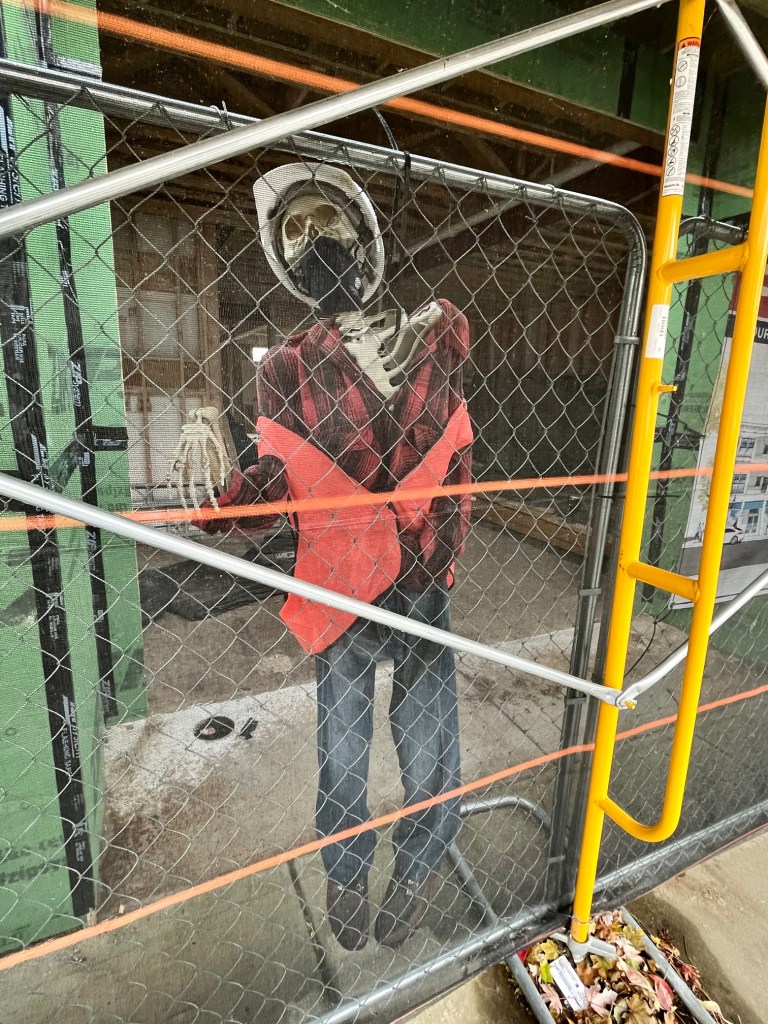
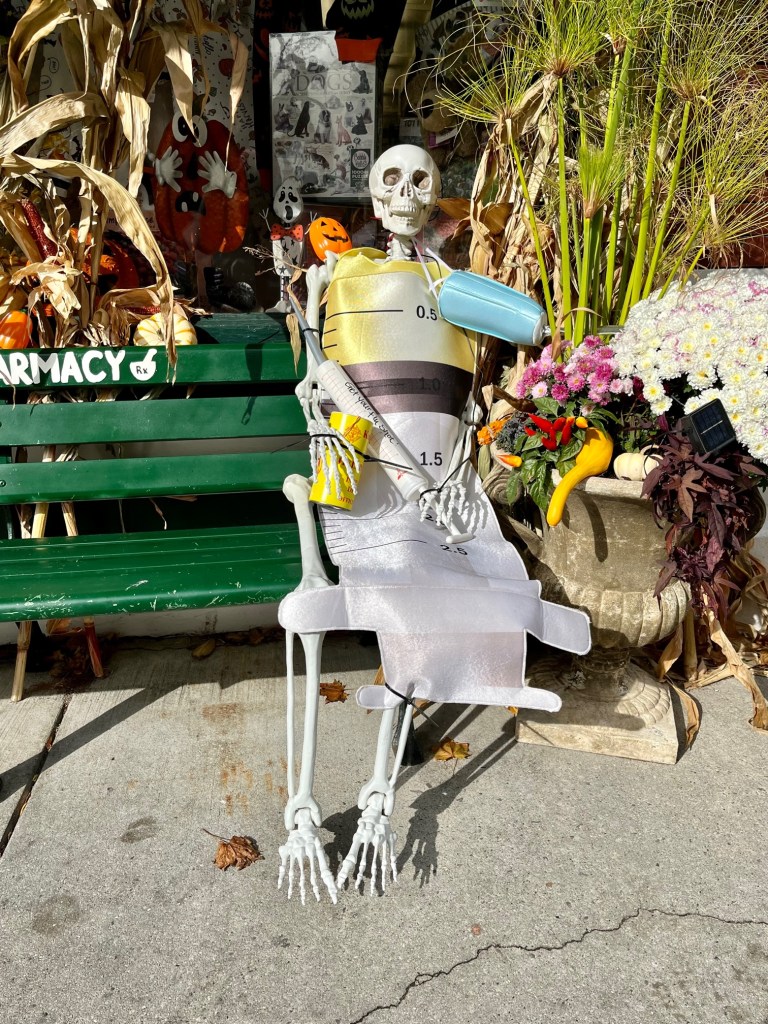
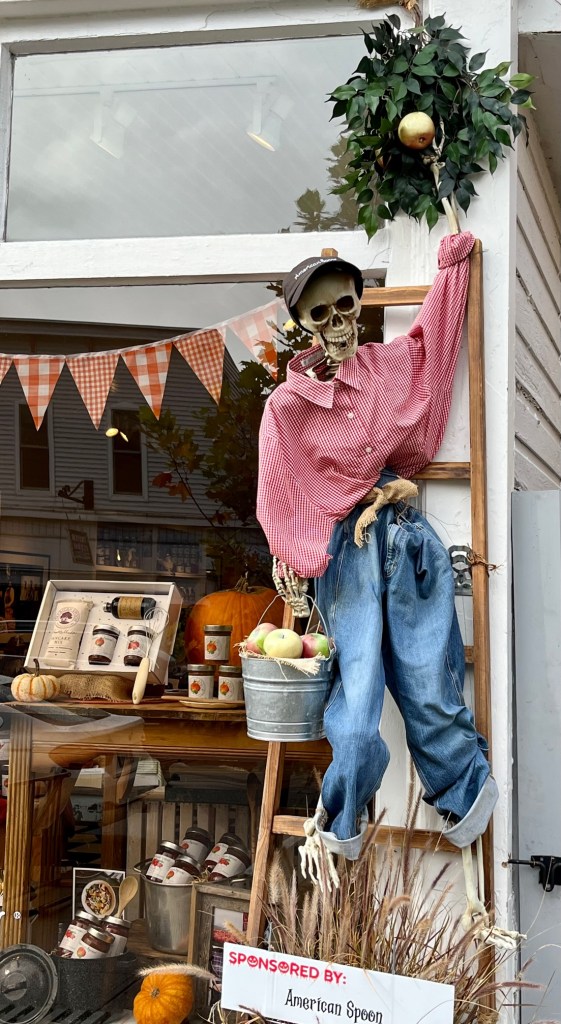
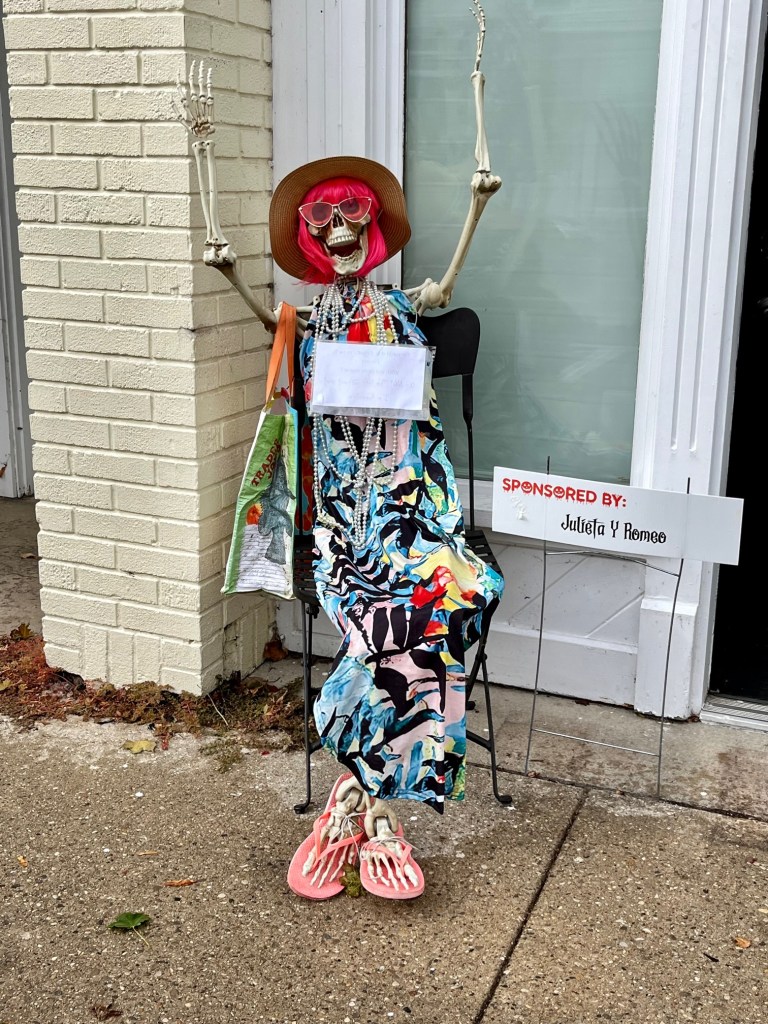
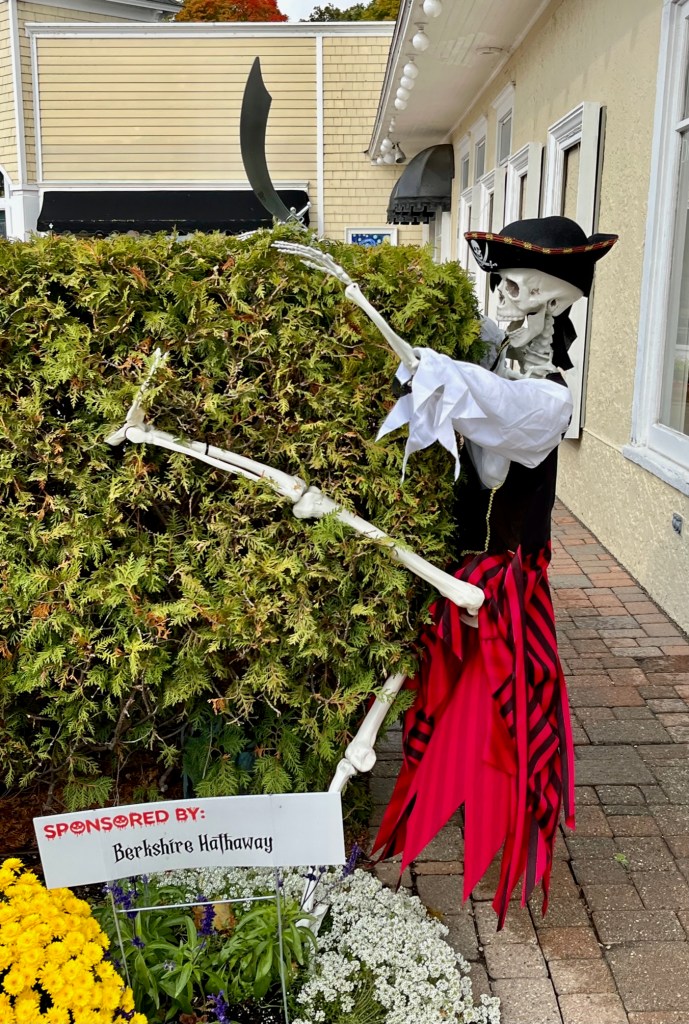
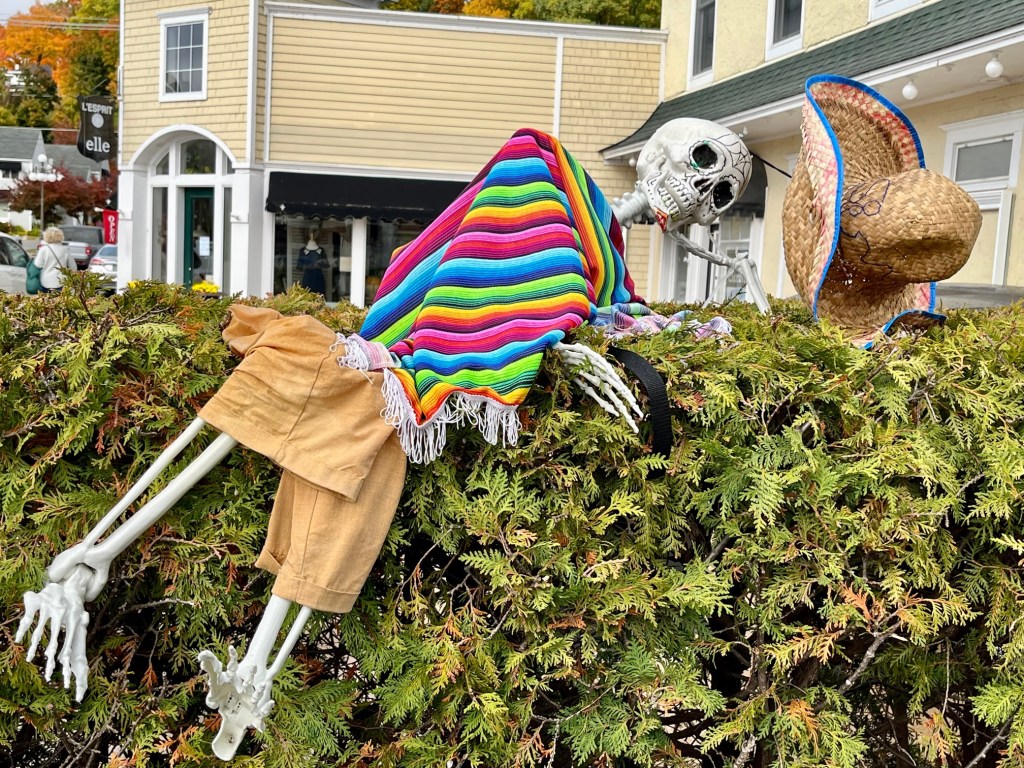
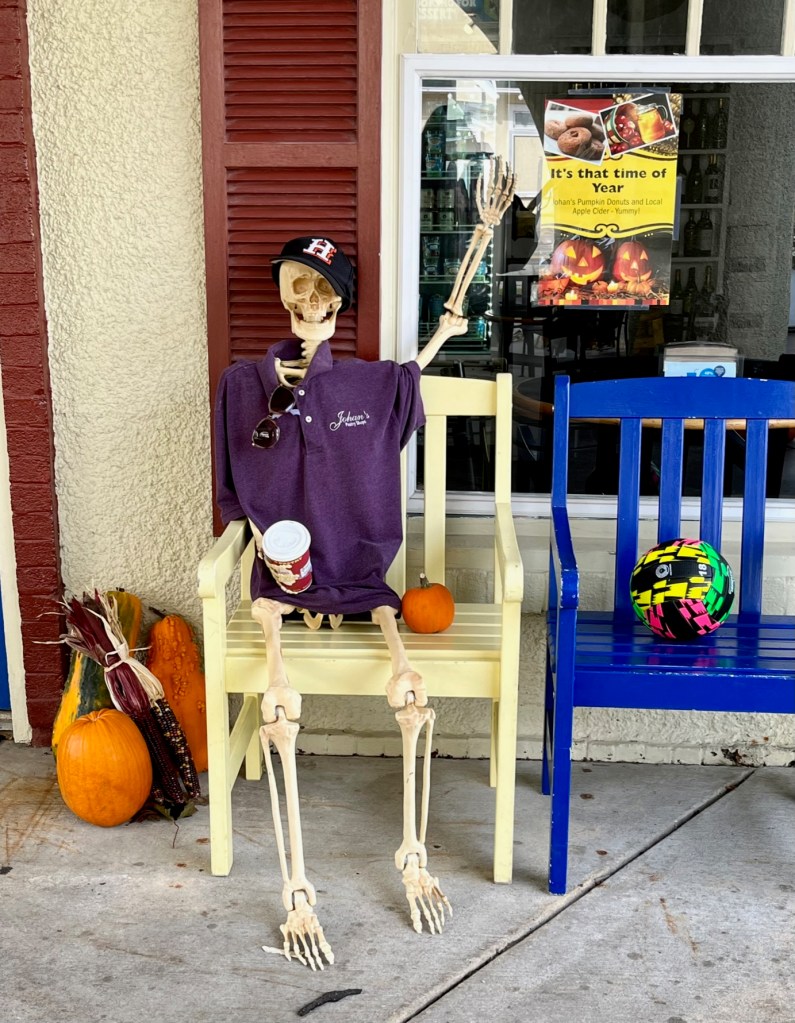
Next, we headed back to Main Street, where I noticed boney visitors who’d stopped by Harbor Springs dressed for Halloween. Bogey had to wait for me while I walked up and down the sidewalks and photographed twenty-seven snappily-dressed skeletons. I know I didn’t get pictures of all the skeletons, but I had fun trying to find as many as I could. Excitement lurked on every block and around every corner. Costumed skeletons have become a Harbor Springs Halloween tradition. And this year there are seventy-five skeletons creaking about.
Tonight the wind howls off Lake Michigan, and it’s raining in spurts. In the hours before dawn, snow is expected before turning back to rain. The National Weather Service has issued a wind advisory. And I wonder how the skeletons will stay warm in all this weather–they don’t have any meat on their bones.
“Nana, you have an infinity of dishes,” says Evan, who is nearly six; who tosses words into the air and pairs them with unlikely partners; who strings together metaphors like a bohemian necklace; who loves puns, making up his own then laughing and asking—Do you get it?
A punster, a mixer of words, a stringer of metaphor, he should be a writer, and I tell him so. He answers, “But I can’t write any words.” I remind him he’s starting school, he will learn.
For a moment the infinity of dishes that tracks through my kitchen from cupboard to table to counter, waiting to be stacked in the dishwasher or hand washed, depending on their taxonomy, gives me pleasure because Evan’s linguistic artistry gives me pleasure.
Yesterday, Ziva, Bogey, and I went for our first walk at 8:00 a.m., our second walk at 1:30 p.m., and our last walk at 4:30. We let the 20-mph winds off Lake Michigan push us down the road, until we had to turn around, then we leaned into the wind and pretended we were walking to school, uphill, in a snowstorm, for five miles. A bit histrionic but fun.
Ziva’s and Bogey’s ears flapped and fluttered in the wind, but my ears were tucked under my stocking cap. I liked stocking caps when I was a girl who played in the snow, but when I turned thirteen, I wouldn’t wear a hat in winter, no matter how cold it was. I wasn’t going to mess up my hair. Instead, I arranged my long, not-so-thick hair over my ears, trying to keep them warm.
Now I have four favorite knit stocking caps, and when it’s cold, I wear one. I even have a knit hat with earflaps that ties under my chin. I’m not letting my head or ears freeze. My nana always told me, “Keep your head and your feet warm, and the rest of you will follow.” I think about her when I put on a stocking cap and a pair of wool socks. Nana repeated her “warm head, warm feet” advice to me a lot when I was a foolish, hatless teenager, dashing through cold winter days.
One of my granddaughter’s leaf creations, October 2020
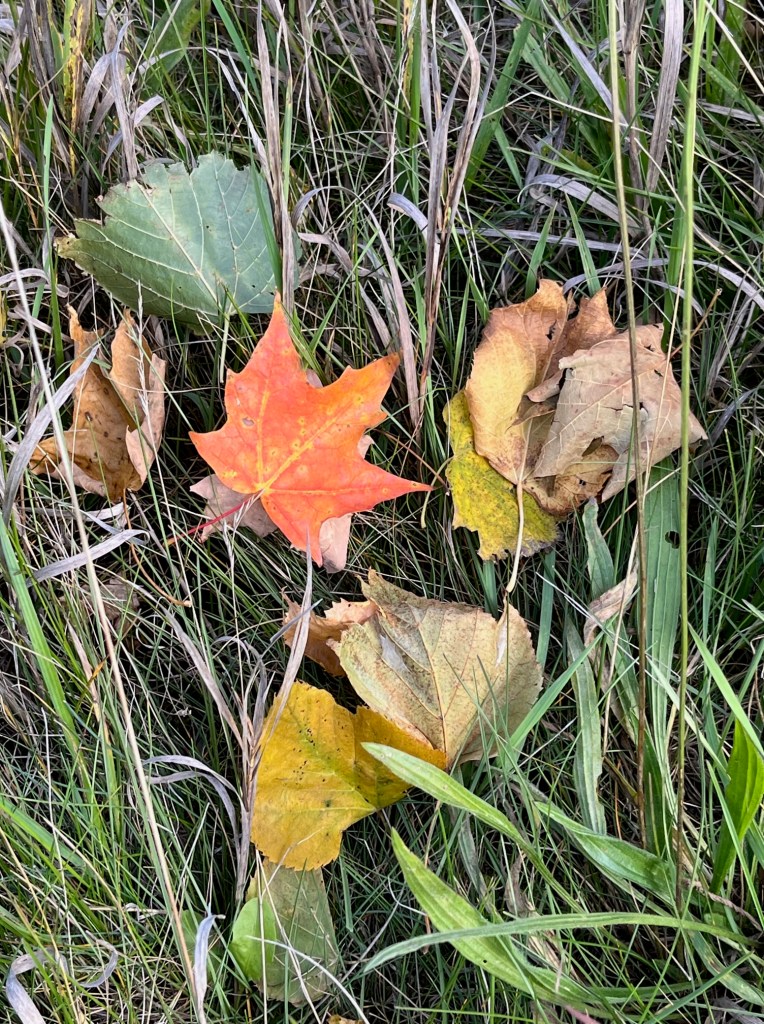
Yesterday’s picture theme: autumn-colored leaves. I took oodles of photos of newly fallen leaves because I could see that each one was unique, deserving to be photographed. If my granddaughter had been with me, she would’ve collected the leaves, oohing over each one, handing them to me to hold as she collected more to use in art projects.
Around 9:00 p.m., I took the dogs out in the yard for their last potty break of the day. The swirling wind whipped up a smorgasbord of scents, stirring something primal in Ziva and Bogey. They sniffed the air and the ground, weaving in and out of bushes, looking for little critters. Under the full moon, they chased each other, zooming in circles, like a couple of young pups with the crazies. Autumn makes me feel that way too.
Overlooking Lake Michigan on our morning walk
Moonlight in Michigan (The sky around the moon was much darker, but this is how my phone camera interpreted the light.)
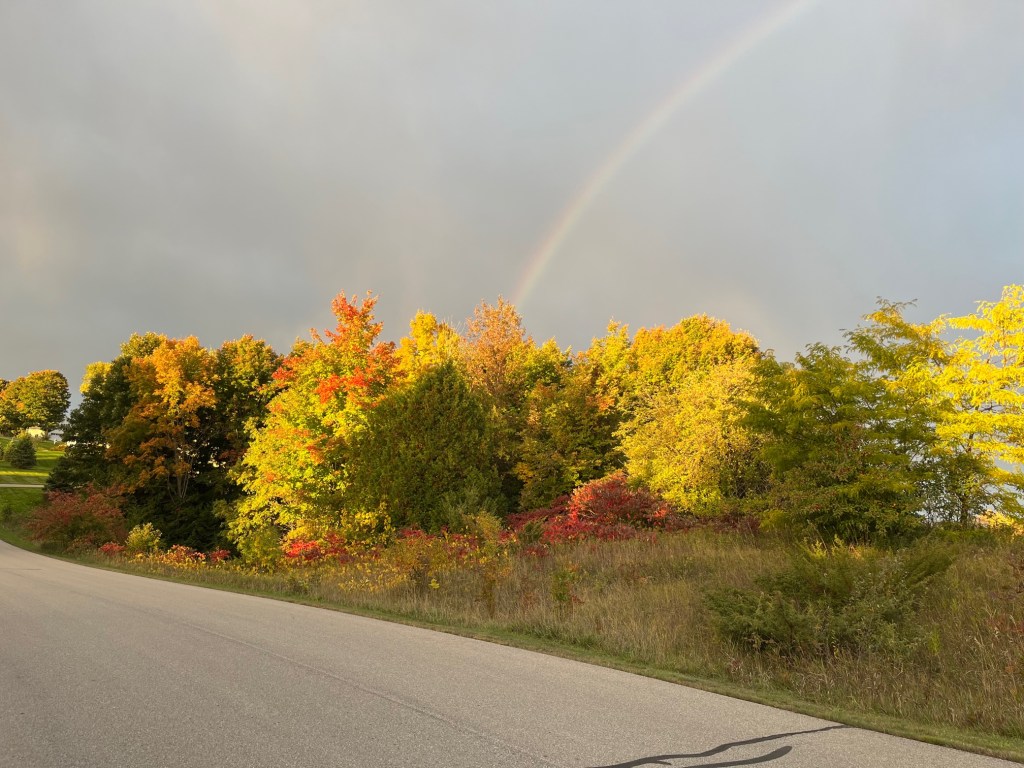
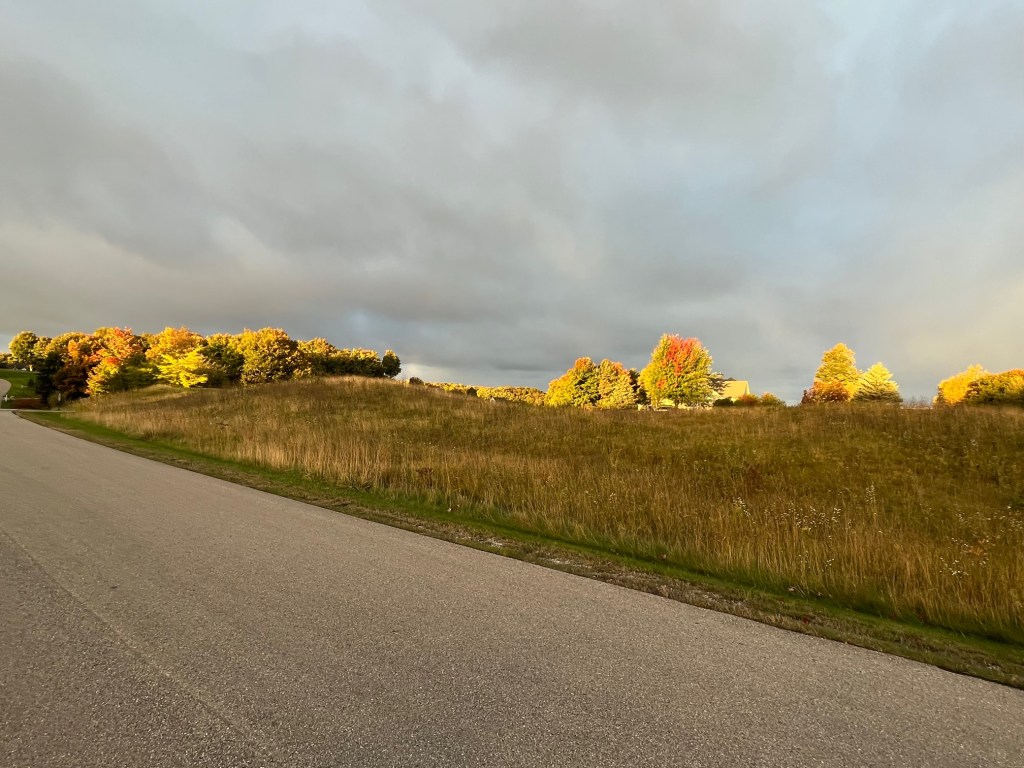
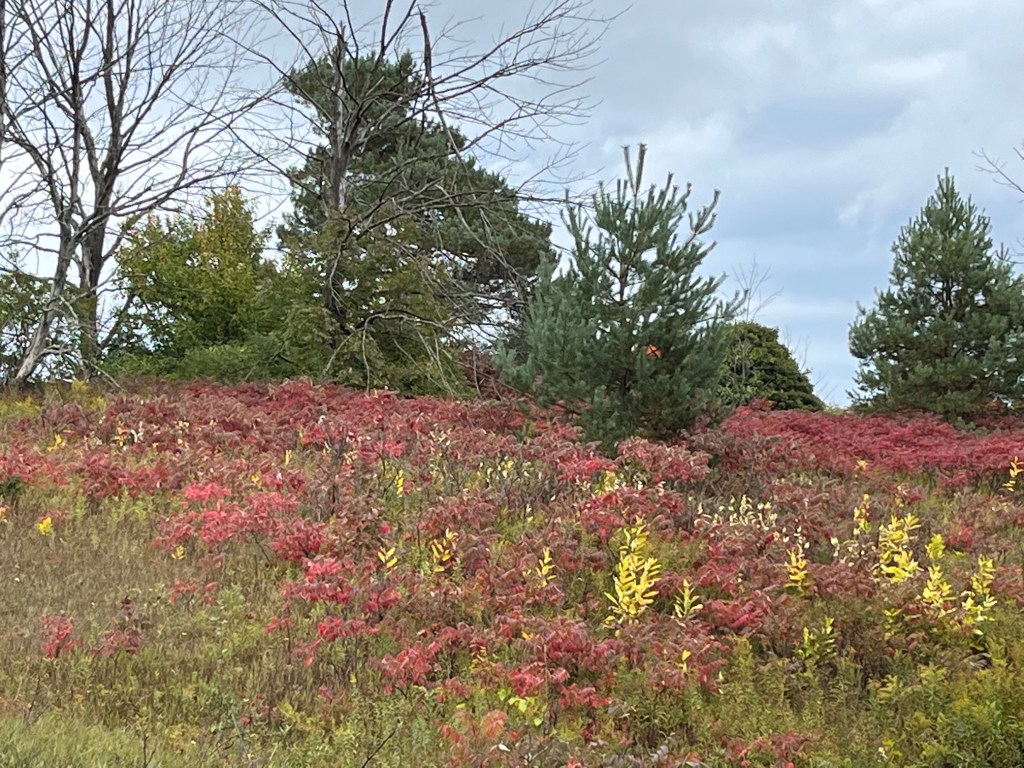
When I walked Ziva and Bogey this morning shortly after sunrise, the sky was a jumble of dark clouds and bright blue patches. The sun illuminated gold, orange, and red leaves, giving the impression they were lit from within. Of course, the dogs had to wait while I snapped pictures, and I never tire of taking pictures of trees dressed in fashionable autumn colors. When the dogs became impatient, I reminded them that I spend lots of time waiting for them while they smell blades of grass, tree trunks, and mailbox posts.
Finally, we turned down another road, and I spotted part of a rainbow. Out came my camera phone, again. As I alternated between walking and taking pictures, the rainbow became an arch, one end appearing to dip into Lake Michigan and the other end appearing to stand in a field about a half-mile away, giving the impression that if the dogs and I set off across the field, we would find the end of the rainbow with a leprechaun and a pot of gold.
Standing on a fieldDipping into Lake Michigan
As a child, I knew about leprechauns who guarded their gold at the end of the rainbow from people who tried to steal it. My sisters and I fantasized about finding the rainbow’s end and the leprechaun with his riches, but we knew it was a folktale.
If the tale had been true, I’d have picked the leprechaun over the gold, which I knew meant wealth, but only in the way a six- or seven-year-old understands wealth. Besides, I lived in a comfortable home with plenty of food in the cupboard. But a leprechaun was a magical two-foot-high man with orange hair, dressed in green, smoking a pipe, and speaking with an Irish brogue. According to folklore, if we would’ve caught a leprechaun, he would’ve granted us three wishes in exchange for his freedom.
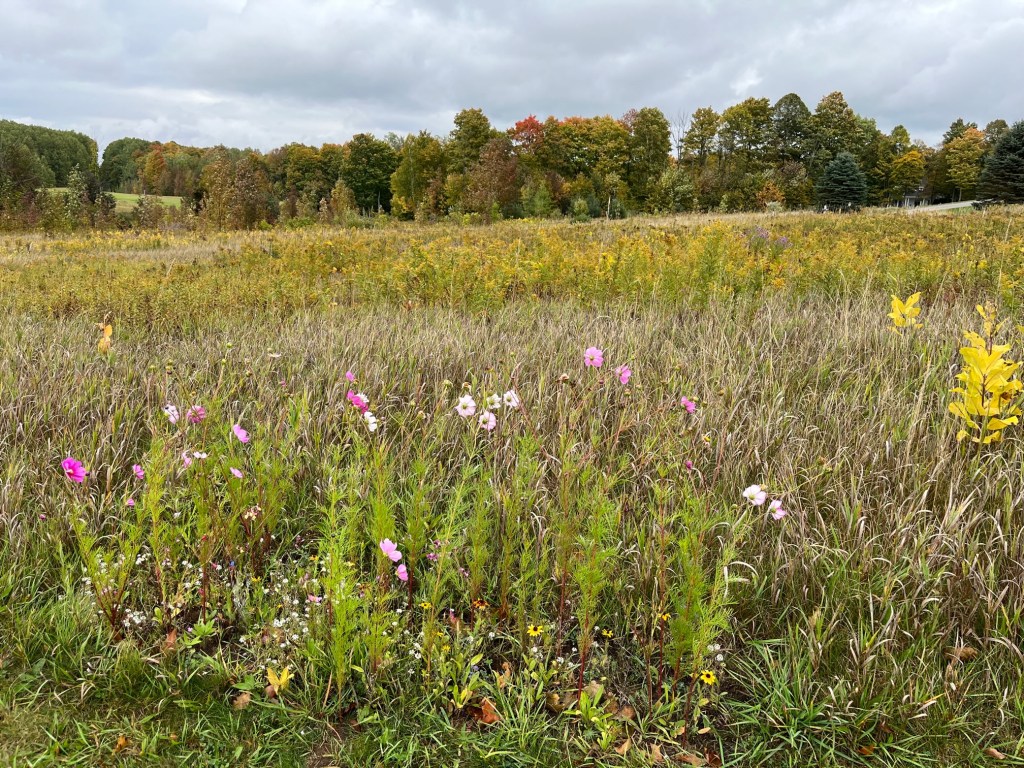
This morning while walking on the country road, watching the rainbow form a half circle through the sky, I wished that the fields and trees in this enchanted place would stop disappearing. In the eight years I have been visiting my mom, ten new homes have been built, and each one stands on an acre of land. Each new house means a loss of trees and fields. A loss of habitat for birds, bees, butterflies, and small critters that I don’t see, but the hawks who perch in the trees are evidence of their existence.
Today, looking at the rainbow arching over the still undeveloped fields, I don’t wish for gold or to meet a magical leprechaun protecting his stash. I imagine a leprechaun at the end of today’s rainbow protecting a field, keeping it safe for insects, birds, and small critters, and I wish that each homeowner in this neighborhood would leave a strip of field along their lot lines.
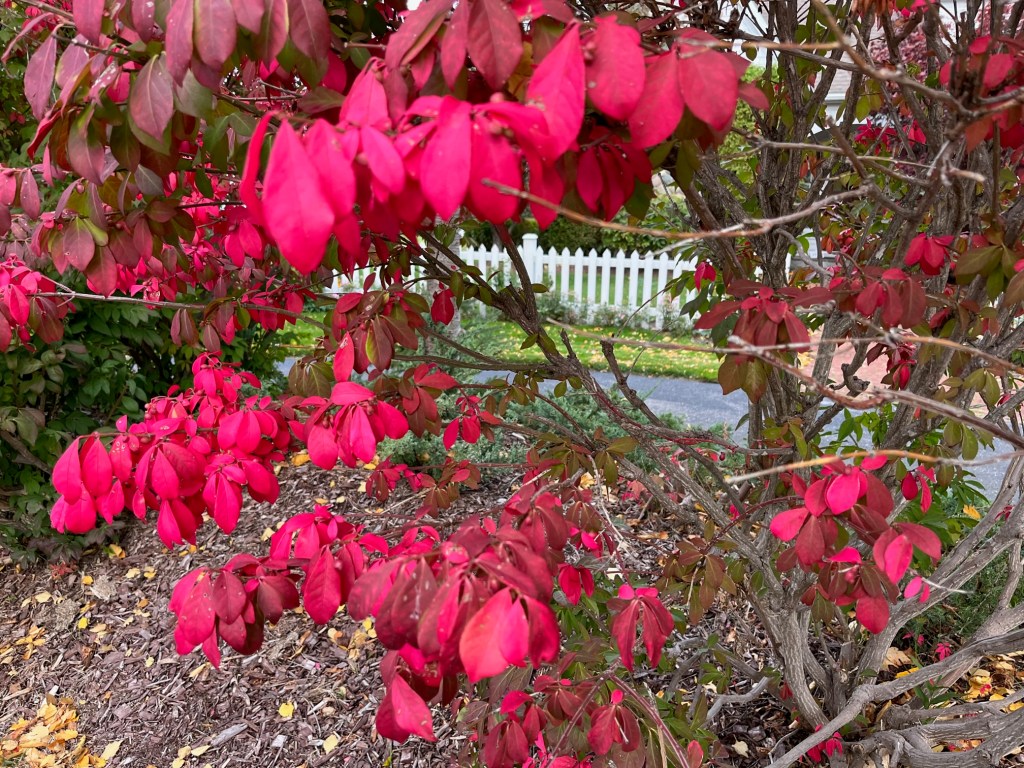
Crisp autumn days are my favorite time to walk my dogs. I watch the shifting scenes of autumn: trees turning shades of red, orange, and yellow; leaves dropping gently to the ground—then days of high melodrama when howling winds and heavy rains come to rip the once-vibrant leaves from their stems, stripping the trees bare.
As the rich autumn shades—all warm hues on the color wheel—replace the cool hues of green, autumn wraps me in nostalgia, carrying me back in time to my youth. I’m warmed by memories of raking leaves into circular paths resembling the yellow brick road; of walking through the woods with oak, hickory, and maple trees awash in fall colors; of gathering acorns and hickory nuts while a blanket of dried leaves crunched under my feet.
I’ve been in Petoskey, Michigan, since Tuesday, and I’ve been walking Ziva, my dog who came with me, and Bogey, my mother’s dog. Petoskey, nestled on the eastern side of Lake Michigan, is beautiful anytime of the year, but October is my favorite time to visit. The weather, scenery, and vegetation are a blend of southeast Wisconsin, where I grew up, and northwest Wisconsin, where I live by Lake Superior. Coming here is like returning to the fields and woods of my youth, while almost feeling like I haven’t left home because Lake Michigan keeps me from missing Lake Superior.
On Tuesday and Wednesday, sunshine, warm breezes, and fall colors filled the days, and the dogs, my sister, and I walked the country roads in my mother’s neighborhood. My sister went home yesterday, but I’m still here with my mom and the dogs. Today, the rain and wind arrived, pulling autumn-colored leaves from the trees. The dogs and I still walked, but we timed our strolls between shifts of rain. Bogey has a raincoat, but Ziva would rather get wet than wear one. I could’ve carried an umbrella, but the strong winds would have turned it inside out.
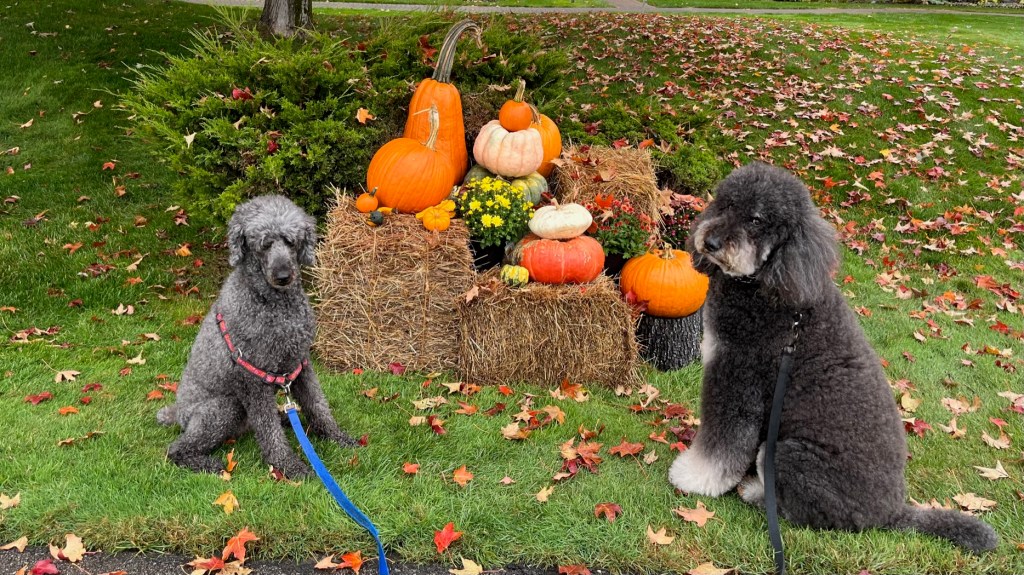
On our second walk of the day, I had the dogs pose by a vignette of pumpkins, squash, mums, and hay bales arranged by one of my mom’s neighbors. I’m going to have a 5 x 7-inch photo made and frame it, a reminder of a gray but lovely autumn day when two big-hearted dogs kindly let me take their picture on a blustery day.
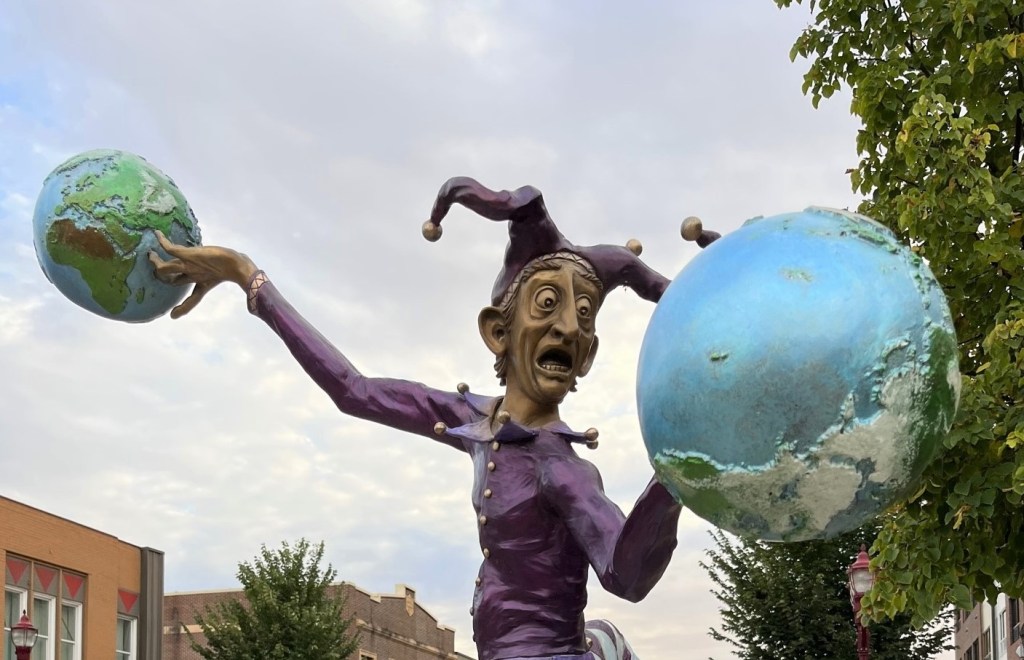
A Delicate Balancing Act by Kimber Fiebiger; downtown Mankato; made me think about the writer’s life
The Deep Valley Book Festival is set in Mankato, Minnesota, a charming town tucked in by rolling tree-covered hills and edged by the Minnesota and Blue Earth Rivers. This is the first book festival I’ve ever attended. My daughter-in-law and I drove down on Friday afternoon, a warm sunny day that premiered some stunning fall colors.
After we checked into the River Hills Hotel–a cozy and clean establishment with a friendly clerk–we headed to downtown Mankato for a walk then dinner. It was quiet for a Friday night, but I imagine if the Mankato Mavericks had been playing, the streets would’ve been skating with hockey fans. We had a good meal at the Pub 500. Our waitress was friendly and efficient. She carded my daughter-in-law, but she didn’t card me! Of course, that’s probably because I didn’t order a drink; otherwise, I’m sure she would have. I had a delicious fish taco.
On Saturday morning we arrived at the book festival just before nine o’clock, and we planned to stay until it ended at 4:30. We were motivated by the hourly drawings for books and the opportunity to hear author Curtis Sittenfeld talk about her writing.
We made sure we stopped at all the tables, sometimes briefly, other times lingering to listen to writers speak about their books, which included children’s and YA literature, fantasy, mystery, thriller, romance, historical fiction, memoir, nonfiction, and poetry.
A book festival is filled with writers, but they are there to sell their books. There are no writing classes. The local library had a table, and Content, a bookstore from Northfield, Minnesota, also had a table. I noticed two publishers who were selling books by authors they represented. I asked one publisher if they were a traditional publishing house–they weren’t. The representative of the company said they like an author to put up fifty percent of the cost of publishing his or her book. I didn’t ask the other publisher about their business model.
Authors work hard at a book festival. They sit or stand for hours and talk about their books to people who look, smile, and listen, but often leave without buying a book. I bought two children’s books, two novels, and a nonfiction book. My daughter-in-law bought some books too. We plan to exchange our books with each other.
We finished touring the festival around noon. We sat and each of us started reading a book we had purchased. I read Facets of Death by Michael Stanley, a fast-paced Detective Kubu story that captured my attention, a good thing because I won another Detective Kubu story, A Carrion Death in a drawing being held by the author. My daughter-in-law read Bingo Barge Murder by Jessie Chandler, which she enjoyed, saying it was humorous.
When reading made us hungry, we left to have lunch at Applebee’s, then went for a walk. But we soon returned to the book festival to check the small white board to see if we had won any books–we hadn’t.
The book festival was held at the WOW! Zone, an interesting place for a book festival. The WOW! Zone has a bowling alley, a game arcade, and food. It was noisy, but fortunately, most of the booksellers were tucked into the restaurant that had been converted into a makeshift venue, and so the noise wasn’t too bad. We wanted to read more because we had almost two hours to pass before Curtis Sittenfeld’s talk. Seating in the WOW! Zone was limited, so we ended up at a table in the bowling ally and read to the rumble of rolling bowling balls and clattering pins. But when I’m reading a good book, background noise fades away.
By three o’clock, I was tired and we had a four-hour drive home. But I had heard Curtis Sittenfeld speak on a Zoom talk and enjoyed listening to her, so I didn’t think about cutting out early. Sittenfeld began by saying that she has done hundreds of talks all over the country, but this was her first time giving a book talk in an arcade. The audience laughed with her because we understood. Most of us had spent the whole day or part of the day at a book festival held in an arcade. Sittenfeld was kind, charming, informative, and entertaining. The hour flew by.
With our bags of books, my daughter-in-law and I headed home. We had new reading material, and we were ready for the upcoming winter.
Books I bought:
Facets of Death by Michael Stanley because after reading a paragraph, I liked the writing, so I took a chance that the story would also be good.
Tuckerbean in the Kitchen by Jill Kalz because the book festival was the same day as my grandson’s birthday. He turned six, and I think a story about dogs cooking will appeal to him. Plus the illustrations by Benton Mahan are adorable.
Eligible by Curtis Sittenfeld because she was there, and I wanted to have a book for her to sign. And because I’ve read American Wife by her and liked it, AND because Eligible is a modern retelling of Pride and Prejudice, which I love and have read three times. Plus I’ve seen three different movie versions of Austen’s enduring novel.
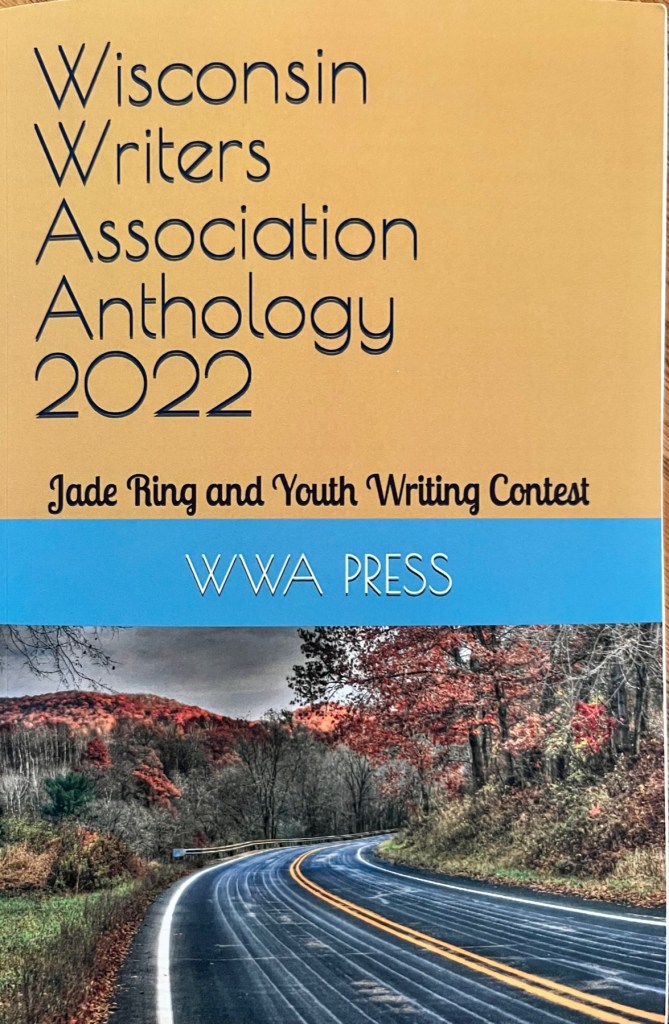
[This essay received an honorable mention in the Wisconsin Writers Association’s 2022 Jade Ring Contest. To read the works of other winners, see the links after the essay.]
Charlie broke my heart in 1971. Dressed in a top hat and tuxedo, and well-groomed with manicured nails and combed hair, he was debonair, even if his monocle made him look a bit stuffy. Always ready with a smart comeback, a smooth put-down, or a drop of wisdom, he was witty, candid, and self-assured. Charlie was a dummy, but I wanted him anyway.
The big problem—he was unavailable. Like all desirable men, he was taken. Women everywhere had lined up to have a chance with him. Seems like everyone wanted a wise-cracking fella who was perpetually dressed for the opera.
My mother broke the news to me. “Honey, I have to talk to you about your Christmas list.” I was twelve, so we had long ago stopped calling it “my letter to Santa.”
“I’ve looked everywhere.” Her voice shrunk as she spoke. “I can’t find a Charlie McCarthy doll.” She asked me to think of something else to add to my list. I did, but I don’t recall what it was. I could’ve asked for a hand puppet, but that would’ve been like having to settle for Eddie Haskell after hoping to date Donny Osmond. There was no substitute for Charlie.
I wanted to be a ventriloquist. I was going to be famous. I was going to be a star. And I couldn’t do it without Charlie. My daydream about becoming a celebrated ventriloquist was another chapter in my someday-I’ll-be-a-famous-singer-actor-or-dancer book of fantasies. I spent hours singing with Doris Day, Petula Clark, Dionne Warwick, and Barbara Streisand, pretending to be them. Sometimes I sang along with Johnny Cash, Frank Sinatra, Sammy Davis Jr., or Trini Lopez, pretending they had recognized me—a famous singer—in the audience and called me up on stage to sing with them. The exuberant audience, unable to contain their cheers and thunderous clapping, would rise to their feet moments before we had finished our duet.
Sometimes, I’d lay on the floral velour couch in the living room, the most elegant space in our farmhouse, and imagine myself a great actor giving spellbinding performances on stage or film. Or I would be Cyd Charisse, dancing, defying Newton’s laws of motion, giving men whiplash. When I wasn’t doing my famous talent stuff, I would travel to exotic places, win awards, and marry a leading man or a velvet-voiced crooner.
With Charlie I would’ve been more than a ventriloquist—I would’ve been funny! The see-saw, back-and-forth humorous banter between Charlie and Edgar Bergen captivated me. Bergen said things that came out of Charlie’s mouth. Through Charlie, Bergen insulted people and everyone laughed at Charlie. Through Charlie, Bergen flirted with women and everyone thought Charlie was adorable. Charlie sassed Edgar, his elder, and never got whapped alongside the head. My twelve-year-old mind found this setup very attractive. But reflecting on it now, I don’t think my mother would’ve whapped Charlie alongside his head.
After I learned Charlie wouldn’t be helping me on my way to ventriloquism fame, I crawled in the closet under the stairs. I sat with a box of hats, mittens, and scarves. I inhaled a mixture of musty wool and dust while tears rained down my cheeks. Charlie would never sit with me on the floral velour couch. I wouldn’t toss my voice into his throat. I wouldn’t watch our reflections in the mirrored wall as we practiced talking to each other. We might have sung along with Sinatra or Streisand, the three of us making harmony.
I was crushed. I was heartbroken. I was an overly-dramatic twelve-year-old. Oscar worthy, no doubt.
I’d like to say that I pined for Charlie and that Christmas Day was hollow without him and that I asked for him for my birthday in March. But I did none of that. I was over him before Christmas. I don’t remember what I got instead of Charlie, but it was the next best thing, and I’m sure I was happy with it. I ate my mom’s good cooking. I played board games with my sisters and cousins. And I read my new Nancy Drew mystery before I drifted off to sleep that night.
If Charlie hadn’t stood me up, truth is, I would’ve dumped him. Within a month or so, he would’ve been tucked away in my closet, along with my fantasies of winning an Oscar or a Grammy. I hope all the Charlies found better homes.
I never became a famous singer, dancer, or actor. I can’t carry a tune. I have no sense of rhythm. And in seventh grade, I learned I had terrible stage fright.
Funny, when I was twelve, I never imagined myself as a famous writer. I started writing after I retired, so I’m too old for silly fantasies now. But if I were twelve, I would win a Pulitzer Prize, I would make Oprah’s reading list every other year, and the New Yorker would call me and beg for one of my short stories.
[All the winners of the 2022 Jade Ring Contest can be read in the online Creative Wisconsin Magazine, along with other essays, poetry, and articles. If you wish to purchase a copy of the Wisconsin Writers Association Anthology 2022: Jade Ring and Youth Writing Contest, click here.]























 Writing Near the Lake