[In 1976 when I was seventeen, I traveled to Europe with a group of fellow high school students. I wrote the essay European Tour 101 in 2023. This essay was published in Tales of Travel by the University of Minnesota-Duluth. I’m publishing it to my blog in five parts.]
Lesson Five: Serenade Your Tour Guide
Salzburg, Austria, 1976
Our train left Salzburg in the evening, shortly after nightfall. The station’s platform was written in romantic darkness, punctuated with street lamps. Our Austrian tour guide had come to the station to make sure our travel arrangements were in order and to say goodbye. We were headed to Paris.
A hazy view from the Alps, 1976
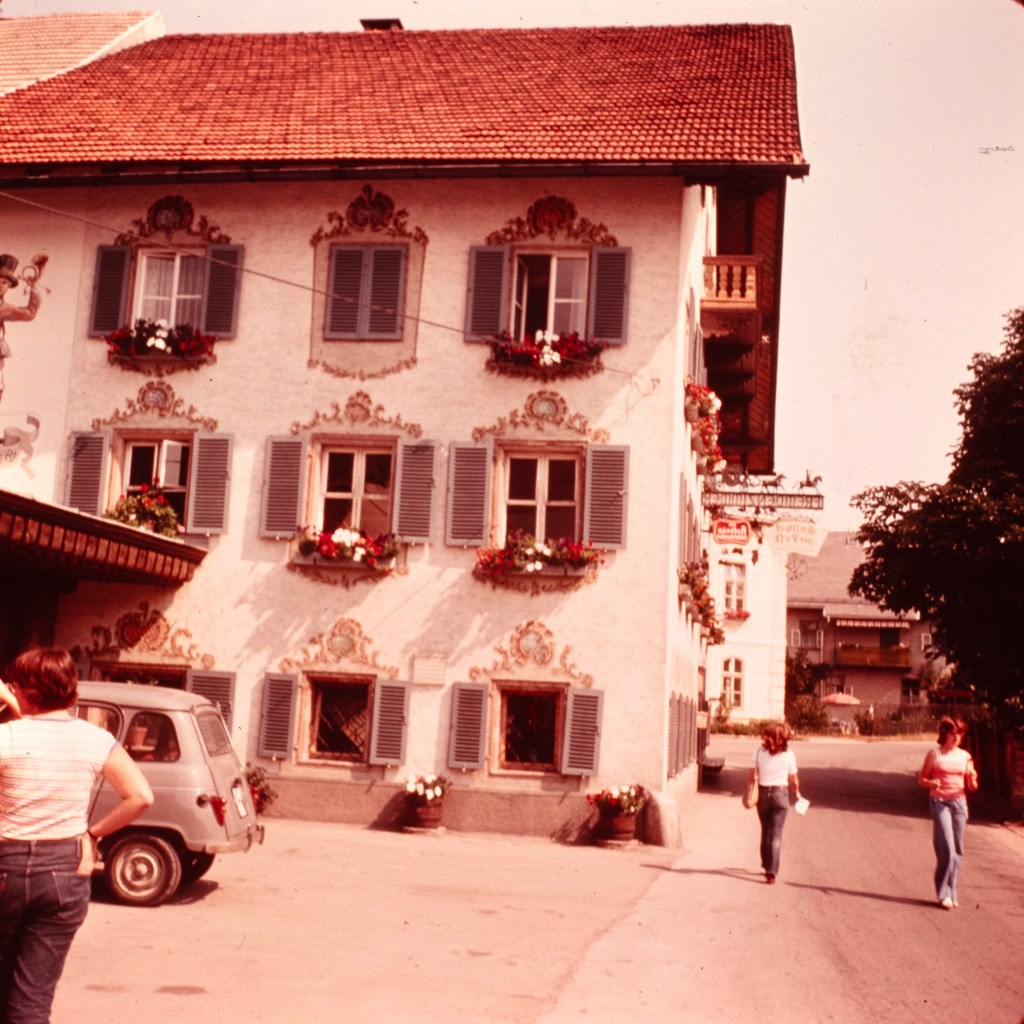
I no longer remember the guide’s name. She was a university student, kind and soft spoken, with a gentle smile and a lilting laugh. Warm blue eyes sparkled behind her gold wire-rimmed glasses. She had accompanied us to a salt mine, to museums and art galleries, and to the Alps where the mountain scene for the Sound of Music was filmed. We stayed in Adnet, a farming village, thirty minutes from Salzburg. The small village had a well-lighted, welcoming restaurant, and we ate our evening meals there as one large group. After dinner we sang songs, and one night someone taught us the words to “Edelweiss” from the Sound of Music.
After we boarded the train, our tour guide stood on the platform waving at us. Someone in our group began to sing “Edelweiss.” Spontaneously, voice after voice, the rest of us joined in, and on a warm summer’s night as the train eased its way along the track, we leaned our heads and hands out the windows, and as one rhythmic beating heart, over and over, we sang the words about a small white flower, about meetings and greetings, about remembering and forever.
A view of Adnet, Austria, where we learned the words to “Edelweiss,” 1976
Our guide cried, wiping tears from her cheeks before they could splatter on the concrete beneath her. We sang and waved until we could no longer see her. And as the distance between us grew, one by one our voices drifted off, and we pulled our heads and hands inside the windows, and settled in our seats, bound for Paris, the City of Light.
I sang “Edelweiss” to both of my children when they were babies, and it became my youngest child’s favorite lullaby. After all these years, I remember the gifts we traded with our guide at the station: our song for her — and her tears of delight for us. I wonder if she ever plays the memory in her mind like a scene from an old movie as I still do.
[In 1976 when I was seventeen, I traveled to Europe with a group of fellow high school students. I wrote the essay European Tour 101 in 2023. This essay was published in Tales of Travel by the University of Minnesota-Duluth. I’m publishing it to my blog in five parts.]
Lesson Four: Patriotism is Fine, But Ditch It for the Ballet
Rooftops of Rome, 1976
On July 4, 1976, our tour group was in Rome. Even before I left for Europe, I felt bad about missing America’s Bicentennial birthday bash. When we arrived in Rome, we were given a choice about how we wanted to spend the Fourth of July. We could attend a professional ballet performance or an evening picnic followed by fireworks sponsored by the American Embassy. I chose the picnic and fireworks because if I couldn’t be in the States for the Bicentennial, I could at least be with a group of patriotic Americans eating scrumptious picnic food and watching extravagant fireworks.
It was the worst Fourth of July celebration I ever attended. The food was second-rate, the fireworks were average, and the park was peppered with litter. I grew up inspired by Lady Bird Johnson and the Keep America Beautiful campaign. Every spring and fall my sisters and I pulled our red wagon up and down our road and picked garbage out of the ditches. I yelled at friends who threw litter out of car windows. The inconsiderate Americans who couldn’t put their trash in the garbage can embarrassed me. Before the fireworks even started, I regretted skipping the ballet.
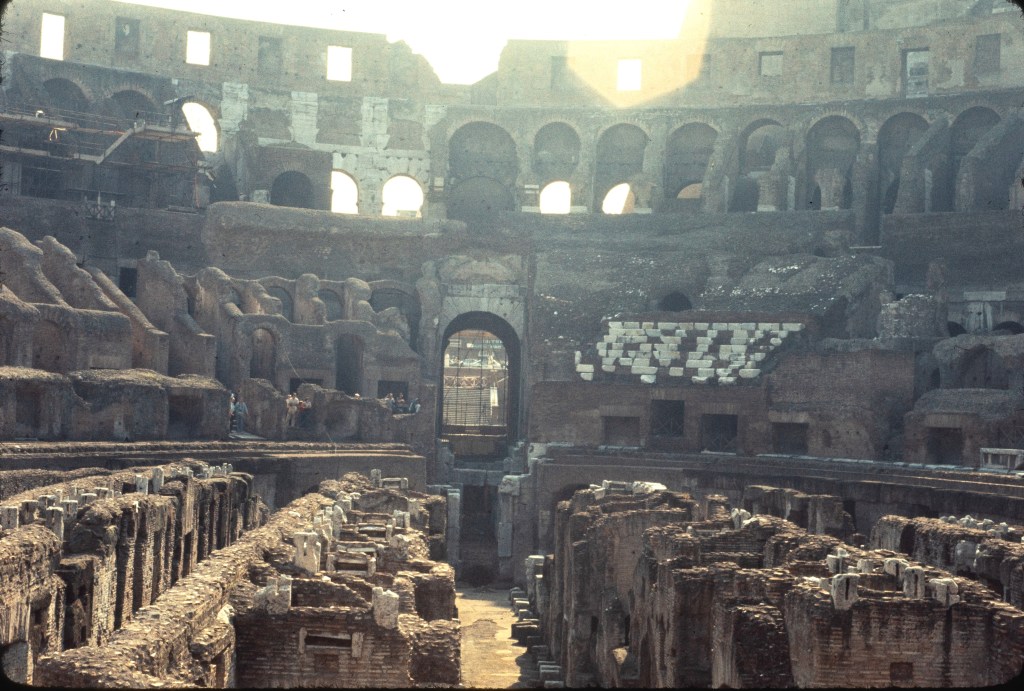
Roman Colosseum, 1976
At the time I saw the embassy picnic as a lackluster celebration that didn’t match the significance of two centuries of democracy. In hindsight it strikes me that American democracy has a long history of casting aside many of its citizens, like the discarded rubbish I saw on July 4, 1976, dropped by patriotic Americans who somehow felt entitled to litter someone else’s park. Patriotism isn’t about eating a hotdog or watching fireworks. Patriotism should be about loving a country that embraces equality, justice, and opportunity for all.
Years later my mother-in-law took me to my first ballet, The Nutcracker. I loved everything about it—Tchaikovsky’s music, the graceful dancers, the whimsical costumes, and the enchanted scenery. And again, I regretted missing the ballet in Rome, which I think was Swan Lake.
Always choose the ballet.
[Coming soon: European Tour 101 – Part 3, Austria]
[In 1976 when I was seventeen, I traveled to Europe with a group of fellow high school students. I wrote the essay European Tour 101 in 2023. This essay was published in Tales of Travel by the University of Minnesota-Duluth. I’m publishing it to my blog in five parts.]
My European scrapbook is filled with ticket stubs, receipts, brochures, maps, postcards, etc.
In the spring of 1976 when I was seventeen, I brought home a brochure from my German class that showcased a thirty-day trip to six European cities in five countries. I had studied high school German for two years and middle and high school Spanish for five years, and Austria and Spain were two of the countries we would visit. I had no illusions about my ability to chat in German or Spanish with the locals, but I longed to visit Europe. I gave the brochure to my mother, who after reading it told me I could go. There was never a discussion of “maybe” or “we’ll see.” The trip cost around $1,400 in 1976, a lot of money for my parents who were on the lower end of the middle-class ladder.
Mother never said it in so many words, but she believed in learning about other cultures. She had encouraged me to study a foreign language. While I was in high school, she signed up to host foreign exchange students for Milwaukee Week. During this time, exchange students from all over Wisconsin spent a week in Milwaukee. I enjoyed meeting the exchange students, learning about their countries, and showing them around my city.
I’m over sixty now, but I remember my only trip to Europe with fondness because it was a good time, it influenced my life in a positive way, and it was educational on many levels. The life lessons I learned in Europe stand out to me because my European experiences are stored in my brain on a thirty-day shelf between two bookends—the touchdown in Madrid on one side and the departure from London four weeks later on the other side. The memories lean on one another, easy to access and tapping one wakes up its neighbor.
Lesson One: Travel without a Hangover
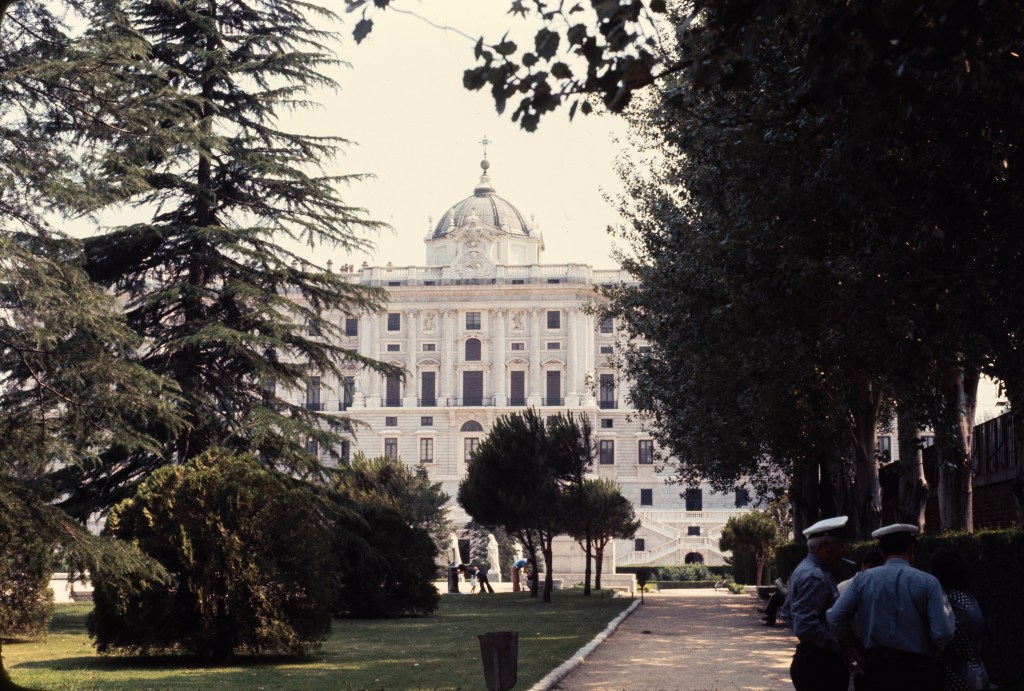
Royal Palace of Madrid, 1976
Sabatini Gardens, Madrid, 1976
The first lesson I learned was don’t be hungover as a tourist. A pounding headache and an unsure stomach turned out to be poor companions while touring Madrid’s architectural marvels on my second day in Spain. The day before at lunch, I split a small bottle of white wine with a friend, and at supper we split a small bottle of red wine. I never drank in the States because I was seventeen, but in Europe I wasn’t breaking the law, so I decided to embrace the whole experience, which is why I tried white wine at lunch and red at supper. In the evening a group of us went dancing. While disco music and colorful lights pulsated around the nightclub, and we danced with Spanish teenagers, I drank two screwdrivers because that is what my friends were drinking.
The next morning, a chaperone banged on our door, rousting us for breakfast. Startled, I sat upright in a finger’s snap. My head lagged behind, pounding as it tried to keep up with my body. Most of the day I had a throbbing headache. I didn’t throw up but the possibility was a nagging pest. Thousands of miles from home and only seventeen, I decided to experience Europe without hangovers, so if I drank at all, I limited myself to no more than one or two drinks in a day. I carried the lesson back home with me and even after I turned eighteen and could legally drink, I never forgot about my second day in Madrid.
Don’t be hungover in life.
Lesson Two: Even Muscle-Bound Bulls Have Feelings
Madrid, Spain, 1976
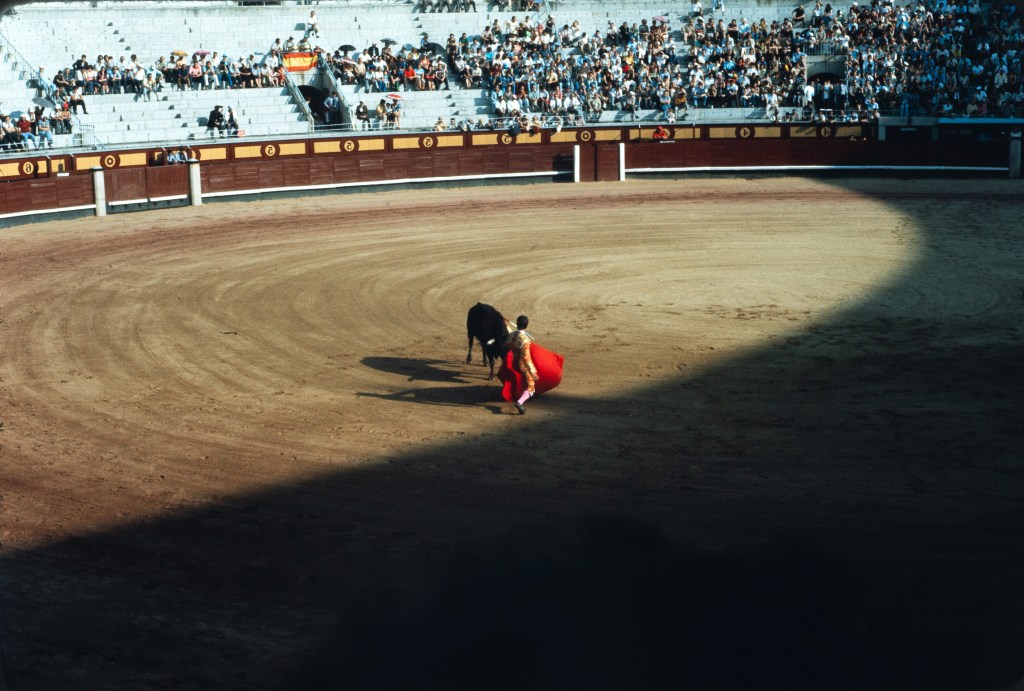
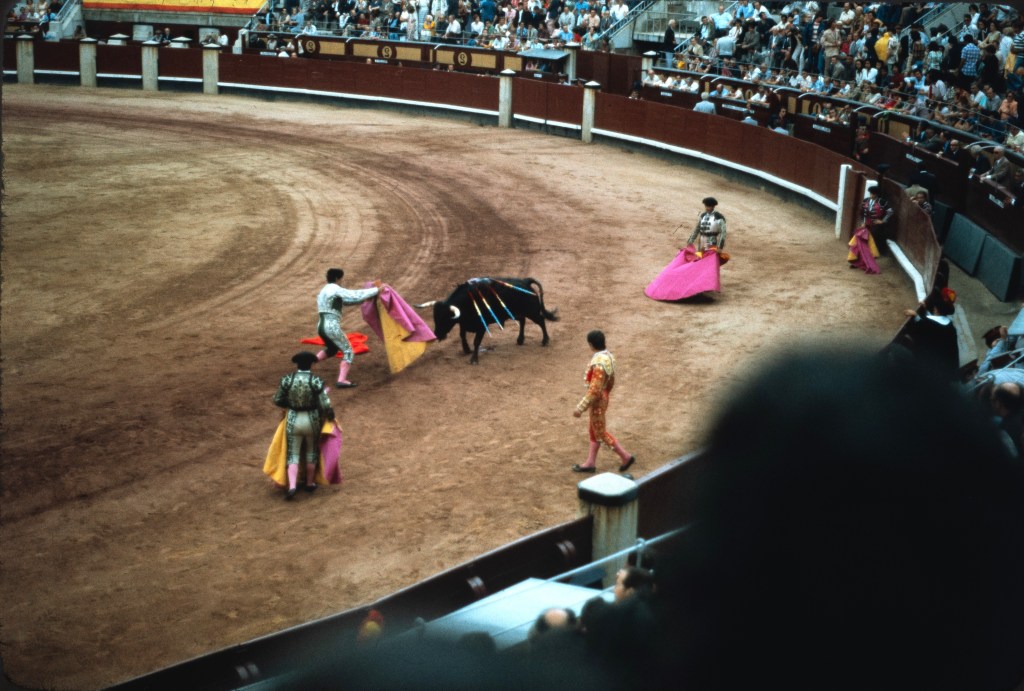
In Madrid we went to a bullfight. Attendance was optional because even though bullfights were part of the Spanish culture, the pretense of masculinity and bravado they symbolized had begun to dissipate as more people spoke against the cruelty suffered by the bulls. I decided to go because it was a Spanish tradition. I don’t remember if the bull died, but the matador didn’t. The stadium, crouching under the Mediterranean sun, became a cauldron of heat. I didn’t like hot weather, and I was sorry I had come. Why would anyone sit in the scorching sun to watch a choreographed drama between a sidestepping matador dressed like a golden baroque candlestick swirling a red cape and an incensed bull snorting like a diesel engine?
We had been told it was a nuanced battle, steeped in meaning. Clearly, I didn’t get it because that afternoon I decided if the object was to kill the bull, it was a show of pointless machismo. I sympathized with the bull, who unlike the matador or me, had been given no choice about where it wanted to be on that blistering afternoon. I concluded that any competition, legal or not, that humiliated or sacrificed animals in the name of amusement was wrong. But I couldn’t throw stones because I knew Americans had their dog fights and rooster fights and probably other types of fights.
Madrid 1976
As an adult, while watching cartoons with my children, I discovered Ferdinand the Bull, a Disney animated short that won an Oscar in 1938. Ferdinand wouldn’t fight. He wanted only to smell flowers. He so enraged the bullfighters they simply took him back to his green fields filled with flowers. Ferdinand was a consummate pacifist.
Don’t go to bullfights or dog fights or rooster fights.
Lesson Three: If You Don’t Know the Language, Don’t Insult Those Who Do
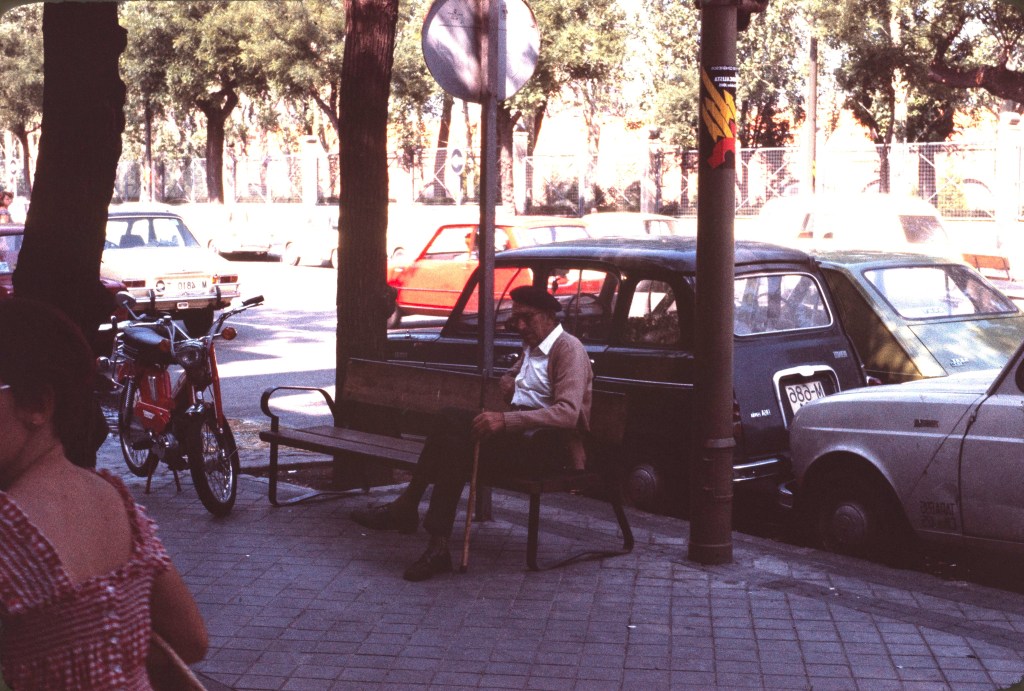
Man on a bench, Madrid, 1976
Mr. Z., who had been my freshman history teacher came on the trip as a chaperone. He was passionate about history, which I had liked about him. But he had a condescending manner that he dressed up as humor, often unsuccessfully, and that I didn’t like. His manner of off-handed superiority almost got him thrown out of a restaurant in Madrid. Tom and Gene, teachers from a neighboring high school, who were seasoned chaperones, often took us to restaurants that catered to locals instead of tourists. The food was usually excellent and the prices reasonable. But this meant staff at the restaurants rarely spoke proficient English. However, between Tom and Gene, we always had someone who could speak Spanish, Italian, German, or French, someone who could help with the pesetas, liras, shillings, or francs.
Firemen in Madrid, 1976
At this particular lunch, after listening to Tom speak Spanish with the waiter, Mr. Z., who probably suffered from a bit of insecurity after being shown up by a multi-lingual, seasoned traveler, declared, “It’s easy to speak Spanish. You just add an o or an a to the English word. So, soup is soupa.” Not quite, but no one corrected him. During the lunch, Mr. Z. needed butter for his rolls, but instead of asking Tom to talk to the waiter, he decided to ask the waiter directly. Applying his theory about the simplicity of the Spanish language to the word butter, he waived the waiter over, looked at him, and uttered a word that came out sounding like the Spanish word burro, meaning donkey. The waiter’s face went red, and his words, rapid and angry, crashed like falling rocks, frightening Mr. Z., who at least had the good sense to stop talking and look nervous.
Tom, fluent in Spanish, straightened out the mess. Understanding the arrogant American hadn’t meant to call him a donkey, soothed the waiter a bit, but Mr. Z.’s insult to the Spanish language still rankled him. To Mr. Z.’s credit for the rest of the trip, he didn’t try to speak Spanish or any other foreign language, but he should have known better. He had been to the same pre-trip meetings the rest of us had been to. We had been told that many Europeans looked down on Americans who expected everyone to speak English, yet couldn’t be bothered to learn another language themselves. Perhaps Mr. Z. wanted to soothe his bruised ego, or maybe he wanted to be funny, but either way he failed.
Yesterday morning I asked my dog, Ziva, if she wanted to go for a car ride. Of course, she said yes. She’ll go anywhere in the car, around the block or on a ten-hour trip to Petoskey, Michigan. She is just happy to be included.
We had three errands to run: go to the post office, go to the bank, and pick up my grand-dog Nellie. Before we could do any of those things, Ziva and I had a mishap. In a residential neighborhood, a speeding truck pulled out in front of us. Not only was the driver speeding, but he couldn’t see us as he approached the street that I was driving on because several thick evergreen trees grew on the corner of the lot. When he did see us, he drove even faster to avoid us, which was the better choice because he could not have stopped in time.
I was already going slow, but I had to use a heavy foot on the brakes, causing Ziva to slide from the front seat onto the floor. After I stopped, I honked my horn loud and long. The man stomped on his gas pedal, zooming away like an Indy race car driver after the green flag waves. If he thought he was fleeing from an angry woman, he was right. Had I been alone in the car, I would not have honked at him, as my honking would have come too late to serve as a warning. But my dog was tangled up on the floor, struggling to regain her footing. I used my horn to scream at him.
Ziva gingerly worked to untangle her feet. She slowly climbed back up on the front seat. Nothing appeared to be broken. For a moment I wondered if she would ever want to get in a car with me again.
Fritz, the dog who never forgot, Christmas 1962
When I was almost one, my mother had a car accident. Our two-year-old German Shepherd, Fritz, and I were in the car. After the accident the car was not drivable, but other than my mother having some cracked ribs, everyone was fine, including Fritz, who had been sleeping when the accident occurred. He never forgot that accident or that he had been sleeping instead of on guard. Afterward, if my mother was driving, no matter how long or short the journey, Fritz would sit on the seat and watch the road. His head might bob and his eyelids might droop, but he would jerk himself back to consciousness if he momentarily drifted off. If my father drove, Fritz would curl up and go to sleep. Fritz lived to be fifteen years old, and he never again slept in the car when my mother drove.
Nellie and I settled on the couch for some reading time. December 16, 2024
Ziva and I finished our errands then picked up Nellie. I was glad my grand-dog hadn’t been in the car when I had to slam on my brakes. She has an excellent memory, and in the future she might have become reluctant to get in my car.
As for Ziva, she was more than happy to get back in the car when we took Nellie home. And later on when I went to the grocery store, she was excited to ride along. She blamed neither me nor our car for her mishap, and she had been oblivious about the stupid, lead-footed pickup driver.
But after Ziva got up this morning, her head was crooked and she couldn’t seem to hold it straight, and when she walked, her gait was awkward. So, I decided to stay home with her. She ate a good breakfast, and after she moved around a bit, her stiffness disappeared and her head righted itself. People are always stiff and sore the day after an accident, so it would make sense animals would be the same.
Ziva is taking her morning nap as I write this. She’s happy to have me at home, and I’m happy to be with her. She is almost fourteen years old, and this morning, for a brief moment, I worried something might be wrong with her that couldn’t be fixed. After all, falling hurts more when we get older. We don’t bounce as well.
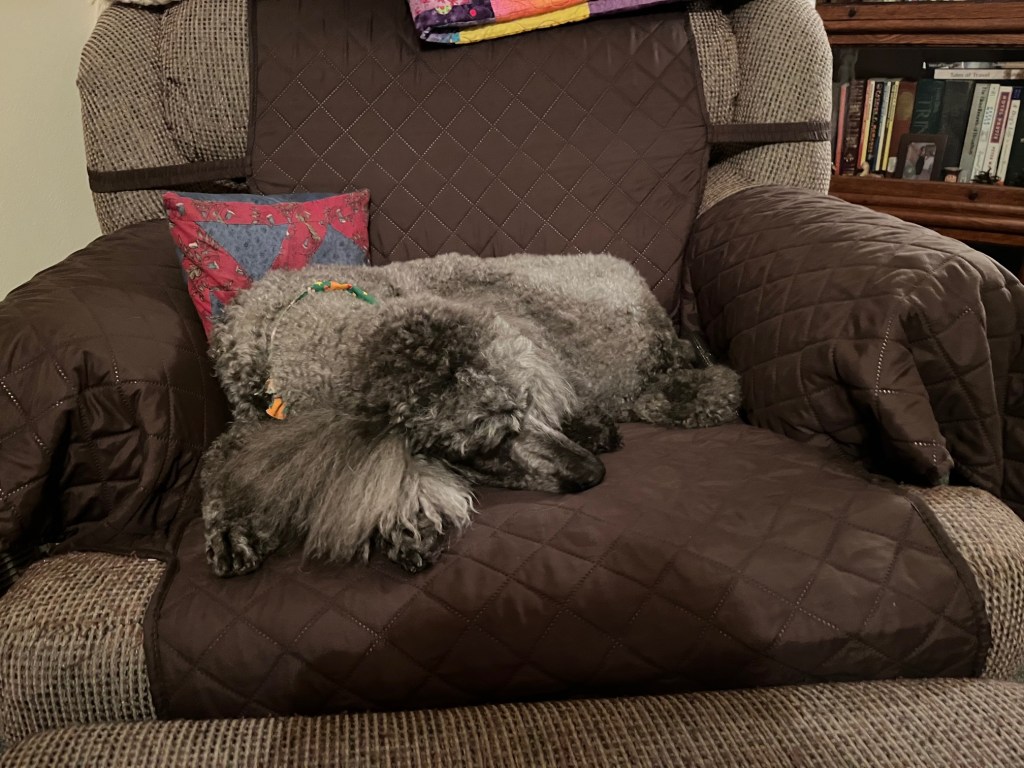
Ziva enjoying a good snooze after breakfast, resting up for our walk. December 17, 2024
A Place for Fido, Fitgers, Duluth, Minnesota. The stuffed toy display is straight ahead on the left.
Yesterday I went to a boutique pet store to buy my grand-dog Nellie a stuffed toy for Christmas. Next to the toy display stood a black, brown, and white, medium-sized dog. The dog looked at me and wagged its tail. Its big brown eyes were merry and its toothy smile was bright, so I asked its people, “May I pet your dog?”
“Of course,” said the woman, “she loves that.”
After petting the dog, I turned to the toys. I wanted one that didn’t squeal, squeak, groan, moan, or crackle because when my grand-dog sinks her teeth into one that makes noise, she is relentless.
The tri-colored dog turned with me. She watched me select toy after toy and squeeze it. The dog and I began a conversation.
“This one’s too high pitched,” I said to her.
“It sounds good to me. I like that toy,” the dog’s eager face said.
“This one makes a low noise,” I said. “It might work.” I kept it in my hand instead of hanging it back up.
Yeah, don’t even think about it — my grand-dog is cuter than your grand-dog.
“It sounds good to me. I like that toy, too.” The dog’s eager face filled with anticipation. She wanted a toy, but she was too well-mannered to do more than drop a hint. (My grand-dog is a Vizsla and she would have reached up and grabbed the toy. She’s not rude, mind you. She’s very, very sweet, but she’s a Vizsla. They’re impulsive. They’re enthusiastic. They’re larger than life.)
I tested toy after toy, telling the dog that each one was too loud, and each time the dog looked at me and the toy in my hand and answered, “It sounds good to me. I like that toy.”
I looked at the dog’s kind face. “My grand-dog will drive me crazy with these toys,” I told her. I decided even the toy that made a low noise was too noisy, so I hung it back up. I walked around the back of the display to see if there were more toys.
At this point I realized I’d been talking with the dog for several minutes while her owners looked at products on a display rack opposite the stuffed dog toys. Other than asking for permission to pet their dog and telling them I had a dog at home, I’d ignored them. It occurred to me this might be considered rude. It occurred to me that carrying on a conversation about noisy dog toys with a dog I’d just met might be considered strange. But in my defense, the dog was a good conversationalist.
I turned to look at the dog’s mother. “I guess you might think I’m a bit strange, standing here in a store having a conversation with your dog.”
“Not at all.” The woman smiled warmly. “I talk to her all the time. I would think it strange if you didn’t want to talk to her.”
Nice of her to say. I talk to my dog all the time too.
The owners and their dog moved on. And I wondered if they had stayed longer than they had wanted, thinking it rude to interrupt their dog’s conversation with a lady who was trying to find the right toy for her grand-dog.
I did find the right toy for Nellie. A nice clerk helped me find the only toy in the store without a squeaker. It looks like a cross between a squirrel and a beaver. Maybe it’s a woodchuck. Doesn’t matter. It’s nice looking, well-made, and quiet.
Ziva, September 2024. She’s loving the pâté.
I didn’t forget about my dog, Ziva. She’s not interested in toys, so I bought her two fancy-schmancy cans of dog food: Venison and Lentil Pâté and Lamb Recipe in Bone Broth. Both sound as though they should have come with a footman from Downton Abbey to dish up her food.
A heart without a pet is just an empty cockle shell.
When I returned home from A Midsummer Night’s Dream, a mystical moonscape greeted me.
Last night I went to see a high school production of A Midsummer Night’s Dream. Student actors dressed in colorful, eclectic, whimsical costumes, creating shimmering visions on the stage. They recited Shakespeare’s verse, never stumbling over their words. As the love potion delivered by Puck caused chaos and confusion, the energetic actors made their way on and off the stage, delivering humorous lines, catching the audience up in laughter. All of this on a stage decorated with cut-out trees so enchanting in their color changes, they almost stole the show.
During the quieter moments of the performance. I thought about the many high school and college plays I have seen over the years. All of those young people working together to create a moment of magic on a stage. A moment that would never be the same as the performance that came before, or the one that would come next. I thought about the long hours drama students spend rehearsing, creating sets, lighting the performance, making costumes. How they pass their time together, forging friendships and romances, talking about life and their dreams. Cracking inside jokes that only they understand, the bond of a shared experience. I thought about how young they are, with their whole lives ahead of them. I thought about how once these young thespians leave high school or college, they might never act upon a stage again.
Then I thought about Tom Lake by Ann Patchett, which I recently read and loved. Tom Lake is a story within a story. Lara Nelson, now in her fifties, owns a cherry orchard with her husband. Set in 2020 during the COVID lockdown, Lara’s three adult daughters are staying at the farm with their parents. Because of the pandemic, the family of five works the cherry farm without the usual hired help. Picking cherries is time-consuming, monotonous work. To pass the time, Lara, in a series of flashbacks, recounts the story of her summer in Tom Lake, where as a young woman she performed in a summer stock production of Our Town by Thornton Wilder. Even though Patchett’s novel is set during COVID, it’s not about the pandemic–at all. It’s a beautifully written, heart-wrenching coming of age story.
Last night as I watched the young actors perform, I wondered about their coming-of-age stories. I thought about my own coming-of-age stories.
And that is what good literature does. It slumbers in a corner of your brain, until something in your present world nudges it, and it lives once again in your imagination, giving meaning to both the world that is your life and the world of make believe.
I forgot to take a picture of the pancakes after they were fresh out of the pan, but I think the dogs are more interesting! Ziva (l) and Bogey (r), my mom’s dog
After I made the Pumpkin Bundt Cake, I had six ounces, or 3/4 of a cup, of pumpkin left. (Cooking math is the most important kind of math, and if I could go back in time to my freshman algebra class, I would tell Mr. W, “Who cares about solving for x — there is no x in cooking!”)
So, what to do with the leftover pumpkin? I hate to throw food away. It’s like throwing money in the garbage. And there are other more important considerations when food is thrown away. The waste ends up in landfills. The energy used to raise, cultivate, package, and distribute the food has been wasted. All that investment and those expended resources with no caloric intake to show for it. And as weather patterns change, food will become more scarce.
My husband suggested I make pumpkin pancakes, so I found a recipe that called for a 1/2 cup of pumpkin. All you math phenoms will know this left me with two ounces or a 1/4 cup of leftover pumpkin. (Now, I’m just showing off my math skills.)
This morning I made a batch of pumpkin pancakes, which yielded nine pancakes. We have a few leftover, but my husband will eat them. I put sliced bananas and maple syrup on mine. My husband opted for butter and maple syrup on his.
I still have two ounces of pumpkin. I could try making a pumpkin spiced latte, but that looks like a lot of work, and I don’t have anything to froth the milk. I could try feeding some to my dog, Ziva, but she’s turned her nose up at pumpkin in the past. I could just eat it. I tried a teaspoon when I made the cake, and it’s not bad. The two ounces are back in the fridge. I think I’ll mix them in with my oatmeal along with a sliced banana.
Simply Pumpkin Pancakes
Ingredients
Yields 4 servings of two pancakes each. (I ended up with nine pancakes.)
1 ¼ cups all-purpose flour
¼ cup white sugar
2 teaspoons baking powder
½ teaspoon ground cinnamon
¼ teaspoon ground nutmeg
1 cup milk (I used whole milk)
½ cup pumpkin puree
1 egg, beaten
1 tablespoon vegetable oil
Directions
Sift flour, sugar, baking powder, cinnamon, and nutmeg together in a bowl.
Whisk milk, pumpkin, egg, and oil together in a bowl. Pour milk mixture into flour mixture and stir until just moistened. Batter will be slightly lumpy.
Heat a lightly oiled griddle over medium-high heat to 350 degrees F. Drop batter by large spoonfuls (I used a ¼ measuring cup) onto the griddle and cook until bubbles form and the edges are dry, 1 to 3 minutes. Flip and cook until browned on the other side, about 1 minute more. Repeat with remaining batter.
Yesterday I made a pumpkin bundt cake from scratch. I discovered the recipe on the blog In Diane’s Kitchen. I’m proving a point to Betty Crocker.
On Tuesday I called Betty Crocker. Well, not a real Betty Crocker because she doesn’t exist. Instead, I talked to a representative in the General Mills customer care department. I lodged a complaint because Betty Crocker cake mixes have shrunk — again.
For most of my life, cake mixes were 18.25 ounces. I have some great cake recipes that call for an 18.25-ounce cake mix and build from there, like a decadent chocolate rum cake and a tasty pistachio cake. So about ten years ago when the cake companies dropped the mixes to 15.25 ounces, I wasn’t happy. At the time, I called Betty Crocker and Duncan Hines to complain. (Unlike Betty Crocker, Duncan Hines was a real person, but he died in 1959.) Neither company cared that I was concerned my cake recipes could become obsolete — 15.25 was their new standard. They weren’t rude, not at all. They were apologetic and sympathetic, but I could read between the lines — I could like it or lump it. (The phrase customer care is an oxymoron.) Fortunately, my cake recipes still worked with the 15.25-ounce size.
But last week I discovered there has been another shrinkage. Betty’s cake mixes are now 13.25 ounces. So far Duncan Hines is still weighing in at 15.25 ounces, as is Pillsbury. When I called Betty Crocker’s consumer care department on Tuesday, I told them I would no longer buy their cake mixes. I explained that I wasn’t about to experiment by using a cake mix that is 5 ounces less than the amount called for in the recipe. I further explained that if other companies followed suit, I would make all my cakes from scratch because I have some good recipes. The customer care representative was sympathetic and kept saying, “I’m sorry about that.” She said she would pass my concerns along. But I know nothing will change, except in the future when the cake mix loses more weight.
You can google to find out how much extra flour and other ingredients, like baking soda, to add to the prepared mix. But go ahead and call me “my father’s daughter” on this one: I’m not buying a product then adding what the company should have added in order to make up the difference. One website suggested buying two boxes of cake mix, and adding six tablespoons from the second box to the first box. Then I was to seal up the leftover cake mix and save it to use for other cakes. AS IF!
So yesterday to prove my point to Betty Crocker, I made a pumpkin bundt cake — from scratch. Because I follow the blog In Diane’s Kitchen, the recipe landed in my email a couple of weeks ago. Pumpkin mixed with a dash of cinnamon, ground cloves, and ground ginger makes this cake taste like a slice of autumn. It has the consistency of a pound cake, which pairs well with coffee. And, in my experience, baking a pound cake is more forgiving than baking a regular cake.
Some thoughts to keep in mind if you make this cake:
Diane recommends eating the cake with vanilla ice cream. I’d go with a creamy vanilla custard. However, this recipe calls for three sticks of butter and six eggs, so I skipped the ice cream. I’ve never baked a cake recipe that called for six eggs. This reminded me of one of my all-time favorite novels City of Thieves by David Benioff. Set in Russia in WWII, the two main characters in the novel have been arrested and are to be executed. However, a powerful Soviet colonel promises to pardon them if they can find a dozen eggs for his daughter’s wedding cake. There is war and famine, but the colonel wants his daughter to have an elegant wedding and a big cake, and so an epic quest for a dozen eggs begins. And this bundt cake? That might serve twelve people at the most? It gets six eggs!
The recipe Diane shared says to spray the bundt pan with cooking oil. I used Baker’s Joy. When it was time to remove the cake from the pan, it came out like a dream.
Diane noted that while the recipe said to bake for 60 minutes, she needed to bake the cake for 64 minutes. So did I, but I started with 60 minutes.
I will make this cake again. It was worth the extra time and effort. Besides while I made the cake, I listened to A Lady’s Guide to Gossip and Murder, the second book in Dianne Freeman’s Countess of Harleigh Mystery series.
[To read my review of Freeman’s first book in the series, click here.]
Look carefully. Grandchild #3 is nestled between the fish.
My grandkids didn’t have school today, and they don’t have school tomorrow, so they came to my house. I was hoping for nice weather because I planned to take them on a hike to Lost Falls in Cornucopia, Wisconsin, today, and to Cascade Falls near Grand Marais, Minnesota, tomorrow. But rain, cold, and winds up to 30 mph said differently.
Instead we went to the mall. Our first stop was the bookstore, where I bought each grandkid two books for Halloween. Then we hiked to the indoor playground. While they played, I took out my book — A Samuel Pepys Mystery: The Brampton Witch Murders by Ellis Blackwood — and I began to read.
About fifteen minutes later, my first grandchild came for her book — Dipper’s & Mabel’s Guide to Mystery and Nonstop Fun! — and she began to read.
A few minutes after that, my third grandchild came for his book — The Wild Robot by Peter Brown — and he began to read.
Not to be left out, my second grandchild came for his book — Demon Slayer Kimetsu No Yaiba #1 by Koyoharu Gotouge — and he began to read.
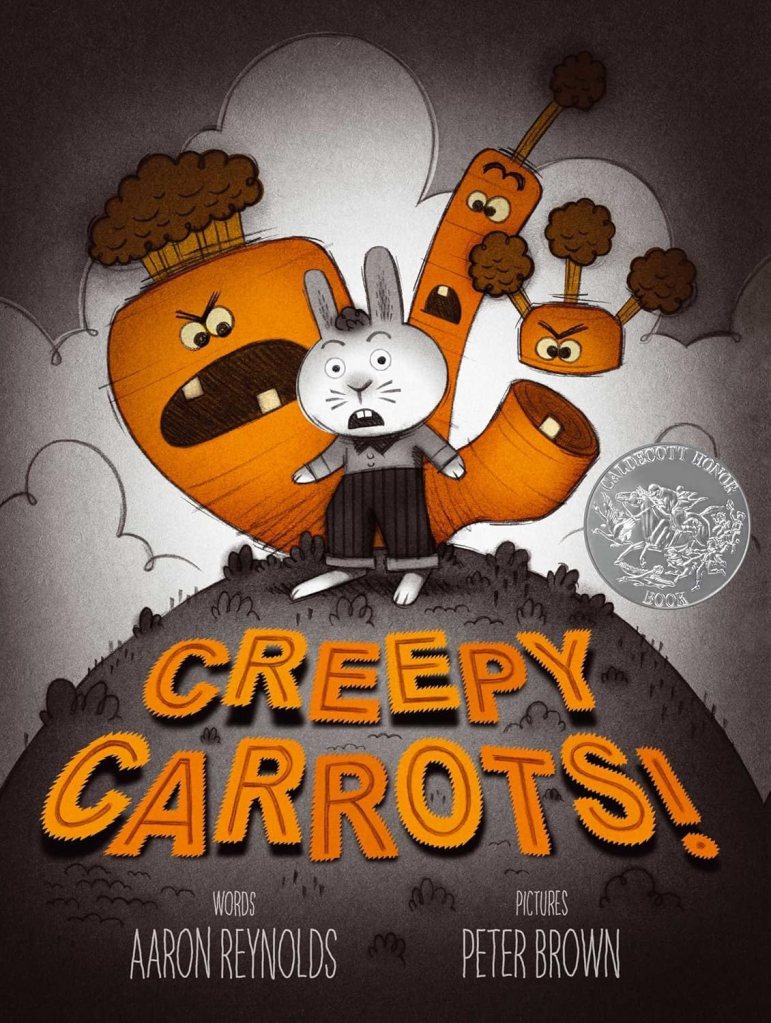
My fourth grandchild ignored the trend and kept playing on an interactive screen. He enjoys its puzzles, games, and coloring app. He read his book — Creepy Carrots! by Aaron Reynolds — on the way home.
I didn’t give my grandkids candy for Halloween. They’ll get a stash of it tonight when they trick or treat in the rain and cold and wind. I gave them candy for the imagination.
















 Writing Near the Lake