I’m reading through a manuscript of short stories, one hundred fifty-two pages, double-spaced, Times New Roman, one-inch margins. I’m reading each story out loud, listening to the beat of the words and the rhythm of the phrases and clauses. This is a good way to find discordant sentences. It’s also a good way to find typos, misused words, and missing words. It gives me more time to agonize over commas. Sometimes I add a few words or sentences because something needs saying, and other times I snip a word or two because I’ve been redundant. Or I snip a sentence or two or three or a whole paragraph because I’ve discovered they are little darlings masquerading as part of my story.
But I’ve read this manuscript out loud so many times that the changes I make now are miniscule. Yet, I’m reading it again, one more time to make sure. Before May 31, I will submit my manuscript to a contest for short story collections. I want it to be as error free as possible. I want each story to be the best that I can make it.
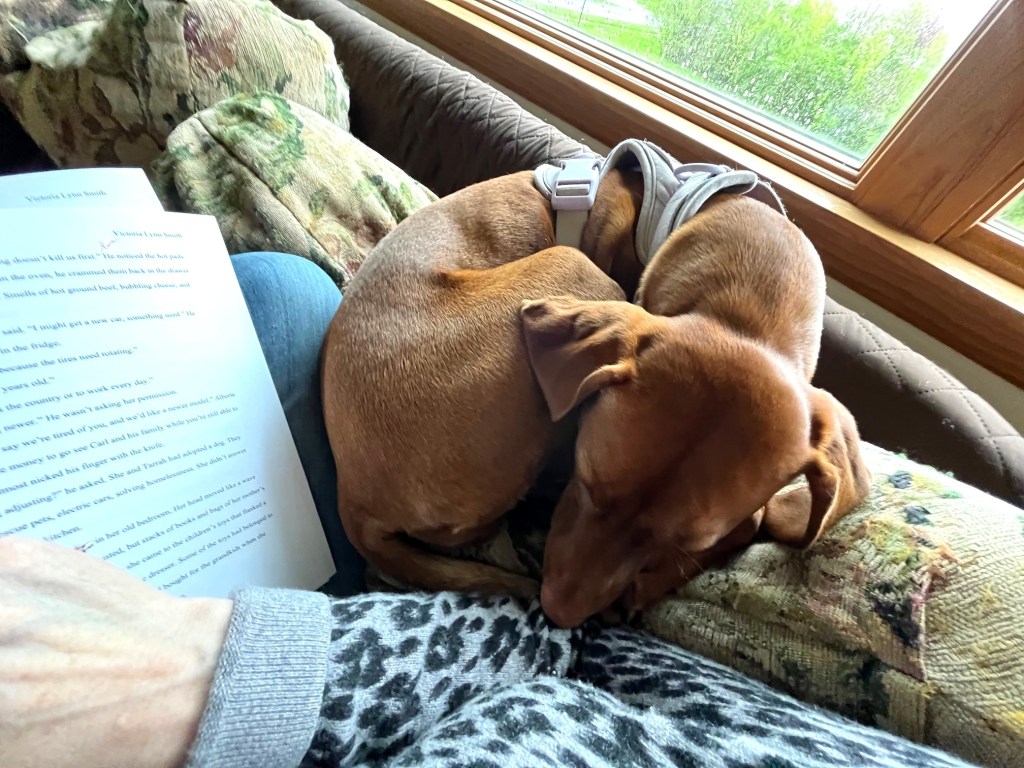
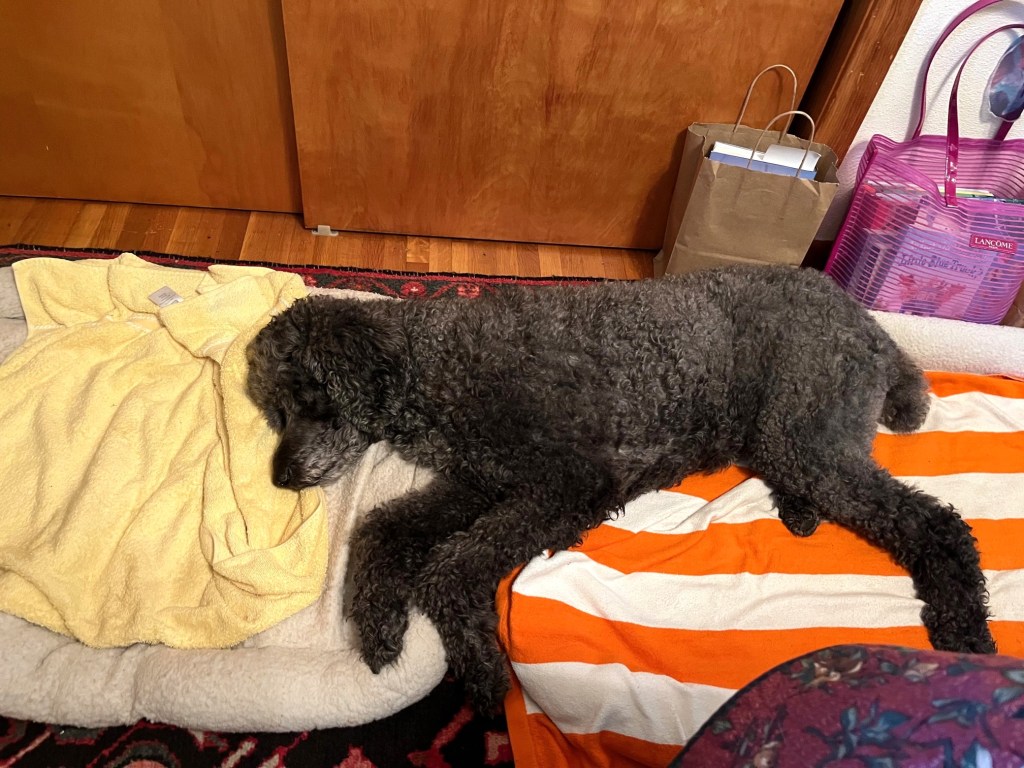
Yesterday evening I sat on the couch with my granddog, Nellie, who listened to me read. And to show her support, my dog Ziva lay on the floor and listened.
The dogs were a willing audience. After all, I’m the giver of treats and walks. And should I have gotten up from the couch, they wanted to be near in case I headed to the treat bowl or grabbed their leashes.
A friend of mine asked, “What did the dogs do when you read to them?”
“They fell asleep,” I said.
“Oh, no,” she laughed, “that’s not good.”
Yep, the dogs keep me humble. But their love is unconditional, especially when reinforced with treats. They are content to be with me, and I love reading to them. They are a kind, loving audience. They don’t care if I struggle with commas, words, rhythms, and little darlings. They don’t care what happens to my manuscript. (Although, if I put it on the floor, Ziva might shred it because she loves to shred paper.)
By the way, after reading one of my stories, I fell asleep too. Nothing like napping with dogs after a good story.
Photo: Max Youngquist, 2024 Instagram@maxyoungquist
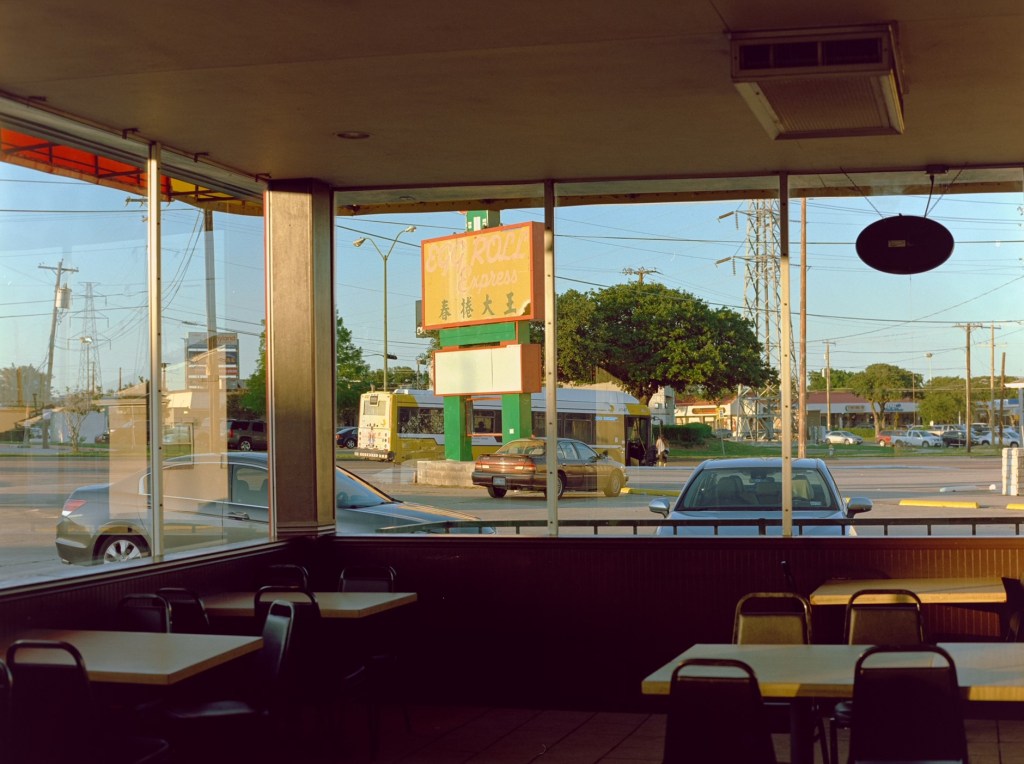
My nephew took this picture. He said that at first he wasn’t very impressed with the photo, but after looking at it for a while, he started to think it wasn’t bad.
I fell in love with his photo from the moment I saw it. “This photo,” I told him, “is full of stories.”
Some photos capture the beauty of a bird on the wing, or a sunset over an ocean, or a flower in the breeze, or a Japanese tea set at rest on an oak table. Those photos can be works of art, and we love them for their composition, study of light, and subject matter, but they are not a story in themselves, though they may evoke one.
My nephew’s photo is a story — even more than that — it’s a collection of stories. “This” I said, “is the kind of a picture a photojournalist takes because he or she is telling a story about a place or event or people.” Then I told him about all the stories I saw in the photo.
My nephew is a wonderful photographer. I love his work. I love to listen to him talk about his digital and film cameras. He develops both black-and-white and color film. He speaks of camera settings, film speeds, and film brands. Focus, depth of field, and lighting. And I understand enough of it because I took art photography and photojournalism classes in college, enough of them to minor in photography, if I’d only been willing to take an art history class. I loved photography, but not enough to make it a passion or career. Today my camera phone is all I need. But my nephew’s eyes are lens, always framing a shot. He has developing fluid coursing through his veins. And like a true artist, he experiments.
And with this photo, he has inspired me. I’m composing a story set inside of this moment he captured.
Photograph as a collection of stories. Tales about inside and outside, darkness and light, illumination and shadow. Stories of three cars pointed toward different journeys, a bus releasing and corralling commuters. Glassed reflections recounting illusions, faded signs whispering of past triumphs and failures. Photo by Max Youngquist
[Max asked me to write a blurb about his photo to post on Instagram. What I wrote is in the photo’s caption. You can see Max’s work on Instagram @maxyoungquist]
When I posted my thoughts yesterday about the twelve Raymond Carver stories I liked, I discussed, from a craft standpoint, what I believe makes those stories so good.
Someone pointed out to me that some of Carver’s stories were heavily edited by his editor Gordon Lish. I was aware of that, having read about it a handful of years ago. But I made a decision to keep the Carver-Lish editing relationship out of the blog because I wanted to focus on what worked in those stories for me. I wanted to write about what I took away from those stories as far as craft. Also, I have no idea which stories on my list were written by Carver when Lish was his editor, and which stories were written by Carver after he stopped working with Lish. Or which stories might be printed as Carver originally wrote them.
I didn’t want to get into the conversation about Carver and Lish because that wasn’t the focus of my blog. But after thinking about it for a day, I should have made mention of the writer-editor relationship between Carver and Lish, so my readers could decide if they still wanted to read the stories. Because I knew about Carver and Lish’s working relationship before I decided to read the stories, I should have let my blog readers know. However, either way, whether a story on my list is solely written by Carver or one written by Carver then heavily edited by Lish, making it more of a collaboration, I still love these stories and admire their craft. And the stories stick to my ribs.
A friend of mine gave me a used copy of Where I’m Calling From: New and Selected Stories by Raymond Carver. She had picked up the book from the free shelves at our library, which is a section of books that have been donated by people who need to make room in their homes for more books. Anyone can come in, peruse those shelves, take what they want, and leave — no library card needed. People can keep the books, pass them along to friends, or donate them back to the library. Note: I’m keeping the copy of Carver’s short stories. My heirs can argue over who gets to inherit it.
My paperback edition of Carver’s stories was published in 1989 by Vintage Books: A Division of Random House. My particular copy has an intense black-and-white photo of Carver staring at his readers. The whites of Carver’s eyes are abnormally bright, suggesting an effect created by the photographer. Carver is neither smiling nor frowning, but looks like he could have done either after the shutter clicked. Every time I look at his photo, I wonder what he is thinking. This book is still in print, but the updated cover art isn’t nearly as interesting as Marion Ettlinger’s photograph of Carver, with its Mona Lisa vibe.
After my friend finished reading Carver’s book, she thought I’d like to read it. Sure, why not. I hadn’t remembered reading any of Carver’s work before. (Probably not the only gaping hole in my literary education. I still haven’t read a single Colleen Hoover novel or War and Peace.)
There is no way I’m going to take on reviewing Carver’s short story collection. Literary critics have done that. But having read the book, cover to cover, I feel compelled to share some thoughts.
If you write short stories, you might want to read Raymond Carver, not because you need to write like him, but because you will learn about craft from him. So here, and in no particular order, are random thoughts about Carver’s stories:
He writes great dialogue, conversations filled with irony, skepticism, avoidance, misunderstandings, and sarcasm — the way angry, unhappy, disillusioned, conflicted people talk.
He writes great first-person point of view narration. It’s not easy to create a character’s narrative voice that can reflect, ponder, and think about the past and the present without becoming oppressive or irritating. It’s a skill that when done right looks so easy, but when done wrong sounds like fingernails scratching on a chalkboard.
He creates characters who come to life, stirring up emotions of dread, disgust, helplessness, loss, confusion, regret, grief, boredom, uselessness, and addiction. Carver has been called a postmodernist and a minimalist. He writes about real life in a stark manner with bruised and broken characters, leaving readers to fill in between the lines, and he doesn’t provide tidy endings. But you don’t need to go all postmodernist to admire and learn from Carver’s character development.
I read Carver’s stories before bed. Some of his characters drank so much alcohol, I worried I would be hungover in the morning. They lit up one cigarette after another, filling ashtrays to overflowing. Occasionally, a joint gets passed around. The dulling of the senses is a motif in many of Carver’s stories, but it’s usually not the story. It’s an atmosphere created, one that made me psychosomatically nauseous as I read through a powerfully told, unsettling story.
I didn’t like all of Carver’s stories. To me, some of them were little more than a short conversation, and I felt something was missing. This was especially true when the dialogue pulled me in, making me want more of a story. Most of the stories I didn’t like were in the first part of the book, but I kept reading because it was Raymond Carver, who is considered one of the finest short story writers in American literature.
But I loved a lot of his stories, usually the longer ones, which were in the second half of his book. My favorites from this collection: “The Third Thing That Killed My Father Off”, “So Much Water So Close to Home”, “Careful”, “Where I’m Calling From”, “Chef’s House”, “Fever”, “Feathers”, “Cathedral”, “A Small Good Thing”, “Boxes”, “Elephant”, and “Blackbird Pie.”
Carver’s story titles throw subtle, understated jabs at the situations in his stories. The title “A Small Good Thing” nods to a sad irony in a tragic story. The title “Where I’m Calling From” is layered with multiple meanings, including its play on the phrase, where I’m coming from. The one-word title “Boxes” is brilliant in its ability to cover the physical and the metaphorical dimensions of a dysfunctional family.
Carver sometimes weaves absurdly unexpected events into the mundane. And they’re believable because Carver believes them. For example, in the story “Feathers” a city couple goes to dinner at a country couple’s house. The country couple have an ornery peacock that likes to come into the house at night, a plaster-of-Paris cast of repulsive teeth that decorates the top of their TV, and the ugliest baby one can imagine. My take-away: Don’t be afraid to throw curveballs in your story.
Even though some of Carver’s characters believe they are happy, they actually live vapid lives, teetering in the balance. So, when a complication occurs, their lives become complete crap, miring them in muck that will stick to them, even should they pull themselves out of the cesspool. The stories I liked best reveal a before, followed by a pivotal change, which lets loose a wrecking ball headed toward at least one of the characters. We don’t get to see the impact; we are left to imagine it.
Less is more. Carver’s stories say so much by not saying all of it. Every word counts for something, and he never nags. I’m reminded of Grandma’s advice: Put your jewelry on, then take one piece off. Or Marilyn Monroe’s advice: Don’t make your hairdo too perfect, or no one will notice the rest of you. You know, just “kill your little darlings.”
Of course, I looked up Carver’s own story. He died of lung cancer. He was an alcoholic, but found sobriety. He had a failed marriage, but found a second love. He died young, at 50, but he achieved a literary immortality.
A shout-out to my kind friend who handed me a collection of Carver’s stories and said, “I thought you might like to read these.” She was right.
And I recently discovered I won’t have to read War & Peace because PBS is airing it as a miniseries, starring James Norton, a dreamy British actor, who I came to adore while watching Grantchester. That means I have time to re-read David Copperfield and Huckleberry Finn then read Demon Copperhead by Barbara Kingsolver and James by Percival Everett.
I recently finished a short story, and for the past few weeks, I’ve been reading and rereading it and sending it to my favorite readers for feedback. After minor revisions and edits, I think it’s done. I’m happy with the story now. But I almost ditched it because I’d spent months (on and off) trying to figure out how to write this particular story. As proof, I have multiple handwritten versions in a journal and several other attempts saved on my computer. None of those drafts were salvageable.
I had decided to use present tense and third-person point of view. But I couldn’t find a way into the story — each draft lacked a beating heart. The real problem? My third-person narrator desperately needed a voice, and I couldn’t find one. I kept putting the story aside and working on other writing. And I kept reading: fiction, nonfiction, and short stories.
It would be a short story written by Raymond Carver that gave me an idea.
Although, if you read the Carver story, you might not see its connection to my story because our styles and voices are so different, plus his story uses past tense and first-person point of view. So, what was it about the Carver story that inspired me? Narrative distance. Carver’s first-person narrator tells his story from the distance of years gone by, even though there are some closeups. As I read Carver’s story, I became giddy. A hundred-watt light bulb lit up over my head. I’d found a way to tell my story. I needed to keep my narrator at a distance.
I began my short story anew — on a blank page, without even a glance at the other drafts. I did keep the present tense and third-person point of view, but I created narrative distance. It worked. That distance gave my narrator a voice, which in turn gave my story a heartbeat.
And I’m grateful because something about the story wouldn’t let me go. It kept pleading, “Just give me one more chance.”
Experienced writers tell beginning writers to write, write, write. They also tell beginners to read, read, read. I used to think if I read while I was writing, I would end up writing like the author I was reading. But that just doesn’t happen. Instead, I’m inspired. I pay attention to how an author crafts her story, from sentence to paragraph, from beginning to end. And sometimes (thank you, Raymond Carver), I come across a technique that I can apply to something I’m currently writing.
My essay “European Tour 101” appears in Tales of Travel, a Duluth Publishing Project. This collection of poems, creative nonfiction, and photographs center around the theme: Lessons Learned while Traveling.
The anthology was curated in early 2023 by talented University of Minnesota-Duluth students from a class taught by Professor David Beard, who gave his students the gift of a real-world project.
Participating in this project was fun right from the start. I discovered the call for submissions on a Facebook page. Right away I knew I would write about the month-long trip I took to Europe when I was seventeen years old. I had been itching to write about my European trip because I have fond memories of traveling through six cities, in five countries, in twenty-seven days. But I always wondered where I could submit the essays. My trip was too long ago to be relevant for travel articles. And my European tour wasn’t filled with angst or tragedy or mind-bending revelations that would be worthy of thought-provoking, rousing essays convincing editors to say, We’ve got to publish this!
But the theme: Lessons Learned while Traveling was perfect — proving if a writer is patient, sooner or later her submission mate will arrive. Some of my best memories from my European trip could easily be described as lessons learned.
Fortunately, memory didn’t prove to be a big problem because I have a scrapbook filled with postcards; pamphlets; ticket stubs from museums, trains, subways, and buses; my airline boarding pass; maps; menus; and receipts. Plus, I have lots of photos. I quickly came up with an idea for an essay, but I spent hours writing and revising. I wanted it to be perfect, so perfect that the editors would say, We’ve got to publish this!
I divided my essay into sections: Travel without a Hangover; Even Muscle-Bound Bulls Have Feelings; If You Don’t Know the Language, Don’t Insult Those Who Do; Patriotism is Fine, But Ditch It for the Ballet; Serenade Your Tour Guide; Be Alone with Yourself in a Place You’ve Never Been Before; and Freedom from the Threat of Violence.
I was thrilled when my essay was accepted. My fondest memories about one of the best times in my life would be in print. And out there in the world.
Making it even sweeter, Professor Beard and his students hosted a book lunch for the writers during the spring semester, even though the book wouldn’t be released until December 2023. But college classes change at the semester and the students who worked on Tales of Travel would be off to other classes or perhaps have graduated when the book came out.
Held in a university classroom, it was a wonderful book launch, and there were a couple of copies of the book that we could hold and thumb through. I’m sure each writer looked for their own piece of writing in the book. I know I did. We munched on cupcakes, cookies, and assorted chips, and sipped bottles of water.
Each writer was invited to read for about five minutes. Some of the students had pieces in the anthology, but I think only one or two of them read. When they were called upon, most turned a ghostly white, lowered their eyes, and shook their heads. They were too nervous to read in front of strangers, most of whom were old enough to be their parents or grandparents. But we older folks were nervous too. I could see it in our hesitant walks to the dais. I could hear it in our voices that trembled. I could feel it in our lungs as we reminded ourselves to just breathe. Because young or old, we shared a common wish — that someone would like what we had written.
After the reading, we all gave a collective sigh of relief. It was over, and no one had fainted. We mingled and thanked the professor and the students. When people started to leave, Professor Beard pleaded, “Please, have more food. Take some home with you.” He didn’t want to haul it back to his car.
I’d already had a cupcake, but I grabbed a bag of Fritos, my favorite salty treat. Something to savor on my ride home, along with the rest of the evening.
The editor of Perfect Duluth Day puts out a list every two years or so.
The “Guide to Duluth-related Blogs” was published in 2022 by Perfect Duluth Day, which is itself a blog, along with an events calendar and a section called “Saturday Essay,” where I’ve had three essays featured over the last couple years. But until yesterday, I hadn’t known that I’d been recognized as an active area blogger. This isn’t a prize or a big coup, but it made me smile like a red-carpet celebrity anyway.
In the photo to the right, I’m the blogger in the middle, standing in front of Lake Superior in Two Harbors, Minnesota, wearing my favorite raincoat, a raspberry red, flannel-lined Pendleton that I bought while shopping with my favorite aunt. My granddaughter took the photo.
I’ve been blogging since fall 2020. One Hundred and ninety-five people follow my blog. But out of those 195 followers, a certain percentage are hustling products. For example, I write about my dogs a lot, so occasionally companies who use blogs to market canine merchandise will “like” and “follow” my blog. Most likely an algorithm does this for them. And while I don’t write about makeup, skin care, or fashion, I have some followers who sell beauty products. Again, probably an algorithm, however misguided because I don’t wear makeup or use skincare products.
I don’t want to know how many of my 195 followers are companies trying to hawk products. Instead, I enjoy the people who interact with me via likes and comments. It’s heartwarming to know that something I wrote resonated with someone out there. So, thank you to all my readers. And thank you to Perfect Duluth Day for recognizing that I’m an active blogger in their area. As someone who knows she should get more exercise, it was nice to be labeled as active.
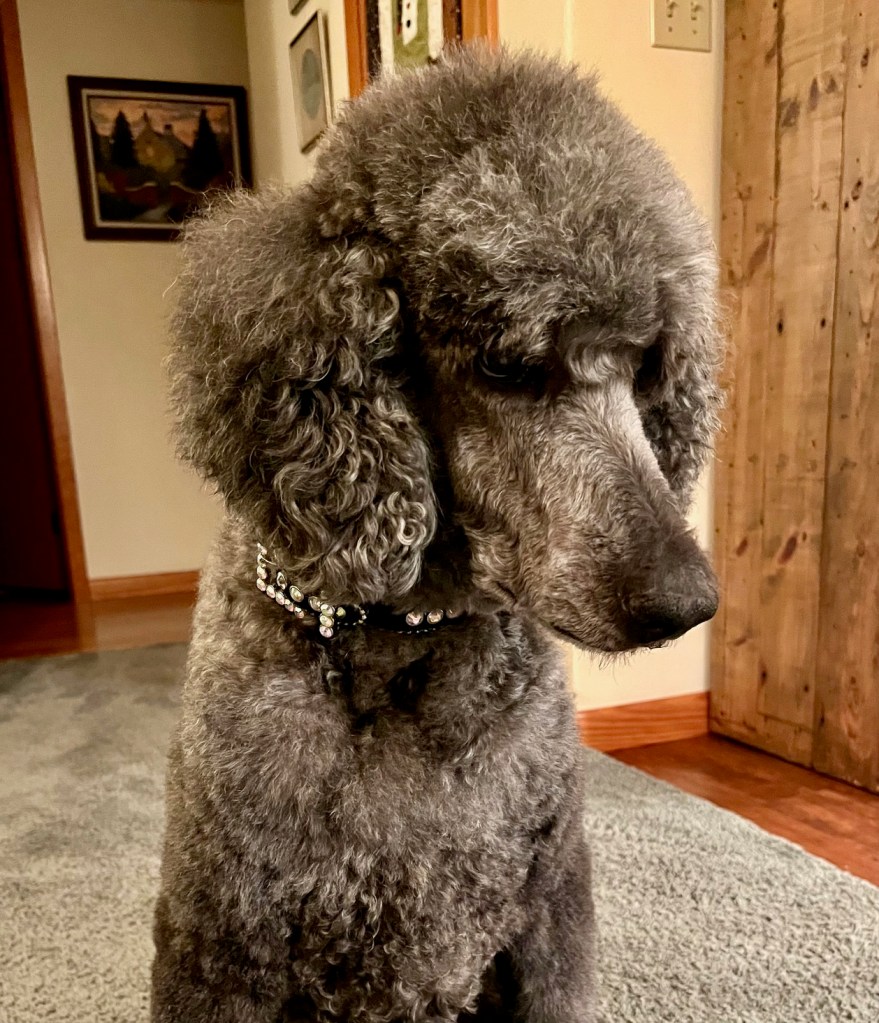
In an effort to hit 200 followers, I’m posting this picture of my standard poodle, Ziva. She had a bath and a haircut today at the doggie spa. She’s wearing a crystal and faux leather collar my mother bought for my first standard poodle, Bailey. As you can see Ziva is a reluctant, humble diva (but only when I take her picture). So, if there are any companies out there selling glamorous dog merch, turn on your algorithms. Ziva might be in the market for a glitzy coat, fur-lined booties, or specially formulated dog shampoo.
Today the 2023 Hal Prize winners were announced. I’m so excited and honored to have won 1st place for my short story “Newlyweds Standing in Front of a Lilac Bush” and 3rd place for my short story “New Boy.”
The winning short stories, nonfiction, poetry, and photos will be published in the 2023 8142 Review, which I believe will happen in January 2024. Here is a link to the 8142 Review: https://www.thehalprize.com/issues/. The 2023 edition isn’t for sale yet, but back issues can be purchased. My second-place story “Maginot Line” is in the 2022 journal and my second-place story “Silent Negotiations” is in the 2020 edition.
I was inspired to write “Newlyweds in Front of a Lilac Bush” after taking a historical flash fiction class with Rebecca Meachem. She is an excellent teacher. The class with Rebecca was offered through Write On, Door County.
Both of my short stories were workshopped through Red Oak Writing, which was so helpful! To learn more about Red Oak Writing and its wonderful offerings, such as roundtable writing critique groups, workshops, and literary services, click here.
Ziva slept while I wrote, and the birds and the squirrel visited the feeder.
Today while I was writing, Ziva, my twelve-year-old standard poodle, slept on her dog bed in my office. She doesn’t take my writing seriously. She takes a nap. And when she is bored with napping, she will get up and jab my right elbow with her nose. This means she wants a walk, because when we return she knows she will get a treat. She’s very good with cause and effect. If I ignore her first jab, she will jab again and again, until I say, “Okay, just let me finish this sentence.” It’s difficult to type when my elbow is suddenly tossed into the air by Ziva’s snout. But, today we walked before I started writing, so she was content to sleep instead of interrupting my stuttering flow of creative whatever.
Today’s big distraction took place outside my office window. Nuthatches, chickadees, house finches, a downy woodpecker, and a squirrel showed up at the bird feeder that hangs in the pine tree. It was a comic opera of dance, birdsongs, and slapstick.
The nuthatches and chickadees were happy to take turns at the feeder, but when a pair of house finches arrived, the other birds backed off and lit upon nearby branches in the pine tree. The house finches parked themselves on the feeder and ate, and ate. House finches are about the same size as the nuthatches and chickadees, but they obviously have an unsavory reputation in their small-bird community.
Occasionally, a chickadee attempted to fly in and snitch a seed, but the finches refused to yield. The chickadee, chickening out at the last second, would furiously flap its wings, nearly come to a screeching halt, then hover a moment before veering off to the left or right, returning to a branch in the tree. One chickadee flew up to the feeder, and one of the house finches turned its head, making a motion like a dog barking to defend its dish of food. The chickadee made a hasty retreat.
For the most part, the nuthatches made do with eating insects they found on the bark of the pine tree. But occasionally, one of them, craving a tasty sunflower seed, bravely approached the feeder. The house finches weren’t intimidated by them either.
During all this comedic drama, a squirrel arrived. His fluffed-out, bad-ass, tail-twitching demeanor made all the birds, including the house finches, seek higher branches. I chuckled because my bird feeder is squirrel proof. Many squirrels have tried, and all have failed. In a scene of choreographed comedic buffoonery, I watched the squirrel walk back and forth on the branch, eyeing the feeder. Next, he climbed on top of the feeder and stretched a paw downward toward the opening filled with sunflower seeds. Maybe, I thought, this one will figure out how to nab a seed from the squirrel-proof feeder. But no. He was only providing that moment in a story when we think a character will get what she wants, which made the next moment funnier because the squirrel fell off the feeder and onto the ground. My laughter startled Ziva, who lifted her head. The birds, however, wasted no time guffawing. They vied for position at the feeder.
And the squirrel was fine. He climbed back up the tree and sat a couple of branches above the feeder. He made a big show of licking his paws then smoothing the fur around his face and ears. Finally, he fluffed his tail with his tiny claws then gave it a swish, swish through the air. His rendition of a human tripping, picking herself up, looking around to see if anyone saw her fall, then smoothing out her clothes, before moving along like nothing happened. The squirrel made no second attempt at the feeder. The house finches came and went a few times, and each time they departed the chickadees and nuthatches rejoiced.
A downy woodpecker joined the troupe, an extra without a speaking role, relegating herself to the background while she pecked at the branches and trunk of the pine tree. Downy woodpeckers like to chum with chickadees and nuthatches, maybe because they take turns at the feeder, and downy woodpeckers like sunflower seeds. But today she was above jostling for seed, maybe she didn’t like house finches either.
I was supposed to be writing, but all the drama at the bird feeder was as good as a rousing, twisting, turning period drama on Masterpiece Theatre. Cooperation, backstabbing, greed, ingenuity, snobbery, high drama, and comic relief all outside my window. All potential themes and plot twists for a future story I might write.
On Friday morning I woke up with several goals in mind. I needed to wash some blankets and area rugs. I planned to cook an enchilada casserole using some homemade enchilada sauce a friend gave me. And I wanted to submit my 45,600-word collection of short stories to the 2024 Iowa Short Fiction Awards.
I have been working on a collection of short stories since January 2019, when I wrote my first short story, one I actually completed from start to finish. I submitted the story to a local contest, and it won first prize.
But I had a lot to learn.
For the next four years, I kept writing stories and essays. I started a blog. I took writing classes and attended writing seminars. I went to hear authors speak about their writing. I subscribed to writing magazines and read them. I read books on the craft of writing. I shared my drafts with writing groups, friends, and family members who were willing to give me feedback. I read lots and lots of books, novels and memoirs, short stories and essay collections. I was always a reader, but I kicked it up to a new level. And I revised “finished” stories based on my new insights.
I have submitted stories and essays to journals and contests, and I have nearly two hundred rejections to prove it. But some of my stories and essays have been published, and a handful have won or placed in contests. A year ago I did some math and discovered my acceptance rate was almost fifteen percent, but I don’t get published in the higher-ranking literary journals.
The writer’s bio I send with my submissions usually contains the words: “She is working on a collection of short stories.” Because a writer’s bio is written in the third-person, it feels like I’m talking about some other person, way over there, sitting at the other end of the room. But putting the words about writing a book of short stories in my bio was a contract with myself. That I wouldn’t just say it — I would do my best to make it happen. And my story collection grew.
On Friday morning the only thing I had left to do was finalize the order in which my stories would appear in my book. I paced like a traveler on a platform, waiting for an overdue train. I put the dishes away, made oatmeal, paid the power bill, and did a load of washing. I waited for my husband to go to work, so I could concentrate without interruptions, then I waited for feedback from one of my readers regarding which seven stories she felt were the strongest. I had asked four different readers to choose their top seven stories. The goal in arranging a short story collection is to start and end strong, and sprinkle other strong stories throughout the collection.
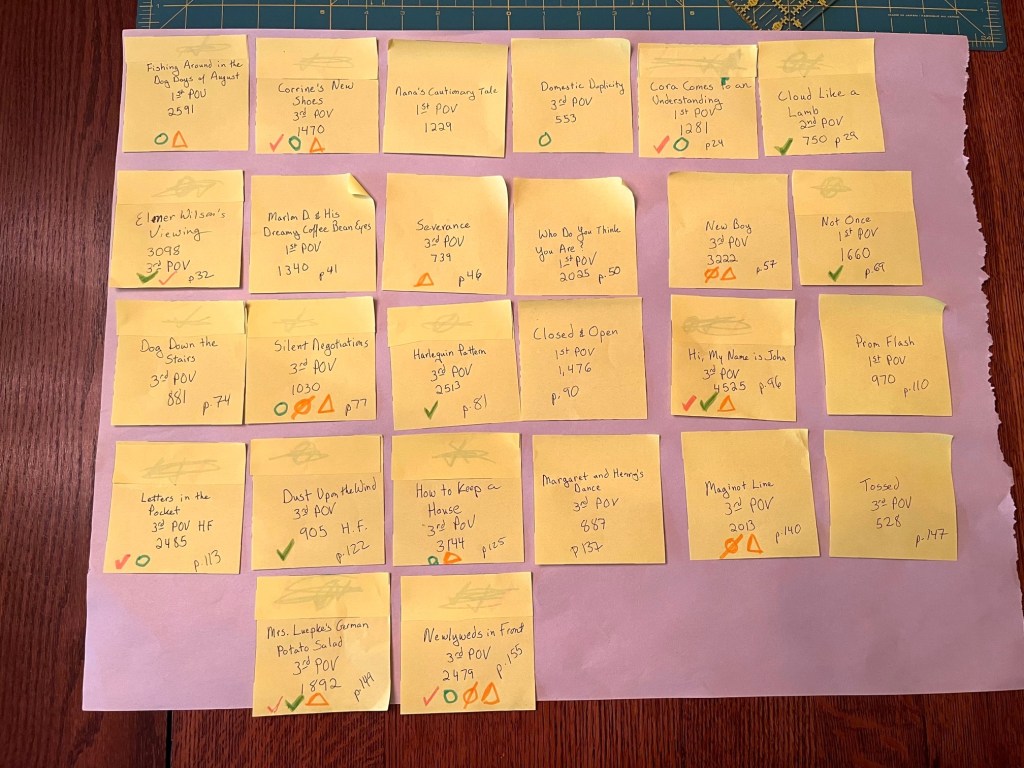
I knew which story would be the engine and which one would be the caboose, but I agonized over how to arrange the rest of the cars in my train of stories. I finally told myself, “Stop being ridiculous. If the judges don’t choose your story collection, it won’t be because they felt you should have put “Silent Negotiations” before “Elmer Wilson’s Viewing.”
I took a deep breath and folded over in the ragdoll yoga pose. After all, I didn’t even need to write a query letter to accompany my submission, and I didn’t have to pay a reading fee. Just a minimum of 150 pages, double spaced, with one-inch margins, preferably as a PDF file. Geez, I just needed to relax.
A short while later, I received my last reader’s list of favorites. Using Post-its on a large piece of newsprint, I moved story titles around until I was happy with their sequence. I copied and pasted the stories into one document then reviewed it. I filled out the electronic submission form and uploaded my file. After a slow inhale, I clicked submit, then exhaled. My stories had left the station on their first adventure. I won’t hear about them until January 2024. In the meantime, I will keep reading and learning and writing.
In the afternoon I washed the blankets and rugs, then I made the chicken enchilada casserole for supper. It was marvelous, and to celebrate my first book submission, I paired the casserole with a Bell’s Oktoberfest beer.
Now my bios will include: “She has finished her first short story collection and is submitting queries to publishers,” or something like that — it might need a few revisions.





 Writing Near the Lake