It’s Cabela’s 15th Birthday Today!

Cabela, the morning of her 15th birthday

We don’t have any celebrations planned.

Each day that Cabela is still with us and healthy enough to enjoy her food, a walk, and a gallop around the yard is a celebration. However, today she is having a spa day, but she knows “spa day” is just a fancy term for a bath and a haircut. She has always liked her beauty appointments, but last month the groomer told me Cabela balked a bit about being brushed out and clipped, especially around her legs and feet. This didn’t surprise me because Cabela moves slowly these days, with an off-kilter hitch in her giddy-up.

I’m sure Cabela has arthritis. When she is willing to take it, I give her a mild pain medication to help with her aches and pains. Most days she eats the pill like she is The Mrs. Astor nibbling a tasty hors d’oeuvre. Other days she turns her nose up like she is Tom Sawyer forced to swallow cod liver oil. Because she doesn’t need the medicine to survive, I let her decide if she wants to take it or not.

I’m proud of Cabela and her 15th birthday, so over the past several months, I’ve repeatedly said to family and friends, “You know, Cabela is going to be 15 years old on June 24.” This morning I sent texts along with a birthday photo of Cabela to family and friends announcing her milestone birthday. Throughout the day, text messages have come through for her. When my husband and I picked Cabela and her sister, Ziva, up from the groomer this afternoon, I read the texts to her.

According to a chart put out by the American Kennel Club, Cabela is 93 years old. A couple of days ago, my 6-year-old grandson kept asking questions about measuring a dog’s life in human years. I tried to answer each question, but the more I tried to explain it, the more questions he asked, including, “How old are people in dog years?” (He asks a lot of interesting questions.)

I told him there wasn’t a chart for that. But this morning I was still thinking about his question. Using the AKC chart, I came up with a way to answer it. Cabela is a large-breed dog, so I chose that category. I moved down the column of a dog’s age in human years until I reached 61 years. The number below that is 66 years. I’m 64 years old. Next, I moved horizontally to the left on the chart, and I found that in dog years I’m between 9 and 10 years old. That makes sense to me because a large-breed, 9-year-old dog is entering its senior citizen years just like I am.

It still amazes me that Cabela came into our home as an 11-week-old puppy, and she is now older than me. It amazes my grandson too. He wanted to know how Cabela could be considered older than his 64-year-old nana. “Most animals,” I said, “age faster than humans.” Of course, he asked what that meant. I reworded my answer: “They grow old faster than humans.” He was quiet, but I don’t think it was because I had managed to explain the mysterious dynamic of aging in dogs and humans. Most likely he was trying to incorporate the new information with his current understanding of aging.

I printed the “How Old Is My Dog in Human Years?” chart for my grandson, so when he comes back on Monday, he can see a visual of the dog-to-human-years concept. I’m sure he’ll have more questions, and he likes to ask them when we’re in the car.

I have to admit this year Cabela’s birthday makes me sad. At 15 (or 93 in human years) she is doing okay. But if she makes it to her 16th birthday, she will be 99 years old. She will age 6 human years in one dog year. Standard poodles have a life expectancy of 11 to 13 years.

When I took Cabela for a walk around the block this morning, I let her go as slow as she wanted. I let her smell each interesting spot as long as she wanted. Ziva and I waited as if we had nowhere else to go, nowhere else we would rather be, and no one else we would rather be with.

Cabela’s day-spa afternoon was a success. The groomer said Cabela did well today, no signs of discomfort. And she looks marvelous, all soft and fluffy. She also smells frou-frou, like she sampled the wares at a perfume counter.

Cabela is taking a well-deserved nap now. As a dear friend of mine once said, “It’s not easy being eye-candy.”

Happy birthday to Cabela, who is still beautiful inside and out!

Cabela agrees, “It’s not easy being eye-candy.”
Cabela out for her second birthday walk
Ziva and Cabela, June 24, 2023

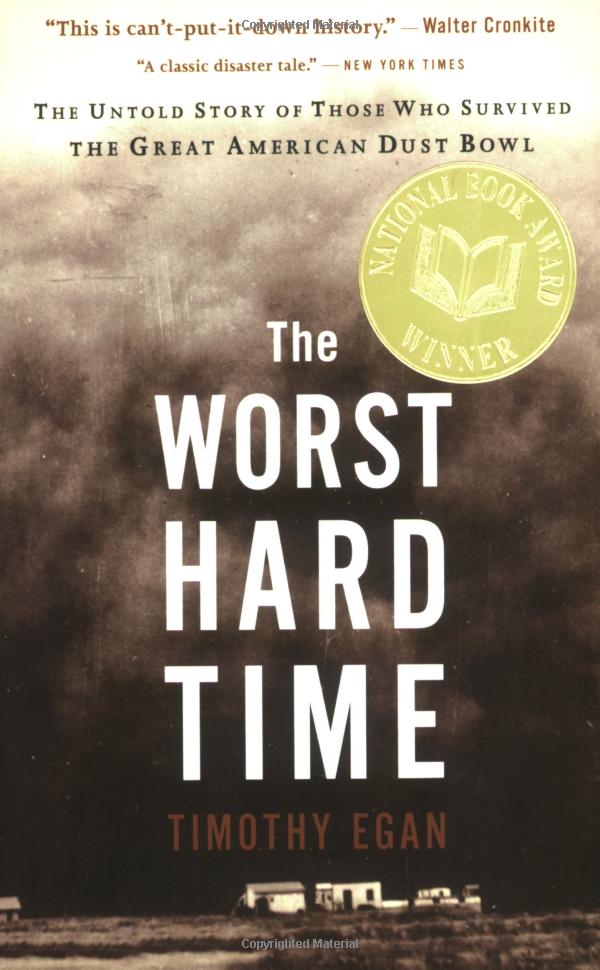
What I’m Reading This Week: The Worst Hard Time: The Untold Story of Those Who Survived the Great American Dust Bowl by Timothy Egan

What is this nonfiction book about?

The Worst Hard Time by Timothy Egan is about the Dust Bowl of the 1930s. It tells the story of an ecological disaster of epic proportions caused by greed triumphing over reasonable behavior.

Before white people arrived on the American High Plains (the setting of Egan’s book) the tall grasses and buffalo had thrived for centuries upon centuries in a symbiotic-type relationship that allowed them to survive bitter cold, searing heat, and cycles of rain and drought. Then white people drove Native Americans off the plains and killed buffalo by the millions to ensure Native Americans wouldn’t have a food source.

Next came ranchers who raised cattle on the grasslands where the buffalo once roamed. But cattle, unlike buffalo, struggled to survive the extreme heat, cold, and drought. And when the prices of beef dropped or weather killed their cattle, many ranchers went bankrupt.

Then came farmers who believed they could grow wheat on the High Plains. At first there was enough rain and the price of wheat was high, so farmers borrowed more money and tore up more grassland, chasing higher and higher profits. But like a pyramid scheme, their dreams of wealth tumbled when wheat prices dropped precipitously and drought wrapped its hands around the neck of the High Plains and refused to let go. Wheat died in the fields, and farmers couldn’t pay their bank loans.

Ranchers and agricultural specialists warned against the unchecked removal of the grasslands because they understood the temperamental moods of the High Plains. The prairie is a place of wind, and so the winds, drought, and bare fields whirled like a dog chasing its tail, wearing itself out, completely spent. In a couple of decades, American farmers destroyed an ecosystem that had thrived for thousands of years.

Most of Egan’s book describes the horrific dust storms that raged over the plains, lifting millions of tons of topsoil and depositing it hundreds of miles away. He interviewed people who lived through the fierce, stinging storms. He retells their harrowing stories of survival, despite displaced dirt that filled their nostrils, mouths, and eyes, buried their possessions, killed their loved ones, and destroyed their livelihoods and communities.

Why is this book important?

People have changed the earth’s temperature, and they can’t just say, “It’s cyclical. It’s a phase.” Human behavior is accelerating the warming of the earth. During the Dust Bowl, many people blamed the ecological collapse of the High Plains on the drought. They refused to believe their stripping of the grasslands was the real issue. But other people knew better because droughts had come and gone many times and the grasses held the soil in place, just how nature designed it to work.

Yesterday the air quality where I live registered 182 on the AQ Index. That’s in the red zone, labeled unhealthy. And a thirty-acre wildfire started burning in the Boundary Waters Canoe Area Wilderness in northern Minnesota. It’s the first wildfire in the beginning of what appears to be a season of drought in Minnesota. We had lots of snow this winter, but the spring rains haven’t come. And there will be more fires. But the smoke that tanked our air quality yesterday came from one of the Canadian fires.

A smoky haze filled the sky, and the acrid smell stung my nostrils. I kept the windows and doors closed, but I could still smell the smoke in my house. I canceled plans to take my grandkids to a big outdoor park in a neighboring town. Physical activity is not advised when the AQ Index is in the red zone. We went to the library instead, but I could smell smoke inside the library too.

I thought about families who lived during the Dust Bowl. The babies and children and the young and old who died of dust pneumonia. How people and animals caught in a dust blizzard sometimes suffocated on dirt. How everyday women and men tried to defeat mounds of dust, shoveling it out of their homes, barns, driveways, and roads. How they covered every crack in their houses with tape or paper and hung damp sheets and blankets over windows and doorways to stop the dust. But each night while they slept, dust seeped into the house and cloaked them in grime.

Yesterday when I looked at the skies hemmed in with brown smoke, I felt claustrophobic, and my sinuses hurt. I wondered how people coped day after day, month after month, year after year with tons and tons of dirt. Of course, not all of them did. Some left, some died, and some lost their minds. I don’t think I could have handled the Dust Bowl.

Today the AQ Index dropped out of the red zone, through the orange and yellow zones, and by the afternoon entered the good green zone. But what will happen as the earth continues to heat up? There will be more wildfires. Will the air be filled with brown smoke every day?

If anyone has any doubt about how quickly greedy, ignorant humans can destroy a habitat, read The Worst Hard Time. It’s a well-written, well-researched book. And although it’s sad to read about the disaster of the Southern Great Plains and its tragic impact on the people who lived there, it’s an important story.

I have about one hundred pages of the book left to read, so I don’t know how it ends yet. It’s 1935, five years into the story, and drought still strangles the High Plains. Black Sunday, the worst storm of the Dust Bowl, has just occurred. And finally, the politicians in Washington, D.C. have decided they need to act. I don’t know how people worked to solve the Dust Bowl disaster, but I’m optimistic there was a workable solution. I hope to finish Egan’s book tonight.

I’m not so optimistic about today’s politicians in Washington, D.C., and their willingness to handle climate change.

My New Grand-Dog Is a Linguistic Genius (and Adorably Gorgeous)

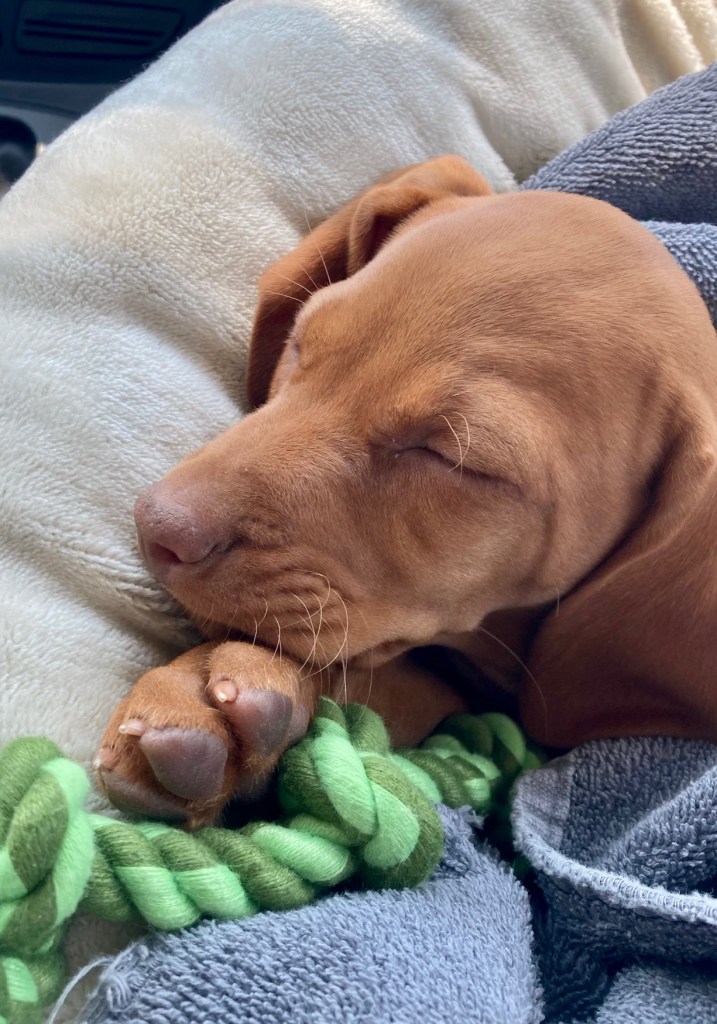
Nellie, adorably gorgeous

My new grand-dog Nellie is a soft, snuggly, copper-colored Vizsla with sapphire-blue eyes, which will turn green as she matures. She’s nine weeks old, and she’s already a linguistic genius.

When I arrived at Nellie’s house, she was in her kennel. As I came through the front door, she greeted me with a combination of barks and whimpers. Wow, I thought, she’s bilingual. Of course, Nellie wasn’t certain whether I spoke bark or whimper, so she alternated between both languages, hoping, I imagine, that her new Nana would be conversational in at least one of the two. Nellie had nothing to fear, I speak both bark and whimper. I understood her every word: “Hurry up! Open the kennel! Quick, I need a hug! Let’s go outside!”

I hurried to open the kennel, and Nellie and I exchanged nuzzles and cuddles. I put her leash on, and we went for a sniffing stroll. I let her explore the grass, sidewalk, and trees with her nose. Last week, while listening to Minnesota Public Radio, I was reminded why dogs love sniffing walks: The world is written in the odors they smell on the ground. Nellie was interested in all of them, especially the scent of some dried dog pee on a concrete step. The dog expert on the radio said pet owners should take their dogs for at least one sniffing walk a day and let the dogs move as slowly as they want. It doesn’t matter if the walk is short because all that sniffing is mentally stimulating for dogs, and it tires them out.

I’ve got something to say!

Nellie sniffed and walked. I walked but did not sniff. Somehow Nellie and I knew when we had reached the end of our walk–it’s our great psychic connection–and we looked at each other. “Let’s go home,” I said. Nellie stood on her hind legs, placed her front paws on my leg, and whimpered, “Carry me. I’m all worn out from sniffing and processing and analyzing.” (She’s a precocious puppy with a large vocabulary.) I picked her up, snuggled her against my chest, and one of us walked home!

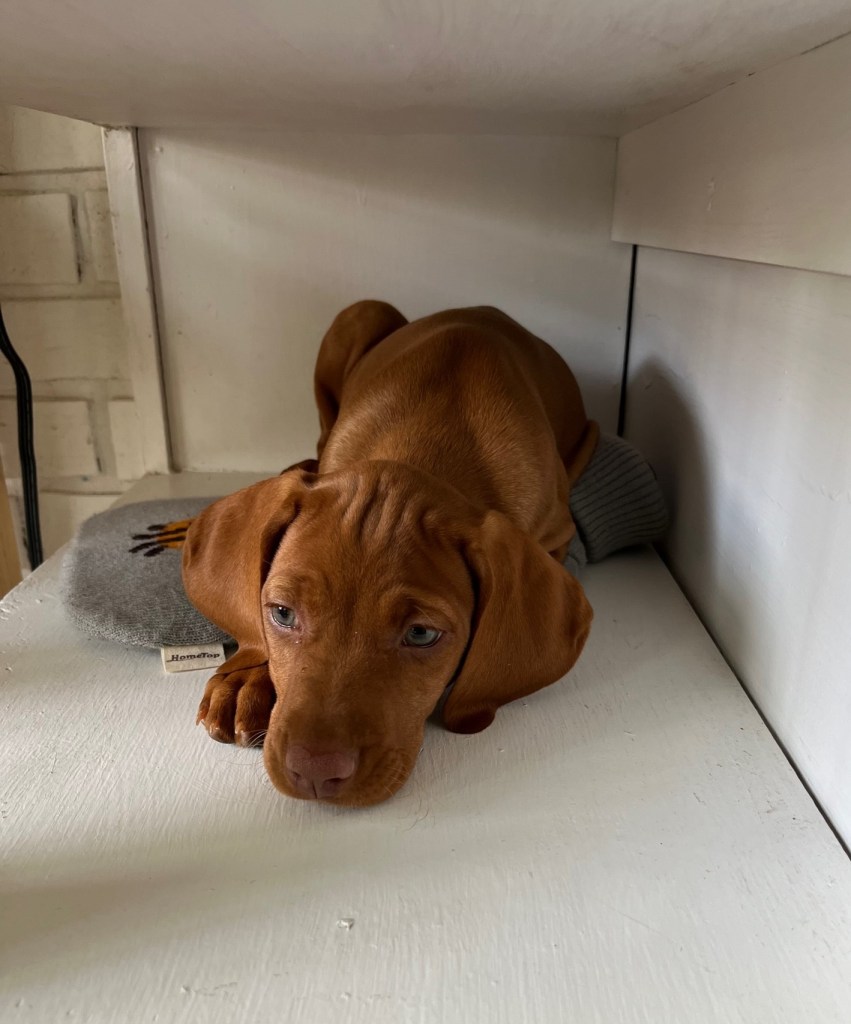
Next, I fed Nellie and gave her some water. She ate only a few nibbles and ignored the water. Then she climbed onto the bottom shelf of the kitchen cart, using it as a step to climb up on a built-in shelf next to the lower cupboard. She curled up on an empty hot water bottle clothed in its own soft knitted sweater. She wanted to sleep. I reached in and pulled her off the shelf. “Not yet,” I said. I took her out to the backyard. We played with a ball and walked around the yard. She tinkled and attacked dandelions.

I can sleep here. I’ll be good.

Hoping she had worked up an appetite, I took Nellie back inside. She ate most of her food and drank some water, then she climbed back up onto the shelf. She looked at me and whimpered, “Please don’t take me off this cozy, sweater-covered hot water bottle on this tucked-away shelf. It’s my favorite place for a nap.” She hadn’t forgotten that I had removed her from the shelf twenty minutes ago.

“Sorry,” I said, for I truly was. “It’s time for me to go.”

I placed Nellie back in her kennel. She didn’t bark or whimper. Her eyes were dozy, and she was too tired for words. As I pulled the front door closed, she sat watching me go. I like to think that by the time I drove away, she was sleeping and dreaming about our next conversation.

Tina Turner Died Today

Sunset Beach, Fish Creek, Door County, 2023

I loved her voice and the way she danced and strutted across the stage, giving every song her all. She was power and elegance and talent.

As kids my sisters and I loved Ike and Tina Turner’s version of “Rolling on a River.” We loved how they started the song out “nice and easy” because as Tina said, “we never, ever do nothing nice and easy” then halfway through they rocked the song like a river bursting over its banks.

We called Milwaukee’s Fun-Loving WOKY at 920 on your AM dial. They took requests. So we asked, “Can you play ‘Rolling on a River’ the way Ike and Tina Turner sing it?”

“Sure,” someone at WOKY said. After all, they were Fun-Loving.

Instead they played “Rolling on a River” by Creedence Clearwater Revival. Disappointed, we called again and again, asking for the “nice and easy” version. But we were kids, and we pissed them off with our insistence they get our request right. They told us they wouldn’t play Ike and Tina Turner’s version because they’d just played the CCR version.

We gave it a rest. But we called every couple of days, asking to hear “Rolling on a River” by Ike and Tina Turner. Fun-Loving WOKY at 920 on your AM dial never honored our request. After a couple of weeks we gave up.

Today I didn’t need to call a request line to hear Tina Turner sing “Rolling on River.” I’ve got YouTube. I watched three different versions of Tina sing and dance to the best version ever of “Rolling on River.” And I was twelve years old again.

Ike and Tina Turner live in 1971 singing “Proud Mary.”

Tina Turner live in the Netherlands in 1996 singing “Proud Mary.”

Tina Turner live in 1999 singing “Proud Mary” with Elton John on piano and a duet with Cher.

What I’m Reading This Week: Last Circle of Love by Lorna Landvik

Why am I reading this book?

I’m reading Last Circle of Love because I met Lorna Landvik, for a second time, at an author’s book talk in April. Lorna is a kind, funny person, and I enjoy listening to her talk about life and writing. When I met her for the first time in 2019, I bought her book Your Oasis on Flame Lake, and I thoroughly enjoyed the characters and their stories. In April, I bought Last Circle of Love, believing I would like it just as much or even more. Turns out I like this book even better. It’s a heartfelt story with interesting and diverse characters who come to life and pull at my heart with their stories..

What is this book about?

The women who belong to the Naomi Circle at All Souls Lutheran have just attended a luncheon at the Prince of Peace. Everything about the Prince of Peace is larger, shinier, newer, more opulent, and richer. But what really bothers the women from All Souls is the glitzy, full-color, professional-looking recipe book the women at Prince of Peace will be selling. The Naomi Circle of women are discouraged because they need a good fundraising idea to help keep All Souls’ doors open.

Someone jokes that the Naomi members should write a book called the ABCs of Erotica. The idea for their book isn’t meant to be pornographic, but rather romantic. The women and men who write pages for the book write about loving gestures, kindness, understanding, and sharing that have brought them closer to their loved ones. Of course, the Naomi Circle of women worry that some church members may think the book will be pornographic, but Pastor Pete, relatively new to the church and more open-minded than the last pastor, gives support to the women to explore the idea.

Will the ABCs of Erotica be the fund-raising savior All Souls needs? Or will the idea divide the church members, causing some to join Prince of Peace Church? Will Pastor Pete be hailed as forward thinking or sent packing?

Why is this book important?

It’s a cozy story with important themes. Many of the main characters are in their sixties, seventies, and eighties, and Landvik portrays them as real people with hopes, dreams, desires, and goals — people who want to embrace life, just like they did when they were young. In Landvik’s story, old people are complicated and vibrant, still trying to figure out life and what’s next for them. They are interesting.

While Last Circle of Love is set in a small fictitious town in Minnesota, the story is filled with a diversity of people and themes about diversity, such as sexual orientation, ageism, and sexism. Landvik’s gentle tale counters intolerance, anger, and ignorance with themes of love, acceptance, open-mindedness, and forgiveness. She delivers an important message with a spoonful of sugar. But more importantly with her novel, she accomplishes what a good story should. Even though we are entertained by mostly upbeat characters and a light-hearted plot, the story makes us think about important issues.

A Vacancy in the Neighborhood

Flowers in Mrs. H’s garden

I look out my kitchen window. I can see Mrs. H’s house. She died last November at the age of ninety-one. Yellow caution tape runs from the road, past the side of her house, and toward the back of her yard where her magnificent gardens, filled with daffodils and tulips and other flowers I can’t name, bloom every spring. The caution tape evokes the feeling of a crime scene, but it’s simply there to keep the people at the estate sale from trampling through the gardens. Cars park up and down her block and the next block and on my block. People line up outside her front door, waiting to enter her home, hoping for bargains at the estate sale. I think about Scrooge’s visit with the Ghost of Christmas Yet to Come and the scene with gleeful characters scavenging through the belongings of the recently dead Scrooge.

I’m not saying Mrs. H was like Scrooge, she wasn’t, or the people in line are gleeful, they’re not, but this is what I think about. I waver about whether or not I will go to the estate sale. Going into Mrs. H’s home — looking at her possessions, which under normal circumstances would have been in cupboards and closets and drawers — feels like an invasion of her privacy.

I’ve lived in this neighborhood for twenty-seven years. Mrs. H was here when I moved in, but I’ve never been inside her house. We were of different generations. But I liked her well enough and enjoyed our brief chats when she walked by my house, first with one Miniature Schnauzer then later on after that dog died, with another one.

Even though going to the estate sale feels like an invasion of her privacy, I’m curious about what her house looks like inside. It’s adorable from the outside — one of my favorites on the street. I might buy something as a keepsake.

I keep watch out my kitchen window, and when the line of people is gone, I grab my purse and walk to Mrs. H’s house. I don’t have to knock to enter, but I do have to take off my shoes.

The front door empties into the living room filled with used furniture. There is a three-person couch for $800, a small outdated stuffed chair and ottoman for $700, and a four-person couch for $900. So much for bargains.

I notice the picture hanging on Mrs. H’s wall has been straightened and marked with a $40 price tag. It’s from the 1980s, like something that hung in a middle-class hotel. For almost a year before Mrs. H died, the picture hung crooked on her wall. Every evening when I walked my dogs past her house, I wondered why she didn’t straighten it. Eventually, I came to believe the crooked picture meant something was wrong with her.

One afternoon, as I walked my dogs by Mrs. H’s house, I ran into her daughter. I asked how her mother was doing. She answered, “Not good.” Her mother was suffering from dementia. I told the daughter about the crooked picture on the wall, that it had convinced me something wasn’t right with her mother. After our conversation, I thought the daughter might straighten it, but she didn’t. The picture remained crooked for months, a signal flag of Mrs. H’s difficulties.

I wander through the house. Its rooms are small, but neat. Simply decorated but bland. Everything is clean. There isn’t much for sale in the house. I get the impression that Mrs. H didn’t like to clutter up her small home with lots of stuff. Objects are $10, $15, $20, $30, $50, $60, $90, and more. If this were a rummage sale, the same objects would be a fraction of the cost. I don’t buy anything, and I don’t stay long. I feel like an interloper. But once outside, I take pictures of some beautiful flowers in one of Mrs. H’s gardens.

Everything changes. Mrs. H is gone. Mr. H died eight years ago. The dishes and tools and clothes and knickknacks that made up their lives are being sold. Mrs. H’s gardens didn’t winter well, and the daffodils and tulips, usually plentiful and jovial, are sparse and lonely. Someone new will live in the house. Mrs. H’s daughter-in-law isn’t sure if the family will sell the home. Perhaps one of the family will live in the home. If they sell it, I hope someone with children will move into the house. When I first moved to this neighborhood, it was filled with children, including my own, and I miss the shouts and the laughter of children playing outside.

The Saga of the Difficult Flash Essay Continues

Ziva and Cabela, my walking buddies

Yesterday I blogged about my struggles while trying to write a flash essay. By the end of the blog, I decided to write my story as fiction. The plan was to walk my dogs and brainstorm ideas.

Well, I walked the dogs. And I thought about the essay as fiction. But every story path I went down rang false.

When the dogs and I returned home, and after I gave them treats, I looked at the rough draft of my flash essay. It didn’t read as badly as I thought it did when I’d spent time with it the night before. Maybe we just needed a break from each other.

Yesterday afternoon I revised and edited then emailed my essay to some readers, both writers and nonwriters. The feedback was good, so I think I’ve done okay. I can hang out with the essay for a week before I have to submit it. I’ll check on it a couple of times a day, making sure it still looks okay.

Something about the event in my essay wouldn’t let me turn it into fiction. I had to find a way to make the real story say what I wanted it to say, as best I could. Then I had to accept that it would never completely hold what is in my heart.

Years ago when my father and I were driving around his hometown, he pointed to different houses that had been built by the same carpenter. I’ve forgotten the name of the man but not the wisdom of my father’s story. The carpenter told my father that each time he built a house, he tried to improve upon the previous house he’d built. He wanted the new house to have a better floor plan and better function. He also told my father that each time he finished a house, he knew he hadn’t reached his ideal, that he’d always find something about the house wanting. The carpenter told my father that he came to realize he would never build the perfect house, no matter how many houses he built.

That’s good wisdom for a writer. Because that’s how I feel about each story or essay I write: It doesn’t match the ideal in my head, but sometimes I get close.

I’m Supposed to Be Writing a Flash Essay . . .

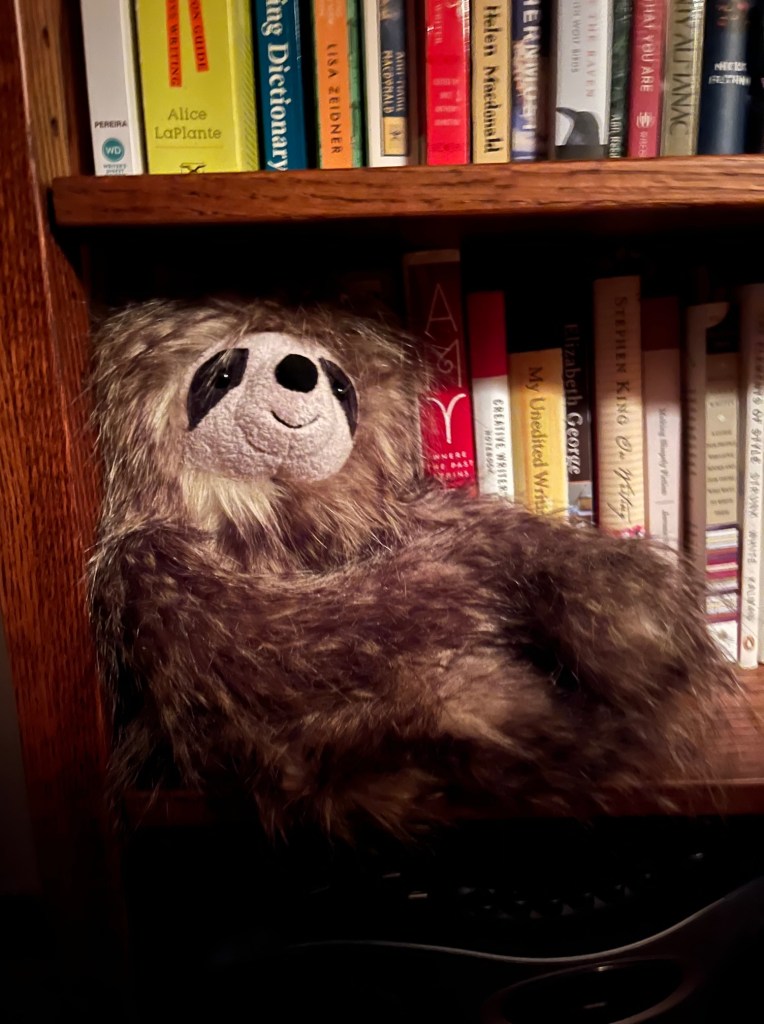
Sloth is outpacing me today.

. . . but instead, I’m blogging about having a difficult time writing the flash essay. Probably because it’s about a moment in my life that has a lot of meaning and emotions attached to it. (I’ve already tried writing about this event as a long essay, and I have several versions of it in notebooks and computer files. But none of that was working either.)

Writing about something that is very near to me can be tricky. I want to capture the feeling of the moment without sounding trite or whiney. I want to express its importance in a way that gives it respect, but also in a way that says what I want it to say. And that’s the hard part. I can hear the words and emotions in my head, but when I try to put them on paper, they don’t always come out in a way that is even close to what I want to say.

So, I’ve been experimenting. I’ve started the flash essay at different points in time, and I’ve tried different tenses. There is less wiggle room with point of view. Most essays I write are in first-person. I’ve used second-person a few times when the essay is very brief, but only after I couldn’t make the essay work in first-person. Using the second-person point of view seems to give me permission to put a bit of distance between me and the raw emotion that is hampering my writing. But sometimes second-person doesn’t work either. How do I know these other attempts aren’t working? Because when I try them, they are clumsy, tripping over their own words, then falling flat upon the page.

On rare occasions, I take a third approach. I turn my essay into flash fiction or a short story. A couple of months ago, I worked on an essay but couldn’t make it work. I wrote and rewrote, trying different tenses and points of view, different starting points, more dialogue, less dialogue, more backstory, less backstory, more showing, less showing. I ruled out trying a second-person point of view because I knew that wouldn’t work. I was frustrated, feeling like a failure. Why couldn’t I write my personal essay? I gave up, and put it away. A few days later, I returned to it and wrote it as a short story in third-person point of view.

And ZING, it worked. Writing it as fiction allowed me to step away from the story that I couldn’t tell as nonfiction. I let my characters’ conversations, thoughts, and actions tell the story, and they were able to convey the emotional richness that I couldn’t capture in an essay. I also manipulated the timeline and tossed in some fictional details, none of which changed the emotional truth of the story, but rather made the story flow better as fiction. I wish I could write the flash essay as a flash fiction story, but I remember the submission guidelines as asking for nonfiction flash essays or poems. And I’m no poet.

I’m back. You didn’t know I was gone, but after I wrote the previous paragraph, I decided to take a shower, which is another way I try to solve writing dilemmas. And while in the shower, I kept wishing the publication took flash fiction along with flash essays and poems. The hot water smacking me in the head must have thawed something in my memory because suddenly, I thought I’d remembered reading that the publication took fiction too. But that was a few years ago when I submitted my first flash essay to them. This time I hadn’t actually read the submission details beyond the word count and the topic, because having submitted nonfiction flash to them twice before, that’s what stuck in my mind. As soon as I got out of the shower, I checked and, sure enough, they accept flash fiction too!

So, today, I’m going to try writing my essay as fiction. I can fiddle with timelines and factual details to give it the shape of a story. And I hope by letting the characters have the spotlight, I’m able to capture the emotional truth of the story, telling it in a way that will say what I want it to say.

The shower is such a good place to think.

I’m going to walk the dogs now and ruminate about my flash fiction story before I start writing it.

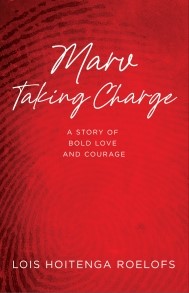
What I’m Reading This Week: Marv Taking Charge: A Story of Bold Love and Courage by Lois Hoitenga Roelofs

Why am I reading this book?

I follow Lois Roelofs’ blog: Write Along with Me, Blogging as a Retired Nurse. Lois is a wonderful writer, and I enjoy reading her blog. When I started following her blog, she was already a widow, having lost her husband, Marv Roelofs. I also knew she was writing a book because she would occasionally blog about the book’s progress. When her book was published in the spring of 2023, I wanted to read it because I knew it would be well written and because Marv’s story about how he chose to live with his terminal diagnosis is an important one. I’m over half way through Marv Taking Charge, and it is a well-written, informative, and touching story.

What is this book about?

In January 2018, while vacationing in Arizona, Marv receives a call from his pulmonologist, who tells him he has lung cancer, small cell, the very aggressive type. The doctor explains to Marv that he needs to start chemo right away. Marv answers, “I’m not interested in treatment,” then hands the phone to his wife, Lois, who is a nurse.

The doctor makes it clear to Lois that Marv’s cancer is terminal, but that he must start chemo right away in order to have a chance of more time. Marv doesn’t change his mind, and he and Lois continue their vacation in Arizona. When they return home, Marv is enrolled in hospice care. Then he and Lois set about living their lives. They visit family and friends, and they do the everyday activities they’ve always enjoyed. Marv has a lot of good days, but Lois also writes about the difficult times.

Why is this book important?

Many people, like Marv, will learn they have a terminal illness, and they will face decisions about how they want to live the rest of their lives. Currently, most terminally ill cancer patients are treated with chemo and radiation, not because treatment will provide a cure, but because it may extend their lives a few months. However, those extra months often come with a decreased quality of life because chemo and radiation are harsh treatments with potentially severe side effects. Marv chose quality of life over quantity, then he and Lois made the best of the days they had left together.

Cancer is talked about with words like fight and battle, and patients are described as courageous. However, Lois, agreeing with Atul Gwande, who wrote Being Mortal, says terminally ill patients should be asked what is important to them.

Marv’s answer to that question was to live out his days without the side effects of medical treatments that were not going to save his life.

[Lois Hoitenga Roelofs book Marv Taking Charge is available here.]