
Today Brevity Blog published my essay “It’s Going to Have All the Right Stuff.”
You can read it by clicking here: Brevity Blog for April 27, 2023.
Today Brevity Blog published my essay “It’s Going to Have All the Right Stuff.”
You can read it by clicking here: Brevity Blog for April 27, 2023.

My short story “Prom Flash” appears in the 2023 Freshwater Literary Journal published by the Asnuntuck Community College. The Freshwater is a print journal, but the editors post a copy of the journal online. It is available here: Freshwater Literary Journal 2023. My story appears on page 118
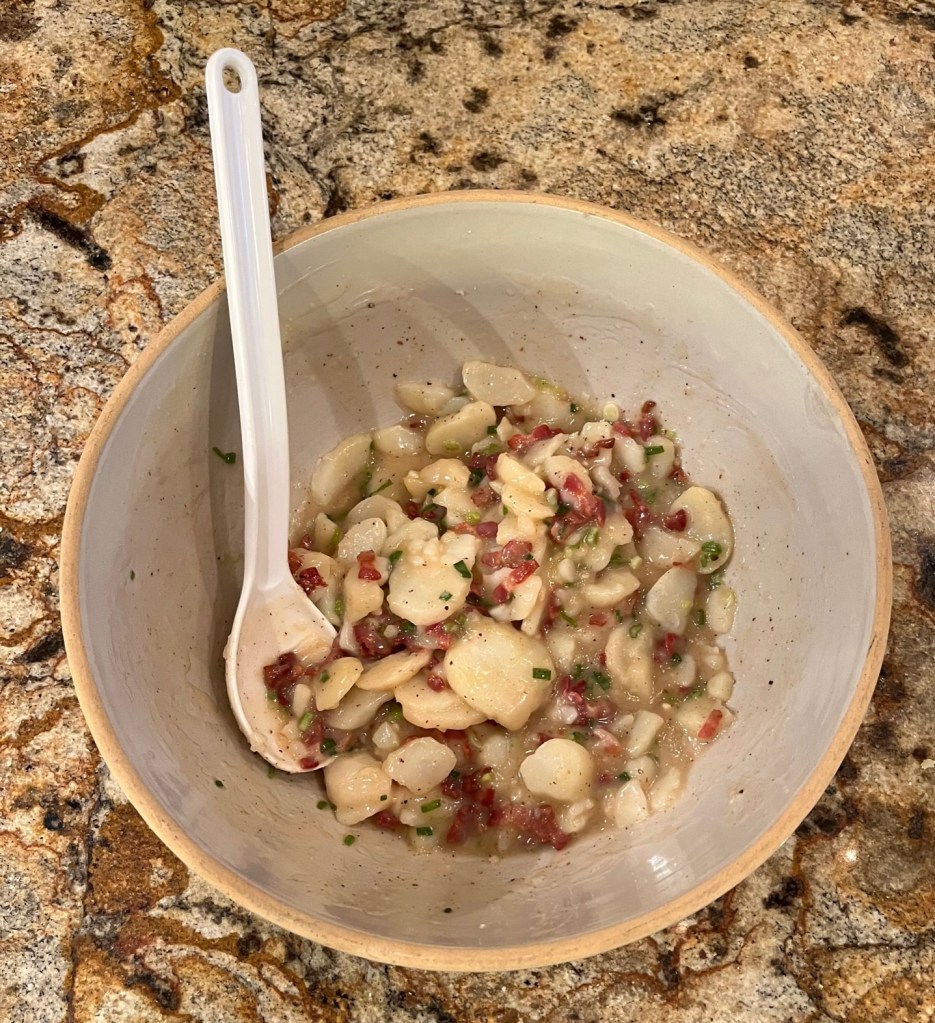
Mrs. Luepke is part of my childhood, but I don’t remember her. She was my parents’ neighbor when I was born. But she is a legend in my mind because she taught my mother how to make a wunderbar German potato salad.
I grew up hearing stories about Mrs. Luepke who kindly shared cooking tips with my mother, who in 1958 was a young bride with no cooking skills.
My mother made Mrs. Luepke’s German potato salad for special events, holidays, and picnics. When I was old enough, I helped. The kitchen filled with the smells of boiling red potatoes and sizzling bacon. Followed by the sweet, tangy smell of vinegar and sugar simmering on the stove in a bath of bacon fat and butter roux, which would be poured over the potatoes, bacon, and sliced green onions.
My favorite way to eat the German potato salad was when it was warm. I’d sneak a spoonful (or two) while I mixed the ingredients together.
For years the recipe had been lost. But this winter my mother discovered that her brother, who now lives a thousand miles away, had a copy of the recipe. My mother copied down the ingredients on a piece of small paper, and handed it to me when I visited her for Christmas last year. The paper contained no instructions, so when I made the potato salad, my mother explained the steps. Our mother-daughter-German-potato-salad project was the highlight of my Christmas. And the salad tasted as wonderful as I remembered it tasting when I was a child.
If you make the potato salad, think of Mrs. Luepke. During the years when her recipe was lost to my mother and me, I never found another German potato recipe that tasted as good as hers. In some small way, I’m glad to keep her memory alive.
The Ingredients
The Recipe
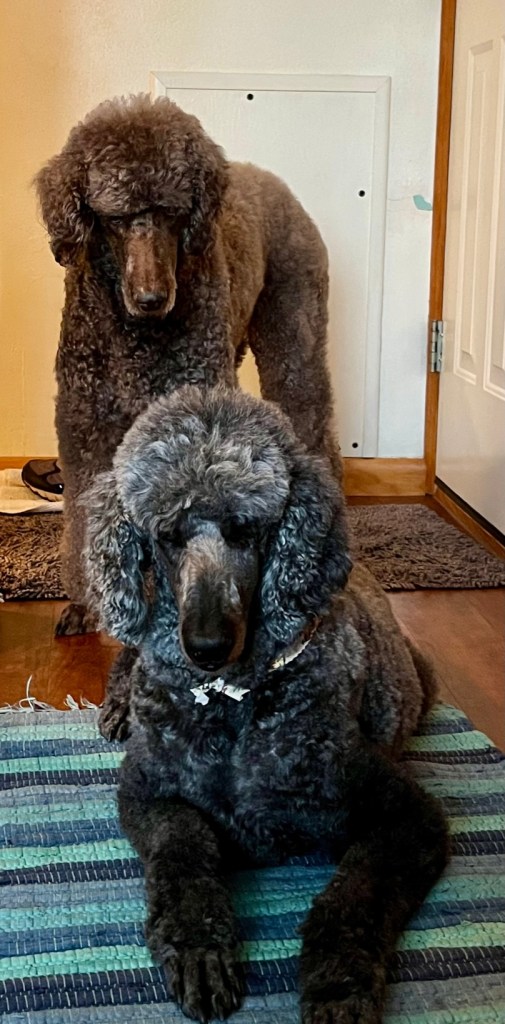
Cabela, my fourteen-and-a-half-year-old standard poodle, has been moving slowly over the past two days. But she has a good excuse. She treed a big raccoon on Friday evening. Then she stood under the tree and barked at it, warning it to stay put. She barked some more to alert my husband that a big raccoon was up the tree, but that he didn’t need to worry about it. She had it all under control.
My husband brought Cabela into the house, then he watched the raccoon through a window. When the raccoon finally decided to come down the tree, its descent took twenty minutes because it inched its way down while keeping an eye out for Cabela the Mighty Hunter.
After the raccoon skedaddled down the road, my husband took the dogs back outside. Cabela ran hot laps around the house, probably looking for the raccoon. It’s the hot laps that she’s paying for. She’s moving like an old athlete who needs an anti-inflammatory and a heating pad after a rowdy game of touch football.
“Old enough to know better, but young enough to do it anyway.” That’s what my father would’ve said about Cabela’s escapade with the raccoon. It was one of my father’s favorite expressions. When someone asked him how old he was, he answered, “Old enough to know better, but young enough to do it anyway.” If someone did something foolish (and that someone was often my father), he would repeat the mantra, “Old enough to know better, but young enough to do it anyway.”
Years ago, Jelly Bean, the first dog my husband and I owned, spent a night on the lam. One of my nephews had let her outside, and I didn’t realize it until a couple of hours later. I drove all over the neighborhood, several different times, but I couldn’t find her. I was upset when I went to bed because she still hadn’t returned.
Around midnight the temperature dropped and heavy rain accompanied by thunder and lightning rumbled through the night. I kept dreaming that I heard Bean barking. I’d wake up and listen, then sad and disappointed, I’d go back to sleep. Finally, at four o’clock in the morning, I heard a loud bark outside, and I knew it wasn’t a dream. At the backdoor stood my soaking wet, black lab mutt with her tail between her legs. I dried her off and wrapped her in a blanket. We both went to sleep. The next day Jelly Bean was sick, so I took her to the vet.
During the exam, I told the vet about Bean’s night in the cold and rain. He asked to be reminded how old she was. “She’s ten,” I said. “Old enough to know better, but young enough to do it anyway.” He laughed. This was a big deal because that vet barely smiled let alone laughed. Additionally, he didn’t like small talk, and he could be cantankerous. Most people didn’t like him, but he was a good vet. His demeanor hadn’t ever bothered me because he was just a milder version of my father. In the past when I had to take Bean to the vet, I gave the pertinent information and refrained from talking about the weather.
But after I made the quip about my old dog’s youthful folly, the vet and I had a different relationship. My father’s expression must have struck a chord with the vet because during future visits, he smiled and made small talk with me. Perhaps, his father had used the expression, or maybe he often felt that way about his own life.
My Cabela isn’t keen on small talk, and she still thinks she’s young enough to do whatever she wants. She and the cantankerous vet would’ve understood each other. And my father, who knew Cabela, would’ve been proud of her for treeing the raccoon and doing hot laps around the house, age be damned. I don’t think Cabela would like using a heating pad, but I gave her canine anti-inflammatory medicine last night and this morning.
I hope the raccoon is old enough to know better and stays away.
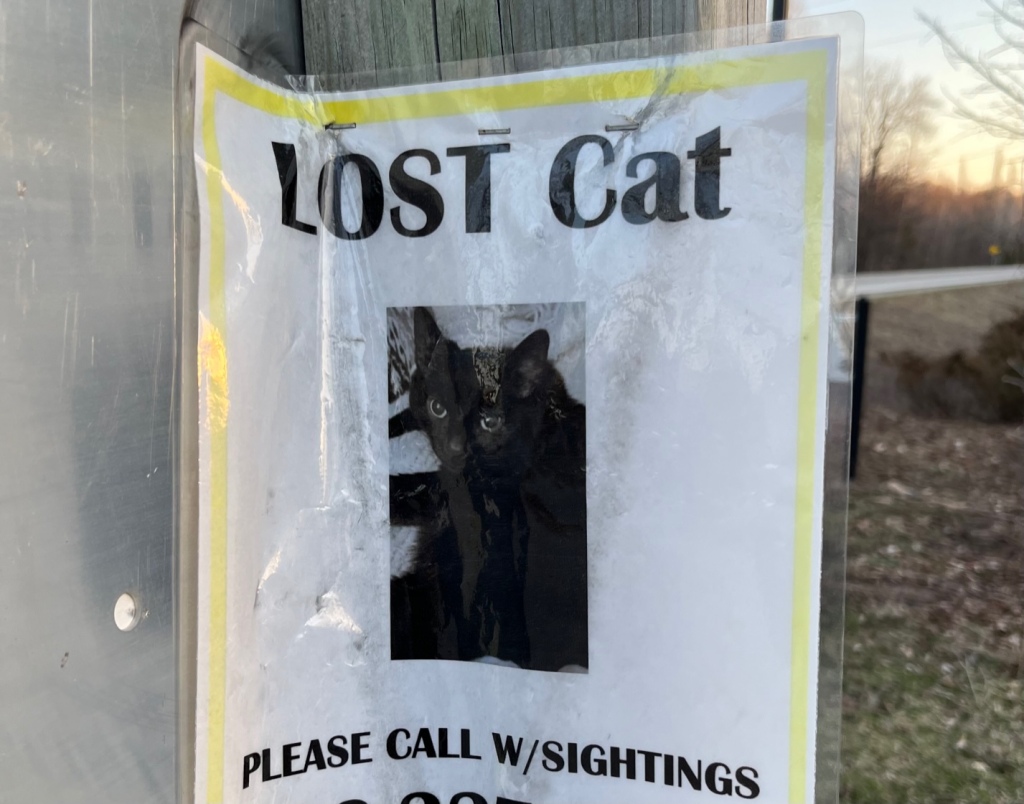
I’m away from home, and I’ve been taking lots of walks. On day two of my amblings, I noticed a couple of signs had been posted with a picture of a black cat and the words: Lost Cat Please Call w/Sightings. There is, of course, a phone number.
When I’m walking, I look for the cat, but all I’ve seen are deer, woodpeckers, crows, small birds, rabbits, geese, ducks, turkey vultures, and two foxes frolicking in a farmer’s field. But I haven’t seen the black cat, so I haven’t used the phone number.
Several days have passed and the notices are still up, so the cat is probably still missing. I like to think if the cat had been found, the owner would have removed the signs. I leave for home tomorrow, but I expect to see the signs on my morning walk before I go. I hope the owners find their pet, but the longer the cat is gone, the less likely it will return.
Something might have killed the cat. It also might have found a new home. Cats have been known to do that. I had a good friend who gained a gray cat that way when it showed up at her house. While she tried to find its owner, she fed it and took care of it, and the confident cat made itself right at home. Then the cat disappeared for a couple of days. Then it returned, only to disappear and reappear again over several weeks. Finally, she discovered the cat lived across the alley and down a few houses. The cat, like a bigamist, had been keeping two families. Plenty of jokes were cracked about its behavior, and both of the cat’s families kept in contact in order to keep tabs on their mutual pet. Eventually, the cat dumped the other family and settled in with my friend. She felt badly and kept asking the owners if they would like their cat back. Sure, but only if the cat wanted to come home. They were pragmatic about the situation because it turned out that was how the cat had come to live with them the year before.
But that’s not much comfort to the owners of the missing black cat because they wouldn’t know if their pet was safe.
We had a black cat when I was ten years old. My mother brought it home. I’m not sure if it was because my siblings and I wanted it or if she wanted it. She didn’t need much prompting to bring home animals, and what little kid doesn’t want a playful kitten with a soft, rumbly purr.
My father wasn’t happy when he came home and was introduced to a black kitten named Lucifer. He claimed he didn’t like cats. Lucifer, sensing my father was his enemy, joined ranks with him. That cat greeted my father when he came home from work, sat on his lap when he read the newspaper at the kitchen counter, and curled up with him when he fell asleep on the couch. My father grew fond of Lucifer, the cat with a name that belied his personality. Dad had a soft spot for animals too.
Lucifer was full grown but less than a year old when he died. No one noticed that he was missing because he hadn’t been gone long enough. One of my siblings discovered his body floating in our above ground pool in the backyard. The sides of the pool were four feet off the ground, but cats have leaping superpowers. However, once he’d gotten in the pool, he was unable to get out.
We were all upset about Lucifer, especially Dad.
A few months later, the pool, too, would have a sort of death. My father flew skydivers, and one weekend afternoon, Dad and some of the jumpers thought it would be fun if a couple of them were to land in our pool. Boredom was probably the mother of this crazy idea because the skydivers normally aimed for a small metal disk in the middle of much larger circle of pea gravel back at the airport. I can picture the scales in their adventurous brains as they weighed their options: Same gray pea gravel, again? Or a Caribbean-blue pool filled with chlorinated water? Tipping the scale was the much smaller size of the pool, twenty-five feet in diameter, making it a more challenging target. The skydivers were thrill junkies. Besides, the pool’s water was only three feet deep. No one was going to be in over his head.
We lived out in the country on two-point-two acres, and our land was surrounded by sprawling fields of tall grass. So, if the skydivers missed their target, they had plenty of grass to land on. Also, my father had a certain reputation in the neighborhood, and if someone saw a couple of guys with parachutes drifting toward earth in our backyard, well, that kind of thing was business as normal at our house.
But like many good ideas hatched in the heat of a Saturday summer afternoon, this one was a near miss or a near hit, depending on your point of view about the half-a-glass-of-water personality test. One of the skydivers didn’t land outside the pool or inside the pool. He landed on the edge, crumpling the side. Skydivers don’t float like dandelion seeds landing gently on terra firma. They come down a bit fast, so part of their ground school training covers proper techniques for landing to avoid injuries.
The skydiver wasn’t hurt, but he took some ribbing for “riding the fence.” The pool was totaled because once metal is bent that badly, there is no unbending it, so my father dismantled it and took it to the dump. That fall we got another cat, a Siamese kitten we named Cleopatra but called Cleo. A few months later, sadly, she was run over by a car. We didn’t get another cat for several years, and we never got another swimming pool. My father kept flying skydivers, but there were no more landings in our backyard.
I hope someone finds the cat on the poster, and it returns home. And if not, I hope the cat finds a nice second home. I’d like to think of the cat as keeping someone’s lap warm.

In 1924, Seegar Swanson and Elliott Nystrom, both twenty years old and friends since elementary school, decided to take a year off and tour the perimeter of the United States, making sure to visit the four corners of the country: Maine, Florida, California, and Washington. They saved money for their trip and bought a 1919 Model T Ford touring car for $125. They left Ashland, Wisconsin, in the late summer of 1924, and returned to their hometown in 1925. The trip took about a year because they worked at different jobs along the way. Also, Swanson points out, more than once, that the top speed of their Model T was 25 mph, if the roads were good.
Along the way Swanson and Nystrom kept a log of their experiences and expenses and took many photographs. Additionally, they wrote long letters home. After Swanson and Nystrom finished their journey, Swanson attended Northland College in Ashland. In 1936, he became the editor of the Superior Evening Telegram and later on he worked at the Duluth News-Tribune. After a long career in journalism, he retired at seventy-two. At the age of ninety, when he started writing Ford Tramps, he had his detailed resources and years of writing experience. He spent three years writing his book, and his hard work and dedication paid off because Ford Tramps is a well-told story that captures the mood of the country and its people in the mid-1920s and gives readers a glimpse into the daily lives of ordinary Americans and the places they lived.
Published in 1999, Ford Tramps is out of print, so if you want to buy a copy from Amazon, it will be used and it will cost between $56.26 and $154.63. Thriftbooks has one copy listed for $59.99. I paid under $20 per book when I bought two copies in 2000. I gave one to my father, and I kept the other.
My father read Ford Tramps right away and loved it. I cracked open my copy in March 2023. It’s amazing how fast twenty-three years can drive by. And if I hadn’t read a blog about autocamping in the 1920s written by Chris Marcotte, my copy of Ford Tramps would still be parked on my bookshelf.
I wish I’d read Ford Tramp years ago, when my father was still alive so we could’ve talked about the book and why we liked it. Even though we never had that conversation, I’m going to tell you why I think he enjoyed the book so much.
He liked it because Swanson’s descriptions of the 1919 Model T bring the car to life. The Model T that Swanson and Nystrom drove had three pedals on the floor and a lever by the door side of the driver’s seat that controlled the transmission, and it had a lever on the steering wheel that controlled the throttle. A complex coordination between feet and hands was needed to shift gears. Machines fascinated my father. He loved being a part of them, manipulating them, controlling them, understanding them, and pushing them to their limits. He drove cars and motorcycles, and he flew planes. Just as Swanson and Nystrom had to learn the personality of their Model T and what it could and couldn’t be asked to do, my father took pride in mastering his cars, motorcycles, and planes.
He liked the book because the Model T broke down on the road, and its tires often went flat. Swanson and Nystrom played nursemaid to the Model T, learning what they could fix themselves or rig up until they could afford a mechanic. My father, a savvy mechanic, would’ve reveled in the Model T’s challenges. Sure, when the car broke down, he would’ve sputtered and cursed. Then he would’ve put the Model T in its place and back on the road. He owned his own garage where I once heard a customer with an old sports car ask him, “What if you can’t get a part?” My father answered, “I’ll rig something up, and it’ll work.” That 1919 Model T would’ve been putty in my father’s hands.
He liked the book because he was in his 60s when he read it, but he could be young again, on a vicarious adventure from the comfort of his couch where his standard poodle and his greyhound curled up near him. In 1955, he was eighteen when he moved from a small unincorporated town in northern Wisconsin to the big city of Milwaukee, hoping to make his way in the world. My father never took a road trip like Swanson and Nystrom, but in a small way, he liked to travel and experience new places and meet new people. Swanson and Nystrom met many interesting and kind people while working odd jobs and autocamping. Swanson’s writing breathes life into these men and women, allowing readers to work beside them in an orchard picking crops or sit with them around a cookstove as they share stories and food with other autocampers.
My father liked the book because Swanson included many photographs, maps, log entries, expense accounts, and receipts. It was fun to see what food, lodging, camp fees, car repairs, and other necessities cost in the mid-1920s. Swanson and Nystrom also reported how much they were paid doing manual labor. My father, an avid photographer, took photos when he traveled. After he had his film developed, he would show you ten pictures of the same vista, then ten pictures of the same museum display, then ten pictures of the same man who took him out fishing on a charter boat. My father considered maps to be among the most useful items in his life. He used them when driving to someplace unfamiliar, and he used them to plan his flights from one airport to the next. As a pilot he kept a log of all his flights, and as a businessman he kept expense accounts and receipts.
My father liked the book because the Ford Tramps spent time in his beloved state of Arizona. He moved to Arizona when he was forty, and he thought his adopted state was amazing. Swanson and Nystrom marveled at the Petrified Forest, amazed that trees had turned to stone. The pair debated between seeing a bullfight in Mexico or seeing the Grand Canyon, with both of them favoring the bullfight. The Grand Canyon won out because in Mexico, bullfights were only held as part of major holiday celebrations, and it was too long a wait for the next holiday. Some things are meant to be. Swanson and Nystrom fell in love with the Grand Canyon, agreeing it was, as Nystrom remarked, “The greatest thing we’ve seen so far.” They stayed for five days. They hiked to the bottom of the canyon and swam in the Colorado River. They hiked along the rim in both directions, and they attended a Native American ceremony. One afternoon they took shelter in their Model T during one of the desert’s quick moving and furious storms accompanied by lightning that seemed to touch the ground and thunder that redoubled its intensity as it echoed off the canyon walls. My father never tired of watching desert storms roll through Tucson.
I’m at the point in the book, when Swanson and Nystrom have just crossed into California. Even in 1925, in an effort to contain harmful pests, California border patrol officials stopped cars to make sure people weren’t carrying fruit into the state. The Model T was searched from top to bottom because Swanson and Nystrom admitted to having a handful of oranges that they’d been given in Florida. Embarrassed, but having nothing else to hide, they were allowed to enter California. I have eighty-eight pages left to read, and Swanson and Nystrom are about to visit Yosemite Park. I’m sorry my journey with them will soon come to an end.
Someone suggested I sell my copy of Ford Tramps, pointing out my investment in the book had at least tripled. I’m not selling my copy, but if I did I could list it as “like new” because it’s only been read almost once, and I haven’t spilled any coffee on it. I wish I had my father’s copy of the book, but I wouldn’t sell his copy either. However, I would’ve been willing to share one of the copies with someone else. My father would’ve liked that, too.


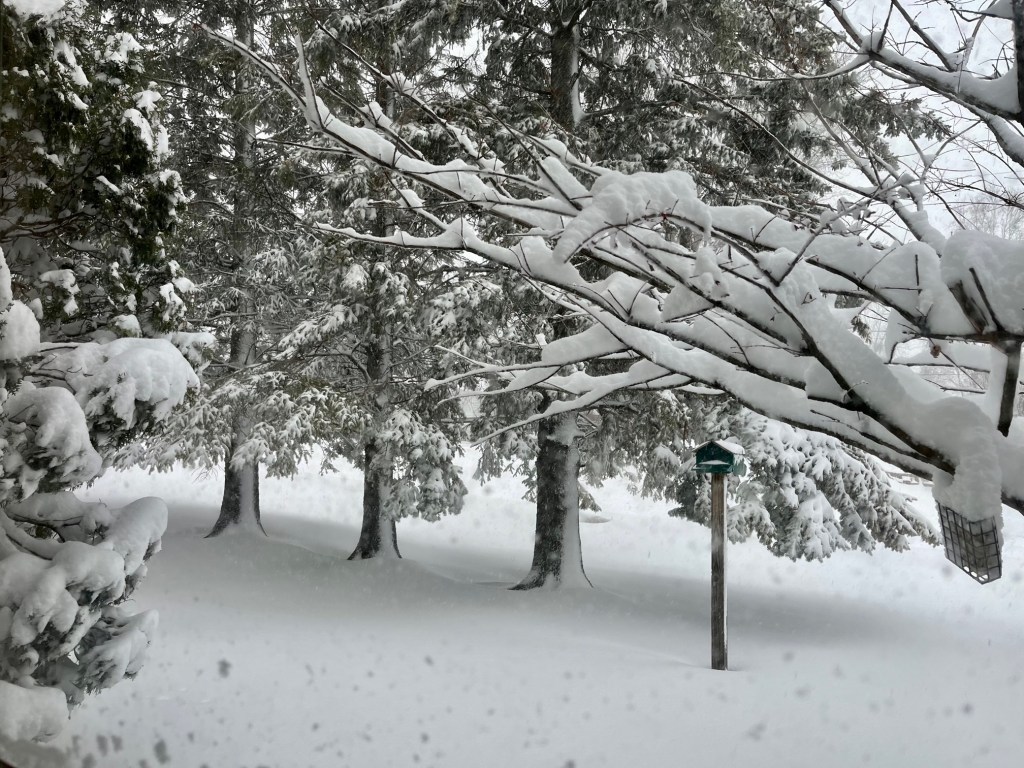
I think of these mornings as Ansel Adams mornings, when overnight the snow has fallen wet and heavy, clinging to branches, railings, and the sides of houses. The sky is tinted with the blue-gray of first light, and sunrise is moments away. It’s a world captured in gray and black and white.
Aiming my phone out the window, I take color photos, but they come through as black and white. Later when I apply the noir setting to them, the difference between the original and edited photos is nearly nonexistent, so I discard the changes.
Adams, one of my favorite photographers, captured the American West in black-and-white images, and his landscape photos featuring snow are among my favorites. I learned about Adams in a college photography class that I enrolled in because friends were taking the class for their art requirement. Having taken a ceramics class that summer, I didn’t need anymore art classes, but I signed up anyway because the class met on Monday nights when we all went country swing dancing at a local bar. If I was at class with them, it would be easier for us to carpool to the bar. I miss those days of whimsical logic.
That autumn I had a marvelous fling with country swing dancing, but I fell in love with the photography class. My friends spent just enough time completing assignments to earn what we called Charity C’s. But I spent hours photographing people, architecture, nature, and landscapes. And I spent hours and hours in the photo lab developing negatives and printing pictures, experimenting with different papers and exposures. I saved up money and bought my own 35 mm camera, playing with the f-stop, shutter speed, and film speed. I took four more photography classes over the next two years.
I thought about a career in photography, but I was more in love with taking pictures than the idea of earning a living by taking pictures. After I married and had children, my manual 35 found a shelf on a closet and retired. My husband bought me one of those instamatic 35 mm, a point and click camera that used 35 mm film. I used it for years, until I bought a digital camera with an SD card. But now my camera is a smart phone. And I can be a photojournalist wherever I travel or from the inside of my house.
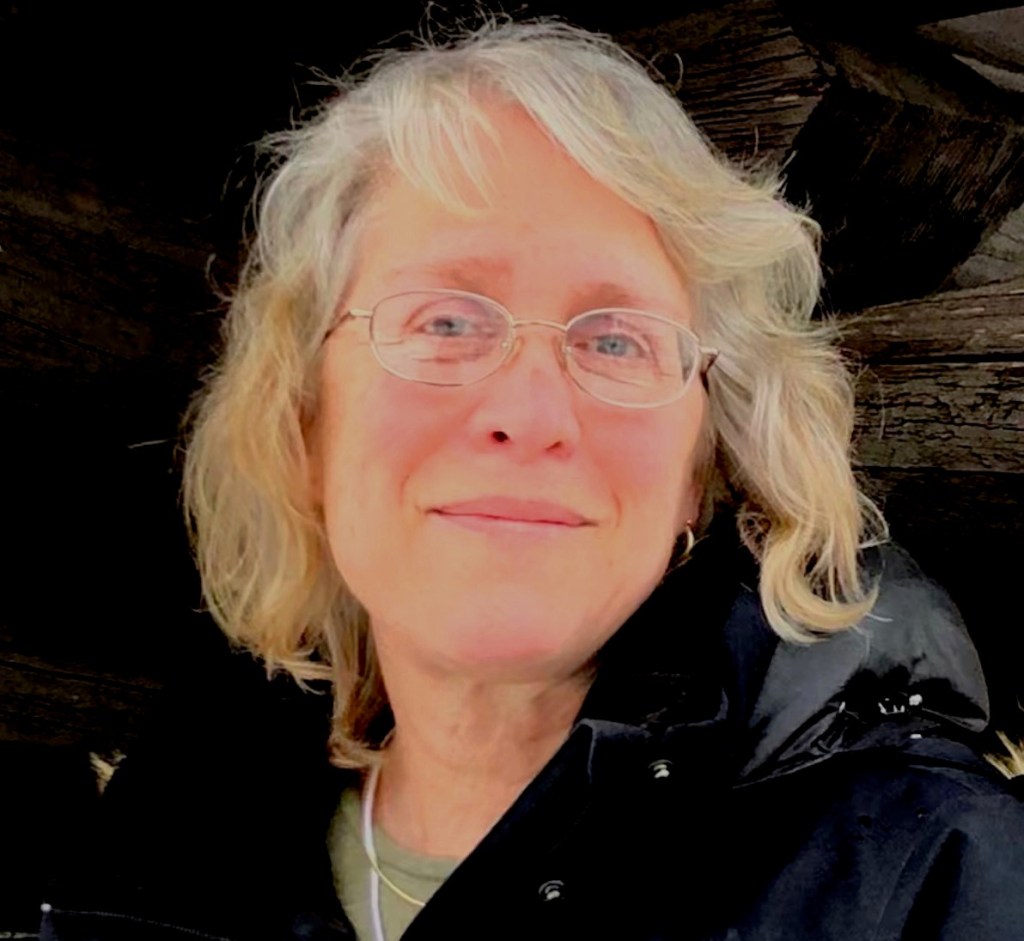
This class is offered by Write On, Door County as part of my writer’s residency. Class description:
Submitting writing for publication can be scary and intimidating. But if you have written stories, essays, or poetry, and you are longing to see them published, you will need to submit. In her virtual workshop, Victoria Lynn Smith will cover the basics. You will learn about submission guidelines and where to send your work. We will discuss the issue of fee-based versus free submissions. Tips for writing a cover letter and bio and how to increase your chances of acceptance will be shared. Most importantly, we will take about rejection and how to deal with them. A list of resources and a class outline will be shared with all participants. Please note that this class does not cover submitting articles to magazines, which is often done through query letters.
This opportunity is presented free but registration is required. Goodwill donations are accepted. To register click here. (Donations go to support Write On, Door County and the many programs they provide for the writing community.)
Teaching Artist: Victoria Lynn Smith writes short stories and essays. Her work has been rejected more than 174 times but has been accepted thirty-eight times. She lives by Lake Superior, a source of inspiration, happiness, and mystery. Her work has been published by Wisconsin Public Radio, Twin Cities Public Television, Brevity Blog, Better Than Starbucks, Hive Avenue Literary Journal, Persimmon Tree, Jenny, 45th Parallel, Mason Street Review, and regional journals. Her essay “The Dummy Never Showed Up” won an honorable mention in the 2022 Wisconsin Writers Association’s Jade Ring Contest. Her essay “Show and Tell to Remember” won an honorable mention in Bacopa Literary Review’s humor category and was published in November 2022. She was a semi-finalist in the Wisconsin People & Ideas 2022 Fiction Contest, and she placed second in the 2022 Hal Prize Fiction Contest. She is working on a collection of short stories.

Today, March came in like a lion. The winds were 20 mph, and the gusts were a whole lot gustier. We were supposed to get one to three inches of snow, but at least six inches blew in off Lake Superior, and flurries are still coming and going. Around two o’clock this afternoon, a light pole fell over onto the Bong Bridge and blocked traffic from Duluth to Superior. Fortunately, it didn’t fall on a vehicle.
In my yard the snow piled up on existing drifts, turning hills into mountains. I will need a Sherpa, oxygen, and snowshoes to walk around my yard. When I opened my back door, I pushed it slowly, using it as a plow to move a drift just enough so I could reach around and grab the shovel. I cleared a path across the deck for the dogs, who unfortunately need to go potty outside, and do other stuff, like walk around the house to smell for bunnies. They come back inside looking like four-legged abominable snowmen, and I have to towel dry them and dig ice balls out of their feet.
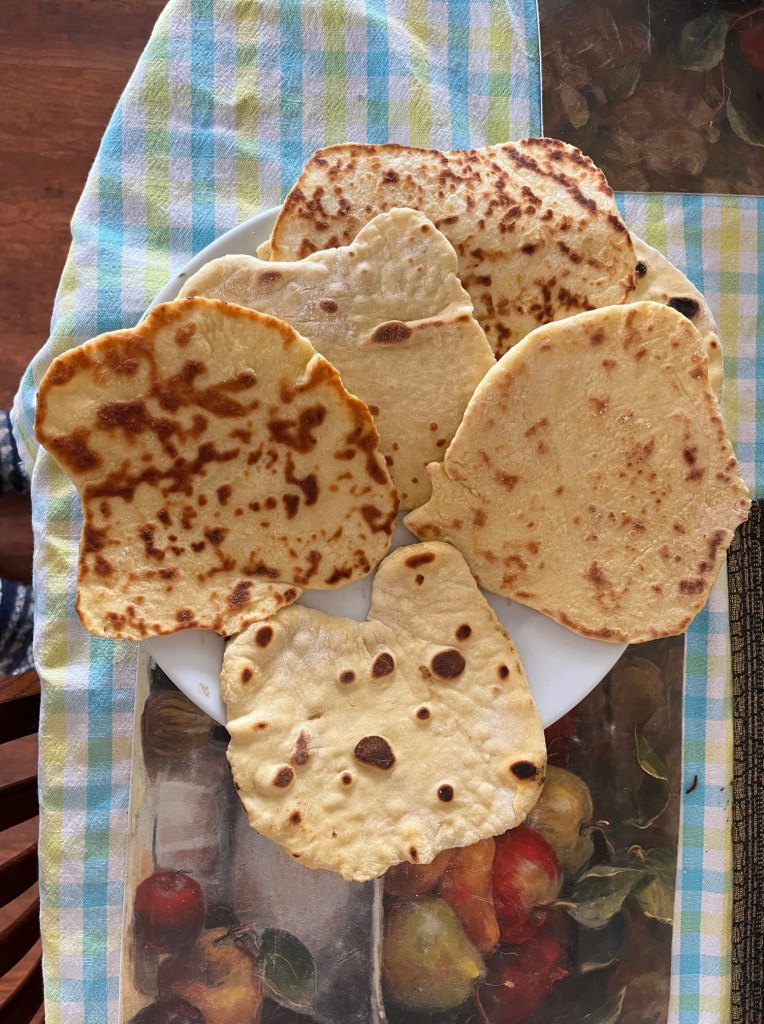
I worked this morning, which left my afternoon wide open for cooking — something I feel compelled to do during a snowstorm. Perhaps it’s a primal instinct, meant to ensure I survive the brutal winter elements while I’m inside my house with central heating, electricity, and running water. First, I made taco soup in the crockpot. Nice and simple. This gave me time to make naan bread.

Why did I decide to make naan bread? Reading made me do it. I’ve read Behind the Lens and Double Exposure written by Jeannée Sacken. Her novels are about the adventures of photojournalist Annie Hawkins, who travels to Afghanistan. They are page-turning adventures with twists and turns and danger and romance, but they are also filled with the sounds, smells, and tastes of Afghan food, and naan bread is mentioned often. After reading the second book a few months ago, I decided I needed to make naan bread. On Sunday, I bought the ingredients.
I made bread once before when I was sixteen and babysitting for my younger cousins. And it turned out perfect. It was so good — just the right color and height and texture and taste — that I never made bread again. I figured I had nowhere to go but down. My next loaf of bread would have surely been a brick. But naan bread is mostly flat, so I was encouraged. The naan bread could be dipped in the taco soup or torn into bits and dropped into the soup.
My first attempt at activating the yeast was a failure. My water was warm enough, but when I put that warm water into a cool metal bowl, the water temperature dropped, and the yeast fizzled instead of bubbling. I had to throw it out. After some internet research, I tried again. This time I used my Pyrex measuring cup. I warmed it up with warm water, then I put warm water in the cup with the yeast. It bubbled up and doubled in volume, just like it was supposed to do. I mixed the other ingredients in and kneaded the dough on the pastry mat. I covered the dough and let it rise for an hour and a half, while I attended a Zoom write-in.
Triple play: soup cooking in the crockpot and dough rising in a bowl under a dish towel while I write.
After the naan bread dough finished rising, I divided it into eight sections, rolled each one into a flat six-inch circle — more or less — and fried each piece. I set off the smoke alarm, but only once. I made a mess out of my kitchen. When I finished there were dishes all over the countertops and stove, and I found flour on the floor. I don’t know how I can cook something and make so many dirty dishes and create such a mess. I guess it’s a gift.
When my husband came home, there was no evidence of my afternoon cooking spree. The kitchen was clean and the dishes were done. (I even managed to read a bit and take a nap.) He looked at the plate of naan bread on the counter and asked, “What are those?”
“That’s naan bread. I made it this afternoon.”
“Yeah, right. You went to the grocery store and bought it,” he said.
“Nope,” I said, “I even took out the rolling pin and pastry mat and put them in the dish rack, so you would think I made them from scratch.”
He looked at the dish rack overflowing with bowls, pans, and measuring cups, and he laughed. He knew I’d been cooking and baking. He also doesn’t understand how I can cook something and make so many dishes and such a mess. Some talents are inexplicable. But he liked the naan bread and soup, happy to have a hot home-cooked meal after snow blowing.
In December 2022, Hive Avenue Literary Journal published my short story “Harlequin Pattern.” The story appears on page 262, which can be reached by scrolling down.

I dedicated the story to Milan Kovacovic, a kind mentor who gave me feedback on the story. Milan passed away in 2020. I miss him and think of him often. Milan said my story was “a fine piece of satire.”
Milan wrote a thought-provoking and beautiful memoir called Ma’s Dictionary: Straddling the Social Class Divide about his life in France and the U.S. He wrote lovingly about his primary-school teacher, Madam Mercier and her importance in shaping his life. He wrote about his movement between the social classes in France and his emigration to the U.S. When I met him, he was translating his book into French. His book is still available on Amazon.

 Writing Near the Lake