Bloganuary Post for January 4: A Treasure That I Have Lost

[Bloganuary is hosted by WordPress. A new topic is presented each day during January. I’m a day behind.]

When my father, who lived in Tucson, died in 2016, there were three things I wanted from his estate: a bed-sized quilt I’d made for him, a lap quilt my youngest son had made for him, and a scrapbook of photos I’d made for him filled with pictures of him and my sons.

I got two out of three.

Dad’s quilt with a white background in the focus fabric and a dark blue border

The quilt made for my father arrived first. Years before, on a visit north, my father had gone into a fabric store with me on purpose. Maybe it’s a cliché but most men don’t follow women into fabric stores. My husband always sits in the car. I had a friend whose husband always sat in the car and sometimes napped while she bought material. But my father wasn’t a sit-in-the-car kind of guy. Once on an afternoon jaunt along Lake Superior, I stopped at a yarn shop, and my father came inside with me. He found something to like in that store–the owner’s dogs. While I perused the yarn, they chatted about their dogs.

After I picked out some lovely woodsy, snowy themed material in the quilt shop, my father offered to pay for it. He didn’t say, “Make me a quilt.” The gift came with no threads attached. But in that moment, I knew I’d make him a quilt out of the material. A few days later, I bought a second set of the same fabric in a different color scheme, and I made two quilts, one for him and one for me. I thought about the quilts as a gift of connectedness: he had one and I had one.

Weeks later the quilt my son made for his grandpa arrived. It was late coming because at first no one could find it. I wanted my son to have the quilt. On his own he’d decided to make his grandpa a quilt. He picked out a focus fabric with an airplane motif because his grandpa had a small private plane, which he used every summer to fly from Tucson to Wisconsin to visit us.

The airplane quilt

The making of the airplane quilt was a joint effort between my son and me when he was about twelve. He selected the material, chose a design, and sewed the squares together. I cut the squares using a rotary cutter. If you’ve ever seen or used a rotary cutter for quilting, you will understand why you don’t put one in the hands of a child. When the quilt top was finished, I machine quilted it and put a binding on it. During one of my father’s summer visits, my son gave his grandpa the quilt, who most fittingly put it in his plane when he left and few it home.

The scrapbook of photos never arrived. No one ever found it. I made it for my father around 2005. I wasn’t into scrapbooking, but I had a friend who made gorgeous eye-candy scrapbooks to memorialize family vacations. When I was a child, a scrapbook had plain white pages and people taped or glued articles, photos, ticket stubs, and other flat mementos in them. I have one I made when I was a teenager after my trip to Europe. But scrapbooking had evolved, and people used decorative papers, elaborate stickers, and fancy stick-on letters to create themed pages, which were slipped into plastic sleeves then inserted into a binder.

I made one of those upscale, themed, gorgeous eye-candy, fancy scrapbooks for my father. I filled it with pictures of him and his grandsons. Pictures of him holding them as babies. Pictures of them fishing with him. Pictures of them with him when we visited Tucson. And, most sentimentally, the pictures I took each year of him and his grandsons in front of his plane, just before we stepped away and he climbed inside. We’d listen to him yell “clear” before he started the engine. We’d watch him taxi to the runway then take off. We’d stand on the ground and wave, and my father would tip his wings back and forth, waving goodbye to us.

The scrapbook is a treasure gone missing. No one is sure what happened to it. One year my father, who lived in a raised ranch, had water damage in the lower level in an area where he stored a lot of stuff that had to be thrown away. Maybe the scrapbook was part of the flood.

I have copies of all the photos, but it’s not the same. In the scrapbook, those remembrances were gathered in one place. I wanted to be able to open the scrapbook and wander through those collected memories of my father with his grandsons. I could’ve made another scrapbook, but I haven’t. I think of the one I made for my father as perfect, something I couldn’t replicate.

But I use the quilt I made for him on my bed. The gift-of-connectedness quilt that I made for myself hangs on the quilt rack in my family room.

My quilt with a tan background in the focus fabric
and a sage green border

Bloganuary Post for January 3: What’s the Earliest Memory I Have?

My sister and me, a few months before our trip to Pulaski Park

[Bloganuary is hosted by WordPress. A new topic is presented each day during January.]

My earliest childhood memory? That would be the morning my younger sister (2) and I (3) took pity on my sleeping mother, left the house early in the morning, and walked a handful of blocks to Pulaski Park in Milwaukee. Mom was tired. Who wouldn’t be with two busy toddlers around the house? So, we didn’t wake her up and ask her silly questions like, “Can we go to the park?”

We also didn’t worry about getting dressed. My sister and I each wore a stylish combination of cotton training pants and summer pajama tops. During a hot Milwaukee summer, we didn’t bother with pajama bottoms.

Pulaski Park was our favorite because Nana Kitty took us there when she came to visit. She put each of us on a swing and pushed us up, up, up, into the always robin’s-egg-blue sky. And, our best, most favorite part? Nana sang “Puff the Magic Dragon” to us while she pushed us on the swings.

It was my favorite song. And on that morning, it was my idea to go to the park. If my nana couldn’t take us, I would take us. I wanted to go to the park because I wanted to sing “Puff the Magic Dragon” just like Nana did, even though I didn’t know all the words like she did.

I held my sister’s hand, and we walked down sidewalks, waited at stoplights, and crossed streets without getting hit by a car. We walked on the path into the park and crossed a concrete bridge over a small creek. I helped my sister into the swing, and I pushed her up, up, up, into the always robin’s-egg-blue sky. I sang some of the words from “Puff the Magic Dragon.”

A woman who was at the park, pushing her child on a swing, asked me, “Where is your mother?”

“In bed,” I replied. “I’m taking care of my sister.” I smiled. I felt proud as I pushed my sister into the sky and sang about Puff, the childhood friend of Little Jackie Paper.

And that’s where my memory stops, and my mom’s memory begins.

When my sister and I were older, Mom told us how our trip to the park ended. She woke up shocked and panicky to find we weren’t anywhere in the house. But she had a good idea where we went. She put our German Shepherd, Fritz, into the car and drove to Pulaski Park. So relieved to find us there, she hugged and kissed us over and over again.

A couple of weeks later, Mom woke up and my sister and I were gone—again. We’d gone back to Pulaski Park on our own—again. Mom and Fritz came to get us—again. But the second time, Mom was so upset to find us there, she gave us spankings!

Something Published: “How to Keep a House”

My short story “How to Keep a House” was published by Rathalla Review in their fall issue. To read the story click here and download the PDF. My story is on page 26.

I want to thank Felicia Schneiderhan, a wonderful and kind teacher, and Lake Superior Writers. In January 2021, I wrote the rough draft for “How to Keep a House” in a class called “Rules of Engagement” with Felicia, which was sponsored by Lake Superior Writers. We had to decide on five rules for our story before we started writing it. After we started writing, we could bend or change our rules if something wasn’t working. At first, having a set of rules before I had a real story idea was frustrating. Then it morphed into a creative process that I embraced. I began to like my characters and their story, so I kept revising. For an interesting take on this process read “The Power of Constraints to Unlock Creativity” by Amy Goldmacher on Brevity Blog.

I also want to thank Kim Suhr and Red Oak Writing. The final revisions I made on “How to Keep a House” were after attending a Red Oak Writing Round Table. Kim Suhr, the director of Red Oak, led the Round Table writing group. After receiving some excellent feedback from her and the other writers in the group, I revised my story once more. It was at this point that I felt my story was truly finished. I submitted it to Rathalla Review, and they accepted it a few months later. For information on Red Oak Writing Round Tables click here. To learn more about Kim Suhr, who is an amazing writer and a supportive mentor, click here.

Finally, I want to thank the editors at Rathalla Review for publishing my story and for their enthusiastic words about it.

Just so you know, I submitted “How to Clean a House” twenty-one times over the course of a year and a half before it was accepted. It’s hard being rejected so many times. But I think about when I was in gym class, and always the last one chosen to be on a team. It smarted, but I learned that eventually someone had to pick me, and then I’d get to play! I loved gym, even if I wasn’t the best athlete.

Bloganuary Post for January 2: How am I Brave?

[Bloganuary is hosted by WordPress. A new topic is presented each day during January.]

I don’t know if I’m brave because I’ve never been in a situation requiring bravery. I could offer insignificant bits of times when I’ve been microscopically brave, but those examples are dust and easily blown away. However, there are stories of bravery among my family, mostly it’s the kind of bravery needed to get through the beating life sometimes hands a person.

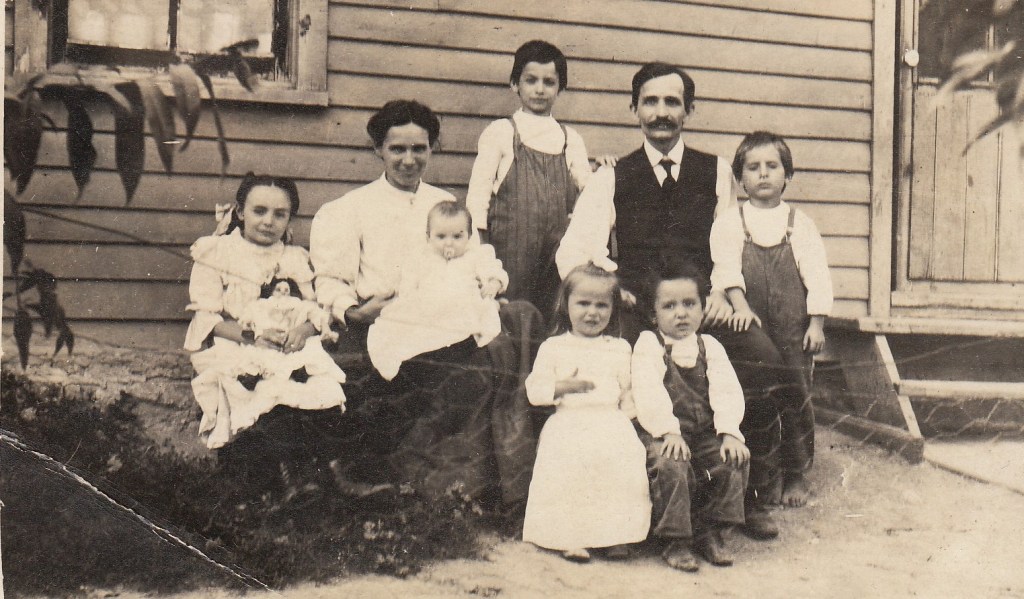
My great-grandfather Joseph, in the vest and tie, died of typhoid fever in 1922. His wife Mary is holding my Nana.

My great-grandparents Mary and Joseph, both orphaned young, traveled from New York City to West Bend, Wisconsin, on different orphan trains when they were small children, most likely with notes pinned to their clothing, listing their names, their destination, and the names of their new families—who they met for the first time at the station. Later, Mary and Joseph fell in love and married. But Joseph died young, leaving Mary with seven children and one on the way.

Grandpa George and Grandma Olive with their first child, my father.

My grandpa George and his three younger siblings became orphans at 11, 10, 8, and 3. They went to live with an aunt and uncle. But young George felt it was his responsibility to provide for his siblings, so he went to work at a copper mine. While riding in a wagon and holding a container of kerosene between his legs to keep it upright, some kerosene slopped on his legs and caused serious burns because George didn’t tell anyone until he got out of the wagon. His aunt put her foot down, refusing to let him work at the mine. He was, after all, only 11, and she and his uncle had the means to welcome the four orphans into their brood of children. Later, George started a business, married, and had three children. For the rest of his life, he quietly helped people in need. In his old age, he lost his sight, and to keep busy he cracked pecans, filling jars with nuts to give to family and friends.

Grandpa Howard as a young man

My grandpa Howard fought in World War II for four-and-a-half years. He was shot in the leg while fighting in Italy, and for that bullet he was awarded a Purple Heart. I don’t know if Howard ever carried a wounded soldier to safety or saved his fellow soldiers from enemy fire. He never talked about the war that gave him two permanent souvenirs: a limp and nightmares. The limp was constant, and the nightmares were frequent. The war wrecked his first marriage. He became estranged from his children. And he drank heavily until he became sober in his late 50s, eventually helping other alcoholics.

My beautiful sister and her beautiful daughter, circa 1994

My sister has a special needs child who almost died from seizures at three months old. My sister was brave on that night and has been brave many times since. Doctors told her that her daughter suffered brain damage and would probably never walk or talk or feed herself or learn to use the toilet. My sister spent as much time with her infant daughter as she could, stimulating her, talking to her, moving her limbs. Now an adult, my niece walks, talks, uses the bathroom, swims, plays soccer, and much more. Was it my sister’s love and bravery? Or the neuroplasticity of an infant’s brain? Or a combination? Because of my niece’s cognitive disabilities, she still struggles, and my sister is still brave.

Someday, I will probably need to be brave. And I hope my family stories will give me courage.

Bloganuary Post for January 1: What Is Something You Want to Achieve This Year?

[Bloganuary is hosted by WordPress. A new topic is presented each day during January.]

I gave up making New Year’s resolutions a long time ago. Maybe because I never kept them any better than the resolutions I made at any other time of year. I also don’t stay up until midnight anymore. The arrival of the New Year finds its way without my shouts of “Happy New Year,” and when I wake in the morning it will still be January 1.

But I have an ongoing list of ways I try to improve that I keep in mind throughout the whole year:

  • Be kind, as much as I can, to both people I know and strangers I don’t know.
  • Move around more and eat better.
  • Socialize more. Because I’m an introvert, my first inclination is to stay home, content in my own world with just my dogs and husband for company.
  • Revise and polish some of the rough drafts of stories and essays that I’ve written.
  • Share.
  • Understand and use commas better.
  • Remember that it’s okay to make time to do the things that I want to do.

The New Year gives us a chance to reflect and start again, to make resolutions and become better people. But any other day of the year can be a good day to reflect and start again, to make resolutions. So, Happy New Year throughout 2023, for today and any other day that you may need it the most.

Show and Tell to Remember

[“Show and Tell to Remember” was originally published by the Bacopa Literary Review 2022. It earned an honorable mention for humor.]

Inside my dress pocket, I had the best thing for show and tell. In 1964, I was new at Pleasant View Elementary, and having started in October instead of September, I was an outsider. My kindergarten classmates were going to be impressed. The popular girls would envy me and ask me to jump rope with them during recess. The cute boys would elbow each other and try to sit by me at snack time. My pretty teacher, with bouncing brown hair that flipped up in a long continuous curl around her neck, would look at me with approval.

“Vickie,” the teacher said, “it’s your turn.”

I snapped out of my daydream, rose from the floor, and stood next to the teacher who sat in a chair. My dress was clean, my saddle shoes were polished, and my unruly hair was combed into pigtails. It was my moment. I slipped my hand into my pocket.

“I brought a balloon,” I said. “Each one comes in its own wrapper.” My classmates leaned forward. My teacher turned toward me for a better view. I opened the package and pulled out the balloon.

“Let me see that,” my teacher said. Her hand clutched the balloon and its wrapper. She told me to sit down then called on the next student.

My face burned. At five and a half years old, I had enough sense to know I had done something wrong. But what? I wanted to ask for my balloon back, but I didn’t dare.

Me, circa kindergarten

After show and tell, I saw my teacher on the phone and heard her say my name. I was in trouble, but I didn’t know why. Too embarrassed to ask her what I had done wrong, I waited for a punishment, which in my imagination grew in magnitude as the afternoon dragged on. My graham crackers and milk didn’t sit well in my stomach, and naptime wasn’t restful. Usually, I rode the bus home, but at the end of the day, my teacher told me my mother would pick me up. My classmates left without me.

Mom arrived shortly after the buses rolled away. The teacher invited her to sit in the chair next to her desk but told me to wait in the hallway. They would talk about me, find me guilty—of what I didn’t know—and punish me forever. It had to be bad, very bad, but they didn’t talk long.

“Where did you get the balloon?” Mom asked after we got in the car.

“From your dresser.” Lying would’ve made it worse. My mother always seemed to know the answers to the questions she asked me.

“Don’t go in my dresser again. Or your dad’s dresser. Understand?”

I nodded in agreement. That was it. Not a word about punishment. No “wait until your father gets home.” This confused me because Mom had been called to school. My classmates said nothing about my show-and-tell offering either, and my dreams of popularity remained buried in the playground sandbox.

Because of the eerie silence that followed my kindergarten show and tell, I never forgot about it. It wasn’t until I was a freshman in high school that I realized I had taken a condom to school, and that Mom had said nothing more about the “balloon” because she didn’t want to explain condoms to her five-year-old daughter.

After I figured it out, I never asked, “Hey, Mom, remember when I thought I took a balloon to kindergarten for show and tell and the teacher called you?” Like any other teenager, I didn’t want to talk about birth control or sex with a parent. The where-do-babies-come-from talk Mom and I had when I was nine, still made me squirm with embarrassment.

After I had children, I appreciated that my kindergarten teacher and Mom handled my show-and-tell blunder with the calmness of an air traffic controller communicating with a pilot as he makes his final approach to a busy airport during a raging thunderstorm. But they never knew how much I suffered that afternoon.

Years later, I wondered if Mom might have been embarrassed because my teacher called her to school to discuss why her five-year-old daughter had a condom in her pocket. If Mom was mortified, she hid it well. She was twenty-four and had three daughters ages, five, four, and one. She may have been more horrified by the wasted condom than my taking it to school. Our family didn’t have the kind of lifestyle where condoms grew on trees.

Having graduated in 1958, Mom was six years out of St. John’s, a catholic high school, from which she almost didn’t graduate. She had written an essay scolding the pope and the Catholic Church for banning the use of birth control by its members. If she had, instead, written an essay describing her struggles with her Catholic faith and questioning the existence of God, the nun who taught the religion class may have said, “God expects his followers will experience a crisis of faith now and then. Keep praying.” But questioning the pope’s stance on birth control was sacrilege.

The school threatened to withhold Mom’s diploma, but she refused to rewrite her essay. She stood ready to see her high school diploma burned at the stake for the right of women to use birth control without fearing God or Hell or nuns who taught religion classes.

But Mom was also practical: She called the Wisconsin Department of Education, who made it clear to the school’s administrators they could give Mom an F in religion, but they couldn’t deny her a diploma because the state didn’t require a religious class for graduation.

For Mom, having to talk to my kindergarten teacher about my birth-control-show-and-tell balloon was probably child’s play. She had already taken on the pope and the Catholic Church and St. John’s High School and a perturbed nun. Besides I went to a public school, and no one threatened to keep me from graduating kindergarten.

[The Bacopa Literary Review 2022 can be ordered by clicking here. To read the complete list of winners and honorable mentions in humor, fiction, creative nonfiction, and poetry, click here.]

On Christmas Day I Saw Three Dogs a Snoozing

A dusky morning in Michigan, Ziva and Cabela, December 25, 2022

Christmas morning used to be about the children. I would hope they’d sleep in longer than they did on school mornings, but they’d wake up and be ready to open their presents before any school-morning alarm clock would’ve rung.

This Christmas morning it was my two dogs, Cabela and Ziva, who woke me up around six o’clock. They weren’t interested in presents–they wanted to go outside in the windy, windy snowstorm and pee. After we came back inside, my mother’s dog, Bogey, wanted to go outside, so back out I went, but I left Cabela and Ziva in the house.

I never take all three dogs outside at the same time. Doesn’t matter what the weather is like or what time of day it is. Bogey tries to run down the back hill through some bushes, hoping to reach the golf course and look for golf balls. He’s not put off by the snow. He plants his nose into the white fluff and comes up with a golf ball. He can smell them under the snow. And Cabela tries to exit the front yard and trot down the road. I have no idea where she thinks she’s going, but something wild in the air calls to her. I can’t chase Bogey and Cabela at the same time in different directions. Bogey won’t listen unless I’m right next to him, saying, “Stay here.” Cabela can’t listen because she’s mostly deaf. Ziva never tries to leave the yard. She keeps her eye on me.

After the dogs had a chance to make yellow snow, I decided to do some writing. The other humans were still sleeping and Bogey went back to bed. I turned on my computer and sat at the kitchen table. My dogs began pacing around the kitchen on the hardwood floors, clickity clack, clickity clack. It’s amazing how loud dog nails clicking on a wooden floor sound when a house is predawn silent. While pacing, both dogs stopped periodically and looked at me, as if to say, “Let’s go back to bed.” I tried to ignore them, but they can be relentless. They wanted to be with me, but they didn’t want to lay on the hardwood floor, not when there were couches to sleep on.

I gave up on writing and joined the dogs in the living room. I curled up on a large stuffed chair with a soft ottoman. Cabela and Ziva commandeered opposite ends of the couch, and we all went back to sleep for an hour. Then I got up, but my dogs kept sleeping.

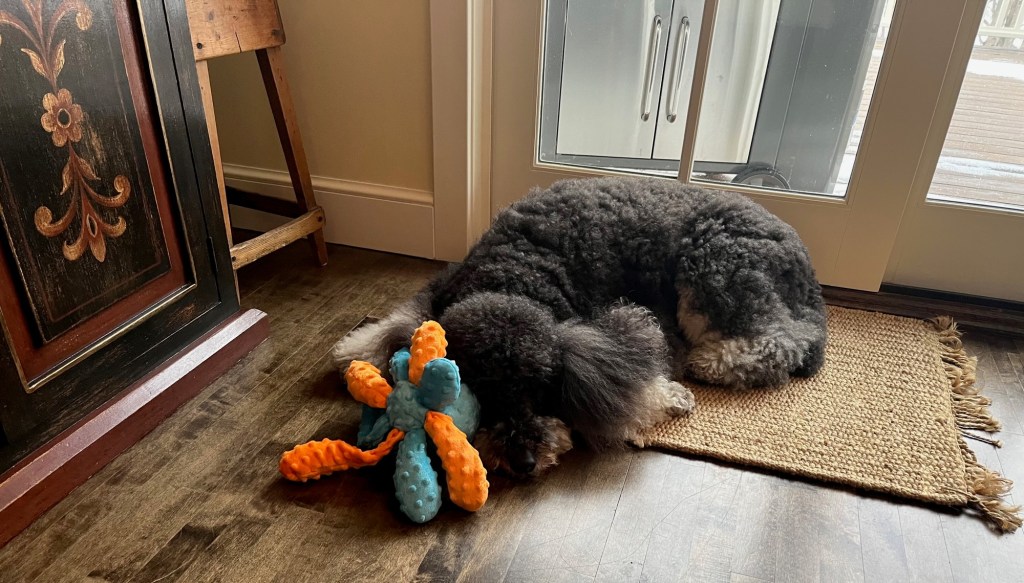
I gave Bogey his Christmas present, a colorful stuffed octopus. He played with it for a bit, then napped with it on the kitchen floor. With all three dogs in the house fast asleep, I made coffee.

Bogey with his new toy, Christmas Day 2022

A Two-Day Bluster and Counting

My writing perch, Christmas Eve

I’m in Petoskey, Michigan, just thirty miles south of the Mackinac Bridge. We came over on Wednesday, threading the needle between stormy weather in northern Wisconsin and stormy weather across the Upper Peninsula. It was a smart choice. We had nice driving weather for our nine-and-a-half-hour trip. It was, however, bitter cold, which my dogs didn’t appreciate during their potty breaks.

On Thursday the temperature in Petoskey rose to 35°, the sun shone, and the Lake Michigan winds kept their breezy nature tucked away. My husband and I took my mom out for a drive in the morning because she wanted to do some shopping. After we dropped her off, my husband and I went to lunch and did some shopping, buying gifts for her, a bread pan for me, and caramel corn for him. Although a winter’s day, it was beautiful for walking in and out of shops in downtown Petoskey. I reminded my husband about the last time we had such beautiful weather for pre-Christmas shopping in Petoskey. Shortly after nightfall, temperatures sank; thick, wet snow blanketed trees, power lines, and the ground; and winds whipped into gale force strength. We lost power at 2:30 in the morning.

Cabela

Once again, the nice weather we had on Thursday was the calm before the storm. By 7:00 p.m., the wind revved up its motor, the temperature dipped fifteen degrees, and the snow flew in horizontally off Lake Michigan. Fortunately, we haven’t lost power, but the water in the toilets sloshes back and forth and side to side like we’re on a ship in rough seas.

Each time I take the dogs outside, including walking my mom’s poodle, Bogey, I bundle up from head to toe–hat, goggles, down coat, long underwear, and boots. Yesterday morning I walked Bogey, and we had to trudge through knee-high snowdrifts. He likes to walk to the cul-de-sac to poo. He has a favorite spot. Sometimes as we walked the wind would gust, stopping me in my tracks and shoving me a step or two backwards. Later in the evening after dark, we repeated our trek through knee-high snow drifts, the wind pushing us around again. I thought about Jack London’s story “To Build a Fire.” I have a fine sense of the dramatic. But mostly, I wondered why anyone would set out for a long walk in subzero temperatures or blowing blizzards. I wasn’t going any place where I couldn’t see house lights.

Ziva

The snowstorm bellowed all through the night, and the winds blew harder. This morning the snow is lighter, but the winds continue to roar off Lake Michigan. This weather front isn’t forecasted to loosen its grip until after Christmas Day.

So, it’s inside entertainment. I’ve watched a little bit of football, lost two games of cribbage, finished a five-hundred piece jigsaw puzzle, and I’ve done some reading and writing. Last night my mom and I watched Flawless, a movie starring Demi Moore and Michael Caine, which we both liked a lot. Today I wrote this blog while sitting in a second-story window seat, watching the white caps on Lake Michigan, listening to the whooshing winds, and being chilled by the cold air leaking through the windows. The winds are gusting at 45 mph. The snow is still falling. And because I’m very cold now, this blog must be done. I need a cup of hot cocoa with whipped cream.

Bogey, just back from our morning walk on Friday

Flashlight Magic after a Snowstorm

Last week a snowstorm moved through our area, and school was cancelled three days in a row. I took care of my youngest two grandsons for two of the days, which included a sleepover.

After the first day of the storm, there was a lull in the evening before part two of the storm hit. So, on a beautiful, warm winter evening dressed in fresh snow, my grandsons bundled up in their outerwear, and my husband gave them headlamps to strap around their hats. I leashed the dogs, and we went for a walk.

My happy grandsons ran down the sidewalk, mesmerized by the bouncing lights shining from their headlamps. They laughed and played games as they ran. My dogs and I trailed behind. The dogs ignored their antics, but I remembered my sisters and I as young children and our fascination with flashlights. We’d heist a flashlight from the kitchen junk drawer and hide it in our bedroom. After dark, we used it to create animals with our fingers on the walls of our bedroom. We had such fun–until my father, days or weeks later, opened the junk drawer to find his flashlight missing when he needed it.

My father’s voice would boom: “Where’s my damn flashlight?” My sisters and I would exchange glances, then fetch it from the bedroom and place it in his hand.

“I can’t have a damn thing around this house!” he’d spout. My father, a master of hyperbole, turned every problem that impacted him into an all-or-nothing event.

In reality, there were only two things my father couldn’t have around the house–flashlights and tape measures. Considering he was a mechanic with an amazing array of tools in his garage and a junk drawer full of household tools, he could’ve fared worse. My father’s booming voice didn’t deter us. Eventually, we’d hijack the flashlight again, always with a plan to return it before he noticed it was missing, a plan that usually failed.

At some point we discovered tape measures were fun, not because we measured stuff, but because the metal tape could be pulled out and locked in place, then with a flick of a finger, unlocked. And ZING, twenty feet of metal tape would dash into its case with satisfying speed and a snappy sounding CHING. Of course, we often forgot to return the tape measure.

One day, one of us, I think it was me, pulled the metal tape out too far. Nothing we tried would fix it. Next time my father boomed, “Where’s my damn tape measure?” we wouldn’t be able to retrieve it and put it in his hand, unless we handed it to him with its innards spilling onto the floor.

We did the only sensible thing we could think of–we placed the broken tape measure in a paper bag and carried it into the field of tall grass behind our backyard. We left it there, hoping no one would find it.

I don’t remember if my father or mother ever found the bag. And I don’t remember what happened the next time my father boomed, “Where the hell is my tape measure?” I asked my sisters and they didn’t remember the event, although they were part of the caper and cover up.

Sometimes I think I have a vague memory of it being discovered, but that my father made no bigger deal out of it than to repeat his usual “I can’t have a damn thing around here” lament, a tirade that probably lasted only a minute or two because being a busy guy, he had other things to do. He also had tape measures in his garage.

My father could at best be described as a curmudgeon, but for all his bluster, he was sentimental. Once we all grew up and moved out, I wonder if he ever went to his junk drawer and felt a bit sad to find both his flashlight and tape measure undisturbed.

Dad and me, before I started playing with his flashlights and tape measures.
Dad was 22 years old, and I was ten months old.

Watching my joyful grandsons with mini flashlights strapped to their heads made me smile, and I offered up some words to my father who passed away six years ago. Dad, I know our love of your flashlights and tape measures drove you crazy, but thanks for being a good sport about it–in your own way. And I told him that my grandsons are crazy about flashlights and tape measures, and if they lived with him, he’d find those things going missing once again.

Michigan Monarch Prepares for Migration to Mexico

Feeding monarch, October 8, 2022
My camera phone captured a brighter color, but to my naked eyes, the monarch wings were very dark brown.

On a cold, windy morning in early October while walking in Petoskey, Michigan, I spotted a monarch butterfly tucked inside a pink garden cosmos, also known as a Mexican aster. As I neared the flower, the monarch ignored me, letting me sidle up while snapping photos with my camera phone. I had never seen a butterfly behave this way. Normally, they flit away before I get within a few feet.

I wondered about the motionless monarch. Was it dead but held in place by its feet? The bottom segments of a butterfly’s legs are called tarsi, plural for tarsus, and they are used to grip leaves and flowers and to taste potential food. If the butterfly was dead, would rigor mortis cause the tarsi to adhere to the flower? And was the nearly dark-brown color on the ventral side of its wings also a sign of death? (Nature show idea: Insect CSI—because there is a CSI for everything.) After some research, I learned that at the end of its life, a butterfly’s colors fade and its wings often look tattered. This butterfly was neither pale nor shabby. Perhaps the overcast sky made the tightly closed wings appear darker.

My next theory involved the weather. Was the monarch using the flower as shelter from the sharp winds and biting cold? It was 38 degrees with 20-mph winds. If I hadn’t been wearing my stocking cap, mittens, and winter coat, I might have nudged the butterfly and crawled inside the flower next to it. However, if the butterfly wanted shelter, the nearby bushes, trees, and tall grasses would have provided better sanctuaries. Monarchs like to hide under drooping foliage, in hollow trees, at the bottom of tall grasses, or underneath rocky outcroppings.

Finally, I wondered if the monarch was guzzling nectar for its upcoming flight to Mexico. Back home the squirrels in my yard were stashing food, digging tiny holes in the lawn to bury tasty tidbits and pilfering sunflower seeds from my birdfeeders, competing with chickadees, nuthatches, goldfinches, and cardinals—all bulking up for winter. I sympathized. The onset of cold weather changes my appetite. I want to ditch salads and veggies and eat hot soups accompanied by slices of a crusty flax-and-sunflower-seed bread made at a local bakery.

While I took pictures, the garden cosmos waved in the wind, but the monarch, whether dead or alive, remained motionless. Once more, I thought it was dead and stuck to the florets at the center of the flower. I didn’t touch the monarch because if it was alive, I didn’t want to disturb it or harm it. Touching a butterfly’s wings damages them. The colored “dust” that appears on your fingers is actually scales from the wings. Touching the wings might not kill the butterfly immediately, but the scales dislodged by human fingers won’t grow back, and that shortens a butterfly’s life. I continued my morning walk and juggled my theories. On my return, the motionless butterfly still clung to the pink cosmos that whirled in the unfriendly wind under a cantankerous sky.

Pink Garden Cosmos, also known as a Mexican Aster

On my afternoon walk, I stopped by the flower again, but it was empty. I scanned the ground, but found no corpse. I decided to research monarch migration.

There are four generations of monarchs every year. In the fall, generation-four monarchs need to consume loads of nectar—bacchanalian style—because they must build up a layer of fat, as most of them migrate to Mexico. When a butterfly finds a suitable flower, it uncoils its long hollow tongue, inserts it in the flower, and siphons up the nectar. The swilling monarch, whose picture I took on October 8, was most likely a generation-four monarch.

Biologically different than its previous three generations, generation-four monarchs will live eight to nine months. Hatched in September and October, they migrate to Mexico shortly after emerging from their chrysalises. Monarchs west of the Rockies migrate to coastal California. A limited number of generation-three monarchs will also migrate, but generations one and two have a lifespan of only two to five weeks and never migrate south.

In the late winter, generation-four monarchs return to the United States but only into the southern regions where they lay eggs then die. Those eggs become generation-one monarchs that fly into the southern Midwest region and lay eggs that become generation-two monarchs, which fly into the northern United States and southern Canada, laying eggs that become generation-three monarchs. Then generation three lays the eggs of generation-four monarchs that will migrate to Mexico. What a glorious cycle!

My curiosity about a sluggish monarch slurping nectar in a pink cosmos led me to discover that my knowledge about monarch migration had been incomplete.

My big discovery? Not all monarchs migrate to Mexico, and those that do only return partway in the spring.

And the monarch butterfly I saw in October? It was probably hungry, bulking up for its migration to Mexico. It was a cold morning, 38 degrees, and it needs to be 55 degrees before monarchs will fly. Also, monarchs move slowly when it’s cold because the chemical reactions in their muscles slow down, which explains why the monarch I saw let me get so close.

Later that afternoon the temperatures were in the low 50s, maybe higher in the bright sunlight in my mother’s neighborhood. I don’t know if the weather warmed up enough for the monarch to fly away, but because it was gone and I didn’t find it on the ground, I assumed it took flight. A bird could have tried to eat it, but birds usually release a monarch once they taste its poisonous chemicals, and they learn to avoid monarchs. Fortunately, a monarch usually survives a bird’s bite. If you see a monarch with a section of its wing missing, chances are it was bitten then released by a bird. A monarch’s large wings help ensure it will be able to fly even with a missing piece.

Hopefully, the monarch I saw made a successful trip to Mexico and is clustered in trees with millions of other monarchs, keeping each other warm, enjoying a rest before the northward migration begins in the spring.

The people who live across from this field planted these flowers.
I like to believe they did it for the butterflies.

[How to tell a monarch from its doppelgänger, a viceroy: Viceroy Butterfly vs. Monarch]

[For more information: Monarch Joint Venture, Monarch Watch: Biology, Butterfly Basics, Monarch Butterflies Start Long Journey South for Winter, Monarch Butterfly Migration (Escanaba, Michigan), Journey North: Monarch Butterflies, Monarch Watch, Biology, U.S. Forest Service: Migration and Overwintering, Winter Survival Strategies of Common Wisconsin Butterflies]