I’m in Petoskey, Michigan, just thirty miles south of the Mackinac Bridge. We came over on Wednesday, threading the needle between stormy weather in northern Wisconsin and stormy weather across the Upper Peninsula. It was a smart choice. We had nice driving weather for our nine-and-a-half-hour trip. It was, however, bitter cold, which my dogs didn’t appreciate during their potty breaks.
On Thursday the temperature in Petoskey rose to 35°, the sun shone, and the Lake Michigan winds kept their breezy nature tucked away. My husband and I took my mom out for a drive in the morning because she wanted to do some shopping. After we dropped her off, my husband and I went to lunch and did some shopping, buying gifts for her, a bread pan for me, and caramel corn for him. Although a winter’s day, it was beautiful for walking in and out of shops in downtown Petoskey. I reminded my husband about the last time we had such beautiful weather for pre-Christmas shopping in Petoskey. Shortly after nightfall, temperatures sank; thick, wet snow blanketed trees, power lines, and the ground; and winds whipped into gale force strength. We lost power at 2:30 in the morning.
Cabela
Once again, the nice weather we had on Thursday was the calm before the storm. By 7:00 p.m., the wind revved up its motor, the temperature dipped fifteen degrees, and the snow flew in horizontally off Lake Michigan. Fortunately, we haven’t lost power, but the water in the toilets sloshes back and forth and side to side like we’re on a ship in rough seas.
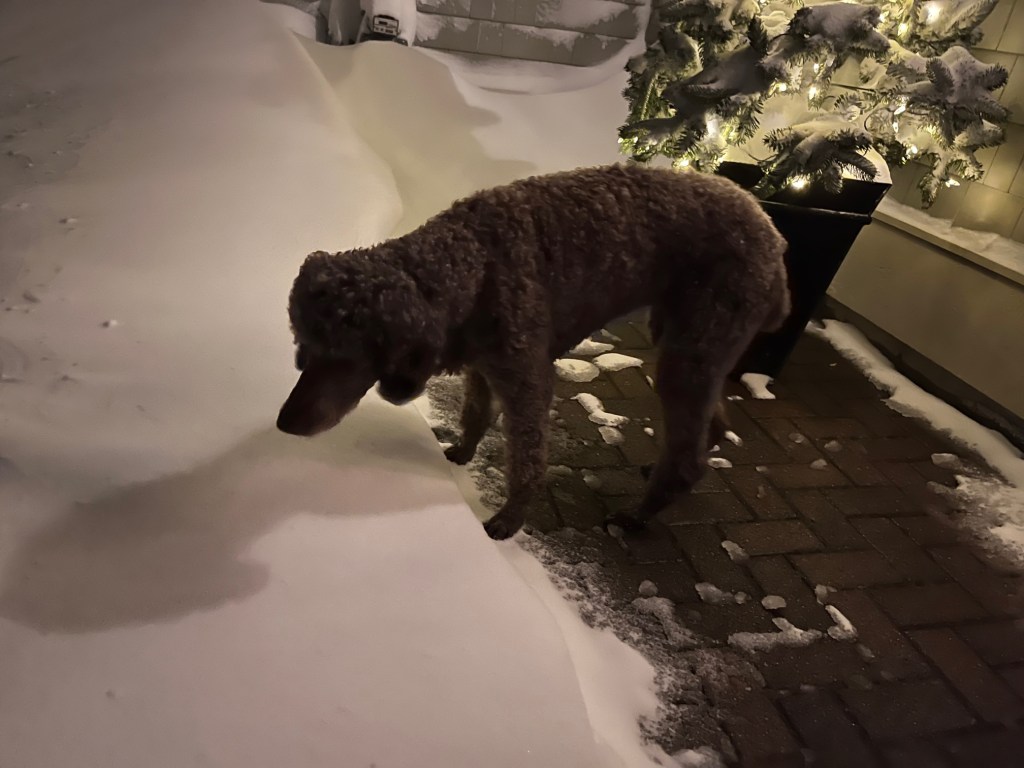
Each time I take the dogs outside, including walking my mom’s poodle, Bogey, I bundle up from head to toe–hat, goggles, down coat, long underwear, and boots. Yesterday morning I walked Bogey, and we had to trudge through knee-high snowdrifts. He likes to walk to the cul-de-sac to poo. He has a favorite spot. Sometimes as we walked the wind would gust, stopping me in my tracks and shoving me a step or two backwards. Later in the evening after dark, we repeated our trek through knee-high snow drifts, the wind pushing us around again. I thought about Jack London’s story “To Build a Fire.” I have a fine sense of the dramatic. But mostly, I wondered why anyone would set out for a long walk in subzero temperatures or blowing blizzards. I wasn’t going any place where I couldn’t see house lights.
Ziva
The snowstorm bellowed all through the night, and the winds blew harder. This morning the snow is lighter, but the winds continue to roar off Lake Michigan. This weather front isn’t forecasted to loosen its grip until after Christmas Day.
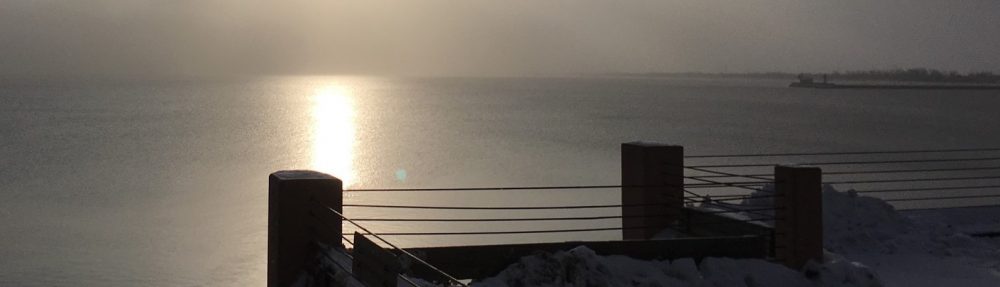
So, it’s inside entertainment. I’ve watched a little bit of football, lost two games of cribbage, finished a five-hundred piece jigsaw puzzle, and I’ve done some reading and writing. Last night my mom and I watched Flawless, a movie starring Demi Moore and Michael Caine, which we both liked a lot. Today I wrote this blog while sitting in a second-story window seat, watching the white caps on Lake Michigan, listening to the whooshing winds, and being chilled by the cold air leaking through the windows. The winds are gusting at 45 mph. The snow is still falling. And because I’m very cold now, this blog must be done. I need a cup of hot cocoa with whipped cream.
Last week a snowstorm moved through our area, and school was cancelled three days in a row. I took care of my youngest two grandsons for two of the days, which included a sleepover.
After the first day of the storm, there was a lull in the evening before part two of the storm hit. So, on a beautiful, warm winter evening dressed in fresh snow, my grandsons bundled up in their outerwear, and my husband gave them headlamps to strap around their hats. I leashed the dogs, and we went for a walk.
My happy grandsons ran down the sidewalk, mesmerized by the bouncing lights shining from their headlamps. They laughed and played games as they ran. My dogs and I trailed behind. The dogs ignored their antics, but I remembered my sisters and I as young children and our fascination with flashlights. We’d heist a flashlight from the kitchen junk drawer and hide it in our bedroom. After dark, we used it to create animals with our fingers on the walls of our bedroom. We had such fun–until my father, days or weeks later, opened the junk drawer to find his flashlight missing when he needed it.
My father’s voice would boom: “Where’s my damn flashlight?” My sisters and I would exchange glances, then fetch it from the bedroom and place it in his hand.
“I can’t have a damn thing around this house!” he’d spout. My father, a master of hyperbole, turned every problem that impacted him into an all-or-nothing event.
In reality, there were only two things my father couldn’t have around the house–flashlights and tape measures. Considering he was a mechanic with an amazing array of tools in his garage and a junk drawer full of household tools, he could’ve fared worse. My father’s booming voice didn’t deter us. Eventually, we’d hijack the flashlight again, always with a plan to return it before he noticed it was missing, a plan that usually failed.
At some point we discovered tape measures were fun, not because we measured stuff, but because the metal tape could be pulled out and locked in place, then with a flick of a finger, unlocked. And ZING, twenty feet of metal tape would dash into its case with satisfying speed and a snappy sounding CHING. Of course, we often forgot to return the tape measure.
One day, one of us, I think it was me, pulled the metal tape out too far. Nothing we tried would fix it. Next time my father boomed, “Where’s my damn tape measure?” we wouldn’t be able to retrieve it and put it in his hand, unless we handed it to him with its innards spilling onto the floor.
We did the only sensible thing we could think of–we placed the broken tape measure in a paper bag and carried it into the field of tall grass behind our backyard. We left it there, hoping no one would find it.
I don’t remember if my father or mother ever found the bag. And I don’t remember what happened the next time my father boomed, “Where the hell is my tape measure?” I asked my sisters and they didn’t remember the event, although they were part of the caper and cover up.
Sometimes I think I have a vague memory of it being discovered, but that my father made no bigger deal out of it than to repeat his usual “I can’t have a damn thing around here” lament, a tirade that probably lasted only a minute or two because being a busy guy, he had other things to do. He also had tape measures in his garage.
My father could at best be described as a curmudgeon, but for all his bluster, he was sentimental. Once we all grew up and moved out, I wonder if he ever went to his junk drawer and felt a bit sad to find both his flashlight and tape measure undisturbed.
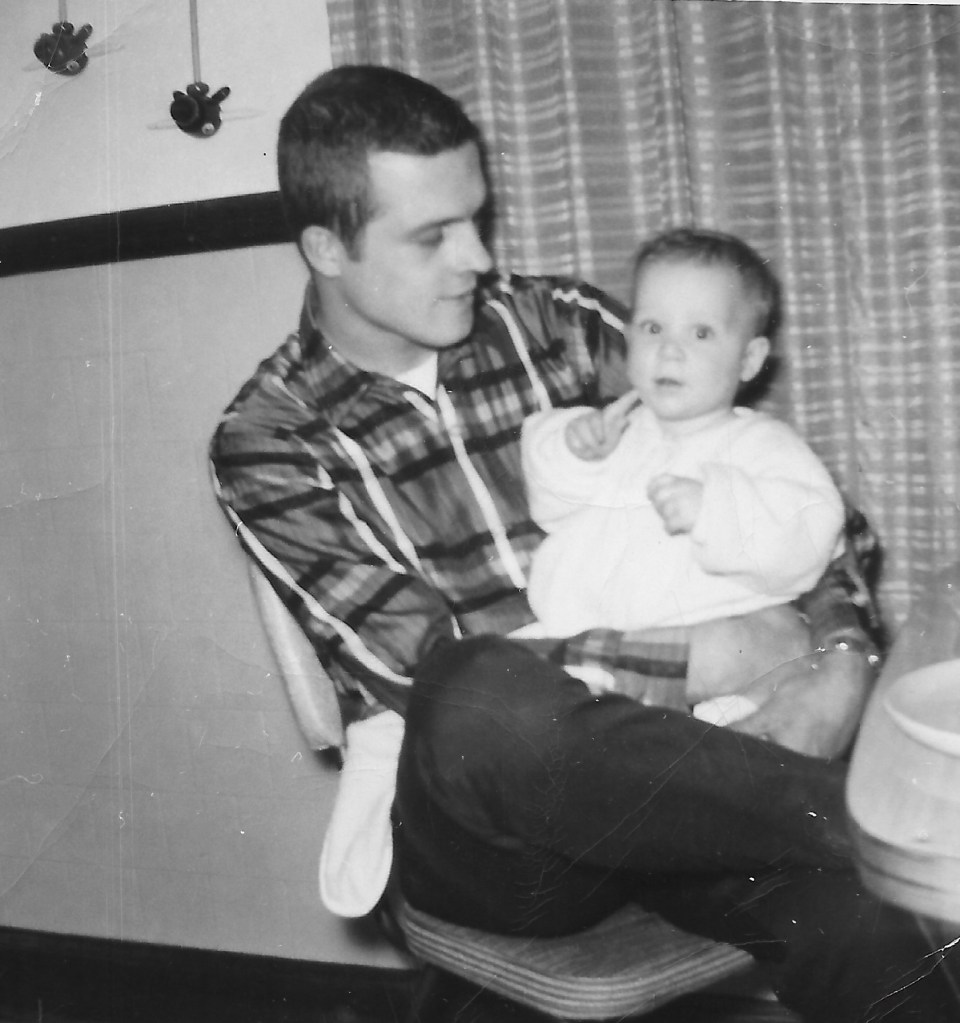
Dad and me, before I started playing with his flashlights and tape measures. Dad was 22 years old, and I was ten months old.
Watching my joyful grandsons with mini flashlights strapped to their heads made me smile, and I offered up some words to my father who passed away six years ago. Dad, I know our love of your flashlights and tape measures drove you crazy, but thanks for being a good sport about it–in your own way. And I told him that my grandsons are crazy about flashlights and tape measures, and if they lived with him, he’d find those things going missing once again.
Feeding monarch, October 8, 2022 My camera phone captured a brighter color, but to my naked eyes, the monarch wings were very dark brown.
On a cold, windy morning in early October while walking in Petoskey, Michigan, I spotted a monarch butterfly tucked inside a pink garden cosmos, also known as a Mexican aster. As I neared the flower, the monarch ignored me, letting me sidle up while snapping photos with my camera phone. I had never seen a butterfly behave this way. Normally, they flit away before I get within a few feet.
I wondered about the motionless monarch. Was it dead but held in place by its feet? The bottom segments of a butterfly’s legs are called tarsi, plural for tarsus, and they are used to grip leaves and flowers and to taste potential food. If the butterfly was dead, would rigor mortis cause the tarsi to adhere to the flower? And was the nearly dark-brown color on the ventral side of its wings also a sign of death? (Nature show idea: Insect CSI—because there is a CSI for everything.) After some research, I learned that at the end of its life, a butterfly’s colors fade and its wings often look tattered. This butterfly was neither pale nor shabby. Perhaps the overcast sky made the tightly closed wings appear darker.
My next theory involved the weather. Was the monarch using the flower as shelter from the sharp winds and biting cold? It was 38 degrees with 20-mph winds. If I hadn’t been wearing my stocking cap, mittens, and winter coat, I might have nudged the butterfly and crawled inside the flower next to it. However, if the butterfly wanted shelter, the nearby bushes, trees, and tall grasses would have provided better sanctuaries. Monarchs like to hide under drooping foliage, in hollow trees, at the bottom of tall grasses, or underneath rocky outcroppings.
Finally, I wondered if the monarch was guzzling nectar for its upcoming flight to Mexico. Back home the squirrels in my yard were stashing food, digging tiny holes in the lawn to bury tasty tidbits and pilfering sunflower seeds from my birdfeeders, competing with chickadees, nuthatches, goldfinches, and cardinals—all bulking up for winter. I sympathized. The onset of cold weather changes my appetite. I want to ditch salads and veggies and eat hot soups accompanied by slices of a crusty flax-and-sunflower-seed bread made at a local bakery.
While I took pictures, the garden cosmos waved in the wind, but the monarch, whether dead or alive, remained motionless. Once more, I thought it was dead and stuck to the florets at the center of the flower. I didn’t touch the monarch because if it was alive, I didn’t want to disturb it or harm it. Touching a butterfly’s wings damages them. The colored “dust” that appears on your fingers is actually scales from the wings. Touching the wings might not kill the butterfly immediately, but the scales dislodged by human fingers won’t grow back, and that shortens a butterfly’s life. I continued my morning walk and juggled my theories. On my return, the motionless butterfly still clung to the pink cosmos that whirled in the unfriendly wind under a cantankerous sky.
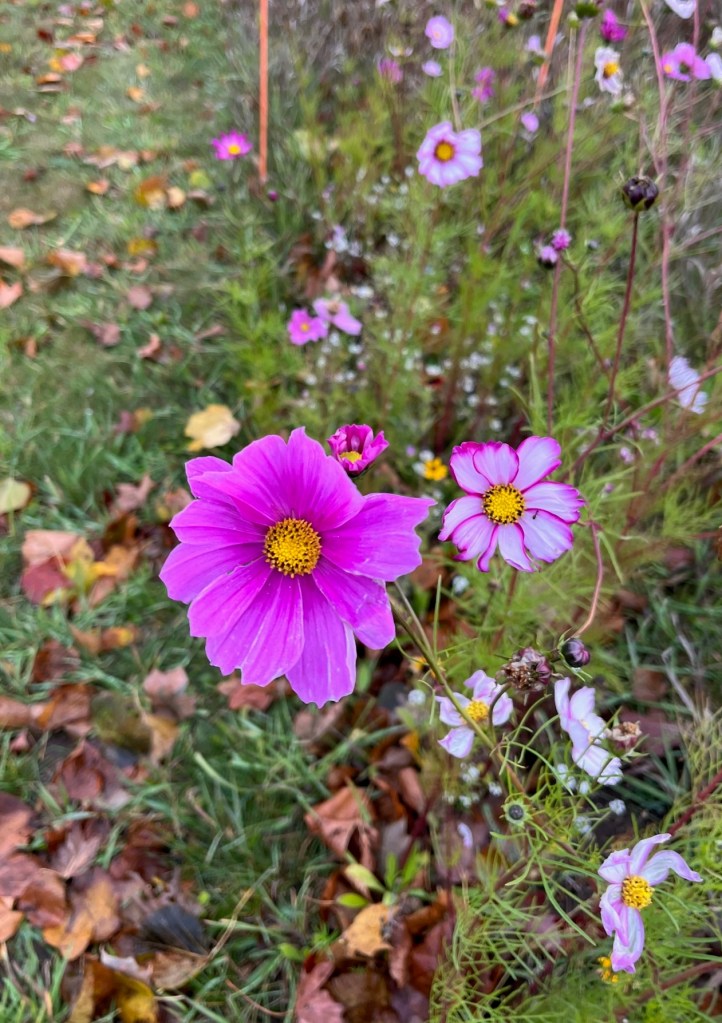
Pink Garden Cosmos, also known as a Mexican Aster
On my afternoon walk, I stopped by the flower again, but it was empty. I scanned the ground, but found no corpse. I decided to research monarch migration.
There are four generations of monarchs every year. In the fall, generation-four monarchs need to consume loads of nectar—bacchanalian style—because they must build up a layer of fat, as most of them migrate to Mexico. When a butterfly finds a suitable flower, it uncoils its long hollow tongue, inserts it in the flower, and siphons up the nectar. The swilling monarch, whose picture I took on October 8, was most likely a generation-four monarch.
Biologically different than its previous three generations, generation-four monarchs will live eight to nine months. Hatched in September and October, they migrate to Mexico shortly after emerging from their chrysalises. Monarchs west of the Rockies migrate to coastal California. A limited number of generation-three monarchs will also migrate, but generations one and two have a lifespan of only two to five weeks and never migrate south.
In the late winter, generation-four monarchs return to the United States but only into the southern regions where they lay eggs then die. Those eggs become generation-one monarchs that fly into the southern Midwest region and lay eggs that become generation-two monarchs, which fly into the northern United States and southern Canada, laying eggs that become generation-three monarchs. Then generation three lays the eggs of generation-four monarchs that will migrate to Mexico. What a glorious cycle!
My curiosity about a sluggish monarch slurping nectar in a pink cosmos led me to discover that my knowledge about monarch migration had been incomplete.
My big discovery? Not all monarchs migrate to Mexico, and those that do only return partway in the spring.
And the monarch butterfly I saw in October? It was probably hungry, bulking up for its migration to Mexico. It was a cold morning, 38 degrees, and it needs to be 55 degrees before monarchs will fly. Also, monarchs move slowly when it’s cold because the chemical reactions in their muscles slow down, which explains why the monarch I saw let me get so close.
Later that afternoon the temperatures were in the low 50s, maybe higher in the bright sunlight in my mother’s neighborhood. I don’t know if the weather warmed up enough for the monarch to fly away, but because it was gone and I didn’t find it on the ground, I assumed it took flight. A bird could have tried to eat it, but birds usually release a monarch once they taste its poisonous chemicals, and they learn to avoid monarchs. Fortunately, a monarch usually survives a bird’s bite. If you see a monarch with a section of its wing missing, chances are it was bitten then released by a bird. A monarch’s large wings help ensure it will be able to fly even with a missing piece.
Hopefully, the monarch I saw made a successful trip to Mexico and is clustered in trees with millions of other monarchs, keeping each other warm, enjoying a rest before the northward migration begins in the spring.
The people who live across from this field planted these flowers. I like to believe they did it for the butterflies.
Persimmon Tree published my flash essay “Women’s Choices” in the Short Takes section of their winter edition. The Short Takes theme for the winter publication is Resistance and Resilience. All the selected poems, artwork, essays, fiction, and music reflect that theme.
To read the rest of “Women’s Choices” click here: Short Takes: Resistance and Resilience. You will need to scroll down about halfway through the selections.
The Spider, most likely a species of cellar spider, September 2022
This is the spider I could not kill. It spun its web along the outside curb of the shower in the finished basement of my mother’s house.
When my husband and I visit my mom, we stay in that basement, an elegant suite with a large bank of windows, a beautiful bathroom, a spacious living room, and a large bedroom.
But I’ve killed other spiders, many times, in that same place. I can’t fathom where they come from or why they like the spot on the outside curb of the shower in the elegant basement.
I discovered this spider a couple of days after my mother had quadruple bypass surgery in September. But I did not grab a piece of tissue paper, I did not squish it, and I did not flush it down the toilet. The spider in the bathroom and my mother in the hospital reminded me of an O. Henry story called “The Last Leaf.”
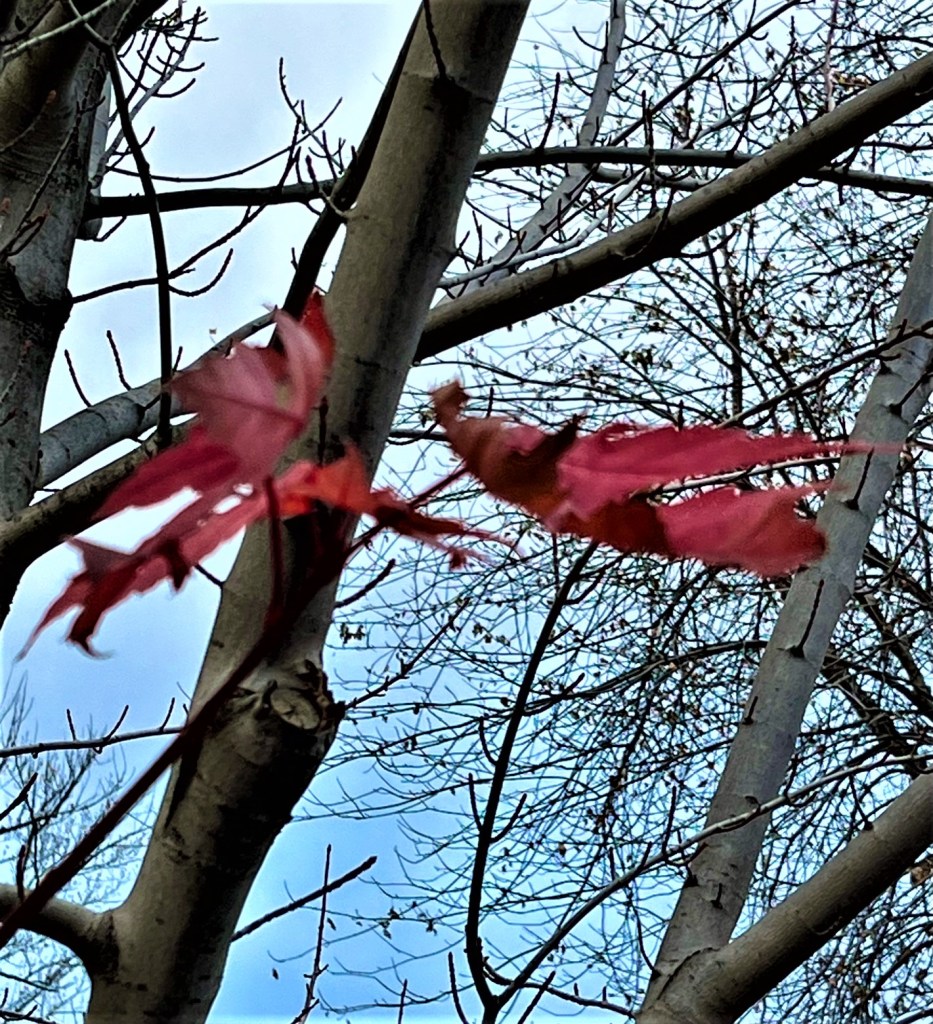
The leaves
In the story a young woman with pneumonia believes she will die. Dailey, she watches leaves drop from a vine outside her window and believes when the last leaf falls, she, too, will expire. And so, because I read a story forty years ago, the spider stayed. I wanted to believe as long as the spider existed, my mother would recover.
I visited my mother in the hospital. I walked her dog at home. And when I took a shower, I was mindful of the spindly spider. Its existence or extinction would not impact my mother’s recovery. But I remembered the old painter in “The Last Leaf” who paints a leaf so realistically on the wall outside the dying woman’s window, it fools her and she recovers.
And so, the spider stayed. Not because I believed it would guarantee my mother would get better, but because it was all that I could control.
My mother is three months into her recovery, and doing well. I’m not sure about the spider. But the last time I saw it in October, it still commanded the corner along the outside curb of the shower in the elegant basement.
When I left work yesterday, I noticed a crow on the curb near the parking lot, which was unusual. I wondered what he was doing, and as if to answer my question, he bobbed his head to the ground, stuck his beak in a small red bag, and pulled out a tidbit of food. He chewed the morsel and plucked another one out of the bag. Someone had dropped the food, and crows are opportunists. I stopped at the side of the driveway and watched, trying to figure out what he nibbled, but I couldn’t read the words on the shiny red package.
“What are you eating?” I asked. Yes, I said it out loud. Of course, I looked around first to see if I was alone.
If the crow could’ve talked, he probably would’ve said, “Move on, lady. Nothing to see here!” He kept bobbing, pecking, and munching.
But I wanted to know what he was eating, so I stepped toward him. He grabbed the bag with his beak and flapped his wings, taking flight. He landed on the roof of the building. The crow’s whole I-can-fly-and-you-can’t maneuver made me laugh at myself. Because he was right, and because what made me think he’d let me get close enough to read the label on the package. Up on the roof he continued to eat, safe from me and my prying eyes.
“I wasn’t going to eat your food,” I told him, again out loud. The crow might eat food he found on the ground, but I wasn’t going to.
I got into my car and started it. The radio came on. National Public Radio was airing a story about a drought in a country, whose name I’d missed. Not an ordinary drought, a drought brought on by global warning, said a man. Crops had failed, and hunger was growing. People were starving.
And I thought about the crow eating food off the ground that I would turn my nose up at.
And I thought about books. Because that’s what I do, I connect to stories.
Young Elie Wiesel in a concentration camp with other prisoners, all starving, becoming bones, eating scraps riddled with mold and bugs.
The starving North Koreans in the 1990s described by Barbara Demick in her book Nothing to Envy: Ordinary Lives in North Korea. One-fifth of the North Koreans perished. Others survived by eating anything they could, stripping the land of edible vegetation. Their bodies deformed from lack of nutrients, forever announcing the hunger they endured.
Lev and Kolya, characters from the novel City of Thieves by David Benioff, imprisoned in Leningrad, awaiting execution, but given a chance to save themselves by finding a dozen eggs needed to bake a cake for the wedding of the daughter of a Soviet colonel, while thousands of Russians are starving, eating pigeons, dogs, cats, and eventually leather and glue from the binding of books.
I think about the crow eating junk food he found on the ground, something I claimed I wouldn’t do. I think about wars and drought, and crop failure, and food shortage, and hungry people. And I realize crow and I are lucky–crow because he lives in a land where people drop food and can afford to leave it on the ground; me because I live in a land where I don’t have to challenge a crow for scraps of food found on the ground.
Finally, I think about the Ukrainians, who last year at this time didn’t have to worry about food or heat or shelter. About the Pakistanis and the floods that decimated their crops. I think about people living through droughts and disasters. And I think about people in our country who go hungry. I remember an eighth-grade girl from years ago, who was caught stealing packaged cupcakes from the grocery store and arrested. Turned out she’d been stealing food from the store to feed herself and her little sister because the only parent in their life was an alcoholic who often had no money to buy groceries.
And I wonder . . . what I might eat or steal if disaster upended my world.
In her memoir Gravedigger’s Daughter, Debra Raye King writes about growing up in a rural farming community near Menomonie, Wisconsin. Her father, John Edward Torgerson, was both a farmer and the local gravedigger–jobs he inherited from his father. In a series of essays, King reminisces about her childhood, which was both normal and unusual. In the 1950s, small rural farms were more plentiful than today, and King’s essays will resonate with readers who grew up on farms or in rural communities. But a small community usually had only one gravedigger, and that part of King’s childhood was unusual.
In the book’s first essay, “Shoveling Eleven Tons by Hand,” King describes her father’s gravedigging duties and how she and her sister eventually assisted him. She skillfully weaves facts, reflections, and anecdotes together, and after reading her first essay, I was amazed by her father and how he approached his duties of gravedigging with dedication and kindness. The essay also teaches readers about a part of death that most of us never think about–the actual process of how the dead are buried in a cemetery. The themes of community, family, and hard work revealed in King’s first essay continue throughout her book.
I’m enjoying King’s book because her essays are heartfelt, because I am learning about a way of life that has mostly disappeared, and because King’s writing is a joy to read.
*************************
The novel Double Exposureby Jeannée Sacken is a sequel to her novel Behind the Lens. I’m reading Double Exposure because I enjoyed Behind the Lens, which is a well-written, fast-paced story with engaging, memorable characters, and captivating story arcs. I also appreciate the dedicated research Sacken did for Behind the Lens because I learned something about Afghanistan and its struggles. To read my review of Behind the Lens on Good Readsclick here. [There are no spoiler alerts.]
Annie Hawkins, a war photojournalist, is the main character in both novels. Double Exposure opens with Hawkins in Qatar waiting for a flight back to the United States. She longs to see her boyfriend U.S. Navy SEAL Finn Cerelli and her daughter Mel. However, her boss, Chris Cardona, demands to see her first when she arrives in Washington, D.C., then he informs her that she and their news organization are being sued by a rival news organization. Her ex-husband calls, concerned about their daughter Mel. Soon Annie will need to return to Afghanistan to cover the peace talks between the Afghani government and the Taliban, but she also hopes to find a young woman named Seema who disappeared in Afghanistan. And Annie has secrets she needs to keep from Cerelli. Author Sacken weaves all the action together with snappy dialogue, intriguing twists and turns, and superb storytelling. I started reading Double Exposure last night, and kept promising myself–just one more chapter and then I’ll go to sleep.
The first story in Chai’s collection is “Tomorrow in Shanghai.” I liked this story so much I read it twice. The main character in the story is a young doctor, who entered the medical profession with great expectations for his future. But like Pip in Dickens’s Great Expectations, the young doctor discovers youthful dreams and adult realities are often at odds.
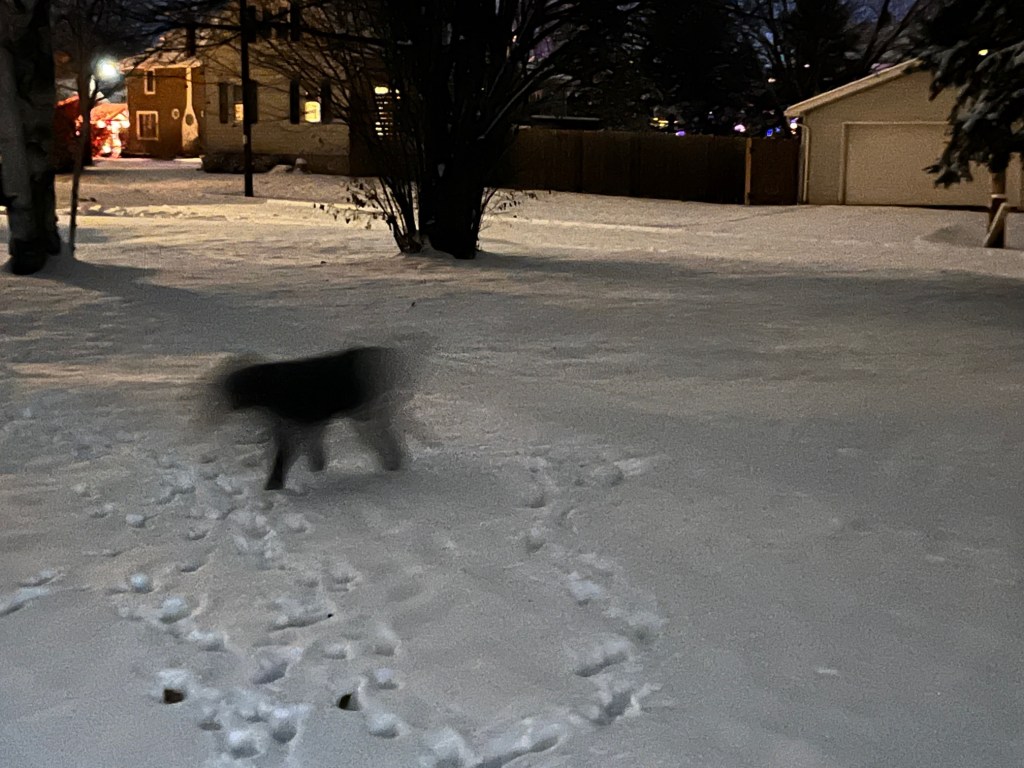
Ziva, November 29, 2022, home after our evening walk
Snow began falling around 8:00 a.m. today. The forecast predicted a trace to one inch, but it snowed all day, and four fluffy inches covered the ground, roads, trees, and cars. Snow can be that way, making weather forecasters look foolish.
This isn’t the first snow of the year, but today’s snow has a good chance of staying on the ground, making it a white Christmas. That’s why I call it the first real snow of the year.
I loved snow as a child, and I haven’t grown old enough yet to resent or fear it. The first real snowfall of the year evokes childhood memories of snowballs, snowmen, snow forts, and sledding. Swaddled in snow pants, jackets, hats, scarves, and mittens, our joyful shouts, squeals, and laughter bounced off the trees and houses.
I love to walk my dogs, Ziva and Cabela, in the evening after a fresh snowfall when the air is still. My dogs love the first real snow too. They prance. They stuff their noses in the snow, tossing it in the air or eating it. Sometimes the snow tickles their noses, and they sneeze. Even Cabela, who’s now fourteen-and-a-half, becomes youthful. When they were puppies, the first snowfall of the year gave them the crazies. They pounced and dashed and rolled in it, creating doggie snow angels. They reminded me of a gaggle of children unleashed into the first good snow of the year.
Perhaps snow sparks something primal in my dogs and myself, something that lights up ancient places in our brains, something that is more complex than our happy memories of youthful frolics in the snow.
My husband likes pumpkin pie. I do not. For more than twenty years we cooked a traditional Thanksgiving dinner for a big group of people. But not pumpkin pie. Someone else always brought pumpkin pie. I baked a cake or cheesecake.
This year we’re having a nontraditional Thanksgiving dinner. No turkey, no stuffing, no mashed potatoes, no pumpkin pie. There will be four of us. We’re having a roast, baked potatoes, and green beans (not mixed with cream of mushroom soup). I’m making a chocolate peanut butter chip cake. My husband is happy to skip the turkey and other fixings, but he mentioned twice that he was going to miss the pumpkin pie. Yesterday, I decided to bake him a pumpkin pie before Thanksgiving.
I called Aunt Coralee. She bakes smack-down, grand-champion, blue-ribbon, best-of-show pies. I asked her how she makes pumpkin pie. She starts with a homemade crust. Her crusts are flakey, tender, rich and golden brown, and if her pie filling mysteriously evaporated, her crust could carry the day on its own. I told her that was an art form I did not have time to master. She told me to buy a premade crust at the store. All I had to do was unroll it and put it in the pie pan. No rolling pin required. I could do that. She told me to use canned pumpkin and follow the recipe on the back of the label. I could do that, too. Off to the store, I went.
My second call to Aunt Coralee was from the grocery store. “Do you bake your pie in a glass or tin pan?” I asked. She uses glass or ceramic. “Cool,” I said because I had a glass pie dish that I used for quiche.
“Don’t forget the whipped cream,” Aunt Coralee said.
“Thank you, thank you, thank you.” I’d thought about whipped cream in produce, but breezed by the dairy cooler in pursuit of refrigerated pie crust. “If you want to see a grown man cry, just hand my husband a piece of pie without whipped cream,” I said. Aunt Coralee and I had a good laugh–everything’s funnier in a grocery store when you’re buying ingredients to bake a pie you’ve never made before.
Back home I unrolled the pie crust and placed it in the glass pie pan. I mixed the filling and poured it into the crust. Baking time: fifteen minutes at 425° then thirty to forty minutes at 350°. Thirty to forty minutes! That’s a big spread of time, like across a few time zones. The instructions said the pie would be done when a knife inserted into the center came out clean.
After thirty-five minutes at 350°, I did the knife test. It came out clean, except for three tiny, wee specks of pumpkin. That had to be considered clean, but the center of the pie was jiggly. I baked it another five minutes. Then tested again. Just a few tiny, wee specks of pumpkin, but still jiggly in the center. I was up to forty minutes but decided the pie needed five more minutes. When the timer binged, I pulled the pie from the oven and set it on the stove. The center was still a little jiggly. I called Aunt Coralee for a third time.
I worried the pie wasn’t done but also worried I’d cooked it too long. Aunt Coralee assured me it would be fine, that I couldn’t really overcook the pumpkin by adding an extra five minutes. But she explained the center of a custard pie will be jiggly when it’s done cooking and will set up as it cools. The pie did look lovely as it cooled and the center set up.
After work my husband discovered his pumpkin pie on the stove, he smiled, and stated the obvious, “You made me pumpkin pie. Thanks.” He kissed me on the cheek. Smart guy.
Next year I’m going to make him another pumpkin pie. I’ll stop baking it when the knife comes out clean, and I’ll remember the center will be jiggly. And even though I won’t eat a slice, I’ll admire it as it cools on the stove.
My short story “Maginot Line” took second place in the Hal Prize Fiction Contest. It appears in the 2022 8142 Review. The names of other fiction, nonfiction, poetry, and photography winners and honorable mentions are listed at “2022 Hal Prize Winners Announced.”
The 8142 Review is a print journal. It can be purchased at Door County Pulse.













 Writing Near the Lake