This evening my husband walked into the house from the back yard, tapped his finger on the side of his nose and said, “I saw the nose. I saw the nose.”
I wanted to ask, “You saw Kovalyov’s nose?” But I didn’t. My husband doesn’t read Russian short stories.
So I said, “What?”
He grinned, a very big grin. “I saw the nose.” He used his silly voice. “I saw the nose.” He kept tapping the side of his nose.
Because I reread Gogol’s “The Nose” a few days ago, I pictured a gigantic schnoz dressed in uniform. But I knew my husband didn’t see Kovalyov’s nose because you couldn’t pay him to read Russian short stories.
So again I said, “What?” because I still didn’t know what he was talking about.
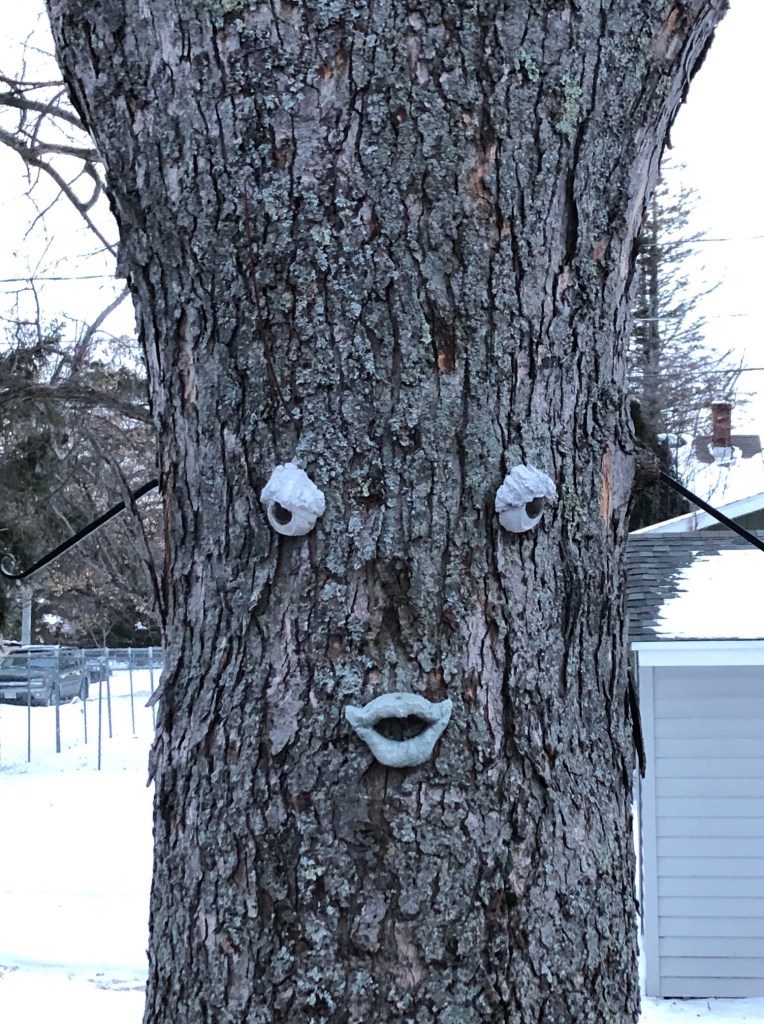
“The tree’s nose,” he said. “I can see it in the snow now.”
The blob in the center is the back side of Tree Guy’s nose.
Turns out, I haven’t been the only one walking to the edge of our deck and looking over the side. I should’ve known. After all Tree Guy was my husband’s idea.
I couldn’t believe I thought about Kovalyov’s nose before thinking about Tree Guy’s nose. And I’d forgotten to look for it the last couple of days. I’ve been distracted, and it’s been cold.
But neither of us went outside to retrieve the nose this evening. The wind was whipping, the temperature was below freezing, and the windchill was a single digit. I was sitting on my couch with a wool scarf wrapped around my neck. Neither of us wanted to climb on the unstable snow pile. Two days ago our grandson climbed that pile and got his foot stuck. When he yanked his foot up, his boot stayed–buried six inches down. I rescued the boot by digging it out of the snow with my bare hands.
Tomorrow I’ll save Tree Guy’s nose because more cold and snow are predicted next week. March wants to go out like a lion.
My husband will give the nose a fresh coat of paint if needed. Then he’ll reattach it to Tree Guy’s face. Like it had never been missing.
If you’re writing a book, and even if you’re not, you should listen to authors talk about their books. I’m not writing a book, at least not yet, and maybe never. But when the COVID lockdowns started, I discovered I liked attending virtual author chats and book launches. Over the last two years, I’ve listened to over twenty authors discuss their books, and I’ve noticed some reoccurring themes and ideas.
Writing is Tough
All writers have moments of doubt. One author almost gave up but decided the only way she could fail was to not finish her novel. Others talked about a manuscript they considered a learning experience then buried it in a drawer. Some took a break from a book they were writing before finishing it. All of them said, “Just keep writing.”
When the pandemic lockdowns started, many writers talked about feeling too anxious to write. When I heard a published author admit this, I realized my anxiousness and inability to sit at my desk and write was normal. I stopped thinking something was wrong with me. Another author found it difficult to write because she wasn’t out in the world, watching and listening to people, gathering material to take back to her desk. I could relate. I never appreciated how much inspiration I brought home, until I didn’t leave home.
When a member of the audience thought things must have gotten easier after a writer published a book, the author said, each book was like starting over and her second book was tougher to write. Hot dog! I write short stories and essays, and I find the same to be true. If published writers flounder occasionally, why wouldn’t I struggle at times?
Writing Takes Work
But take chances. Experiment. Play. Listen to your characters. If something doesn’t work, revise.
Read, read, and reread. Most authors talked about the importance of reading books from the genre they write in. And rereading those books helped them analyze how they were put together.
Research is important, even when writing novels or memoirs. One historical nonfiction writer spent almost a month living on a sixty-foot sailboat in the Arctic in order to research the setting for her book. It gave her confidence to write her book because she had knowledge and experience.
Once the manuscript is done, the revising and editing starts. Get feedback from writers and beta readers. Be open to suggestions, but know when to trust your work. Many authors said revising was as much or more work than writing the book.
Getting Published
Work on building a writing resume by submitting short pieces of writing. Polish them until they’re shiny, beautiful baubles. And submit! One author submitted a story to a university journal, and they loved it so much they asked her if she had more stories like it. She did, and they published a book of her short stories. (This makes me think about Lana Turner being discovered while drinking a soda at a malt shop.)
Hire a good line editor before you submit to agents or publishers. Make sure the manuscript is as good and as error free as it can be. Learn how to write a query letter. Some authors shared helpful resources.
Potential agents and publishers want authors to have a social media presence and a website, even if it’s simple. One author attended an online pitch event on Twitter with agents. A publisher liked her pitch, asked to see her manuscript, then published her book.
Fight for your work. Sometimes an editor is right. One author talked about cutting a chapter from her memoir. Even though she wanted to keep it, she understood the editor’s point. Other times the author is right. Another author fought to keep the opening dream scene in her book, and the editor eventually agreed.
Understand a contract before signing it. Think about hiring an attorney who specializes in publishing contracts. One author warned, “Don’t let excitement about a contract cloud your judgement.”
So, Sign Up for an Author’s Book Chat
You’ll learn what worked and didn’t work for authors, and some of that wisdom will be useful to you. When writers talk about their struggles, it’ll give you perspective about your struggles. As they celebrate their newly published books, you’ll believe that someday you’ll celebrate yours. Finally, almost every author chat and book launch that I’ve attended had a Q & A, and the author answered questions about his or her journey to publication. But best of all, for an hour or two, you’ll be part of a community of people who love to write.
[Looking for a Book Chat? Lake Superior Writers hosts a series called Book Club for Writers, which is free and open to members and nonmembers. Our next author will be Brian Malloywho will talk about his book The Year of Ice on March 29, from 6:30 to 8:00 p.m. For more information: Book Club for Writers.]
For the past week, the snow has been disappearing fast. So, for the past week, I’ve been looking for Tree Guy’s nose. Each day I look over the side of the deck, hoping that enough snow has melted to reveal his schnoz, but it’s still missing.
He doesn’t look bad without his nose, but he’d like it back. If I don’t find it, I’ve promised to buy him two hanging baskets of flowers, one for each ear. With colorful blooms gracing the sides of his face, no one will notice his nose is gone. It’s amazing what people will overlook if something glitzy captures their eye.
After work, I looked for his nose again. No luck. It was too cold today for snow to melt. The wind whipped at 38 mph—and that was the sustained number. The gusts were over 40 mph. The air temp was 35° and the windchill was 19°. Freezing rain, snow with blizzard-like conditions, power outages, and hazardous travel are predicted over the next couple days. Or what I like to call, Springtime in the Northland. March is fickle with an attitude, and I’ve lived here long enough to know that the springs of northern Wisconsin are not the springs of Milwaukee.
I’m beginning to think Tree Guy’s nose is a goner, but there is still snow around him, so maybe his nose is buried deeper than I thought. The mystery of it all makes me want to reread “The Nose” by Gogol. I keep imagining Kovalyov’s and Tree Guy’s noses calling an Uber and gallivanting around the city. The frigid air will make the noses run; hopefully, they have hankies.
Yesterday, a conversation with writers reminded me of the first time I had a character in a story who wouldn’t cooperate with my plot. I wrote this blog after that experience.
At the end of the 1946 romantic comedy, Cluny Brown, Adam Belinski, animated by a flash of insight, tells Cluny, “I’m going to write a bestseller, a murder mystery.” Belinski and Cluny agree the victim must be a rich man because it’s pointless to murder a poor man, and Cluny asks, “Who killed him? Who did it?”
My first initial written in the bark
“For 365 pages, I will not know myself,” replies Belinski, “but when, on page 366, it finally comes out, will I be surprised and so will millions of others!”
The first time I heard Belinski tell Cluny he’d write a mystery without knowing who committed the murder until the last page, I laughed. Ridiculous, I thought. Of course, he’ll have to know who the murderer is when he starts…
Last Monday when I took my nearly twenty-year-old sewing machine to be tuned and cleaned, I looked at a new machine that was the same brand but a step and a half up from the one I own. I’m not sure I would’ve considered buying a newer model if there hadn’t been a pandemic.
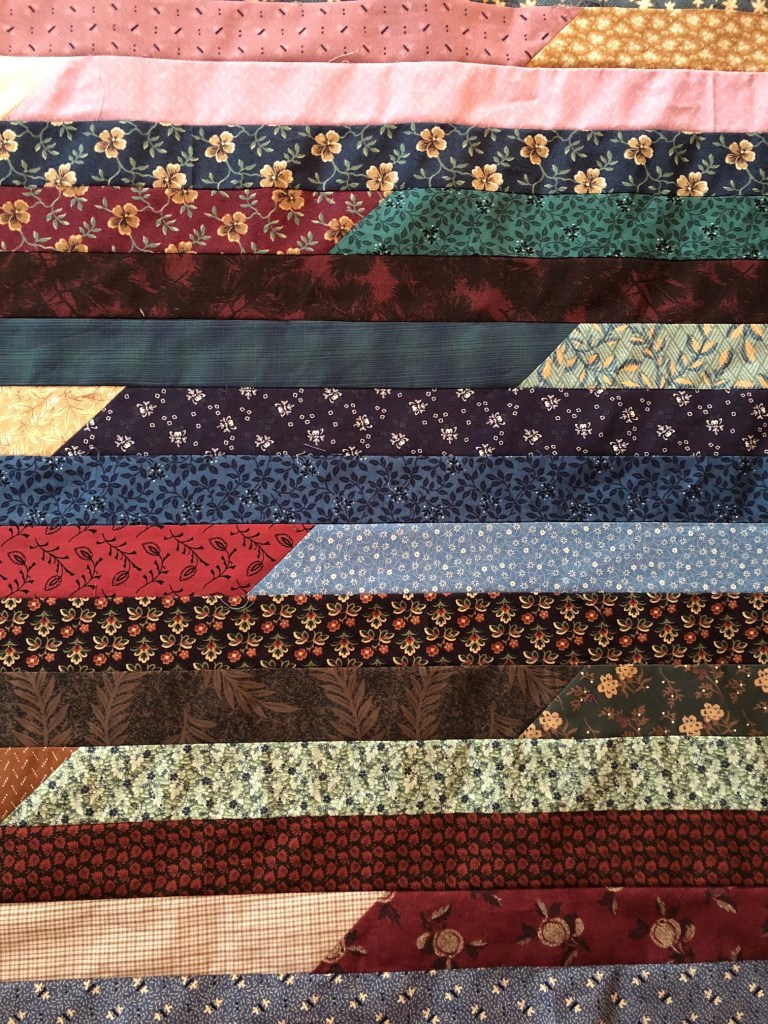
The finished quilt top: I will machine quilt it and bind it, then give it to my sister-in-law. My next project will be another T-shirt quilt.
When the lockdowns happened in the spring of 2020, being able to quilt kept me sane. I was home alone during the week because my husband worked in a business that was deemed essential, and I couldn’t see my children and grandchildren because we all stayed in our own bubbles. With all the death and uncertainty, dicing up fabric and sewing it back together was familiar and calmed my nerves. I could quilt without leaving the house because I have a sizable stash of fabric. I made a T-shirt quilt, two lap quilts, and two wall hangings and gave them to family and friends. I made a throw pillow and gave it to my dogs for their stuffed chair. I wanted a second machine because if there’s another lockdown, and something happens to one of them, I would be able to keep quilting.
The new model had features that would make machine quilting and appliquéing easier, helping me expand my quilting skills. But I wanted to sleep on it, so I left my old machine for a tune up and postponed buying the new one. Long ago, I made a rule for myself: All big purchases could only be made after I slept on it for a night. Over the years there were many purchases I never made but very few regrets about the ones I did make.
When I woke up on Tuesday morning, I was still enthusiastic about the new machine, so after lunch I went back to the store and bought it. When I returned home, I unboxed it and put it on my antique dining room table, which I use for sewing. (Don’t shudder. The table isn’t dainty.) The new machine looked especially modern and sleek on the old oak surface. It stood among a cutting mat, rulers, a rotary cutter, and fabric, becoming a part of the quilting landscape. I turned my back on it and did some writing, cleaning, and cooking. I stayed out of the dining room and away from the new machine. My old one sat in a shop, waiting in a queue for service, unaware it had been replaced. Regret seeped into my psyche. My old machine and I had pieced many quilts together: quilts for family and friends; quilts to welcome new babies into the world. By suppertime I stood in the kitchen and cried, wishing I had waited two nights instead of one.
Would I actually do more machine quilting or appliquéing just because I bought a new sewing machine? For the rest of the evening, I left it untouched. I kept picturing my old one sitting on the technician’s workbench. When it came home, I’d have to store it in a closet instead of returning it to the oak table because I knew it would become the spare.
On Wednesday I woke up at 4:30 in the morning and thought about the new machine with deepening regret. I decided to hide it in a dark corner of the closet and shut the door. An absurd idea. So, I set a goal for Wednesday: make friends with the new machine by making a quilt. I have a closet full of fabric and quilt kits that I’ve purchased over the years since I started quilting in 1994. I never had a sleep-on-it rule for buying fabric.
I selected a package of precut strips because I had a simple pattern for a Jelly Roll Race Quilt that would allow me to use all the strips to create a quilt that was quick and easy. (At the speed I sew, I should call it a Jelly Roll Stroll Quilt.)
I sewed a test strip with two short scraps. The new machine sewed a perfect quarter-inch seam. An essential feature. Then I sewed my strips together making one long strip. The new machine has a bigger work surface, making it easier to sew fabric together. A solid improvement. The redesigned quarter-inch foot did a better job of keeping the fabric in place as it passed through the feed dogs, so I didn’t have to keep repositioning it. A welcome timesaver.
Best of all, the new machine sounds like my old one because underneath its modern, sleek exterior, it has the same motor and frame as the old one, which I’d used for almost twenty years. Hopefully, I can use the new one just as long. I’ve got a lot of fabric in the closet.
The first quilt off the new machine will be a gift for my sister-in-law. The package of precut strips was originally purchased by her sister Jen who passed away from cancer in 2018 before she could sew them into a quilt. Jen gave me the strips before she died because she knew I liked to quilt. I’m piecing together the gift from Jen as a gift to her sister, connecting the past to the future while listening to the old familiar rhythm coming from the inside of the new sewing machine.
My new machine and I are going to be friends. But I will keep my old one. Perhaps each one of my grandchildren would like to sew a quilt, and my old machine will make new friends. I know where they can find some fabric.
[To find the instructions for making a Jelly Roll Race Quilt, click here. To read about one of my pandemic quilts, click here.]
Thanks to writing, my worries have shifted. (So has my ability to make sure I put the milk in the refrigerator instead of the cupboard, but that’s another blog.)
I take a break from writing to get some water. In the kitchen I discover dishes are piling up and all the cereal bowls are dirty. But I worry about a story I want to submit to a contest, so I go back to my desk. I reread the story and forget to start the dishwasher. In the morning I’m handwashing cereal bowls.
“Nana, be careful. You almost stepped on me,” Charlie, my three-year-old grandson, said.
“I’m trying not to, but you’re walking willy-nilly around the kitchen while I’m cooking breakfast.”
“No, I’m not,” he said. “I’m thinking.”
I stopped to watch as he paced the length of the kitchen and back. The top half of his little body leaned forward, his eyes focused on the floor, and his hands pushed against the sides of his hips. Damn. He was indeed thinking. I didn’t ask him for his thoughts. He kept pacing, and I kept making breakfast.
The next day we were back in the kitchen. I walked past Charlie and he started to twirl around. I did that as a child, spinning and spinning until I could barely stand. During one of his rotations, he smacked his hand on the chair.
“Watch where you’re going,” he said, rubbing his hand.
My three-year-old grandson often mimics phrases he has picked up from adults or his older siblings. I love it when he quips, “That’s not how my day goes” after I ask him a question or make a request. At his age it’s funny, but in a few years, he’ll be accused of being a smart aleck when he imitates adults.
“I didn’t bump your hand. You hit it on the chair while you were spinning around.”
“No, I didn’t,” he said. “I was thinking.”
I wanted to tell him he needs to pay attention while he’s thinking. I didn’t because I would be standing on the San Andreas Fault as I said it. This past week I’ve come close to putting peanut butter in the fridge, dirty dishtowels in the recycling bin, and regular milk in my other grandson’s cereal. He’s lactose intolerant. If someone had asked me “What ARE you doing?” My only defense would’ve been—“I’m thinking!”
My problem? I spend a lot of time thinking about writing while I’m doing mundane activities. It’s worse when I’m working on a specific story or essay. I’m surprised that the kitchen scissors don’t end up in the toothbrush holder and my toothbrush doesn’t end up in the junk drawer.
Cabela has many talents, but she’s not good at babysitting me.
At the end of January, I had a seismic-thinking episode. I was sitting at my computer writing a story but had to stop because Cabela, my senior dog, needed to see the vet for a shot. It was a subzero day with lots of windchill, so I went outside, unplugged the extension cord from the outside outlet, then started the van. Because it’s tough to unplug the cord from the tank heater cord, I decided I’d do that just before I left.
Five minutes later I was ready to go. I noted the extension cord was still plugged into the tank heater. I planned to unplug it, but first I loaded both dogs in the van and placed my purse on the front seat. Then I got in the driver’s seat and drove off. I was writing in my head. My hands might have left the keyboard, but my brain was still at the computer.
Cabela was a good patient. We were soon back home, and I was writing again. A few hours later, I took out the garbage and noticed only one cord on the driveway. Someone had pilfered one of our extension cords. But that was ridiculous, why not take both of them. Maybe an unselfish thief? Couldn’t be. Perhaps my husband had driven off with the cord plugged into his tank heater. I doubted it. He’s not a writer, so he’s never thinking about a story. I must have driven off with the missing cord hanging from my van. The more I thought about it, the more I couldn’t remember having unplugged it from the tank heater. The more I thought about it, the more I knew it was my mistake.
My husband was going to think I was crazy. He was going to ask, “How can you not unplug the extension cord?” It would be a rhetorical question because he knows I’m capable of such things. He was going to be upset about his missing extension cord. But he was going to be more freaked out about me being okay. I was freaked out about being okay—I’m at that age.
My only excuse would’ve been “I was thinking.” His retort would’ve been “Yeah, but not about what you were doing.”
It had been hours since I’d been to the vets. But I got in the van and went to look for the cord. I drove less than eighty feet. Curled up at the corner of our lot, where the street intersects with the avenue, was our yellow extension cord sunning itself.
I stopped the van and retrieved it. I looked around to see if anyone was watching. I gave thanks for the kind person who had picked up the cord, coiled it, and set it on the corner. Then I hoped it wasn’t one of our neighbors who would ask my husband, “Was that your extension cord in the road the other day?”
I wasn’t going to tell my husband. But I called a friend and confessed because I needed to tell someone.
To myself I vowed to always unplug both ends of the extension cord before starting the van. Promising myself to stop composing stories in my head while doing routine stuff would be futile.
No one has mentioned the cord to me or my husband. I haven’t mentioned it to my husband, and he doesn’t read my blog. And if he somehow gets wind of this story, I’m going to say, “I was thinking. Charlie gets it.”
I’m on page 200 of 403. This well-researched nonfiction book tells the story of the young women who started working in radium-dial factories just before WWI. Glow-in-the-dark products were gaining popularity, and WWI would significantly increase the demand for them. The dial painters were taught to point the bristles of their brushes with their tongues–called lip pointing–in order to paint fine lines. Supervisors told the painters there was so little radium in the paint that it was harmless.
As factory owners and managers learned that traces of radium weren’t harmless, they hid that information from the dial painters because lip pointing was an efficient, inexpensive method for painting dials, and because they didn’t want workers to become fearful and quit. About five years after the dial painters began ingesting radium, they started suffering painful side effects which were fatal. After the consequences of radium paint became known and proved, companies who employed dial painters kept denying that the radium was dangerous.
One of the women harmed by the radium, found a lawyer who agreed to represent her and some of the other sick women. The companies used high-powered attorneys, lies, and rumors to try and thwart the sick women from winning their lawsuits. Moore skillfully captures the twists and turns of the legal battle between the radium-dial companies and the women who sought compensation. I don’t know how their legal battle ends yet, but I’m rooting for the women.
As I read Moore’s book, I care about the young women, who never grew old. I care about the families they left behind. I want the companies and their executives to be held accountable for their cold indifference to the lives of these women. As I read this story, it strikes me that not much has changed. The story of the women harmed by the profit-minded radium dial companies is the kind of story that still happens today, both in our country and throughout the world.
Stories like The Radium Girls are important because companies still lobby for fewer regulations and for changes to laws that make it more difficult for a harmed person to sue. Without regulatory laws or the ability to sue bad actors in a court of law, people are left to the mercy of those who value their company’s bottom line above all else. The Radium Girls reminds us that we need laws to hold companies liable for their actions.
Every evening I look forward to ignoring the TV and reading The Radium Girls. Moore’s writing is excellent. I’m thankful she told the story of the doomed women who started out loving their jobs and believed their companies were wonderful places to work. We can honor the radium girls by remembering them and by valuing the lives of all workers.
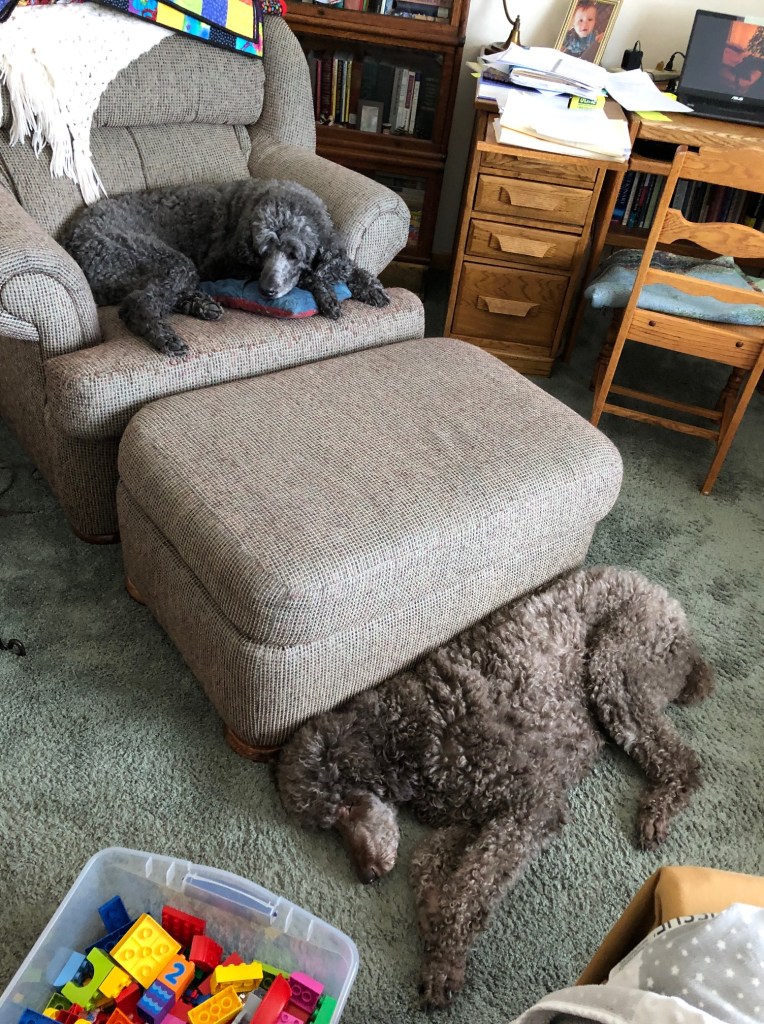
Normally, my dogs want to be outside with my grandchildren. But this was the position they took yesterday.
February has been cold. Yesterday was no exception. But when I asked my five- and three-year-old grandsons, Evan and Charlie, if they wanted to go outside, they were enthusiastic. It was snowing lightly, painting the already thick layer of snow with a fresh coat. The outside world looked enchanted—the kind of magic I remember from my childhood.
The temperature was in the low 20s, the winds about 11 m.p.h., and the windchill about 10°. The weather app on my phone doesn’t use the term windchill—the app and many weather channels now refer to windchill as “feels like.” Good for them, but I use the term windchill, and even the chill part of that sounds like a cover-up. Wind-polar-frozen-vortex-shatter-your-skin gets closer to the truth. “Feels like” is too nice. Think about it: That fabric “feels like” silk. The warm sun “feels like” gold. She “feels like” singing rainbows. “Feels like” is also used to soften a blow: She “feels like” crying—when what she really wants to do is throw a howling tantrum. (Just so you know, I’m not against all change. Unlike some people, I had no problem accepting Pluto being downgraded from a planet to a dwarf planet.)
After I bundled up my grandsons, I offered each one a scarf. Charlie wanted a one. He always does. Evan never wants one to start with, but sometimes, like yesterday, he changes his mind after being outside for a bit. I wish I would’ve taken a picture of them. Bundled up children are cuter than kittens curled up in a wicker basket. Plus, I could’ve shown off the scarves that I’d knitted. I don’t know how to knit anything else.
After sledding down the side hill for a while, Evan opened the back door and asked, “Nana, can we take the picnic table off the deck and put it on the big pile of snow?” It’s a small plastic table designed for preschoolers.
I said yes, but I didn’t ask why. It was a reasonable request, much more reasonable than last week when Charlie asked if he and Evan could go outside and play with the squirt guns. When I told him no, he didn’t think “It’s too cold outside” was a good explanation, and he wanted to debate the issue.
After my grandsons had been outside for an hour, nature flipped the switch on its wind machine from low to high. That’s how it happens—a flipped switch. You can stand outside and experience the exact moment the wind kicks up from fluttering to roaring. The sustained winds were 28 m.p.h. with gusts of 38 m.p.h. The temperature dropped to the low teens. The WINDCHILL dropped to 8° below. I love my weather app—so much detail. Remember when you called the phone company, and all you got were the time and temperature?
The weather details convinced me it was time to get my grandkids inside to avoid hypothermia or being hit by a falling branch from one of the trees in the backyard. Neither one of them wanted to come in, so I sweetened the deal by offering hot chocolate. Of course, it worked.
When they were taking off their outerwear, Evan stared at Charlie’s face and asked, “Are my cheeks as red as Charlie’s?” He was concerned.
I smiled and said, “Yes, your cheeks are as sweet and rosy as Charlie’s.”
Evan grinned. Something his nana described as sweet and rosy couldn’t be bad.
Outside the wind had the final word as it wailed, its breath bending tree branches back and forth to their breaking points.
My mother carried the first Little Critter books by Mercer Mayer into our house. She loved Mayer’s stories and drawings, and she thought Just Go to Bed was hysterical. By the time my second son was four years old, we had eighteen Little Critter books.
Last week my grandson Evan, five, discovered Little Critter books are filled with humorous illustrations. After looking at the pictures in one of the books, he handed it to me and said, “Can you read this to me? It’s funny.”
While I read the book, Evan discovered irony. He laughed at the words Little Critter said and pointed out that Critter’s words didn’t match what he was doing in the pictures. “These are really funny books,” he said. I admired his ability to grasp the gap between what was being said and what was happening. So much of life is like that, and it’s not always amusing.
Evan enjoyed the books even more when I told him that most of them had belonged to his dad when he was a little boy, and a few of them had belonged to his uncle. Now, before I can read one of the stories to him, he asks who the book belonged to, his dad or his uncle. Most of the books have an inscription with a name and date on the inside cover. But some don’t, and it makes me sad that I forgot to inscribe on them.
After reading all eighteen Little Critter books to my grandsons in a marathon session, Evan asked if more books had been written. We did some research, and bought Just Fishing with Grandma (2003), Just a Little Music (2010), What a Bad Dream (1992), and Grandma, Grandpa, and Me (2007).
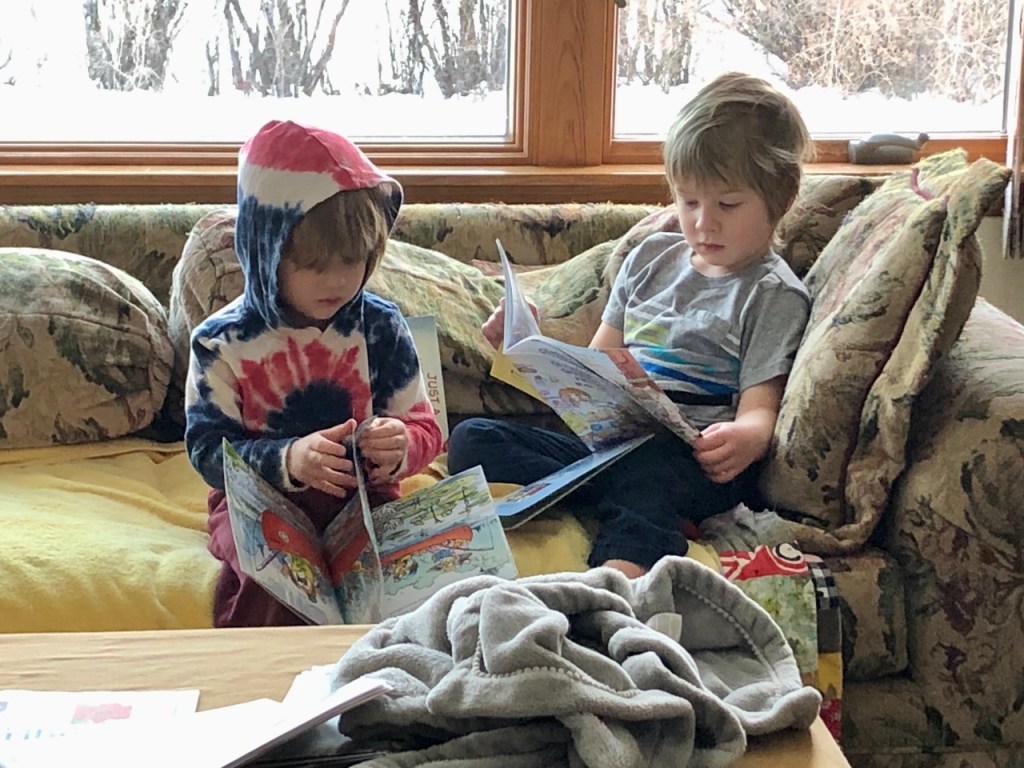
Minutes after the mail carrier delivered the books, my grandsons each grabbed two and scampered up on the couch. Evan looked at each book, silently studying each page. Charlie looked at each book, voicing his own dialogue for each picture.
I thought about my boys when they were young and how they loved new books. I remembered reading to each of them every night before went to bed.
After my grandsons finished previewing the new books, I read to them. Evan pointed out Little Critter’s small ironies. Charlie looked at one of the other books, while I read. He always feels the need to “read” a different book while I’m reading to him.
When I finished reading the books, I inscribed their names and February 2022 on the inside of each cover.