Apostle Island Booksellers: A Store with a beautiful cover, and a stunning interior
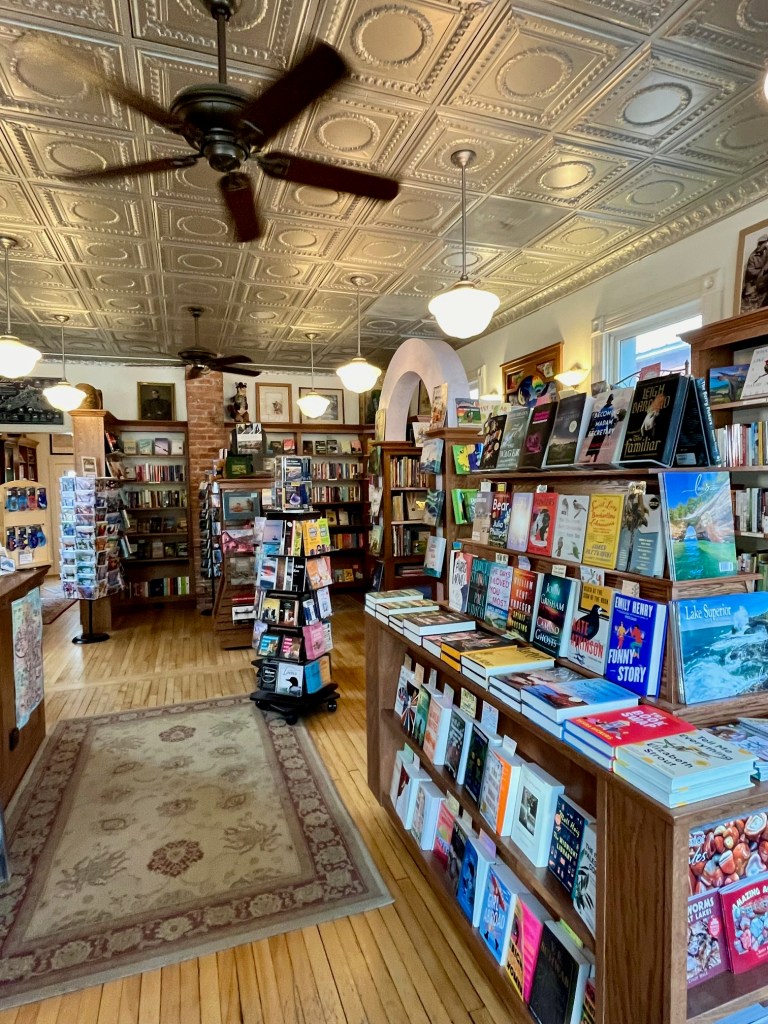
The view after walking in the front door
Bayfield, Wisconsin, has two wonderful bookstores: Apostle Island Booksellers and Honest Dog Books. Every time I visit Bayfield, I visit both places. I will talk about Apostle Island Booksellers in this blog, and Honest Dog Books in an upcoming blog.
Apostle Island Booksellers is small but gorgeous, and stocked with a wonderful selection of books. Walking through the front door, transports me back in time, into a warm and cozy and other-worldly space. A creamy-white tin ceiling with old-fashioned lights — the kind that bring old schoolhouses and libraries to mind — hangs over the natural-colored wood floors. Windows trimmed in decorative molding, wooden shelves, brick accents, and an old area rug catch my eye. But it’s the colorful covers of books that win over, and I look for something to take home with me.
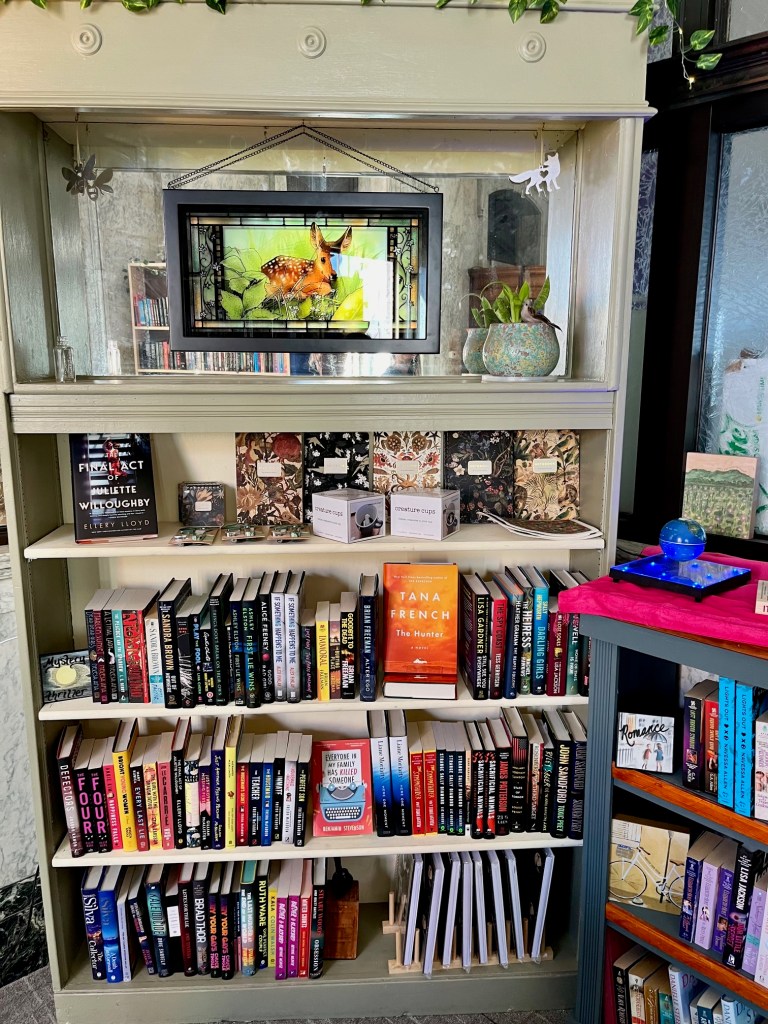
A romantic corner, the perfect place to fall in love with a book.
I walk around the front part of the bookstore, then head for the small back room tucked away like a treasure. As I go, my eyes scan titles and cover art. Along the hallway and in the back room, more books are displayed, making use of every available place to shelve a book. I’m happy to see the room around the corner is unchanged. It has what every bookstore should have: a place for a reader to sit and read a few pages of a book, to see if it’s a good fit.
I think I’ve made up my mind about which book I will buy, but I finish looking around the store before I pluck Slaughterhouse Five by Kurt Vonnegut from its spot on the shelf. My nephew suggested I read it, and I’ve also read that it’s one of Vonnegut’s best.
I discover another book, The Shipping News by Annie Proulx, and snap a picture of its cover. The synopsis intrigues me, but I will think about this book. I might borrow it from the library, or buy it at another bookstore, or buy it from Apostle Island Booksellers the next time I’m in town. Like other book lovers, I wish I could buy all the books that catch my fancy, but I’m limited by the coins in my purse and the space in my home. And my mind becomes uneasy if my To-Be-Read piles mushroom too quickly on the flat surfaces in my home.
While I pay for my book, the clerk and I strike up a conversation about British literature. We are both huge fans and discover that in our early years, we read almost nothing else but British literature. Her love of British authors started with Shakespeare when she was in ninth grade. My love started with Sir Arthur Conan Doyle’s Sherlock Holmes stories when I was in seventh grade.
I slip my new book into my large purse, and head to Honest Bog Books. I have one more book to buy.
Maria Lockwood greets customers with a big smile and the enthusiasm of one book lover to another.
MY TOWN HAS A NEW BOOKSTORE! And I’m shouting with joy. Maria Lockwood opened Foxes and Fireflies Booksellers on August 31. For the time being, her bookstore will be open on Saturdays and Sundays from 10:00 to 5:00, and some occasional evenings. During the week Maria works as a journalist for the Superior Telegram. That’s a lot of dedication to the printed word.
Since visiting the store this morning, I’ve been walking around in a state of happiness. The last bookstore in Superior closed down seventeen years ago. It was a well-loved, successful bookstore, but the owners wanted to retire. And when they locked their doors for the last time, they left behind many bereft bibliophiles.
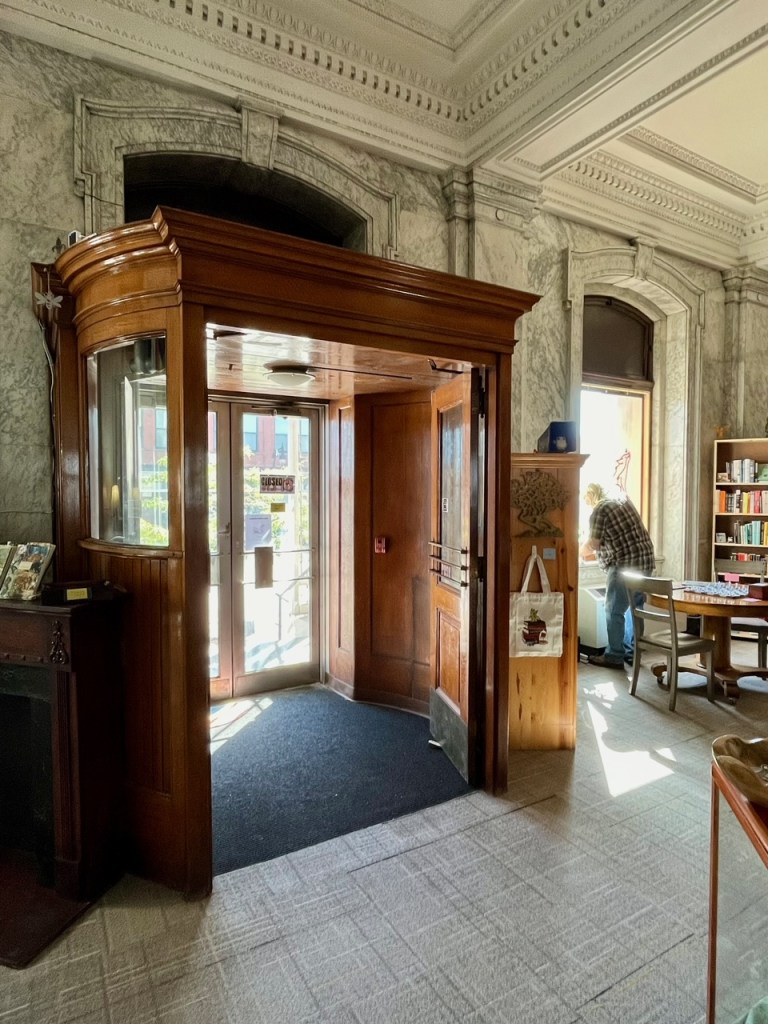
Flooded with light and surrounded by marble, large windows, and wood trim, Foxes and Fireflies invites readers to come in and browse.
But now we have a new bookstore. Foxes and Fireflies is currently located in the old post office building in Superior. It’s in a business incubator space — a place where Lockwood’s bookstore can grow and gain a clientele before she relocates to another, larger space.
On the other side of this cozy space, kids and young adults will find a selection of YA and children’s books.
Lockwood’s bookstore has several places to sit, where a reader can peruse the first pages of a book, trying on a story to see if it will be a good fit. There are kid-friendly spaces with puzzles, some games, and children’s books. I have two grandchildren with birthdays in September and October. They love books, and I plan to take them to the bookstore. They will find the store as magical as I do.
Lockwood has created a warm, inviting space that makes me feel at home while I hang out with books waiting to become my new friends. While most of the books are new, customers can also find some gently loved used books for sale. Besides books, she stocks some beautiful journals, coffee cups, and dish towels, among some other fun objects like stickers.
Today I bought two journals, one decorated with sea creatures and the other with owls; a dish towel scrawled with Shakespearean insults; and the novel North Woods by Daniel Mason.
I’m thankful to have a bookstore in my town. In a couple of years, one of the two bridges connecting Superior and Duluth will close down while the bridge is being rebuilt. It’s hard to know how that will impact travel to Duluth, but I’m guessing it will be a challenge. There are three independent bookstores and one big-box bookstore in Duluth, but when that bridge closes down, driving to them won’t be convenient.
I would rather buy books than clothes or jewelry or dinners out. I would rather read than watch TV. At the end of every day, I ask myself, “Shall I watch something on Netflix or BritBox or shall I read?” Ninety-six percent of the time I choose to read and let the stories play in my head.
When I travel, I love to visit small independent bookstores. Perhaps I’ve been to a bookstore in your town or will visit one in the future. If you come through my town on a weekend, visit Foxes and Fireflies at 1401 Tower Avenue, Superior, Wisconsin. There is plenty of parking on the side street or behind the building.
Get thee to an indie bookstore, or as Shakespeare said, “Fie on thee, jolt-head.” (I’m going to have fun with my new dish towel.)
After fifty-three years, I believe I’m finally ready to get up on a stage and play the Wizard in The Wizard of Oz. When I performed the role in seventh grade, I developed severe stage fright. My voice, which was supposed to roar from behind a curtained booth, stuttered and whimpered instead, barely audible.
Saturday night I went to see Liberace & Liza, A Tribute at the Depot Theater in Duluth. David Saffert and Jillian Snow, two excellent entertainers, became Liberace and Liza for the evening. The show was a wonderful ninety-minute escape into a bygone era from my youth. My sisters and I grew up watching TV variety shows starring Liberace, Dean Martin, Carol Burnett, Sonny & Cher, and Flip Wilson.
Near the end of their act, Liberace and Liza performed a skit called “Liberace OR Liza.” They explained they would read scenarios, and two volunteers from the audience would take turns guessing if the statement was about Liberace or Liza. However, when they asked for two volunteers to come up on stage, the audience went silent. Finally, Liberace and Liza encouraged a young man from the second row to join them. The man, named Kevin, wore a black T-shirt and a pair of gold sequined pants. I had seen him forty minutes before the show started. I had admired his outfit, figuring it was a nod to Liberace and Liza, who both loved sequins. But I had also wondered if he would be part of the show.
No one else raised a hand.
I waited. I mulled it over: a chance to perform with Liberace and Liza, who kept pleading for a second volunteer. All I would have to do was smile big and answer questions in a cheerful, audible voice. I thought some more. I had a chance to be part of a variety show, even if it wasn’t televised. I could smile big and have some fun. After all, I reasoned, the real Liberace was a hometown boy from Milwaukee, so I should help him and Liza. I, too, was born in Milwaukee, and lived there until I was five, when we moved to Franklin, which is still in Milwaukee County.
I stuck my hand high in the air and volunteered.
I was sitting near the back of the theater, so I had a long walk to the stage. Pushing aside the memory of my seventh-grade acting failure, I strode forward, feeling confident and fearless — I became Quiz-Show Contestant on her way to win jubilantly or lose gracefully.
When my sisters and I watched the real Liberace on TV, he performed in flashy colorful sequined outfits. His fingers, festooned with diamond-and-gold jewelry, flew up and down the keys on a golden piano that sparkled with mirrors and rhinestones. The combination of his fast-paced piano playing and his never-ending glitz mesmerized us. If he had played a plain piano while wearing a black tuxedo and using bare fingers, my sisters and I would never have noticed him, even if he had kept the same frenetic playing style. Liberace was an excellent showman who understood how to sell an image.
Before I went to the tribute show, I looked up Liberace and learned that from the 1950s to the 1970s, he was the highest paid performer in the world. I also learned that serious music critics panned his piano-playing skills, to which he responded, “I’m crying — all the way to the bank.”
Once on the stage, Liberace and Liza explained the rules of the quiz to Kevin and me. I smiled. I had no sense of dread or wishing they would get on with it, so I could go back to my seat. I was having fun. Liberace wore a sequined red-white-and-blue, stars-and-stripes themed jacket with long red fringe dangling from its sleeves; a pair of matching sequined hot pants; red-white-and-blue knee highs; and sparkling shoes. Liza wore a red-sequined top and pants, loosely covered by a flowing, floor-length black gauzy garment. Under the stage lights, the gold sequins on Kevin’s pants lit up like fireflies. I wore mostly black, sans sequins. My only bling was a pair of subdued silver earrings and two small rings.
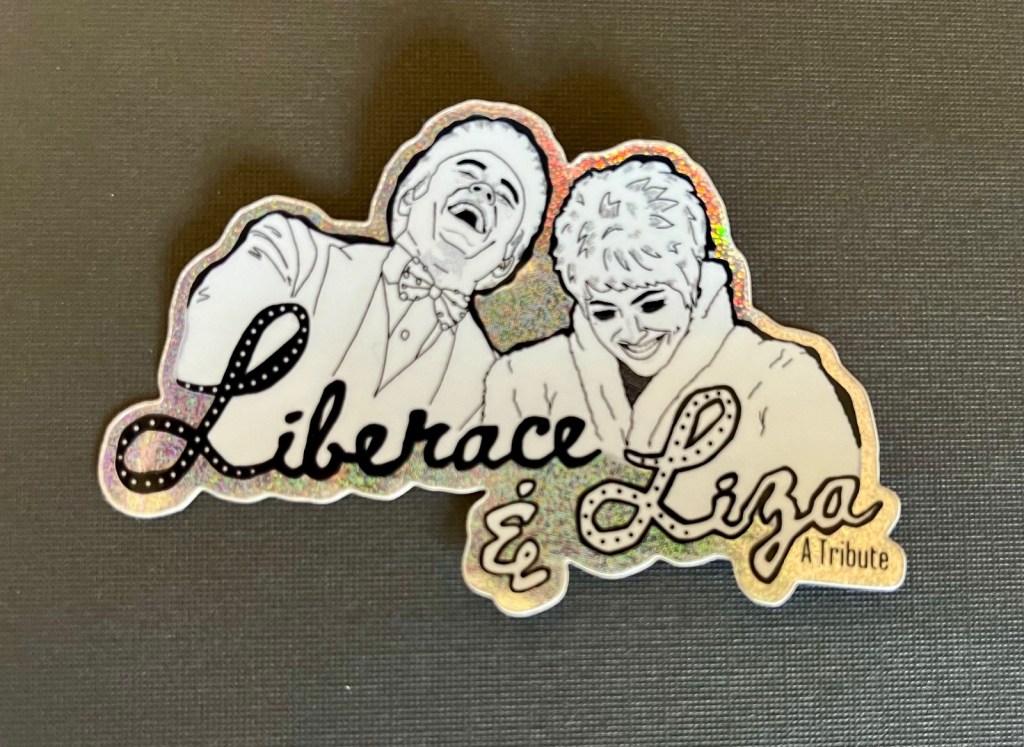
My consolation prize, which I will treasure
Kevin’s personality matched the sparkle of his pants, and he embraced his role. I didn’t try to upstage him. I became the calm, composed character next to Kevin’s funny-guy schtick. I smiled, made a few restrained theatrical gestures, and answered three questions, earning one point. Using grand theatrical gestures and hammy facial expressions, Kevin answered all three of his questions correctly, so he won the big prize. I received a consolation prize, a very cool Liberace & Liza tribute sticker. Liberace and Liza shook hands with me and thanked me. I shook Kevin’s hand and congratulated him. I had become Quiz-Show Contestant Losing Gracefully. But I smiled because I was triumphant in defeat — not once did I experience stage fright, and I had a great time. I even wished there had been someone to take a picture of me up on the stage.
Liberace took my hand and escorted me off the stage. For a moment, as I made my way back to my seat, I wished that I could have felt fearless and confident in seventh grade while playing the Wizard. But my self-assured debut with Liberace and Liza made up for my seventh-grade acting debacle.
Kevin’s big prize was to be serenaded by Liza while he sat on a stool upon the stage. He embraced this with delightfully comic acting, even singing along with Liza near the end of the song. And, although he sang off key and seemed unsure of the words to the song, something about Kevin and Liza’s bit made me think he may have been a plant in the audience. I had even thought about this when he was encouraged to volunteer. On the one hand, Liberace’s and Liza’s interactions with Kevin seemed so spontaneous, but on the other hand, could they really leave finding the perfect contestant to chance? One who would be able to ham it up with Liza as she sang to him? Even Kevin’s outfit made two arguments. Had he dressed to be part of the act or had he just been an enthusiastic audience member? Either way, his glittering gold pants sure looked good on stage, making him the perfect accessory to Liberace and Liza.
The intrigue around Kevin’s role made it even more fun for me. I know someone I could ask, who would probably tell me if Kevin was a plant or not, but I don’t want to spoil the magic and mystery of the moment. Besides, Kevin was perfect up there. I would not have been as entertaining if Liza had had to sing her heart out to me.
Liberace, Liza, and Kevin didn’t realize it, but I did win the bigger prize. I had zero stage fright, and I didn’t worry if I was going to look silly. Something else that Liberace and Liza didn’t know, but the warmth and good humor they had exuded throughout their show, let me know I would be in kind hands if I went up on the stage
Wisdom doesn’t belong to seventh graders playing the Wizard. But thankfully, I have gained some as I have aged: Smile big, have some fun, and don’t be afraid to be silly. That’s what I did. And that’s what Liberace, Liza, and Kevin did.
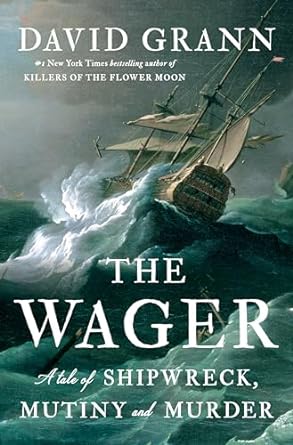
Doubleday, a division of Penguin Random House, 2023
Why did I read this book?
I read a lot of novels; short stories; and nonfiction about history, people, and nature. But every now and then, I love a good book about a real shipwreck. (I’ve read at least nine over the years.) True stories about tumultuous weather, dangerous waterways, towering icebergs, or deadly torpedoes that cause a ship to falter upon rocky coastlines or to sink into dark, deep oceans keep me reading late into the night. Stranded sailors, whether they be in a lifeboat or marooned on uninhabited and untamed land, appeal to me. Both dastardly and brave deeds among the captains, officers, crew, and passengers pull me into a world of drowning, scurvy, starvation, dehydration, desperation, intrigue, cruelty, selflessness, fortitude, and perseverance. I’m not sure why I enjoy these stories so much — or what this says about me.
What is this book about?
In 1740, the Wager, a British ship, left England on a secret mission to seize a Spanish galleon loaded with treasure. Britain and Spain were at war, and wars are expensive. By capturing the Spanish treasure, Britain could fill its war chest while depleting Spain’s. British officers and sailors alike knew this was a dangerous mission.
In pursuit of its quest, the Wager sailed around the tip of South America, perhaps the most perilous stretch of water in the world, then wrecked itself on a deserted island off the coast of Patagonia. The men were able to salvage supplies from the wrecked ship, but they were stranded for months. As the threat of starvation grew, the men decided to build a makeshift watercraft and leave the island. They sailed back to safety and were welcomed home as heroes. However, six months later three more of the stranded sailors returned home, and they accused the first group of sailors of mutiny. Accusations of rebellion, murder, and treachery between the first and second groups of survivors resulted in an investigation followed by a court martial.
What makes this book so good?
David Grann writes a highly engaging and well-researched history about a risky sea mission driven by greed and glory that goes awry. Almost three hundred years later, Grann was able to access the ship’s logs and the transcripts from the ensuing court martial.
A captain and other officers aboard a ship were expected to keep meticulous records. When a ship returned to port in England, all logs were turned over to the Admiralty, who used the information to learn more about weather patterns, sailing routes, and faraway lands. Additionally, if something went wrong aboard a ship, the events and the measures taken to remedy the calamity were to be objectively and completely documented. Logs kept by officers and mates were supposed to be detailed and succinct without emotional slants. However, as things worsened on the Wager‘s journey and after its wreck, it became clear that each officer who kept a log recorded the events in a manner to put himself and his actions in the best light. As to which accounts might be accurate and which might be embellished, Grann smartly doesn’t take sides but simply presents the information.
Grann’s vivid descriptions of bad weather, inhospitable lands, and tempestuous seas recreate the backdrop in which the egotistical, short-tempered, avaricious officers strived to chase down the treasure-filled Spanish galleon that would have made them wealthy and famous.
It’s a rollicking read filled with courage, double-dealing, and foolishness. For 257 pages, I joined the adventure from the safety of my couch, and wondered, Why — before modern ships and navigational equipment — did anyone ever leave the shores of their homeland, especially for a voyage around the tip of South America that had only a slim chance of success? And perhaps that’s what draws me to books about shipwrecks: A group of people get on a small vessel and head across a broad expanse of water, trusting they will arrive on the other side. Often they do, but when they don’t — there’s a story in that. I’m glad Grann thought so too.
Want to read some other good books about shipwrecks?
A Night to Remember by Walter Lord
Dead Wake: The Last Crossing of the Lusitania by Erik Larson
Icebound: Shipwrecked at the Edge of the World by Andrea Pitzer
In the Heart of the Sea: The Tragedy of the Whaleship Essex by Nathaniel Philbrick
Over the Edge of the World: Magellan’s Terrifying Circumnavigation of the Globe by Laurence Bergreen
“The Open Boat” by Stephan Crane (This short story is a semi-autobiographical and fictionalized account based on Crane’s surviving a shipwreck and enduring over thirty hours in a lifeboat.)
In addition to the list above, I’ve read other books about shipwrecks, but I can’t remember their titles. I read two other books about the Titanic and the Lusitania, a book about the collision between the Andrea Doria and the Stockholm off Nantucket Island, and a book about a mutiny in the Caribbean in the 1800s. Endurance: Shackleton’s Incredible Voyage is on my to-be-read pile of books. On my list of books to get and read in the near future are Left for Dead: Shipwreck, Treachery, and Survival at the Edge of the World and The Wide Wide Sea: Imperial Ambition, First Contact and the Fateful Final Voyage of Captain James Cook.
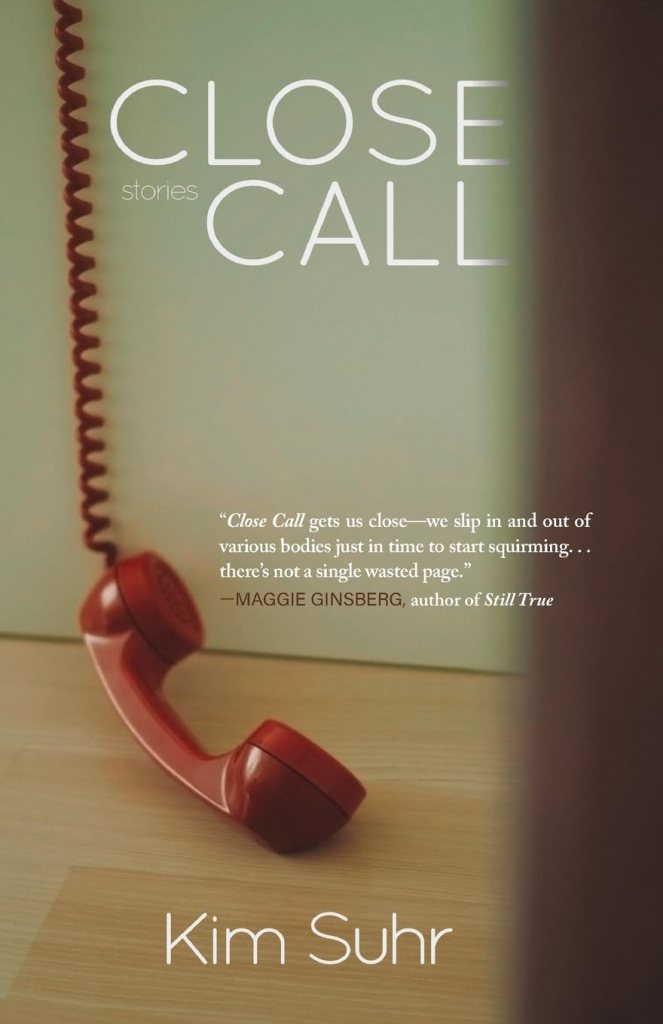
I read Nothing to Lose, Kim Suhr’s first collection of short stories, and loved it. So when Wisconsin Writers Association asked me to review Close Call, her second collection, I jumped at the chance to get an advanced copy so I could read her new collection without having to wait until October 1, 2024.
What is this book about?
Suhr serves up slices of life with intriguing, thought-provoking characters who face conundrums that will either be their undoing or their salvation. Carol, a young girl, works to save her parents’ marriage after a traveling salesman comes calling on her mother. A young married man experiences a new twist on the seven-year itch. Mrs. Morrison, once an artist but now a wife and mother, has lost her sense of self inside a calendar. Allan, an illusionist, has an unusual gift beyond ordinary magic tricks. Deena’s struggles, from childhood to adulthood, are revealed through a series of phone conversations that take place at significant moments in her life. Keith, a DMV employee, has a special talent with a camera. Isabelle, a newlywed, reconsiders her relationship with God after a tragic accident. Willie, a first-grader, gets caught up in a terrifying game of pretend. Dean, a young hockey player, meets Arnie, an old rink rat, who lives for the game of hockey.
At the end of her collection, Suhr gives us two longer stories to savor, “The Dip” and “Eradicated.” “The Dip” is about four women who have known each other since childhood. Now in their fifties, they struggle to maintain their friendship. The story is written through a series of DMs, emails, a Google doc, texts, a poem, scripts, online chat room comments, and an obituary. It takes superb writing skills to pull off this type of story, and Suhr’s talent as a writer shines through. She never lets the experimental techniques be the story, but rather she uses them to create a highly-engaging and cohesive narrative, giving us a lot to contemplate long after we finish reading it.
With “Eradicated,” Suhr presents the perfect dish to round out her collection. This dystopian tale is set in the future where artistic creativity, now labeled a disease, needs to be eradicated, a goal that is nearly complete when we meet Dr. Bells, a scientist. Wishing to observe creative artists before the last of them dies out, the doctor visits an artists’ colony where creative people, who are considered to have “disturbed minds,” have been contained after being extracted from society. Because the themes in “Eradicated” are both timely and timeless, the story sends chills up and down our spines.
What makes this book so good?
Close Call hooks us with one look. The stunning cover art features a red telephone receiver, untethered from its cradle and dropped at the end of its cord. Abandoned, the receiver rests on the floor near a dark shadow, setting the tone for the tales that follow. Stories about close calls, narrow misses, inevitable disappointments, and unavoidable failures. The cover compels us to pick up Close Call and open it, but from the first sentence, it’s Suhr’s vivid writing and intelligent, masterful storytelling that seal the deal and keep us turning the pages. Suhr promises us her collection will be exquisitely crafted, with every word, turn of phrase, and sentence essential in creating her nuanced characters and the thorny situations they face. And she delivers.
Each of Suhr’s stories in Close Call presents a fresh take on love, hate, jealousy, faith, loss, fear, conformity, and disappointment. Her ability to tell stories with unique characters, interesting plots, and captivating complications gives us a look at human nature in a different way, and as we read our way through her stories we hunger for the next one. And Suhr’s stories are a literary treat.
Today Red Rose Thorns published my essay “How I Became My Own Dudley Do-Right.” The editors were wonderful to work with, and I’m glad that my essay spoke to them.
I hear writers say that if a story keeps hounding you, you need to write about it. And so I kept trying to write this essay, but it took me a long time to get it right. I would start to write it, but when I read it, it always fell flat. Then one day I decided to write my essay as a letter, and it clicked.
Trigger warning: This story is about a guy who pulled my tube top down in public, leaving me exposed in front of our group of friends. It’s also the story of me becoming my own hero!
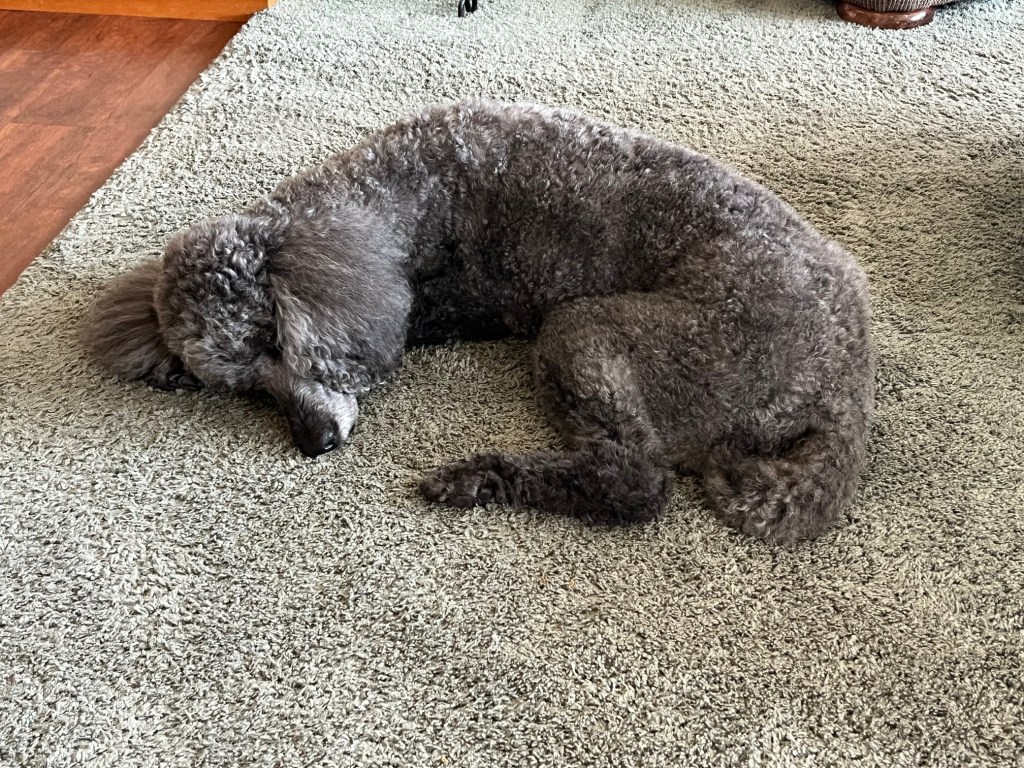
Ziva is pretty much back to her old self this morning.
Ziva loves to be with the grandkids when they visit. March 2024
Yesterday morning Ziva met Dr. F, a new vet, and Ziva loved her immediately, but she loves everyone. I really liked the new vet, too; although, I refrained from leaning my head against the vet’s leg and nuzzling her.
I had been nervous about having a stranger examine Ziva because she already has two other vets, Dr. J. and Dr. M., who treat her. I wanted Ziva to see one of the vets who currently care for her. But now we have three wonderful vets to choose from, which might make it easier to get an appointment when we need one.
From Tuesday, when I made Ziva’s vet appointment, until Thursday, when Ziva saw the vet, she had improved. However, I had videos on my phone to show the vet, so she could see how poorly Ziva had been moving in the previous days. The vet examined Ziva and determined that she most likely had a soft-tissue injury that needed to heal. The vet recommended increasing Ziva’s Librela shots for her osteoarthritis from every four weeks to every three weeks, giving her a three-to-five-day course of an anti-inflammatory medicine, and monitoring her movements.
Monitoring Ziva’s movements is the tricky part. Because when she feels better, she likes to run up the side of the house. She likes to run out to the front yard and prance around while she barks at a squirrel scrambling up a tree or a passing dog or the neighbor who is once again for the zillionth time mowing his lawn. Right now, I cringe when I watch her do these things, so I’ve been taking her outside on her leash. She’s limited to a couple of walks a day, but only around the block, which suits her just fine. And if I take her in the car, I put her on the leash and walk her to the back passenger door, so she can’t dance, prance, and spin in happy circles because she’s excited for a ride.
The reality is that while Ziva’s doing much better, going forward we’ll have to take care with her by limiting her exposure to situations where she could reinjure herself. But we’ll also have to make sure she is living the best life she can. This includes making sure she moves because “move it or loose it” applies to dogs too.
Ziva, cooling her toes in Lake Michigan, September 2023
Yesterday, after her rough morning, Ziva had a slightly better afternoon. She still slept most of the time, but when she did get up, she moved better, slowly and cautiously, but better.
I’ve become an expert at watching Ziva’s movements and her gait. I’ve been doing it for five or six years now. We walk a lot, so I’m able to note how she moves from day to day, week to week, and month to month. In 2017, I read Being Mortal: Medicine and What Matters in the End by Dr. Atul Gawande. He wrote that if doctors know what they are looking at, they can tell a lot about an older person by the way he or she walks. When I worked at a bookstore, medical students sometimes came in with a list of suggested reading (beyond medical texts) given to them by a professor. I always suggested they add Gawande’s Being Mortal to their stack because it deals with aging and death, topics about which they would receive little exposure to in medical school. They usually bought the book because I was able to convince them that geriatric and end-of-life concerns were going to figure in their practice — regardless of their medical specialties. And so, I watch Ziva’s gait and movements. I note the changes over time, and I can describe them to the vet in a manner that impresses her and helps her to treat Ziva. I did the same with Cabela, Ziva’s sister, as she aged.
When my husband and I came home from the grocery store yesterday afternoon, Ziva met us at the door and wagged her tail. I realized how much I take her incessant tail wagging for granted. We made a big fuss over her swirling tail and gave her a treat. It might sound like Ziva gets a lot of treats, and she does. Most days she eats her breakfast and supper too, as long as we doctor it up with good stuff (eggs, boiled chicken, a bit of canned food), what my husband likes to call “frosting.” Ziva isn’t overweight. Rather when we go to the vet’s, I hold my breath and hope she hasn’t lost another half-pound. When she weighs the same as she did the last time, I joyfully exhale.
Around three o’clock, while she appeared to be sound asleep, I whispered to my husband that I was going for a walk. Unbeknownst to me, while I got ready, Ziva got up, walked to the back door, and waited for me. (There is nothing wrong with her hearing or her ability to look like she’s in a deep sleep when she’s actually keeping tabs on her people.) She looked at me with big pleading eyes — the ones that say: You’re surely not going without me?
In the morning we’d agreed that Ziva should have lots of rest. No car rides, no walks, no extended outside time. But she stood at the back door, telling she felt better and wanted to walk. I worried she might tweak her injury if she stumbled. But I kept my comments to myself because she didn’t want to hear about my fears. She had her own. And even though she was hurting, she wanted some say in how she was going to get better. In that moment, I weighed her need for a small outing against the chances she might aggravate her injury. I decided her emotional well-being was important to her healing.
When I was nineteen and living with my grandparents, I got very sick. I was on bed rest for two weeks. Finally, I started to feel better. I wanted to do something other than lay in bed. I hadn’t been out of the house since coming home from the hospital, but I was weak. I called my mother, and I started crying as I explained how I felt. She told me to get out of the house for a bit, that if I felt like going out, it was a sign I was getting better. I called my girlfriend, who said that she and her boyfriend were going to a softball game, and they would come and pick me up, take me to the game, then bring me home. My grandmother and I had a big argument about my going out. Of course, she was worried about me. But I didn’t back down. I finally told her, “I called my mother this morning, and she told me I could go out for a bit.” I felt so much better when I returned home a couple of hours later; although, I did need a nap. My grandmother, noting my happy face, said, “It was so nice of your friends to take you out and bring you back.” I believe she was also relieved I hadn’t overdone it.
While I grabbed Ziva’s harness and fastened it around her, I thought about my grandmother and our argument. I explained the rules to Ziva. We would walk down through the grass instead of down the stairs, and our walk would be slow and short. We walked less than one city block, but Ziva went to the bathroom and sniffed a few of her favorite spots along the way. When I announced it was time to go home, she happily turned around. After we got home, she curled up for a big nap, but she had enjoyed herself. After her nap, she wasn’t any worse for the walk, but she didn’t want her after-dinner walk.
This morning Ziva is moving a little faster and with more confidence, but still carefully. And her tail wagging, while not back to normal, tells me her pain has eased a bit.
A little over a week ago, my dog, Ziva, slipped on the wooden stairs that run along the side of my house. She didn’t just lose her footing, she fell down. When she got back up, she could hardly put any weight on her back left leg. She’s thirteen and a half years old, so injuries are disconcerting.
At the time Ziva fell, we were headed out for a walk with my four grandkids. I thought I’d have to carry Ziva back in the house, but after she took a few steps, her leg worked better, but walking wasn’t easy for her. I figured we’d just walk across the road and let her tinkle, then go back home. But the more she walked, the better her leg worked. She resisted my efforts to turn around and go home, making it clear she wanted to keep walking, just like an athlete shaking off a momentary ache before getting back in the game. We completed our short walk, and Ziva did well for the rest of the day.
Then on Sunday, she must have done something that tweaked her injury. She likes to prance and dance around when she’s excited, especially if she’s outside and we’re getting ready to go for a ride or if she sees a dog walking down the street. She was a little gimpy Sunday evening, but not too bad, and she still insisted we go for her after-dinner walk. When she woke up on Monday, she was back to her old self.
But on Monday afternoon, she tweaked her injury again, probably getting out of the van. Because not long after her ride to the post office with us, she once again struggled to walk around. She was obviously in pain. She ate supper, but she wanted nothing to do with her after-dinner walk. At first I thought she wanted to walk because she stood by the back door. So, I put her leash on, and we walked onto the back deck. But she refused to move more than a few feet beyond the back door. We went back in the house, and she stood in front of the microwave and looked up at her treat dish. Her message to me: I walked a few feet, now I want my treats. Happy that she had an appetite, and that she still enjoyed bossing me around, I gave her a half dozen small crunchy treats. After she realized she wasn’t going to get anymore, she went to sleep on her bed in the family room, where she stayed for the rest of the night.
Tuesday morning when Ziva woke up, she was her cheery, tail-wagging self. Her walking was back to normal, and she was interested in breakfast and her morning walk.
But Tuesday afternoon after prancing and dancing in the yard, Ziva reinjured herself. And this time was worse than the other times. She was in pain. She struggled to walk. Anytime she got up from the floor, she stood still for a couple of minutes, as if waiting to see if she could trust her leg to move forward and keep her upright. She wouldn’t wag her tail.
I called the vet’s office, and because there was a cancellation, I was able to get Ziva an appointment for Thursday morning. I couldn’t believe our good luck. It’s so hard to get a short-notice appointment at my vet’s because they have so many patients and not enough staff. A pet has to be in dire condition, and Ziva’s injury doesn’t meet that standard. Even the emergency veterinary hospital, which is open nights and weekends, wouldn’t want me to bring her in because they wouldn’t consider her critically ill. They would tell me she could be seen by her regular vet. And her regular vet would tell me that I could take her to the ER vet hospital when it opened. It’s a classic Catch-22 moment when this happens. So much so that it gives me pause about getting another dog.
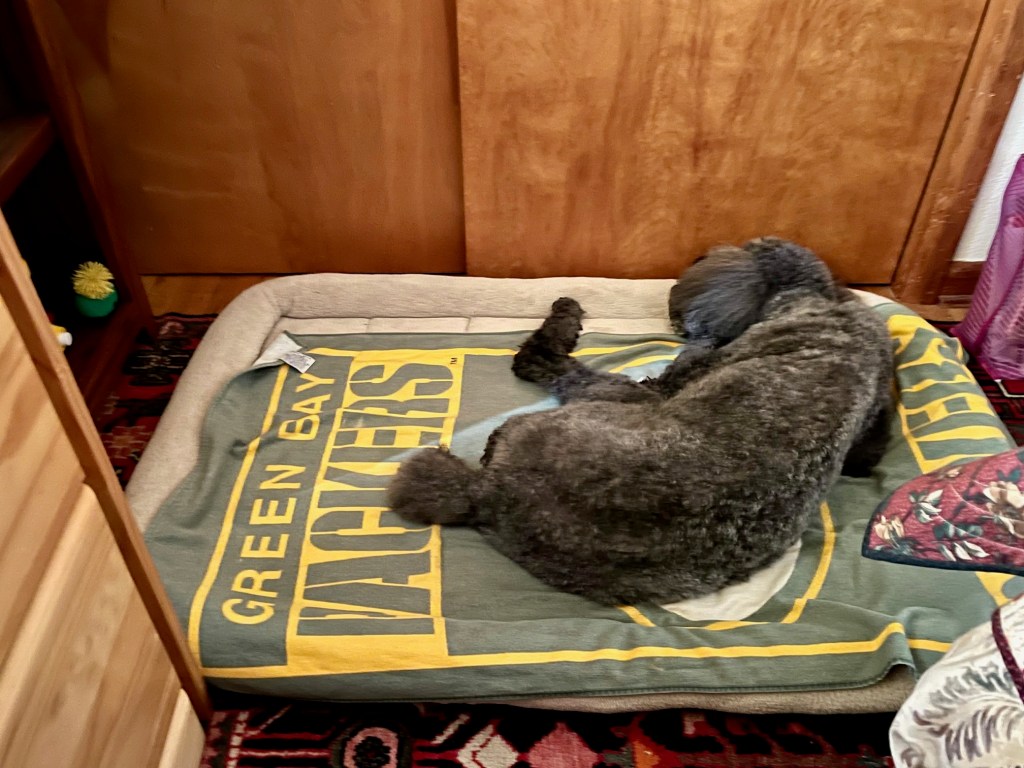
On Tuesday night after her supper, Ziva never asked for a walk or her post-walk treats. After I took her outside to go to the bathroom, she climbed into her large, cushy bed on the family room floor and went to sleep. Throughout the afternoon and evening, she never once wagged her tail. I was glad she had eaten supper and that she drank water, but I wanted to see her poofy tail twirl in the adorable circles it makes when she wags it.
I tried to walk without Ziva. I walked down to the road and started to go left, but that’s usually the way Ziva and I go, which made me sad. Then I discovered I had my T-shirt on inside out, which distressed me. I wondered if anyone would notice because I knew if I went inside the house to turn it right-side out, I wouldn’t come back outside. I decided to walk the other direction, but I couldn’t do that either. I was too sad without Ziva. There are times I have walked without her, but that’s because it was too hot for her or because she was taking a big nap and I didn’t want to wake her. This time was different because she wasn’t able to come with me. I went back inside and turned my T-shirt right-side out. I picked up a book and sat down on the couch. While reading, I kept looking up to watch Ziva as she slept, hoping she was healing.
This morning Ziva was only slightly better. In pain and not trusting her leg, she walked slowly. But before she went outside to the bathroom, she wagged her tail and asked for a treat. My husband and I both gave a small cheer while Ziva ate her treats.
Today there will be no walks or car rides. Ziva won’t go outside unless someone is with her to make sure there is no prancing and dancing. After we see the vet tomorrow, we’ll know more, but continued rest will probably be part of the treatment. We are keeping an eye on her. She can hop up on the couch or the stuffed chair, but when she wants to get down, she looks to one of us for help. As I finish writing this, she is sleeping on her bed in my office. She often joins me when I write. She is a mama’s girl. And she is my Ziva Baby.
Other than this blog, I mostly write short stories and essays, but I had so much fun writing this article. I also took the photos and wrote the captions. One of the highlights of writing this article was interviewing Carol, the co-president of the Lake Superior Rose Society, who was more than generous with her time. She is so knowledgeable about the Rose Garden and its history, plus she knows so much about roses and their history. I learned more from her than I could possibly include in my article, but her willingness to share her knowledge gave me the confidence to write about roses, which I knew so little about.
Our community is lucky to have a publication like Northern Wilds. The articles are well written and cover a variety of topics, such as outdoor activities, artist profiles, nature, ecology, tourist venues, community celebrations, and local restaurants.
My youngest grandson strikes a pose along the Lakewalk. Check out his knees! That is how mine always looked when I was his age.














 Writing Near the Lake