London was the last stop on our European trip. We traveled around the city using the London Underground, nicknamed the Tube, and the adorable red double-decker buses, so quintessentially British. Inside the Tube and on the buses, signs were posted warning riders not to touch unattended packages, but to report them to a conductor or bus driver immediately. The conflict between the Irish Republican Army (IRA) and the British Army had spilled over into England in 1973, and from January through March 1976, six bombs exploded in London. The IRA warned authorities before a bomb went off, so injuries were few and fatalities fewer. Because the IRA and British were negotiating, there were no bombings for the rest of 1976, and our stay in London was free from explosions. However, I didn’t know that when we toured London. Even if I had known, it might not have been much comfort because throughout history truces have been broken.
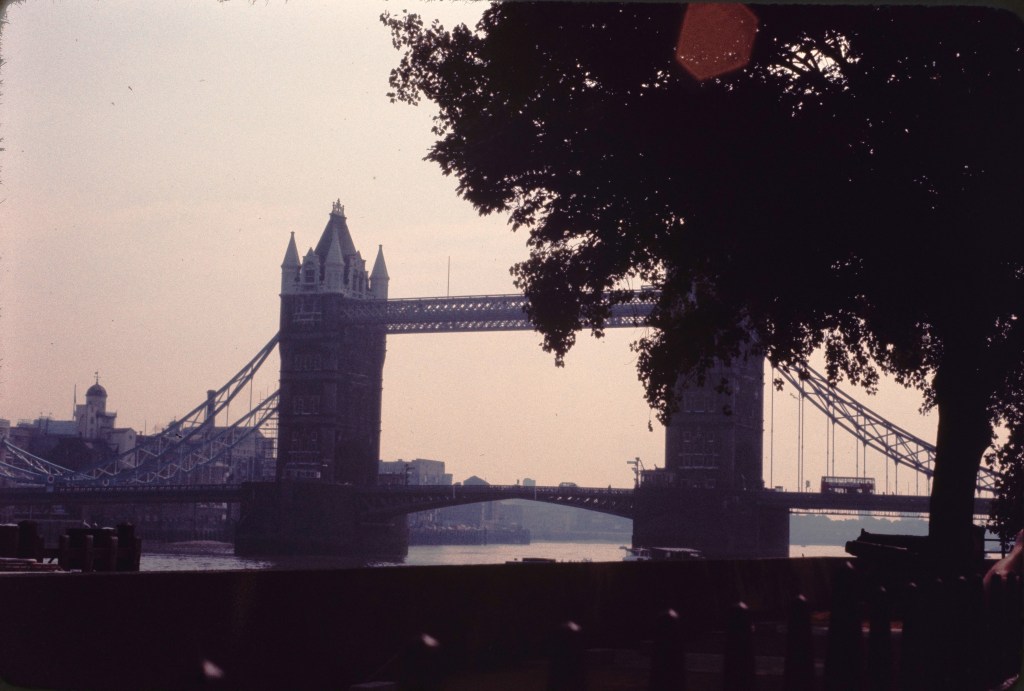
Tower Bridge, London, 1976
The warnings didn’t stop people from riding the Tubes or the buses. But it was strange to think I could board a bus, perhaps off to Hyde Park, Harrods, or Trafalgar Square, and be blown up by someone who wanted to make a point, someone who thought of me only as collateral damage. And yet somehow, I felt I would be safe because I was a visitor from a different country who had nothing to do with the conflict between the IRA and the British. At the time, I wondered what it must be like for people to live under the threat of terrorism.
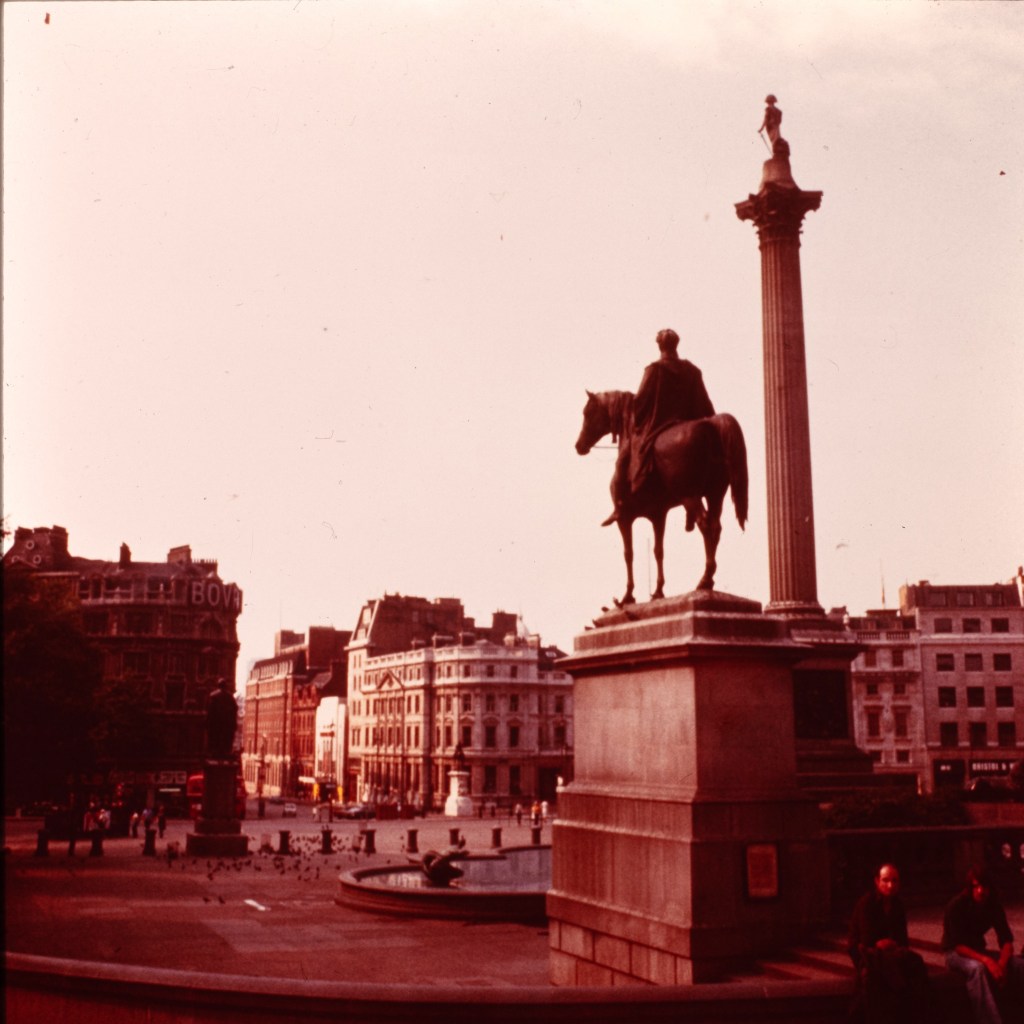
Trafalgar Square, London, 1976
Now, I think about random gun violence in the United States, which has taken many lives. Schools, places of worship, stores, malls, businesses, theaters, nightclubs, restaurants, concerts, parades, neighborhoods, homes, places people expect to be safe have been scenes of bloodshed. When I see a sign that says, “Guns Banned on These Premises,” I think about the don’t-touch-the-unattended-package signs in London. Signs won’t keep us safe from violence or terrorism or war. We need to see each other as fellow travelers in our neighborhoods, our country, and the world.
Learn about people from down the block and from other cultures.
Big Ben and those charming, old-fashioned London cabs, 1976
Going Home
After a month in Europe, we landed at Billy Mitchell Field in Milwaukee. I had a couple of dollars in foreign coins and one U.S. dime in my purse. I had spent the rest of my money and might have spent the dime too, but I needed it to call my parents for a ride home from the airport. After I deposited the dime in the payphone, I was broke, but I was rich with wonderful memories and great experiences.
My love of language and interest in meeting people from other countries continued. When I went to college, I kept studying Spanish, and I made friends with people from Europe, South America, and Asia. We cooked for each other and helped each other with our studies. We went dancing and roller skating. We talked for hours about our lives and dreams. We taught each other swear words and laughed as we cursed in each other’s languages.
The European trip my parents gave me was the best gift: an opportunity for me to grow as a person. I have a scrapbook of mementos and photographs, and occasionally I look at them. I have a Spanish Damascene dinner bell I bought in Madrid and a soft plaid cashmere scarf I bought in London. Occasionally, I ring the dinner bell or wear the scarf. But the best keepsakes are the lessons of kindness, acceptance, and adventure that I have carried with me all these years.
Changing of the Guard, Buckingham Palace, London, 1976
[In 1976 when I was seventeen, I traveled to Europe with a group of fellow high school students. I wrote the essay European Tour 101 in 2023. This essay was published in Tales of Travel by the University of Minnesota-Duluth. I’m publishing it to my blog in five parts.]
Lesson Six: Be Alone with Yourself in a Place You’ve Never Been Before
Notre Dame, 1976
In 1976, I had a lot of freedom in Europe. I can’t imagine high school students today having the freedom we had. We only had a few rules: Be respectful to everyone, be on time for the bus tours, and never go out at night alone. However, during the day when we had time off from tours, we could wander out alone. I did this a bit in all the cities we visited, but in Paris I spent most of my free time on my own, walking miles and miles along city sidewalks and riding the metro to explore different neighborhoods. I didn’t have a word for it when I was seventeen, but now I would say that my introverted self had reached a threshold by the time we had reached Paris.
I listened to musicians busk in the Paris metro, their melodies amplified by the underground walls covered with white subway tile. I bought a bottle of Chanel N°5, my favorite perfume, from a department store that catered to tourists. I walked past bakeries because I didn’t like French pastries.
Arc de Triomphe, 1976. We were in Paris for Bastille Day.
From a local boutique which didn’t cater to tourists, I bought a blue T-shirt even though the clerk was rude when he discovered I couldn’t speak French beyond my greeting of bonjour. I thought if I bought something in the shop, the clerk would see me as a customer and be nice, but he continued to snub me as he took my money, bagged the shirt, and handed it to me. I was angry because I believed I was being respectful by greeting him in French. But now I think about it from his viewpoint: I was just another American showing off my one word of French, someone who couldn’t be bothered to learn the rest of his language.
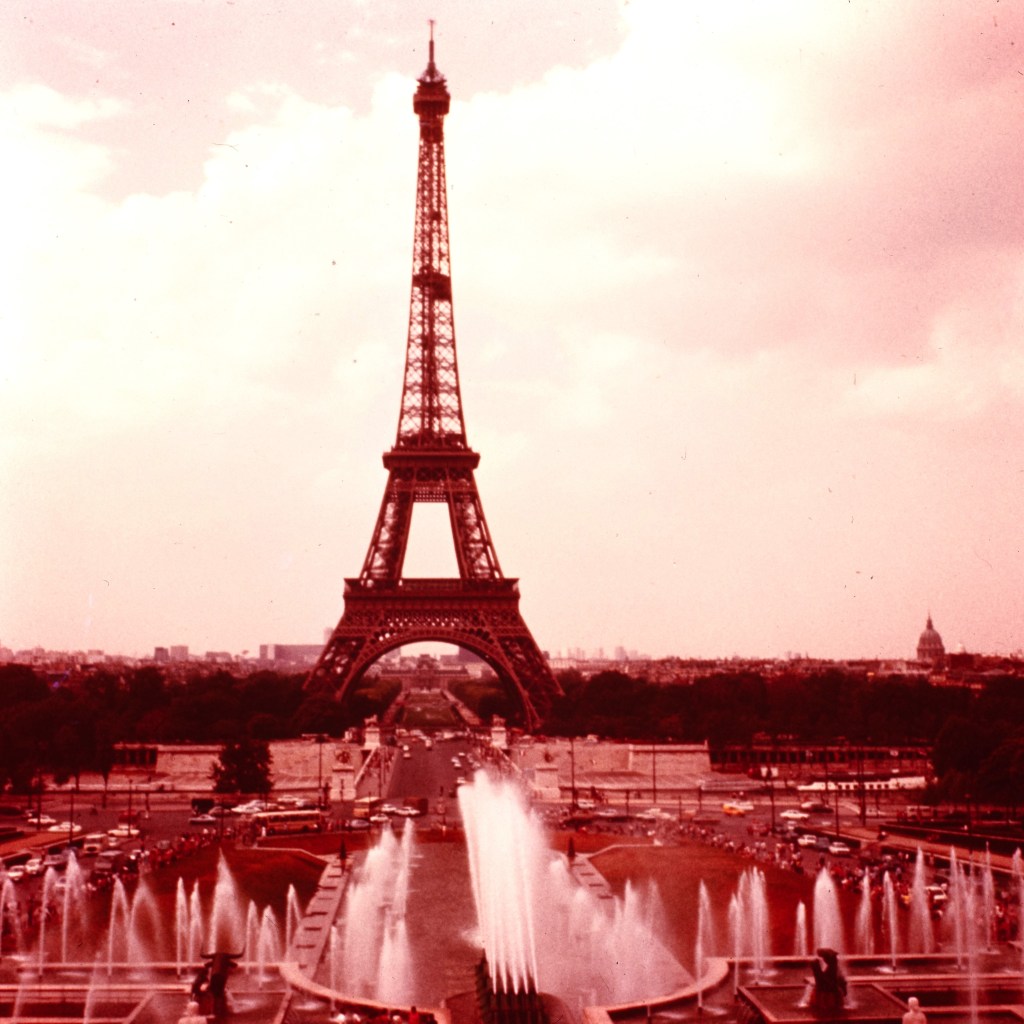
Eiffel Tower, 1976
Almost every day I ate by myself at an Italian restaurant owned by two handsome brothers from Sicily. The brothers were charming, the food outstanding, and the sorbet, served in large Italian lemons, took the sizzle out of the hot Parisian summer. One afternoon I sat in front of the Eiffel Tower next to the Trocadero Fountain, mesmerized by it synchronized spouts of playful water. I saw much of Paris at my own pace – without the need to negotiate with anyone about what to see, or how long to linger, or where to eat.
[In 1976 when I was seventeen, I traveled to Europe with a group of fellow high school students. I wrote the essay European Tour 101 in 2023. This essay was published in Tales of Travel by the University of Minnesota-Duluth. I’m publishing it to my blog in five parts.]
Lesson Five: Serenade Your Tour Guide
Salzburg, Austria, 1976
Our train left Salzburg in the evening, shortly after nightfall. The station’s platform was written in romantic darkness, punctuated with street lamps. Our Austrian tour guide had come to the station to make sure our travel arrangements were in order and to say goodbye. We were headed to Paris.
A hazy view from the Alps, 1976
I no longer remember the guide’s name. She was a university student, kind and soft spoken, with a gentle smile and a lilting laugh. Warm blue eyes sparkled behind her gold wire-rimmed glasses. She had accompanied us to a salt mine, to museums and art galleries, and to the Alps where the mountain scene for the Sound of Music was filmed. We stayed in Adnet, a farming village, thirty minutes from Salzburg. The small village had a well-lighted, welcoming restaurant, and we ate our evening meals there as one large group. After dinner we sang songs, and one night someone taught us the words to “Edelweiss” from the Sound of Music.
After we boarded the train, our tour guide stood on the platform waving at us. Someone in our group began to sing “Edelweiss.” Spontaneously, voice after voice, the rest of us joined in, and on a warm summer’s night as the train eased its way along the track, we leaned our heads and hands out the windows, and as one rhythmic beating heart, over and over, we sang the words about a small white flower, about meetings and greetings, about remembering and forever.
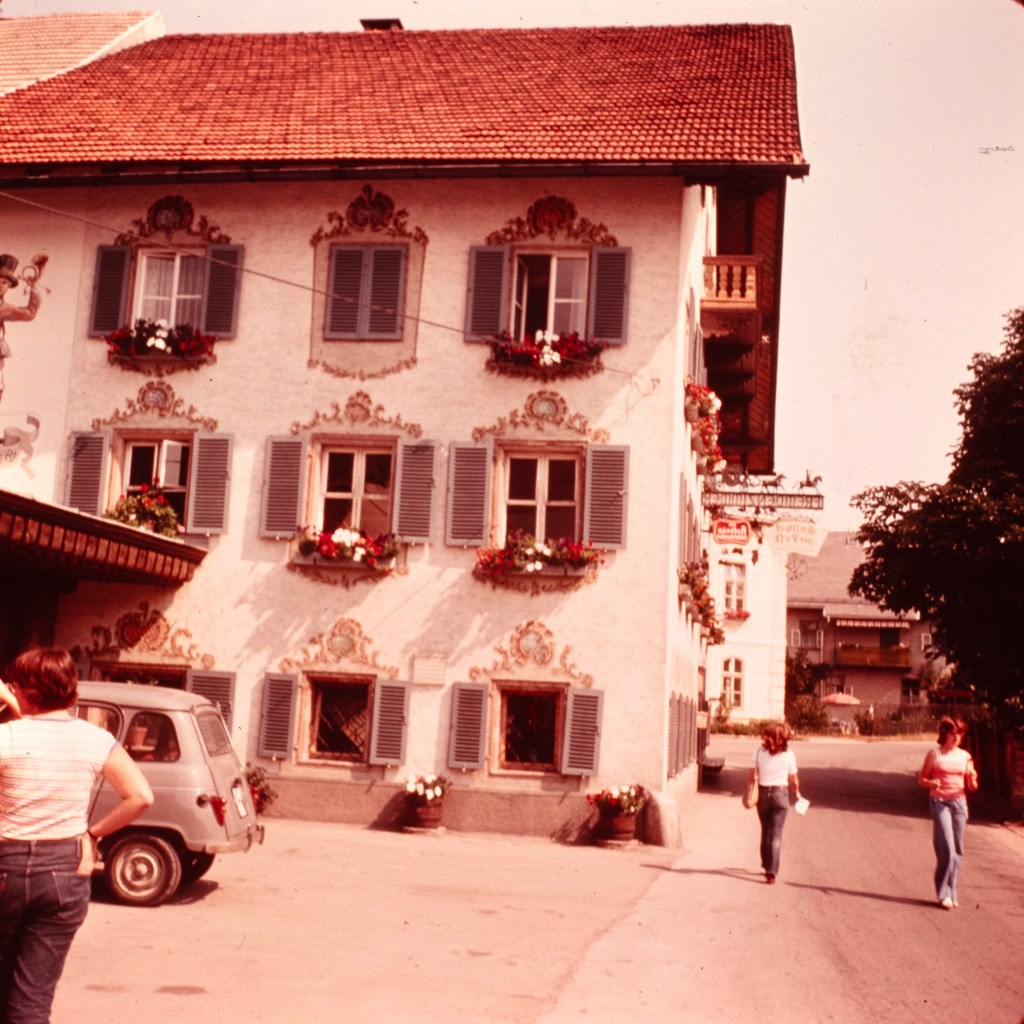
A view of Adnet, Austria, where we learned the words to “Edelweiss,” 1976
Our guide cried, wiping tears from her cheeks before they could splatter on the concrete beneath her. We sang and waved until we could no longer see her. And as the distance between us grew, one by one our voices drifted off, and we pulled our heads and hands inside the windows, and settled in our seats, bound for Paris, the City of Light.
I sang “Edelweiss” to both of my children when they were babies, and it became my youngest child’s favorite lullaby. After all these years, I remember the gifts we traded with our guide at the station: our song for her — and her tears of delight for us. I wonder if she ever plays the memory in her mind like a scene from an old movie as I still do.
[In 1976 when I was seventeen, I traveled to Europe with a group of fellow high school students. I wrote the essay European Tour 101 in 2023. This essay was published in Tales of Travel by the University of Minnesota-Duluth. I’m publishing it to my blog in five parts.]
Lesson Four: Patriotism is Fine, But Ditch It for the Ballet
Rooftops of Rome, 1976
On July 4, 1976, our tour group was in Rome. Even before I left for Europe, I felt bad about missing America’s Bicentennial birthday bash. When we arrived in Rome, we were given a choice about how we wanted to spend the Fourth of July. We could attend a professional ballet performance or an evening picnic followed by fireworks sponsored by the American Embassy. I chose the picnic and fireworks because if I couldn’t be in the States for the Bicentennial, I could at least be with a group of patriotic Americans eating scrumptious picnic food and watching extravagant fireworks.
It was the worst Fourth of July celebration I ever attended. The food was second-rate, the fireworks were average, and the park was peppered with litter. I grew up inspired by Lady Bird Johnson and the Keep America Beautiful campaign. Every spring and fall my sisters and I pulled our red wagon up and down our road and picked garbage out of the ditches. I yelled at friends who threw litter out of car windows. The inconsiderate Americans who couldn’t put their trash in the garbage can embarrassed me. Before the fireworks even started, I regretted skipping the ballet.
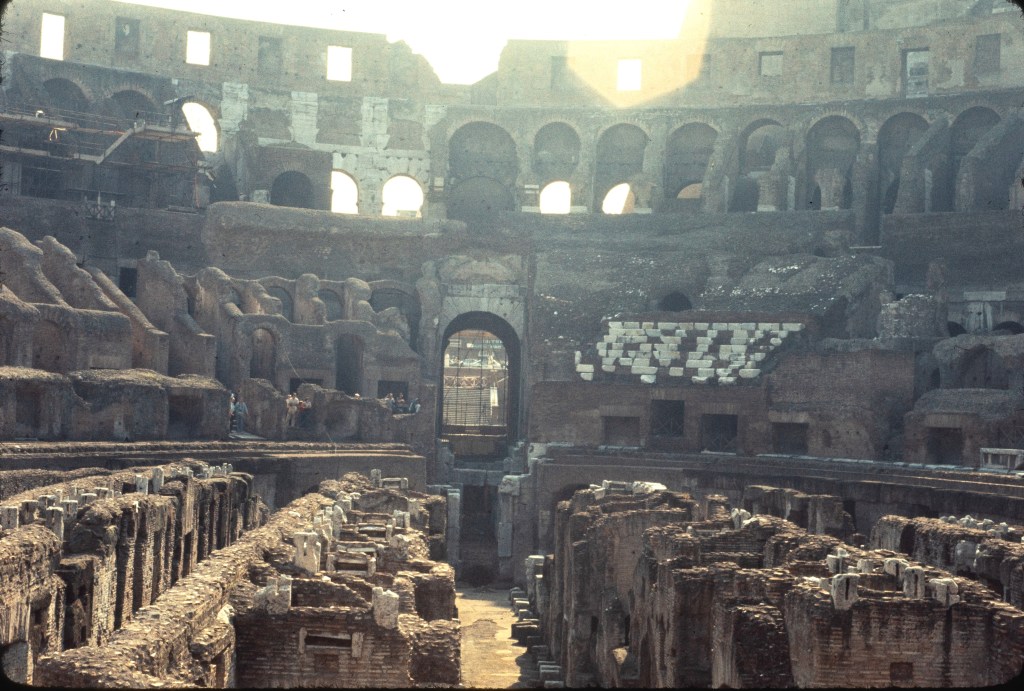
Roman Colosseum, 1976
At the time I saw the embassy picnic as a lackluster celebration that didn’t match the significance of two centuries of democracy. In hindsight it strikes me that American democracy has a long history of casting aside many of its citizens, like the discarded rubbish I saw on July 4, 1976, dropped by patriotic Americans who somehow felt entitled to litter someone else’s park. Patriotism isn’t about eating a hotdog or watching fireworks. Patriotism should be about loving a country that embraces equality, justice, and opportunity for all.
Years later my mother-in-law took me to my first ballet, The Nutcracker. I loved everything about it—Tchaikovsky’s music, the graceful dancers, the whimsical costumes, and the enchanted scenery. And again, I regretted missing the ballet in Rome, which I think was Swan Lake.
Always choose the ballet.
[Coming soon: European Tour 101 – Part 3, Austria]
[In 1976 when I was seventeen, I traveled to Europe with a group of fellow high school students. I wrote the essay European Tour 101 in 2023. This essay was published in Tales of Travel by the University of Minnesota-Duluth. I’m publishing it to my blog in five parts.]
My European scrapbook is filled with ticket stubs, receipts, brochures, maps, postcards, etc.
In the spring of 1976 when I was seventeen, I brought home a brochure from my German class that showcased a thirty-day trip to six European cities in five countries. I had studied high school German for two years and middle and high school Spanish for five years, and Austria and Spain were two of the countries we would visit. I had no illusions about my ability to chat in German or Spanish with the locals, but I longed to visit Europe. I gave the brochure to my mother, who after reading it told me I could go. There was never a discussion of “maybe” or “we’ll see.” The trip cost around $1,400 in 1976, a lot of money for my parents who were on the lower end of the middle-class ladder.
Mother never said it in so many words, but she believed in learning about other cultures. She had encouraged me to study a foreign language. While I was in high school, she signed up to host foreign exchange students for Milwaukee Week. During this time, exchange students from all over Wisconsin spent a week in Milwaukee. I enjoyed meeting the exchange students, learning about their countries, and showing them around my city.
I’m over sixty now, but I remember my only trip to Europe with fondness because it was a good time, it influenced my life in a positive way, and it was educational on many levels. The life lessons I learned in Europe stand out to me because my European experiences are stored in my brain on a thirty-day shelf between two bookends—the touchdown in Madrid on one side and the departure from London four weeks later on the other side. The memories lean on one another, easy to access and tapping one wakes up its neighbor.
Lesson One: Travel without a Hangover
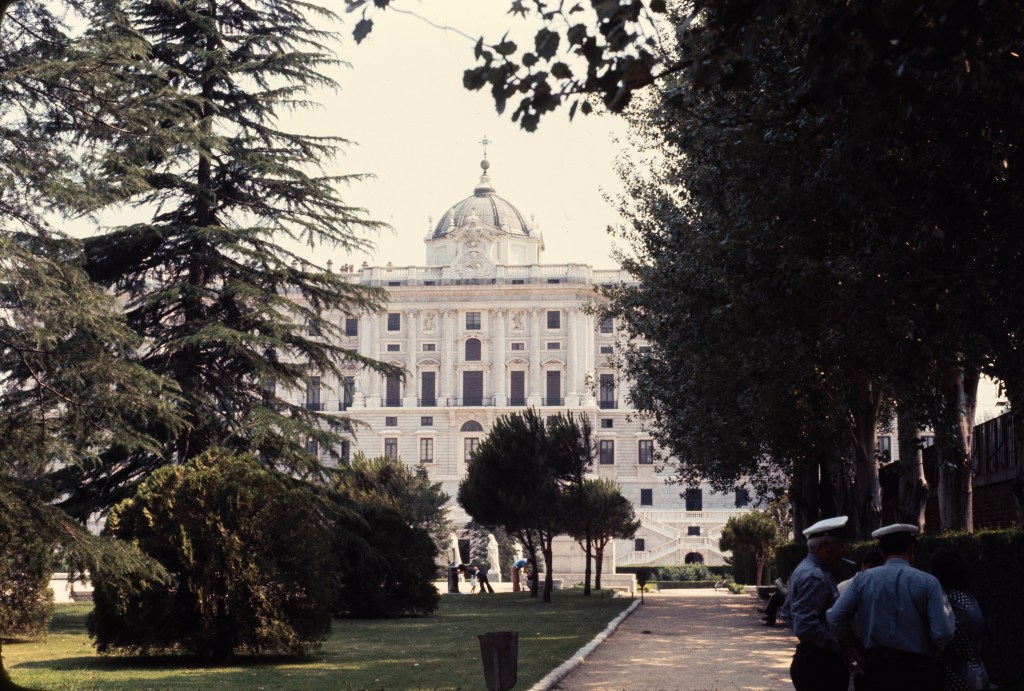
Royal Palace of Madrid, 1976
Sabatini Gardens, Madrid, 1976
The first lesson I learned was don’t be hungover as a tourist. A pounding headache and an unsure stomach turned out to be poor companions while touring Madrid’s architectural marvels on my second day in Spain. The day before at lunch, I split a small bottle of white wine with a friend, and at supper we split a small bottle of red wine. I never drank in the States because I was seventeen, but in Europe I wasn’t breaking the law, so I decided to embrace the whole experience, which is why I tried white wine at lunch and red at supper. In the evening a group of us went dancing. While disco music and colorful lights pulsated around the nightclub, and we danced with Spanish teenagers, I drank two screwdrivers because that is what my friends were drinking.
The next morning, a chaperone banged on our door, rousting us for breakfast. Startled, I sat upright in a finger’s snap. My head lagged behind, pounding as it tried to keep up with my body. Most of the day I had a throbbing headache. I didn’t throw up but the possibility was a nagging pest. Thousands of miles from home and only seventeen, I decided to experience Europe without hangovers, so if I drank at all, I limited myself to no more than one or two drinks in a day. I carried the lesson back home with me and even after I turned eighteen and could legally drink, I never forgot about my second day in Madrid.
Don’t be hungover in life.
Lesson Two: Even Muscle-Bound Bulls Have Feelings
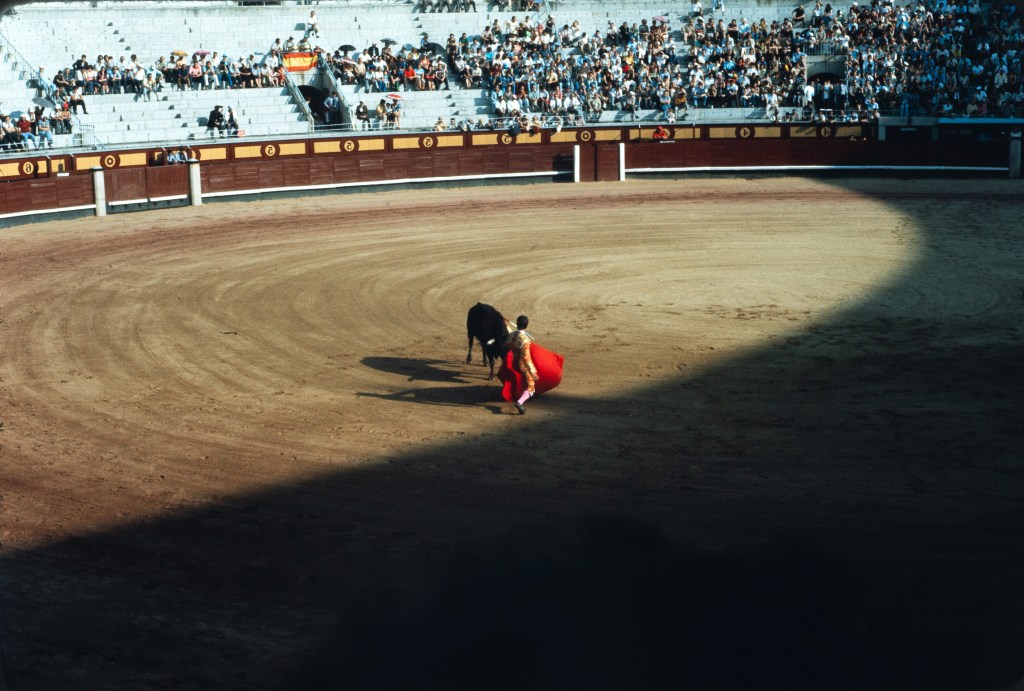
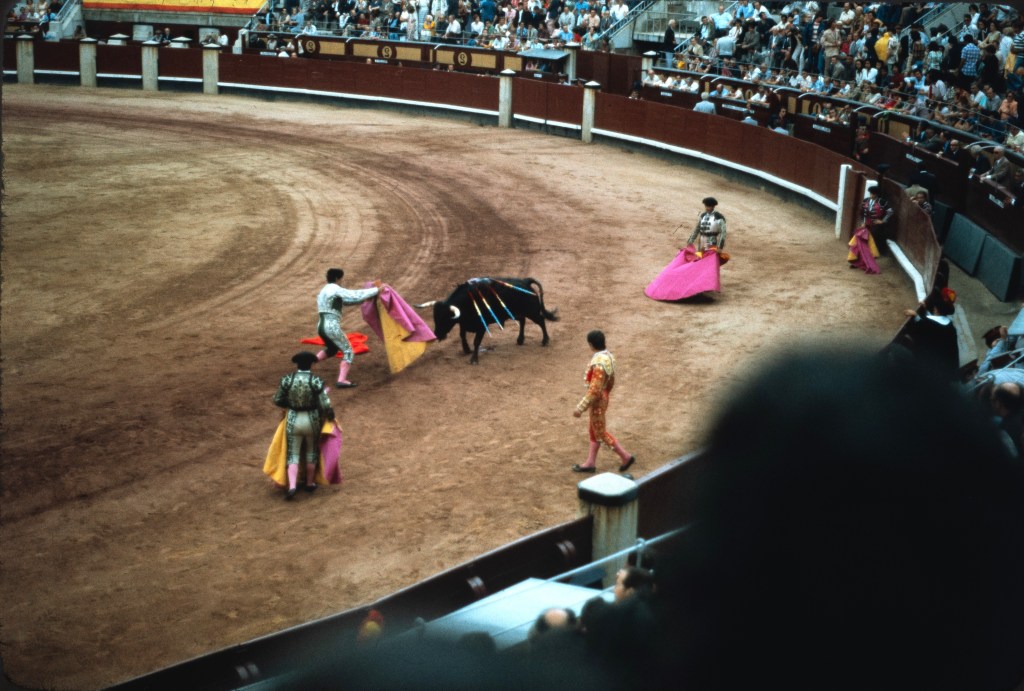
Madrid, Spain, 1976
In Madrid we went to a bullfight. Attendance was optional because even though bullfights were part of the Spanish culture, the pretense of masculinity and bravado they symbolized had begun to dissipate as more people spoke against the cruelty suffered by the bulls. I decided to go because it was a Spanish tradition. I don’t remember if the bull died, but the matador didn’t. The stadium, crouching under the Mediterranean sun, became a cauldron of heat. I didn’t like hot weather, and I was sorry I had come. Why would anyone sit in the scorching sun to watch a choreographed drama between a sidestepping matador dressed like a golden baroque candlestick swirling a red cape and an incensed bull snorting like a diesel engine?
We had been told it was a nuanced battle, steeped in meaning. Clearly, I didn’t get it because that afternoon I decided if the object was to kill the bull, it was a show of pointless machismo. I sympathized with the bull, who unlike the matador or me, had been given no choice about where it wanted to be on that blistering afternoon. I concluded that any competition, legal or not, that humiliated or sacrificed animals in the name of amusement was wrong. But I couldn’t throw stones because I knew Americans had their dog fights and rooster fights and probably other types of fights.
Madrid 1976
As an adult, while watching cartoons with my children, I discovered Ferdinand the Bull, a Disney animated short that won an Oscar in 1938. Ferdinand wouldn’t fight. He wanted only to smell flowers. He so enraged the bullfighters they simply took him back to his green fields filled with flowers. Ferdinand was a consummate pacifist.
Don’t go to bullfights or dog fights or rooster fights.
Lesson Three: If You Don’t Know the Language, Don’t Insult Those Who Do
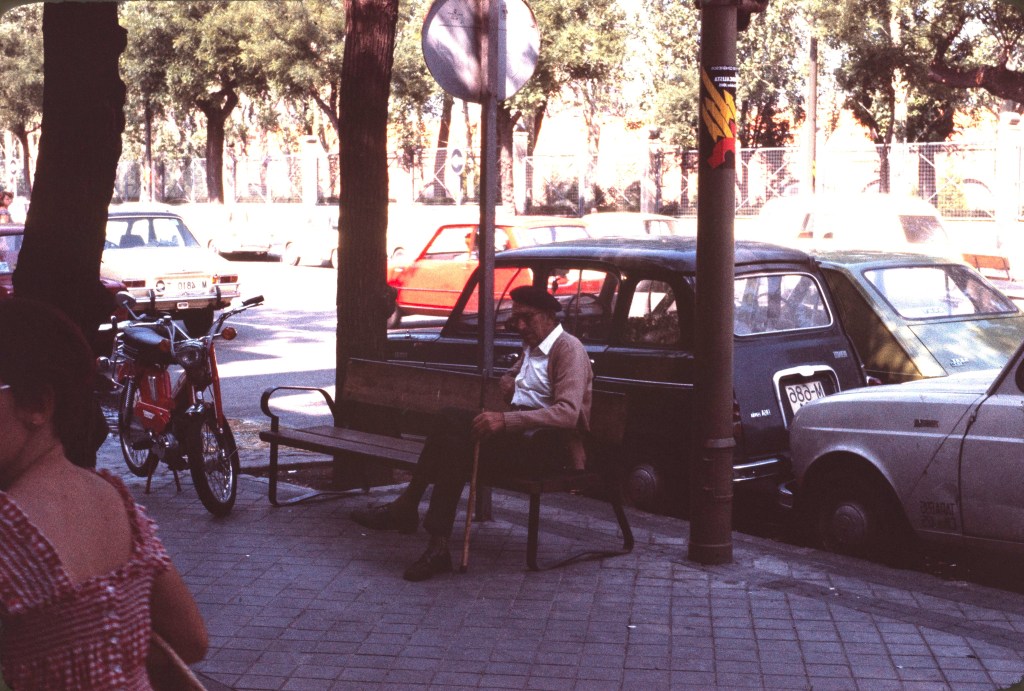
Man on a bench, Madrid, 1976
Mr. Z., who had been my freshman history teacher came on the trip as a chaperone. He was passionate about history, which I had liked about him. But he had a condescending manner that he dressed up as humor, often unsuccessfully, and that I didn’t like. His manner of off-handed superiority almost got him thrown out of a restaurant in Madrid. Tom and Gene, teachers from a neighboring high school, who were seasoned chaperones, often took us to restaurants that catered to locals instead of tourists. The food was usually excellent and the prices reasonable. But this meant staff at the restaurants rarely spoke proficient English. However, between Tom and Gene, we always had someone who could speak Spanish, Italian, German, or French, someone who could help with the pesetas, liras, shillings, or francs.
Firemen in Madrid, 1976
At this particular lunch, after listening to Tom speak Spanish with the waiter, Mr. Z., who probably suffered from a bit of insecurity after being shown up by a multi-lingual, seasoned traveler, declared, “It’s easy to speak Spanish. You just add an o or an a to the English word. So, soup is soupa.” Not quite, but no one corrected him. During the lunch, Mr. Z. needed butter for his rolls, but instead of asking Tom to talk to the waiter, he decided to ask the waiter directly. Applying his theory about the simplicity of the Spanish language to the word butter, he waived the waiter over, looked at him, and uttered a word that came out sounding like the Spanish word burro, meaning donkey. The waiter’s face went red, and his words, rapid and angry, crashed like falling rocks, frightening Mr. Z., who at least had the good sense to stop talking and look nervous.
Tom, fluent in Spanish, straightened out the mess. Understanding the arrogant American hadn’t meant to call him a donkey, soothed the waiter a bit, but Mr. Z.’s insult to the Spanish language still rankled him. To Mr. Z.’s credit for the rest of the trip, he didn’t try to speak Spanish or any other foreign language, but he should have known better. He had been to the same pre-trip meetings the rest of us had been to. We had been told that many Europeans looked down on Americans who expected everyone to speak English, yet couldn’t be bothered to learn another language themselves. Perhaps Mr. Z. wanted to soothe his bruised ego, or maybe he wanted to be funny, but either way he failed.
I write short stories, so I read a lot of short stories. Lots and lots of short stories. Many of which I enjoy immensely. Some stories fade from memory after a few weeks. Others resonate with me for months, while some haunt me for years.
I’ve selected nine stories by five different authors that I read in 2024. I chose these nine out of the dozens I’ve read because as 2025 starts, I still think about these stories. I’ll be doing the dishes, or walking the dog, or standing in line at the grocery store, and one of these stories will pop into my head. These stories have stayed with me, even months after reading them. I’ve listed them in alphabetical order by author. There is no way I can list them in order of preference because each story is both unique and powerful, with beautiful prose, captivating plots, and intriguing characters. Each story is wonderful for its own reasons, making me say, “Gee, I wish I’d written that!” Best of all, these stories give readers plenty to contemplate.
[Click on the authors’ names to learn more about them and their books.]
Two stories from Hunger: A Novella and Storiesby Lan Samantha Chang (25th Anniversary Edition, W. W. Norton & Company, Inc., 2023)
1. “San” is a story about broken dreams and abandonment, and the struggle to survive both. The story is narrated by Caroline, whose parents emigrated from Taiwan before she was born. She tells the story of her father’s inability to claim his piece of the American dream, eventually causing him to desert his family. Caroline recounts the day she watched her father leave, taking her umbrella with him, never to return: “The umbrella had been a present from him. Now I stood and watched it go, bright and ill-fated like so many of his promises.” With stunning metaphors and beautiful prose, Chang creates a shifting setting and vivid characters that tell an ageless story in a new way.
2. “The Unforgetting” is the story of Ming and Sansan Hwang and their young son, Charles, who have emigrated from China and settled in Iowa. They speak Chinese in their home until one day when Charles’s fourth-grade teacher explains that their son’s English vocabulary is below average. The teacher suggests the family speaks only English at home. His parents follow the teacher’s advice, and a rift grows between Charles and his parents. Ming and Sansan never master English, making it difficult for them to express their thoughts and emotions with Charles, who, at the same time, forgets most of his Chinese: “Since they did not test [Charles], Ming never knew how long it took for all of those words to be forgotten.” Language is how people understand their worlds. Chang’s story explores how the stripping of one’s native language is more than a loss of vocabulary.
A story from The Effects of Urban Renewal on Mid-Century America and Other Crime Stories by Jeff Esterholm (Cornerstone Press, 2023)
1. “Long Ago on a Sunday in June” is the story of Patrick, who is almost fifteen. He wakes in the early morning hours on a Sunday to deliver newspapers. In the first paragraph, we learn Patrick won’t be coming home afterward because his body has been found in a field. The rest of the story is told as a flashback. We follow Patrick as he eats his breakfast and begins his paper route. We learn about Patrick and his dreams: “He wanted to get into Mr. Bukoski’s art class when he entered Port Nicollet High in September. That was a given.” He has a crush on his friend’s sister, and he wants a job at a pizza joint. We follow Patrick on the last day of his very ordinary life, and because we know how the story ends, and because Esterholm’s prose is both richly layered and nuanced, we are devastated for the life Patrick will never live.
Two stories from Close Call by Kim Suhr(Cornerstone Press, 2024)
1. “Play-School” is the story of four elementary-aged children who play a game of school. Young Mary plays the teacher, delivering lessons in addition and subtraction. During one of her lessons, she interrupts herself, lowers her voice, and pretends to be the principal as she announces, “It is time to begin our lockdown drill.” Told through the eyes of Willie, a first grader, “Play-School” explores the topic of school shootings and lockdown drills from the point of view of the children. (There are no adults in this story.) Suhr’s use of a child’s point of view, along with her realistic portrayal of elementary-aged children, creates a wallop in a short space. “Play-School” deservedly won first place in the 2024 Jade Ring Contest sponsored by Wisconsin Writers Association.
2. “Eradicated” is a dystopian tale set in the future where artistic creativity, now labeled a disease, needs to be eradicated, a goal that is nearly complete when we meet Dr. Bells, a scientist. Wishing to observe creative artists before the last of them dies out, the doctor visits an artists’ colony where creative people, who are considered to have disturbed minds, have been contained after being extracted from society. He wants “to hang out with people and ask, ‘What’s your medium?’ And say things like, ‘That’s so derivative.'” The themes in “Eradicated” are both timely and timeless. Marvelously written and exquisitely paced, Suhr’s story serves as a cautionary tale against intolerance and mindless conformity.
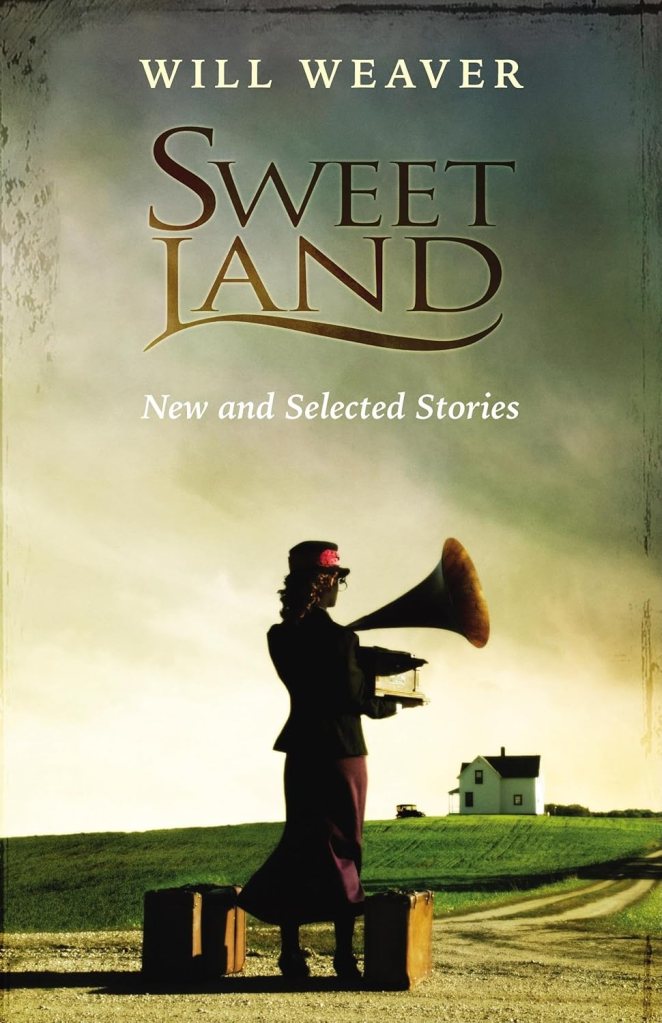
Two stories from Sweetland: New and Selected Stories by Will Weaver (Borealis Books, 2006)
1.“Flax Seed” is the story of a grandfather named Helmer who turns his farm over to his grandson, Kenny. With a handshake, Helmer states the terms of their deal: “Two-thirds, one-third. And no Sunday farming.” Kenny promises. He decides to plant flax, something his grandfather never grew. Farming is difficult. There is a time to sow, and a time to harvest. There is too much rain or too little. Too much heat or not enough. There are pests and diseases, rising and falling prices. There is often a race against time. For Helmer there is God. For Kenny there is the hope of flax and making good as a farmer. Helmer and his God; Kenny and his flax. And a difficult year. It’s a haunting story. Amen.
2. “A Gravestone of Wheat” is the story of Olaf who has loved Inge for forty-five years. They have farmed the land together and raised their son, Einar. They have welcomed grandchildren and great-grandchildren. When Inge dies, Olaf plans to bury her on their farm as Inge wished. But the law has changed: “‘You can’t bury your wife here on the farm,’ the sheriff said. ‘That’s the law.'” Olaf must decide if he will break the law and bury Inge on the farm or if he will bury her in town in the Greenacre Cemetery, knowing she despised the town. Inge has been his devoted wife for forty-five years. As Olaf ponders his choices, he recalls his first meeting with Inge and their unusual courtship, and readers are treated to a beautiful, but pragmatic love story. It’s a wonderful piece of historical fiction.
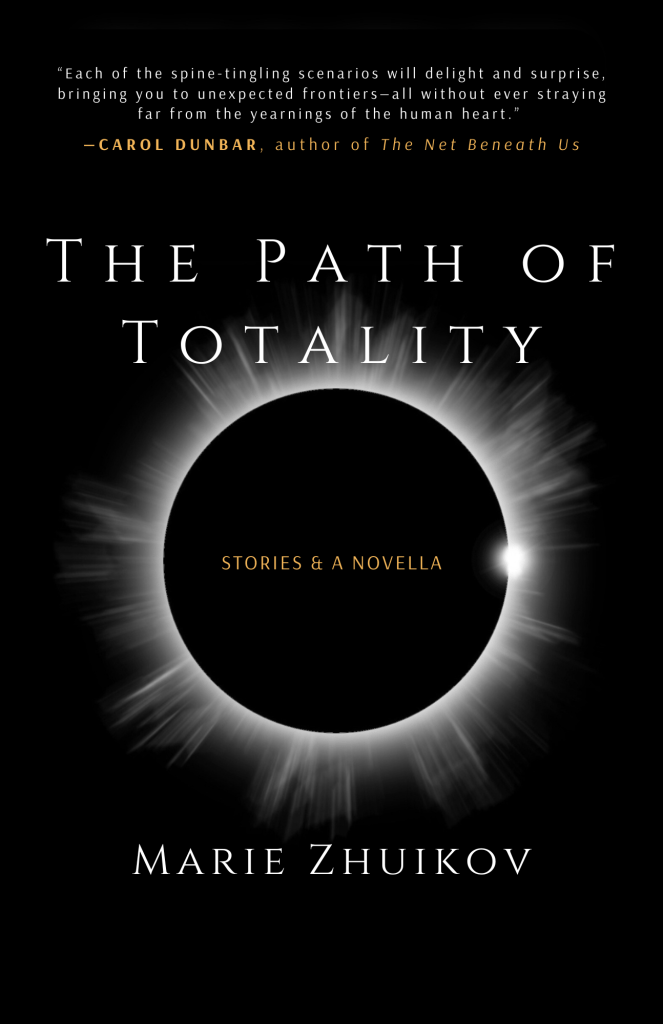
Two stories from The Path of Totality by Marie Zhuikov (Cornerstone Press, to be released February 2025) To pre-order Zhuikov’s book, click here.
1. “The Path of Totality” is the story of Marjorie and Justin, a young married couple, who travel from Medford, Oregon, to Salem, Oregon, to see the total eclipse of the sun. Caught up in a grief that both unites and divides them, the couple each experience the eclipse differently. Marjorie, along with other spectators, sees it all, astounded as the moon covers the sun. “But to Justin, the sun still shone as whole and bright as ever.” With eloquent prose, rich imagery, and well-crafted dialogue, Zhuikov’s story, told from the young husband’s perspective, is spellbinding. From a craft perspective, Zhuikov’s story reminds us that nature and natural events in our world can be powerful metaphors for human experiences.
2. “Bog Boy: A Northern Minnesota Romance” is set in rural Minnesota, where sixteen-year-old Natalie works at the Sax-Zim Bog, a nature preserve. On a spring day, while leading a birding tour, Natalie discovers a mummified teenage boy in the bog, whose remains are determined to be two thousand years old. The well-preserved teenager, with high cheekbones and beautiful hair, is handsome, and Natalie falls in love with him as only a teenage girl can – completely, blindly, devotedly. Because she cannot be without him, she brings the bog boy home to live with her and her father. Darkly humorous, “Bog Boy” combines the realm of speculative fiction with thought-provoking satire that made me laugh out loud at times. I still smile when I think about the story.
Yesterday morning I asked my dog, Ziva, if she wanted to go for a car ride. Of course, she said yes. She’ll go anywhere in the car, around the block or on a ten-hour trip to Petoskey, Michigan. She is just happy to be included.
We had three errands to run: go to the post office, go to the bank, and pick up my grand-dog Nellie. Before we could do any of those things, Ziva and I had a mishap. In a residential neighborhood, a speeding truck pulled out in front of us. Not only was the driver speeding, but he couldn’t see us as he approached the street that I was driving on because several thick evergreen trees grew on the corner of the lot. When he did see us, he drove even faster to avoid us, which was the better choice because he could not have stopped in time.
I was already going slow, but I had to use a heavy foot on the brakes, causing Ziva to slide from the front seat onto the floor. After I stopped, I honked my horn loud and long. The man stomped on his gas pedal, zooming away like an Indy race car driver after the green flag waves. If he thought he was fleeing from an angry woman, he was right. Had I been alone in the car, I would not have honked at him, as my honking would have come too late to serve as a warning. But my dog was tangled up on the floor, struggling to regain her footing. I used my horn to scream at him.
Ziva gingerly worked to untangle her feet. She slowly climbed back up on the front seat. Nothing appeared to be broken. For a moment I wondered if she would ever want to get in a car with me again.
Fritz, the dog who never forgot, Christmas 1962
When I was almost one, my mother had a car accident. Our two-year-old German Shepherd, Fritz, and I were in the car. After the accident the car was not drivable, but other than my mother having some cracked ribs, everyone was fine, including Fritz, who had been sleeping when the accident occurred. He never forgot that accident or that he had been sleeping instead of on guard. Afterward, if my mother was driving, no matter how long or short the journey, Fritz would sit on the seat and watch the road. His head might bob and his eyelids might droop, but he would jerk himself back to consciousness if he momentarily drifted off. If my father drove, Fritz would curl up and go to sleep. Fritz lived to be fifteen years old, and he never again slept in the car when my mother drove.
Nellie and I settled on the couch for some reading time. December 16, 2024
Ziva and I finished our errands then picked up Nellie. I was glad my grand-dog hadn’t been in the car when I had to slam on my brakes. She has an excellent memory, and in the future she might have become reluctant to get in my car.
As for Ziva, she was more than happy to get back in the car when we took Nellie home. And later on when I went to the grocery store, she was excited to ride along. She blamed neither me nor our car for her mishap, and she had been oblivious about the stupid, lead-footed pickup driver.
But after Ziva got up this morning, her head was crooked and she couldn’t seem to hold it straight, and when she walked, her gait was awkward. So, I decided to stay home with her. She ate a good breakfast, and after she moved around a bit, her stiffness disappeared and her head righted itself. People are always stiff and sore the day after an accident, so it would make sense animals would be the same.
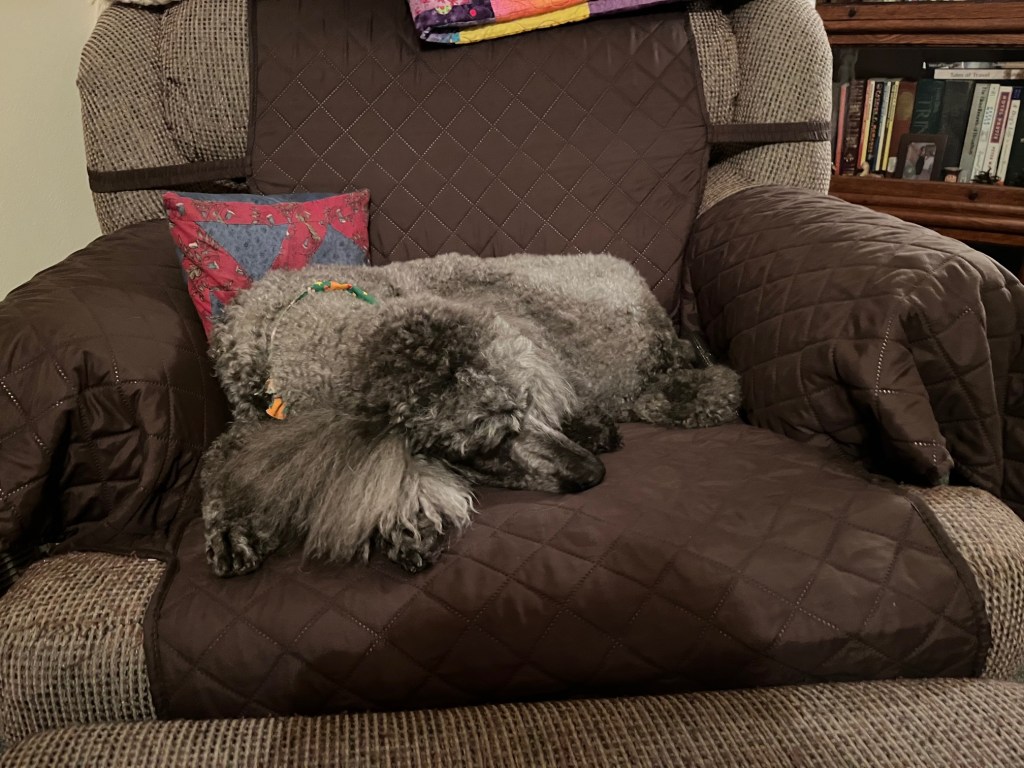
Ziva is taking her morning nap as I write this. She’s happy to have me at home, and I’m happy to be with her. She is almost fourteen years old, and this morning, for a brief moment, I worried something might be wrong with her that couldn’t be fixed. After all, falling hurts more when we get older. We don’t bounce as well.
Ziva enjoying a good snooze after breakfast, resting up for our walk. December 17, 2024
A Place for Fido, Fitgers, Duluth, Minnesota. The stuffed toy display is straight ahead on the left.
Yesterday I went to a boutique pet store to buy my grand-dog Nellie a stuffed toy for Christmas. Next to the toy display stood a black, brown, and white, medium-sized dog. The dog looked at me and wagged its tail. Its big brown eyes were merry and its toothy smile was bright, so I asked its people, “May I pet your dog?”
“Of course,” said the woman, “she loves that.”
After petting the dog, I turned to the toys. I wanted one that didn’t squeal, squeak, groan, moan, or crackle because when my grand-dog sinks her teeth into one that makes noise, she is relentless.
The tri-colored dog turned with me. She watched me select toy after toy and squeeze it. The dog and I began a conversation.
“This one’s too high pitched,” I said to her.
“It sounds good to me. I like that toy,” the dog’s eager face said.
“This one makes a low noise,” I said. “It might work.” I kept it in my hand instead of hanging it back up.
Yeah, don’t even think about it — my grand-dog is cuter than your grand-dog.
“It sounds good to me. I like that toy, too.” The dog’s eager face filled with anticipation. She wanted a toy, but she was too well-mannered to do more than drop a hint. (My grand-dog is a Vizsla and she would have reached up and grabbed the toy. She’s not rude, mind you. She’s very, very sweet, but she’s a Vizsla. They’re impulsive. They’re enthusiastic. They’re larger than life.)
I tested toy after toy, telling the dog that each one was too loud, and each time the dog looked at me and the toy in my hand and answered, “It sounds good to me. I like that toy.”
I looked at the dog’s kind face. “My grand-dog will drive me crazy with these toys,” I told her. I decided even the toy that made a low noise was too noisy, so I hung it back up. I walked around the back of the display to see if there were more toys.
At this point I realized I’d been talking with the dog for several minutes while her owners looked at products on a display rack opposite the stuffed dog toys. Other than asking for permission to pet their dog and telling them I had a dog at home, I’d ignored them. It occurred to me this might be considered rude. It occurred to me that carrying on a conversation about noisy dog toys with a dog I’d just met might be considered strange. But in my defense, the dog was a good conversationalist.
I turned to look at the dog’s mother. “I guess you might think I’m a bit strange, standing here in a store having a conversation with your dog.”
“Not at all.” The woman smiled warmly. “I talk to her all the time. I would think it strange if you didn’t want to talk to her.”
Nice of her to say. I talk to my dog all the time too.
The owners and their dog moved on. And I wondered if they had stayed longer than they had wanted, thinking it rude to interrupt their dog’s conversation with a lady who was trying to find the right toy for her grand-dog.
I did find the right toy for Nellie. A nice clerk helped me find the only toy in the store without a squeaker. It looks like a cross between a squirrel and a beaver. Maybe it’s a woodchuck. Doesn’t matter. It’s nice looking, well-made, and quiet.
Ziva, September 2024. She’s loving the pâté.
I didn’t forget about my dog, Ziva. She’s not interested in toys, so I bought her two fancy-schmancy cans of dog food: Venison and Lentil Pâté and Lamb Recipe in Bone Broth. Both sound as though they should have come with a footman from Downton Abbey to dish up her food.
A heart without a pet is just an empty cockle shell.
When I returned home from A Midsummer Night’s Dream, a mystical moonscape greeted me.
Last night I went to see a high school production of A Midsummer Night’s Dream. Student actors dressed in colorful, eclectic, whimsical costumes, creating shimmering visions on the stage. They recited Shakespeare’s verse, never stumbling over their words. As the love potion delivered by Puck caused chaos and confusion, the energetic actors made their way on and off the stage, delivering humorous lines, catching the audience up in laughter. All of this on a stage decorated with cut-out trees so enchanting in their color changes, they almost stole the show.
During the quieter moments of the performance. I thought about the many high school and college plays I have seen over the years. All of those young people working together to create a moment of magic on a stage. A moment that would never be the same as the performance that came before, or the one that would come next. I thought about the long hours drama students spend rehearsing, creating sets, lighting the performance, making costumes. How they pass their time together, forging friendships and romances, talking about life and their dreams. Cracking inside jokes that only they understand, the bond of a shared experience. I thought about how young they are, with their whole lives ahead of them. I thought about how once these young thespians leave high school or college, they might never act upon a stage again.
Then I thought about Tom Lake by Ann Patchett, which I recently read and loved. Tom Lake is a story within a story. Lara Nelson, now in her fifties, owns a cherry orchard with her husband. Set in 2020 during the COVID lockdown, Lara’s three adult daughters are staying at the farm with their parents. Because of the pandemic, the family of five works the cherry farm without the usual hired help. Picking cherries is time-consuming, monotonous work. To pass the time, Lara, in a series of flashbacks, recounts the story of her summer in Tom Lake, where as a young woman she performed in a summer stock production of Our Town by Thornton Wilder. Even though Patchett’s novel is set during COVID, it’s not about the pandemic–at all. It’s a beautifully written, heart-wrenching coming of age story.
Last night as I watched the young actors perform, I wondered about their coming-of-age stories. I thought about my own coming-of-age stories.
And that is what good literature does. It slumbers in a corner of your brain, until something in your present world nudges it, and it lives once again in your imagination, giving meaning to both the world that is your life and the world of make believe.
Nellie “Bly” ponders an important question regarding investigative journalism: “Isn’t it time for lunch?”
On October 10, my grand-dog Nellie, whom I like to refer to as Nellie “Bly,” went on assignment with me. I was working on an article for Northern Wilds magazine. Our mission was to interview one bookstore owner in Two Harbors, Minnesota, and one bookstore manager in Grand Marais, Minnesota, and to take photos. Nellie Bly was game. (Although, if she had been given a choice, she would have rather chased small game instead of facts.)
Going on a reporting job with a dog is fun, but it requires more time. We were gone for over six hours. In addition to doing interviews and snapping photos, our assignment included four walks, a lunch break, and a supper break.
Nellie waited in the van while I did the hard-boiled investigative work inside the bookstores, asking the managers about the history of each bookstore and which books they anticipated would be hot for the holidays. Good investigative journalism means I had to ask the tough questions too, such as “What is your favorite holiday book? and “Do you have any holiday traditions involving books?” Of course, in the name of gathering evidence, I bought some books at each store.
Nellie got paid in food and treats. However, when I ate my Happy Meal for lunch, she made it clear that she wanted to exchange her bowl of dried kibble for my cheeseburger. And when I had my six-inch sub for supper, she again made it clear she wanted to swap her bowl of kibble for my sandwich. There were no trades. I told her life in the field as a reporter is filled with sacrifices.
Perhaps, if this article goes over well, it will lead to a TV series, where I travel the country, reporting on independent bookstores, asking probing questions about each bookstore’s origins and what’s selling well, all while spending my writing paycheck on books. Maybe Nellie Bly would like to be my assistant. We could travel in a RV with a driver so I could read and she could look out the window. I can hear Nellie now — trying to negotiate a better meal deal and asking for top billing in the credits. With her good looks, she would be the star of the show in no time anyway.
[To read my article click here: Northern Wilds, pages 14-15.]