Kekekabic by Eric Chandler

Reviewed by Victoria Lynn Smith (This review was originally posted on Nov. 27, 2022.)

[To pre-order Chandler’s book click here: Finishing Line Press.]
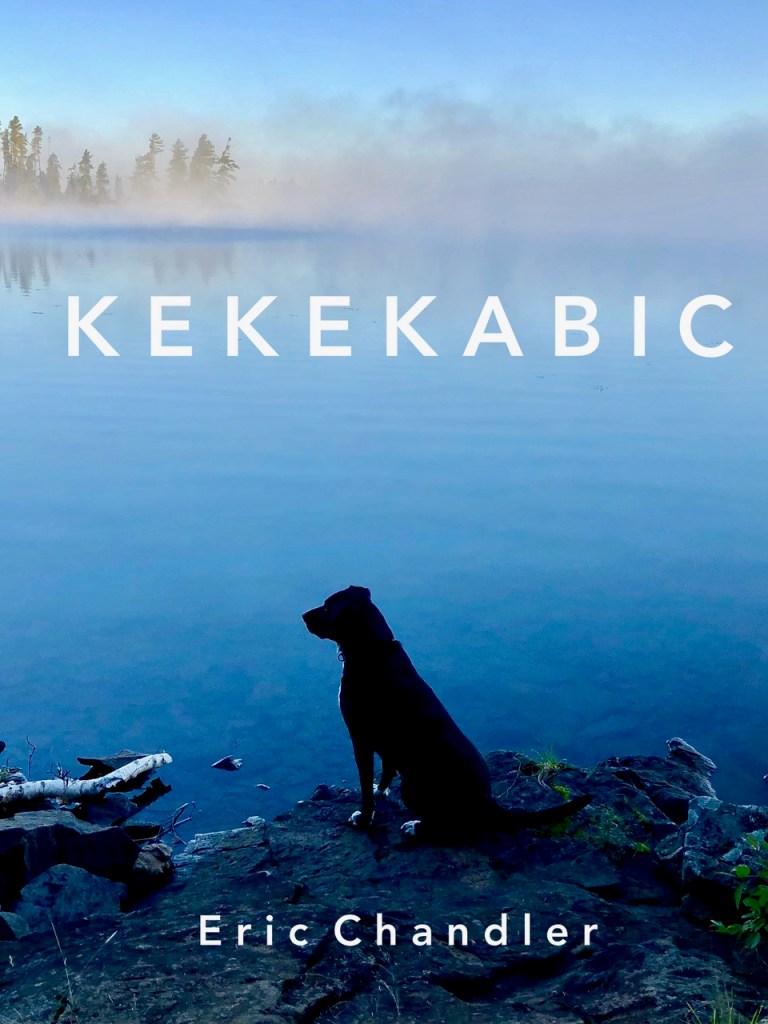
Leo at Parent Lake in the BWCA

Kekekabic, Eric Chandler’s second book of poetry, will be released May 20, 2022. Prepublication sales for the book will run from January 18, 2022, through March 25, 2022. Chandler is the author of Hugging This Rock: Poems of Earth & Sky, Love & War (2017). He has won the Col. Darron L. Wright Award for poetry three times. His writing has been published in numerous journals and magazines.

Kekekabic combines prose and haiku in a poetry form called haibun. In 2018, Chandler wrote a poem after each of his workouts. His goal was “to pay attention to the world” during his workouts in the wilderness, in Duluth, and on the road as an airline pilot. In his introduction he states, “It’s a loss if skiing through the woods is just a workout. All these miles moving over the earth under my own power have meaning.” Chandler’s poems invite us to move over the world with him and share the meaning he finds as he runs, hikes, and cross-country skis.

On the cover of Kekekabic, Chandler’s dog, Leo, sits on the shore of Parent Lake in the serenity of the Boundary Waters Canoe Area (BWCA). Leo invites us to open the cover, read the poems, and reflect along with his hiking companion about being outside in nature. Chandler shares his wisdom about the outdoors in a haiku:

I think more people

should go outside. I think they’d

be much happier.

This resonates with me because on a bad day if I go outside, my spirits lift. Reading Chandler’s poems lifts my spirits too. Nature is an important theme in Kekekabic, and Chandler poems nudge us to go outside.

Chandler’s imagery appeals to the senses. About one of his runs, he writes, “The wind stacked the pack ice up at the fond du lac. The yellow sun sends a yellow stripe across the open water and it hits the shelf of ice and disperses. Brilliant sparkles randomly dot the expanse as the shards reflect the sun.” After a day on the Kekekabic trail, he writes, “Tail-slapping beavers sounded like full-grown men jumping into the lake.” Chandler’s poetic imagery will linger in our minds long after we close his book.

Leo joined Chandler on the five-day hike in the BWCA along the Kekekabic Trail. Chandler wrote a haibun for each day of the hike. The haiku he wrote on the fifth day—

The sound of peace is

my dog snoring on a rock

on a wild lakeshore

—mixes the wonder of nature and the joy of sharing it with family, which includes his dog. He writes of his daughter’s first time on cross-country skis: “I felt like my heart would explode due to an overload of blue kick wax joy, gliding through the trees in silence.” In another haibun Chandler recounts a run along Lake Superior with his son. They find a teddy bear on the path, and his son turns around and races back to where they had just run from to return the teddy bear to a child. Chandler’s poems remind us that small, quiet moments spent in nature with family are special.

Chandler studied the Japanese poet, Bashō, to learn about haibun. He quotes Bashō: “People often say that the greatest pleasures of traveling are finding a sage hidden behind the weeds or treasures hidden in trash, gold among discarded pottery.” In haibun that reflect Chandler’s workouts in large cities, he has taken Bashō’s words to heart—finding the sage, the treasures, and the gold among the grittiness and complexities of urban settings.

Some of Chandler’s haibun explore the theme of urban settings and nature colliding. In Fort Lauderdale as he runs, he notes “That crisp thread between the light blue of the sky and the dark blue of the water” in the distance. But as he observes the sky and water, he runs “Past the cigarette smokers. Past the marijuana smokers. Past the guy lifting dumbbells while he stands at the seawall, looking at the ocean while his car speakers thump.” He continues running down to the water where he concludes, “I got a moment’s peace and then found my way back to my room through the noise.”

Chandler’s poems written after running in cities, combine the beauty of nature and cityscapes with a harsher reality of urban landscapes, a comparison that invites us to think about people and nature as “reaching toward” one another. He writes, “Downwind now, I was struck that the world of man and the world of nature kind of reach toward one another at the border. The palm trees grow out of the sidewalk and the beach chairs cover the sand.”

In his haibun poems, Chandler encourages us to move through life with meditation and awareness. He encourages us to take journeys with family, friends, and our dogs, but also to take some journeys by ourselves. His poems inspire us to go outside and move through our world.

[For more information about Eric Chandler and his writing, click HERE to view his website, SHMOTOWN. Kekekabic will be available for prepublication sales at Finishing Line Press starting January 18, 2022, through March 25, 2022.]

Requiem for a Paperback

The book is dead, nestled among dried leaves and small pine cones, partially covered by the branches of a pine tree nearly sweeping the ground. Sun-bleached pages catch the light and bounce it like a beacon.

Broken open along the spine, its pages swollen by last week’s rain and snow are baked dry. Two pages fused together, blown vertical and dried by the wind, stand perpendicular to the ground, a gravestone for the book.

I walk past, but stop. I turn, and look. I debate.

The front of the book is mangled, its cover rolled under itself. A splotch of sky-blue color entices me to retrace my steps. I want to know its name, but I don’t want to touch the book. It’s a corpse.

I’m walking my dogs, so I juggle leashes and mittens, remove my phone from my pocket, and snap several pictures, like I do in cemeteries to record family grave markers.

Who did the book belong to? How did it end up on the ground? Did someone finish it before it was lost?

I crouch down next to the book, thankful it’s not mine.

Centered on the top of the left page, I read, Ken Follett.

I’ve read some of his books: Triple, Hornet Flight, Night Over Water, and Eye of the Needle—one of my favorite books. The snippet of sky blue on the cover tells me it’s not The Eye of the Needle. The blue is too cheerful, matching none of the cover art I’ve ever seen for that book.

My dogs stand at the end of their leashes while I stare at the book. Still crouching, I contemplate turning the book to read its title.

I let it go.

I stand, leaving it in peace, its fused pages standing perpendicular to the ground, a gravestone for the book.

Cold-Weather Book Buying during a Pandemic

Superior, WI, Monday, February 8, 2021, 7:00 p.m., -5˚F, Windchill -15˚

Cabela, 77 in human years, nestles on the right side of the couch. Ziva, 66 in human years, nestles on the left side. I’m 61, yep, in human years, and sitting at my desk, joining a virtual author chat hosted by Honest Dog Books in Bayfield, Wisconsin, an hour-and-a-half away.

Ziva (in front) and Cabela on a warm summer day in 2020.

It’s excessively cold outside, which explains why the dogs and I aren’t going for a walk. At our combined age of 204 years, our enthusiasm for walking at night in subzero temperatures has ebbed, so this evening we’re opting for warm intellectual stimulation.

We’re going to listen to two authors talk about their books set in immensely cold parts of the world, places that make the western tip of Lake Superior feel like a tropical vacation destination, even in winter. Miniature snowballs of marshmallows bob in a cup of hot cocoa warming my hands. On the couch the dogs remain curled up in heat-conserving positions. While other attendees join the author chat, I leave my seat to slip on a pair of thick wool socks over my flimsy book-themed socks.

Andrea Pitzer (Icebound: Shipwrecked at the Edge of the World) lives in Washington, D.C., and Blair Braverman (Welcome to the Goddamn Ice Cube) lives in northeastern Wisconsin. Around another 140 people join the event. Miles and even time zones apart, we’re all together this evening listening to Pitzer talk about her narrative nonfiction book and Braverman talk about her memoir. Because both authors and the audience are having a good time, the authors, along with most of the audience, stay another fifteen minutes or so before calling it a night.

Superior, WI, Tuesday, February 9, 2021, 1:00 p.m., 3˚, Windchill -14˚

The polar vortex, having parked its big-mass front over much of the country, intends to overstay its welcome for at least another eight or nine days. In search of relief, I make plans to call Honest Dog Books and order both deep-freeze books from last night’s talk. (Books always make me feel better.) During this arctic cold front, I could read books set in warm locations, but I decide it takes daring to read books set in the Arctic where winter submerges itself in darkness. I’ll also need more hot cocoa, another pair of wool socks, and a flannel-backed quilt.

I could order the books via Honest Dog’s website, but I miss going into bookstores. I bypass technology, which allowed last night’s virtual gathering, considered futuristic when I was in high school, and call the bookstore.

“Is it okay if I order books by phone instead of using your website?” I ask.

“Oh yes, certainly,” the clerk answers.

I miss perusing locally-owned bookstores, places where the books I pile on the counter to buy become catalysts for conversation, places where clerks are as thrilled to talk about books as I am.

I order Icebound. And we discuss Pitzer’s research methods.

I order Ice Cube. It’s one of the clerk’s favorites.

I order The Graveyard Book by Neil Gaiman. He wasn’t at last night’s author chat, but I’ve heard him talk about his book (another online experience). I don’t usually read young-adult novels, and I don’t read fantasy novels. But my pandemic-mode response to life has been to be more adventurous.

I order first one, then two, then three Valentine-themed packages of chocolates. The clerk and I chuckle each time I increase my chocolate order. (Chocolate also makes me feel better.)

The clerk and I talk for seventeen minutes. More than half our conversation is about books. After I hang up, I feel like I’ve had a near-small-bookstore experience. I smile.

Superior, WI, Thursday, February 11, 2021, 3:30 p.m., -1˚, Windchill -13˚

At three o’clock the mail arrives, and my nine-year-old granddaughter retrieves it.

“Nana,” she says, dashing up the stairs, “you got a package.”

My four grandkids, ages two-and-a-half to nine, know boxes arriving in the mail have potential.

As soon as I say, my books, the older grandkids lose interest.

I lift the books from the box and lay them on the kitchen table. The two-and-a-half-year-old, with the speed and dexterity of the Artful Dodger, seizes one and runs into the living room.

“This my book, Nana, this my book,” he says, with the cadence of a parrot.

“That’s Nana’s book,” I say.

“No, Nana, this my book. This my book, Nana.” He sits on the couch and looks at the cover.

He’s grabbed Welcome to the Goddamn Ice Cube. I’m certainly not telling him the name of the book. In my mind I can hear his parrot-like repetition of the title. I can hear his parents ask me, What did you say to Charlie?

“That book doesn’t have pictures,” I say.

The mention of pictures redirects his attention, and he exchanges my book for a children’s book on the coffee table.

I retrieve my book and place it on my bookshelf. By six o’clock the grandkids will be gone. By seven o’clock, I’m planning on hot cocoa, a quilt, one of those deep-freeze books, and at least one piece of the Valentine-themed chocolates from my hidden stash.

[Check out Honest Dog’s upcoming author chats at http://honestdogbooks.com/events/]