If you buy thebook, make sure you get the one with the green cover, the photo edition. Released in 2022, it’s the newest edition.
Why did I buy this book?
This book was recommended by Gwen, the manager of Drury Lane Books in Grand Marais, Minnesota, one of my favorite bookstores. (Although, I have to say any independent bookstore I go into becomes one of my favorites! And, once I’m inside a bookstore, I don’t like to leave.)
What is this book about?
Backyard Almanac: 365 Days of Northern Nature covers plants, insects, and animals that can be found in northern Minnesota and northern Wisconsin. One day and one page at a time, readers can learn about birds, butterflies, mosses, mushrooms, berries, wild flowers, amphibians, and trees, among other amazing plants and creatures.
What do I love about this book?
I started reading this book on October 10 because that is when I bought it. I read one page a day, so today I will read the entry for November 6, titled “Jiggly Jelly Fungi of Fall.” I love that I can read about nature one page a day, and it only takes a few minutes. It satisfies my urge to learn about the natural world around me, and it leaves me with time to read other books.
Each page is beautifully laid out. Larry Weber writes clear, concise descriptions with interesting details about each plant, insect, or animal. Photographer Sparky Stensaas provides beautiful photographs and informative captions. And illustrator Judy Gibbs’s enchanting sketches grace every page. It’s fascinating how much life can be found on the forest floor, in low-growing vegetation, and in trees if a person knows where to look.
At the end of each month’s section, is a blank page where a person can record notes about nature. An index at the back of the book makes it easy to look up entries. Because of the book’s thick, glossy, high-quality paper, the photographs are sharp with great color reproduction. Also, the book is heavy — good for doing some arm-toning reps, which I actually do if no one is watching.
What makes this book important?
The more people understand about nature and its interconnectedness, the more they will respect and treasure all of its plants, insects, and animals.
Look carefully. Grandchild #3 is nestled between the fish.
My grandkids didn’t have school today, and they don’t have school tomorrow, so they came to my house. I was hoping for nice weather because I planned to take them on a hike to Lost Falls in Cornucopia, Wisconsin, today, and to Cascade Falls near Grand Marais, Minnesota, tomorrow. But rain, cold, and winds up to 30 mph said differently.
Instead we went to the mall. Our first stop was the bookstore, where I bought each grandkid two books for Halloween. Then we hiked to the indoor playground. While they played, I took out my book — A Samuel Pepys Mystery: The Brampton Witch Murders by Ellis Blackwood — and I began to read.
About fifteen minutes later, my first grandchild came for her book — Dipper’s & Mabel’s Guide to Mystery and Nonstop Fun! — and she began to read.
A few minutes after that, my third grandchild came for his book — The Wild Robot by Peter Brown — and he began to read.
Not to be left out, my second grandchild came for his book — Demon Slayer Kimetsu No Yaiba #1 by Koyoharu Gotouge — and he began to read.
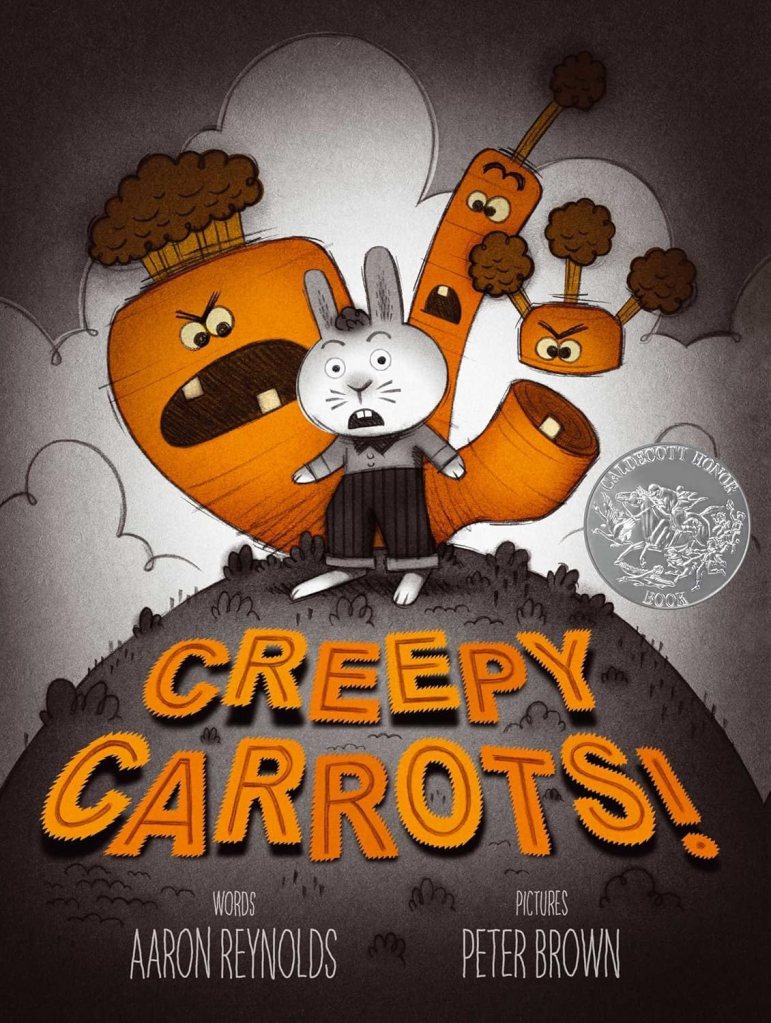
My fourth grandchild ignored the trend and kept playing on an interactive screen. He enjoys its puzzles, games, and coloring app. He read his book — Creepy Carrots! by Aaron Reynolds — on the way home.
I didn’t give my grandkids candy for Halloween. They’ll get a stash of it tonight when they trick or treat in the rain and cold and wind. I gave them candy for the imagination.
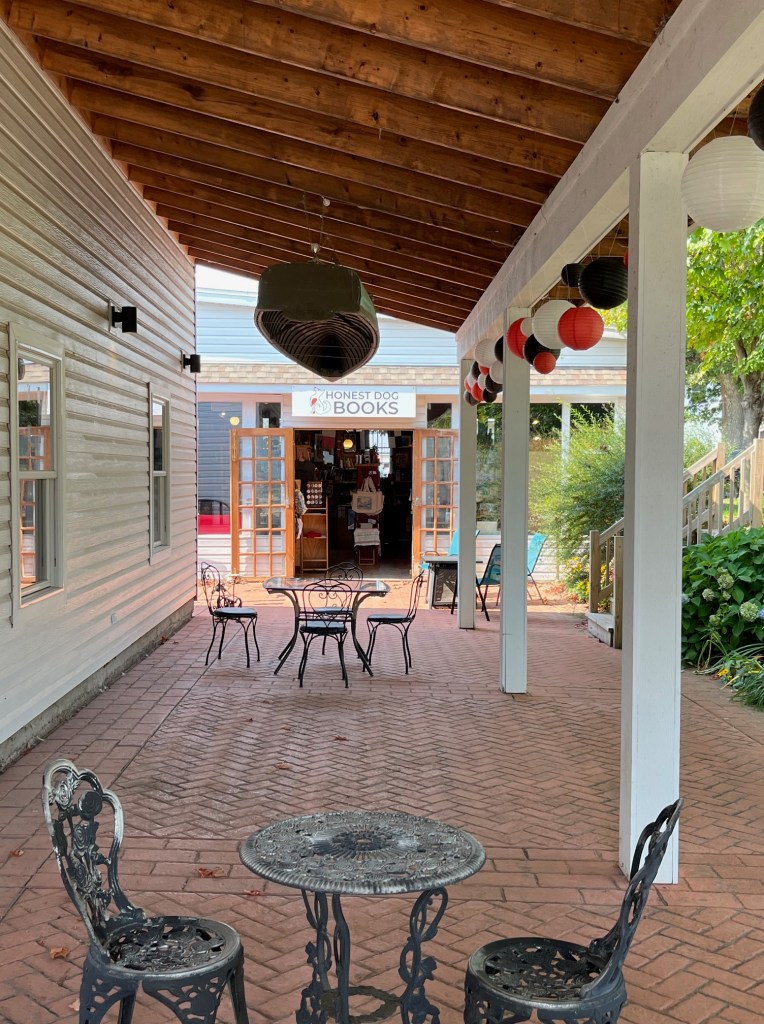
The welcoming red door to Honest Dog Books. It’s a humble entry into an amazing interior.
Bayfield, Wisconsin, has two wonderful bookstores: Honest Dog Books and Apostle Island Booksellers.Last week I wrote about Apostle Island Booksellers. Today, I will write about Honest Dog Books.
Inside Honest Dog — there are more books to the left and the right!
Yes, your dog is welcome in the store. And yes, treats will be provided for your dog while you shop for books. Also, you might meet the shop dogs, Elton and Matt — unless they’re at the beach or in the woods. (If I ever come back as a dog, I want my human to be a bookstore owner!)
Honest Dog’s courtyard
When you walk into Honest Dog Books, it’s like entering a cozy rustic lodge. Warm wood tones gather you into a big bear hug.
The store is stocked with loads of wonderful books. You will find classics and new releases; local authors from Wisconsin, Michigan, and Minnesota; books on the great outdoors; and books for people of all ages. And yes, books about dogs, fiction and nonfiction.
You can walk in the front door of Honest Dog, buy a book, and walk out the back door into a beautiful courtyard, a wonderful place to sit and read the first chapter of your new book or talk about books with a friend.
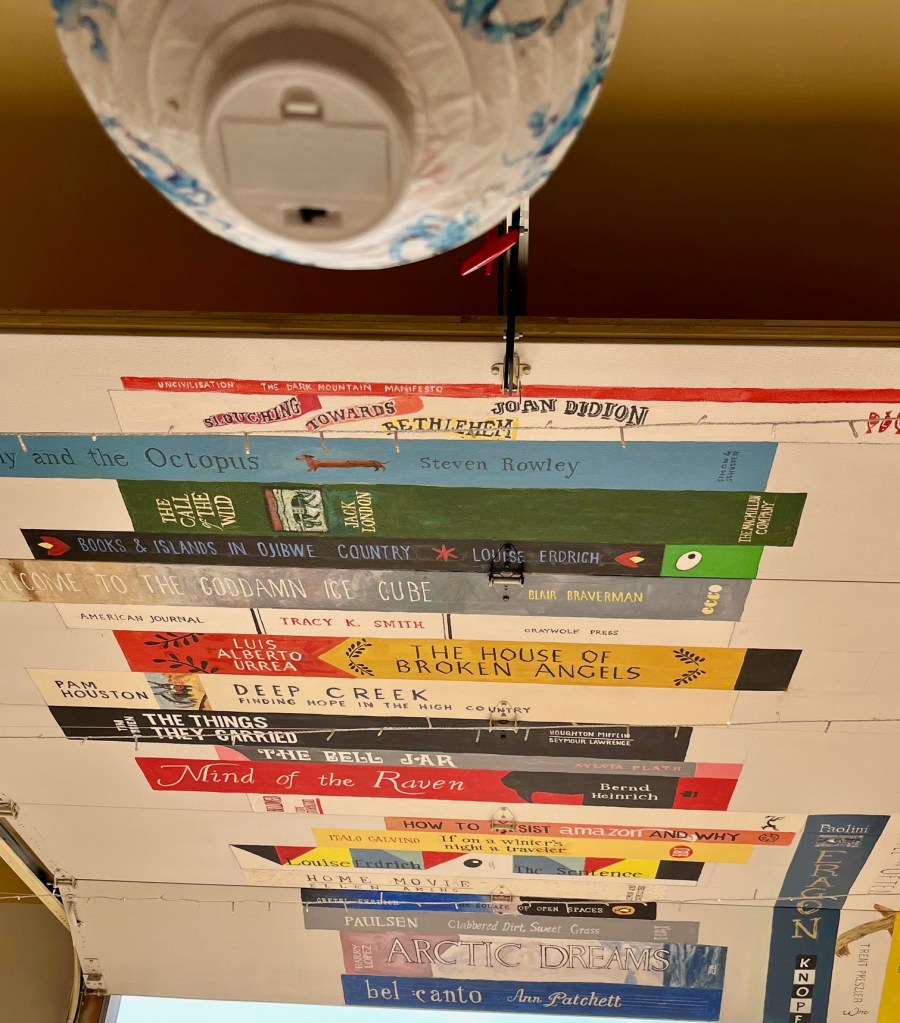
If you walk through the courtyard, you will enter a separate space called the Dog House where you can buy rare used books and vinyl records displayed in a small charming building with painted murals of book spines. The book-painted stairs lead back to the courtyard. The books painted on the inside of the garage door decorate the ceiling when the door is open on a nice day. On a cold or rainy day, the painted books become part of the wall.
What’s on your to-be-purchased list?
So, what did I buy at Honest Dog Books? The Curious Incident of the Dog in the Night-Time by Mark Haddon. The book has been on my to-be-purchased list for a long time, and it seemed right to buy it at Honest Dog Books.
During COVID, Honest Dog Books hosted author talks via Zoom. At a time when in-person social events were severely limited and businesses were closed, Honest Dog’s Zoom events gave readers and writers a chance to talk to authors. It also gave authors a way to launch their books during the lockdown. I will forever be grateful for the evenings spent meeting writers and listening to them talk about their books. It helped ease the isolation of COVID.
Below are the books that I bought — and loved — from Honest Dog during COVID after meeting the authors on Zoom. They are listed in no particular order.
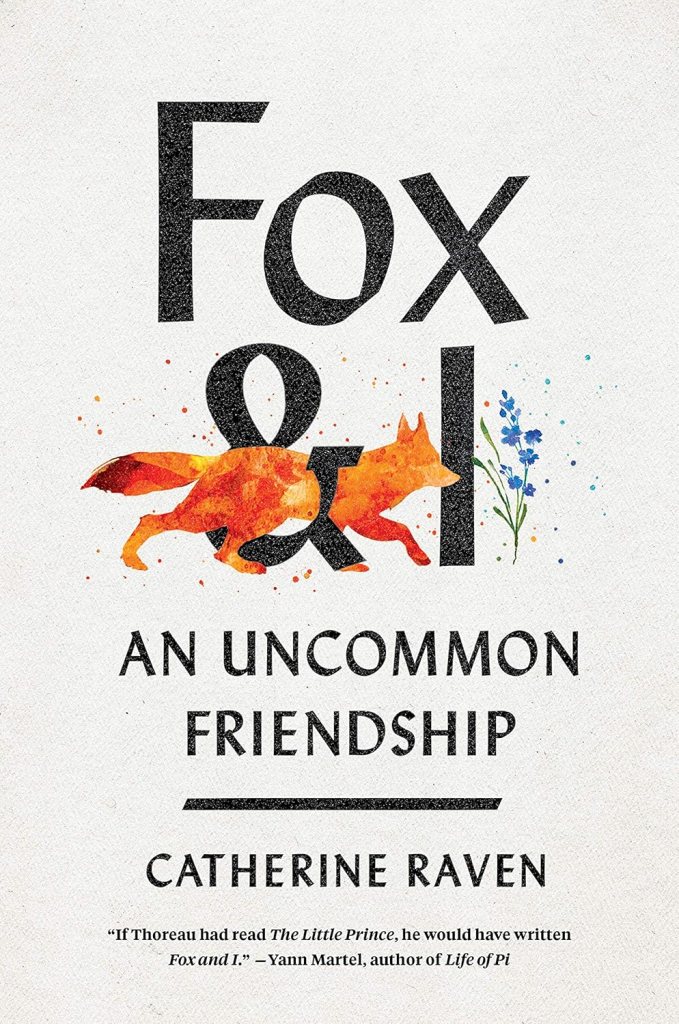
Fox & I: An Uncommon Friendship by Catherine Raven, a memoir
Welcome to the Goddamn Ice Cube: Chasing Fear and Finding Home in the Great White North by Blair Braverman, a memoir
Icebound: Shipwrecked at the Edge of the World by Andrea Pitzer, nonfiction history
To read a post from February 2021 about my joyful experience of ordering books from Honest Dog during a brutal cold snap in the middle of COVID. Click Here.
Apostle Island Booksellers: A Store with a beautiful cover, and a stunning interior
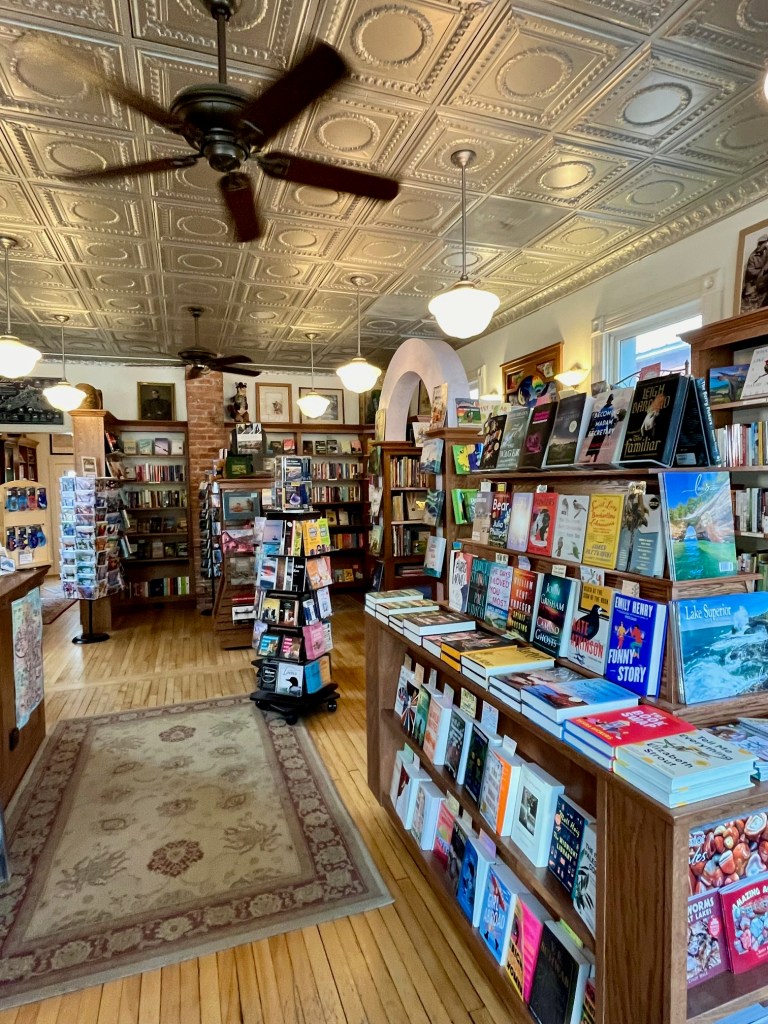
The view after walking in the front door
Bayfield, Wisconsin, has two wonderful bookstores: Apostle Island Booksellers and Honest Dog Books. Every time I visit Bayfield, I visit both places. I will talk about Apostle Island Booksellers in this blog, and Honest Dog Books in an upcoming blog.
Apostle Island Booksellers is small but gorgeous, and stocked with a wonderful selection of books. Walking through the front door, transports me back in time, into a warm and cozy and other-worldly space. A creamy-white tin ceiling with old-fashioned lights — the kind that bring old schoolhouses and libraries to mind — hangs over the natural-colored wood floors. Windows trimmed in decorative molding, wooden shelves, brick accents, and an old area rug catch my eye. But it’s the colorful covers of books that win over, and I look for something to take home with me.
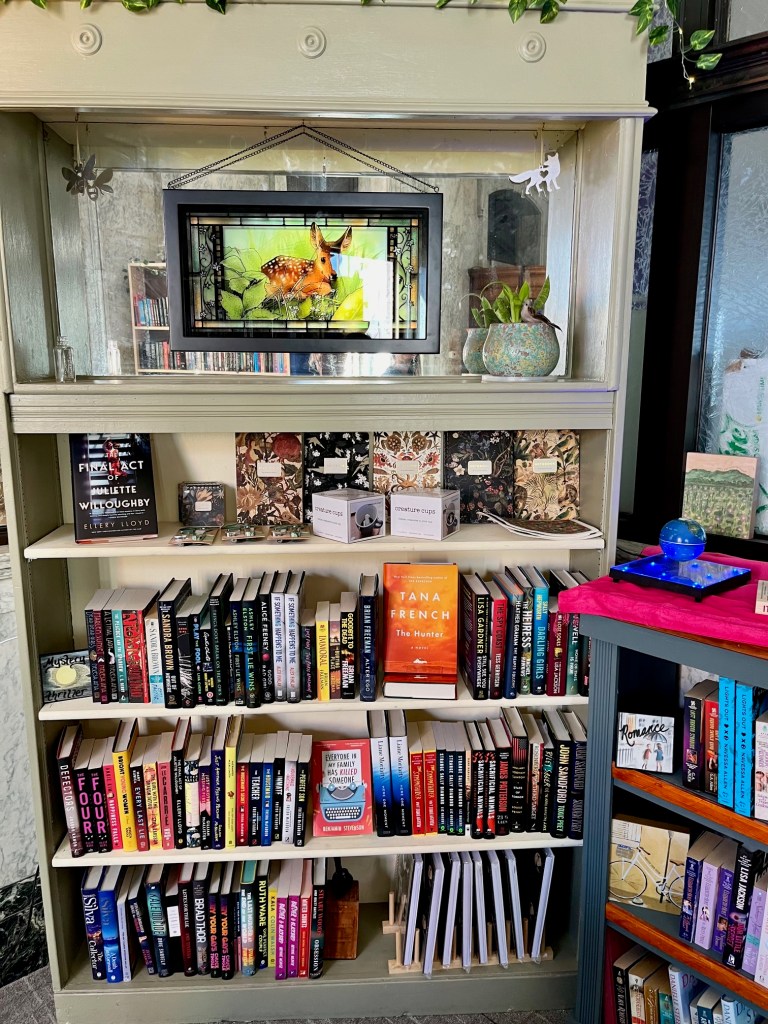
A romantic corner, the perfect place to fall in love with a book.
I walk around the front part of the bookstore, then head for the small back room tucked away like a treasure. As I go, my eyes scan titles and cover art. Along the hallway and in the back room, more books are displayed, making use of every available place to shelve a book. I’m happy to see the room around the corner is unchanged. It has what every bookstore should have: a place for a reader to sit and read a few pages of a book, to see if it’s a good fit.
I think I’ve made up my mind about which book I will buy, but I finish looking around the store before I pluck Slaughterhouse Five by Kurt Vonnegut from its spot on the shelf. My nephew suggested I read it, and I’ve also read that it’s one of Vonnegut’s best.
I discover another book, The Shipping News by Annie Proulx, and snap a picture of its cover. The synopsis intrigues me, but I will think about this book. I might borrow it from the library, or buy it at another bookstore, or buy it from Apostle Island Booksellers the next time I’m in town. Like other book lovers, I wish I could buy all the books that catch my fancy, but I’m limited by the coins in my purse and the space in my home. And my mind becomes uneasy if my To-Be-Read piles mushroom too quickly on the flat surfaces in my home.
While I pay for my book, the clerk and I strike up a conversation about British literature. We are both huge fans and discover that in our early years, we read almost nothing else but British literature. Her love of British authors started with Shakespeare when she was in ninth grade. My love started with Sir Arthur Conan Doyle’s Sherlock Holmes stories when I was in seventh grade.
I slip my new book into my large purse, and head to Honest Bog Books. I have one more book to buy.
Maria Lockwood greets customers with a big smile and the enthusiasm of one book lover to another.
MY TOWN HAS A NEW BOOKSTORE! And I’m shouting with joy. Maria Lockwood opened Foxes and Fireflies Booksellers on August 31. For the time being, her bookstore will be open on Saturdays and Sundays from 10:00 to 5:00, and some occasional evenings. During the week Maria works as a journalist for the Superior Telegram. That’s a lot of dedication to the printed word.
Since visiting the store this morning, I’ve been walking around in a state of happiness. The last bookstore in Superior closed down seventeen years ago. It was a well-loved, successful bookstore, but the owners wanted to retire. And when they locked their doors for the last time, they left behind many bereft bibliophiles.
Flooded with light and surrounded by marble, large windows, and wood trim, Foxes and Fireflies invites readers to come in and browse.
But now we have a new bookstore. Foxes and Fireflies is currently located in the old post office building in Superior. It’s in a business incubator space — a place where Lockwood’s bookstore can grow and gain a clientele before she relocates to another, larger space.
On the other side of this cozy space, kids and young adults will find a selection of YA and children’s books.
Lockwood’s bookstore has several places to sit, where a reader can peruse the first pages of a book, trying on a story to see if it will be a good fit. There are kid-friendly spaces with puzzles, some games, and children’s books. I have two grandchildren with birthdays in September and October. They love books, and I plan to take them to the bookstore. They will find the store as magical as I do.
Lockwood has created a warm, inviting space that makes me feel at home while I hang out with books waiting to become my new friends. While most of the books are new, customers can also find some gently loved used books for sale. Besides books, she stocks some beautiful journals, coffee cups, and dish towels, among some other fun objects like stickers.
Today I bought two journals, one decorated with sea creatures and the other with owls; a dish towel scrawled with Shakespearean insults; and the novel North Woods by Daniel Mason.
I’m thankful to have a bookstore in my town. In a couple of years, one of the two bridges connecting Superior and Duluth will close down while the bridge is being rebuilt. It’s hard to know how that will impact travel to Duluth, but I’m guessing it will be a challenge. There are three independent bookstores and one big-box bookstore in Duluth, but when that bridge closes down, driving to them won’t be convenient.
I would rather buy books than clothes or jewelry or dinners out. I would rather read than watch TV. At the end of every day, I ask myself, “Shall I watch something on Netflix or BritBox or shall I read?” Ninety-six percent of the time I choose to read and let the stories play in my head.
When I travel, I love to visit small independent bookstores. Perhaps I’ve been to a bookstore in your town or will visit one in the future. If you come through my town on a weekend, visit Foxes and Fireflies at 1401 Tower Avenue, Superior, Wisconsin. There is plenty of parking on the side street or behind the building.
Get thee to an indie bookstore, or as Shakespeare said, “Fie on thee, jolt-head.” (I’m going to have fun with my new dish towel.)
Doubleday, a division of Penguin Random House, 2023
Why did I read this book?
I read a lot of novels; short stories; and nonfiction about history, people, and nature. But every now and then, I love a good book about a real shipwreck. (I’ve read at least nine over the years.) True stories about tumultuous weather, dangerous waterways, towering icebergs, or deadly torpedoes that cause a ship to falter upon rocky coastlines or to sink into dark, deep oceans keep me reading late into the night. Stranded sailors, whether they be in a lifeboat or marooned on uninhabited and untamed land, appeal to me. Both dastardly and brave deeds among the captains, officers, crew, and passengers pull me into a world of drowning, scurvy, starvation, dehydration, desperation, intrigue, cruelty, selflessness, fortitude, and perseverance. I’m not sure why I enjoy these stories so much — or what this says about me.
What is this book about?
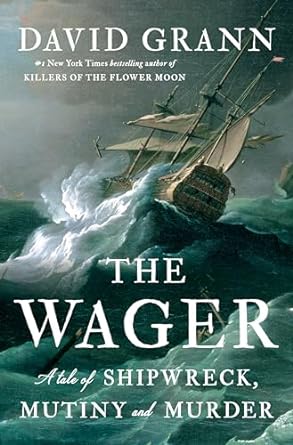
In 1740, the Wager, a British ship, left England on a secret mission to seize a Spanish galleon loaded with treasure. Britain and Spain were at war, and wars are expensive. By capturing the Spanish treasure, Britain could fill its war chest while depleting Spain’s. British officers and sailors alike knew this was a dangerous mission.
In pursuit of its quest, the Wager sailed around the tip of South America, perhaps the most perilous stretch of water in the world, then wrecked itself on a deserted island off the coast of Patagonia. The men were able to salvage supplies from the wrecked ship, but they were stranded for months. As the threat of starvation grew, the men decided to build a makeshift watercraft and leave the island. They sailed back to safety and were welcomed home as heroes. However, six months later three more of the stranded sailors returned home, and they accused the first group of sailors of mutiny. Accusations of rebellion, murder, and treachery between the first and second groups of survivors resulted in an investigation followed by a court martial.
What makes this book so good?
David Grann writes a highly engaging and well-researched history about a risky sea mission driven by greed and glory that goes awry. Almost three hundred years later, Grann was able to access the ship’s logs and the transcripts from the ensuing court martial.
A captain and other officers aboard a ship were expected to keep meticulous records. When a ship returned to port in England, all logs were turned over to the Admiralty, who used the information to learn more about weather patterns, sailing routes, and faraway lands. Additionally, if something went wrong aboard a ship, the events and the measures taken to remedy the calamity were to be objectively and completely documented. Logs kept by officers and mates were supposed to be detailed and succinct without emotional slants. However, as things worsened on the Wager‘s journey and after its wreck, it became clear that each officer who kept a log recorded the events in a manner to put himself and his actions in the best light. As to which accounts might be accurate and which might be embellished, Grann smartly doesn’t take sides but simply presents the information.
Grann’s vivid descriptions of bad weather, inhospitable lands, and tempestuous seas recreate the backdrop in which the egotistical, short-tempered, avaricious officers strived to chase down the treasure-filled Spanish galleon that would have made them wealthy and famous.
It’s a rollicking read filled with courage, double-dealing, and foolishness. For 257 pages, I joined the adventure from the safety of my couch, and wondered, Why — before modern ships and navigational equipment — did anyone ever leave the shores of their homeland, especially for a voyage around the tip of South America that had only a slim chance of success? And perhaps that’s what draws me to books about shipwrecks: A group of people get on a small vessel and head across a broad expanse of water, trusting they will arrive on the other side. Often they do, but when they don’t — there’s a story in that. I’m glad Grann thought so too.
Want to read some other good books about shipwrecks?
A Night to Remember by Walter Lord
Dead Wake: The Last Crossing of the Lusitania by Erik Larson
Icebound: Shipwrecked at the Edge of the World by Andrea Pitzer
In the Heart of the Sea: The Tragedy of the Whaleship Essex by Nathaniel Philbrick
Over the Edge of the World: Magellan’s Terrifying Circumnavigation of the Globe by Laurence Bergreen
“The Open Boat” by Stephan Crane (This short story is a semi-autobiographical and fictionalized account based on Crane’s surviving a shipwreck and enduring over thirty hours in a lifeboat.)
In addition to the list above, I’ve read other books about shipwrecks, but I can’t remember their titles. I read two other books about the Titanic and the Lusitania, a book about the collision between the Andrea Doria and the Stockholm off Nantucket Island, and a book about a mutiny in the Caribbean in the 1800s. Endurance: Shackleton’s Incredible Voyage is on my to-be-read pile of books. On my list of books to get and read in the near future are Left for Dead: Shipwreck, Treachery, and Survival at the Edge of the World and The Wide Wide Sea: Imperial Ambition, First Contact and the Fateful Final Voyage of Captain James Cook.
I read Nothing to Lose, Kim Suhr’s first collection of short stories, and loved it. So when Wisconsin Writers Association asked me to review Close Call, her second collection, I jumped at the chance to get an advanced copy so I could read her new collection without having to wait until October 1, 2024.
What is this book about?
Suhr serves up slices of life with intriguing, thought-provoking characters who face conundrums that will either be their undoing or their salvation. Carol, a young girl, works to save her parents’ marriage after a traveling salesman comes calling on her mother. A young married man experiences a new twist on the seven-year itch. Mrs. Morrison, once an artist but now a wife and mother, has lost her sense of self inside a calendar. Allan, an illusionist, has an unusual gift beyond ordinary magic tricks. Deena’s struggles, from childhood to adulthood, are revealed through a series of phone conversations that take place at significant moments in her life. Keith, a DMV employee, has a special talent with a camera. Isabelle, a newlywed, reconsiders her relationship with God after a tragic accident. Willie, a first-grader, gets caught up in a terrifying game of pretend. Dean, a young hockey player, meets Arnie, an old rink rat, who lives for the game of hockey.
At the end of her collection, Suhr gives us two longer stories to savor, “The Dip” and “Eradicated.” “The Dip” is about four women who have known each other since childhood. Now in their fifties, they struggle to maintain their friendship. The story is written through a series of DMs, emails, a Google doc, texts, a poem, scripts, online chat room comments, and an obituary. It takes superb writing skills to pull off this type of story, and Suhr’s talent as a writer shines through. She never lets the experimental techniques be the story, but rather she uses them to create a highly-engaging and cohesive narrative, giving us a lot to contemplate long after we finish reading it.
With “Eradicated,” Suhr presents the perfect dish to round out her collection. This dystopian tale is set in the future where artistic creativity, now labeled a disease, needs to be eradicated, a goal that is nearly complete when we meet Dr. Bells, a scientist. Wishing to observe creative artists before the last of them dies out, the doctor visits an artists’ colony where creative people, who are considered to have “disturbed minds,” have been contained after being extracted from society. Because the themes in “Eradicated” are both timely and timeless, the story sends chills up and down our spines.
What makes this book so good?
Close Call hooks us with one look. The stunning cover art features a red telephone receiver, untethered from its cradle and dropped at the end of its cord. Abandoned, the receiver rests on the floor near a dark shadow, setting the tone for the tales that follow. Stories about close calls, narrow misses, inevitable disappointments, and unavoidable failures. The cover compels us to pick up Close Call and open it, but from the first sentence, it’s Suhr’s vivid writing and intelligent, masterful storytelling that seal the deal and keep us turning the pages. Suhr promises us her collection will be exquisitely crafted, with every word, turn of phrase, and sentence essential in creating her nuanced characters and the thorny situations they face. And she delivers.
Each of Suhr’s stories in Close Call presents a fresh take on love, hate, jealousy, faith, loss, fear, conformity, and disappointment. Her ability to tell stories with unique characters, interesting plots, and captivating complications gives us a look at human nature in a different way, and as we read our way through her stories we hunger for the next one. And Suhr’s stories are a literary treat.
I love the title of this book because it plays two ways. When I decided to reread the book, I bought my own copy.
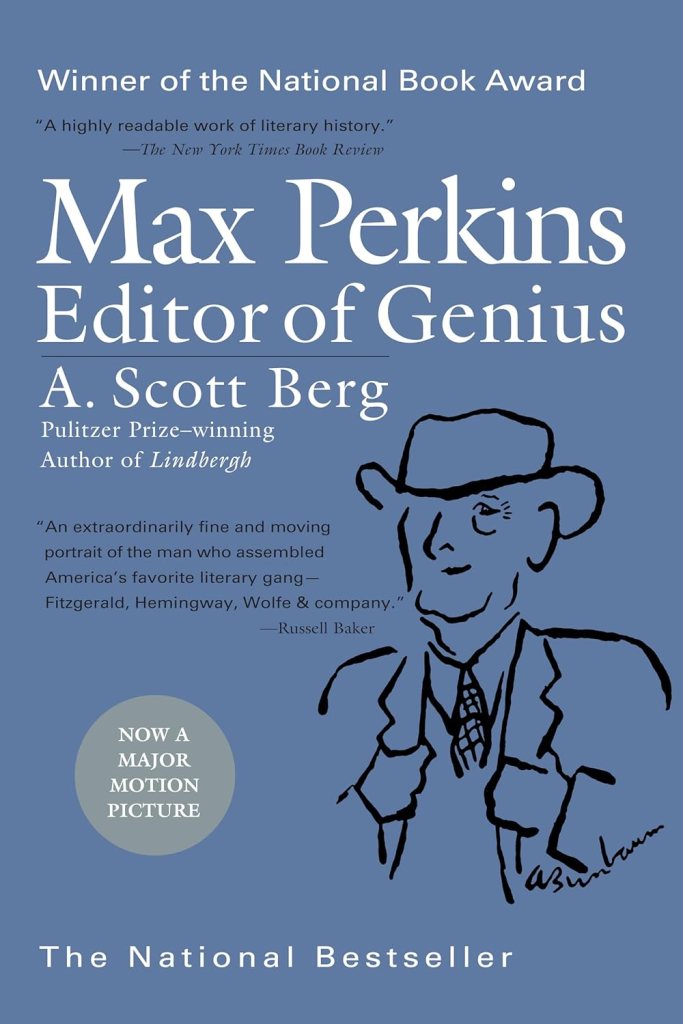
The first time I read Max Perkins: Editor of Genius, I did so because in the spring of 2019 my writing friend Milan suggested that I read it. He said it was a wonderful book. Then he kept following up with the question, “Have you read Max Perkins: Editor of Genius yet?” I felt bad when I had to admit that once again I hadn’t. So, in late fall I borrowed the book from the library and started reading it.
I did indeed love the book, but I never got the chance to talk about it with Milan.
Milan and I met through our local writers’ association, to which we both belonged. Before COVID the association held a gathering once a month at a local coffee house. As a person who was new to the world of writing, it was a great place for me to be in 2019. Not only did I receive lots of good advice, but it was a joy to be with fellow writers.
Every month the usual cast of writers, like me, showed up, and others came when they could. Milan came often. His enthusiasm for being with writers showed in his kindness, his warm smile, and easy laughter. He loved to talk about ideas, writing, social issues, education, and even his pickup truck when I wanted advice about trucks. Born in France, Milan had immigrated to the United States with his mother when he was a young teenager. He had written a fascinating memoir, Ma’s Dictionary: Straddling the Social Class Divide, about his life. He had a book deal with a French publisher, so at the time I met him he was translating his memoir into French, his native language.
Milan and me at the coffee house on a Saturday morning, 2019
Milan became my mentor. He asked to read my short stories, and he gave me encouraging feedback via email, which often arrived at three or four in the morning because that is the time of day when he worked on translating his memoir into French. It was always fun to wake up in the morning and find an email from him. Even nicer — he asked me for feedback on an essay he was writing.
The second week of December in 2019 was the last time I heard from Milan. I had sent him feedback on his essay, but he didn’t respond. Over the next couple of weeks, I sent two more emails but received no answer. That wasn’t like Milan. I figured maybe he had traveled to France for the holidays or maybe he had lots of company. I tried not to think about the fact he might be seriously ill or that perhaps he had died. I had never met any of Milan’s family, and other than email, I had no way to contact him.
On January 14, 2020, I sent Milan another email but again received no response. I started checking the online obituaries every few days. Perhaps that sounds morbid, but if Milan had died, I wanted to know. In March his obituary posted. He had died on March 6, 2020, at the age of 78. I’m assuming because of the time lapse between his last email to me and his death that he’d become seriously ill before he died.
I had known Milan for almost a year. We saw each other about once a month at the coffee house gatherings. And I had attended a couple of community outreach discussion groups he had facilitated regarding his memoir and the social issues it touched upon. After reading about his passing, I was so sad. I’d lost a friend, a fellow writer, and a mentor. Milan had once said that he loved to visit with me because I could talk about ideas. It was such a nice compliment. Talking about ideas was also one of the reasons I enjoyed his company so much.
I finished reading Max Perkins: Editor of Genius shortly before Milan died, but we would never talk about the book. I would never know why he liked it so much or why he kept insisting I should read it. Instead, the book became an unfinished conversation between Milan and me.
I recently reread the book about Max Perkins. My second reading of the book was prodded by a conversation with someone about a well-known writer (who was five years old when Perkins died) and his strained relationship with his editor. At the heart of the conversation was the question: How much can an editor intercede in a piece of writing before a line is crossed and the work becomes not just the writer’s but rather almost a collaboration? This conversation reminded me of the working relationship Thomas Wolfe had with his editor Max Perkins.
Because A. Scott Berg had access to hundreds of letters between Wolfe and Perkins, he was able to write about their often-tumultuous writer-editor relationship. In his book, Berg details the massive manuscripts Wolfe presented to Perkins, and Perkins’s long hours of work with Wolfe to pare them down into manageable books. (Perkins always stated that any suggestions he made to Wolfe were always subjected to Wolfe’s complete approval.)
Berg also included the opinions of some literary critics who believed Wolfe should be able to revise his own work from a rough draft into a cohesive and readable novel without extensive help from an editor. And because Wolfe couldn’t seem to do that, the critics had questions about his overall abilities as a novelist. Eventually, this caused a rift between Wolfe and Perkins, with Wolfe leaving Scribner’s for another publishing house and a new editor. Wolfe wanted to prove the critics wrong.
It’s commendable that Berg never takes sides on either the question of Wolfe’s writing ability posed by literary critics or Perkins’s role in readying Wolfe’s work for publication. Instead, Berg presents Wolfe’s and Perkins’s letters, the accolades and criticisms by others, and the events of Wolfe’s leaving Scribner’s without interjecting his own point of view. It’s up to the reader to form an opinion. I’m sure Milan would have liked to discuss Wolfe and Perkins.
I can’t say for certain what else Milan may have liked to discuss, but I’m sure there would have been lots. Berg’s book is well researched and well written. He does an excellent job of presenting information about Perkins and the many writers Perkins worked with, such as F. Scott Fitzgerald, Ernest Hemingway, Thomas Wolfe, Nancy Hale, Marjorie Kinnan Rawlings, Taylor Caldwell, and other fine writers of the 1920s through the 1940s, many of whom are still well known today.
I wish I would have read Berg’s book when Milan first suggested it to me. We would have liked talking about Max Perkins and the many writers he worked with during his editing career. I miss Milan, and I miss the conversations we never had.
[In 2016, A. Scott Berg’s book was made into a movie called Genius. I haven’t seen the movie, but it has some A-list actors in it. I don’t always like seeing movies based on factual events because Hollywood favors dramatic scenes over reality, but I might make an exception and watch this movie because it appears to stick to the facts better than some biographical dramas. However, overall critics panned the movie, so maybe I won’t. For information on the movie’s historical accuracy, click on Genius: History vs. Hollywood. For a synopsis of reviews by movie critics, click on Genius (2016 film).]

Published by Minnesota Historical Society Press, April 2024
Why did I read this book?
I went to the Boundary Waters Canoe Area (BWCA) in May 1982 for several days. And although I’ve never returned, I was curious to read Joe Friedrichs’s book because it’s about a place that I once visited and found beautiful beyond words, mysteriously ancient, and intensely wild.
But because Friedrichs tells the stories of people who have died or nearly died in the Boundary Waters, I hesitated to buy his book. I wondered how he would approach his topic. Then I read a review that stated Friedrich didn’t sensationalize the stories of death, but rather treated the deceased people and their loved ones with compassion. So I bought the book, and once I started reading it, I was glad I had.
What is this book about?
Friedrichs covers stories about people who have died or almost died in the Boundary Waters due to lightning, drowning, fire, cold, and falling trees. He also tells about a couple of people who entered the BWCA, disappeared, and were never seen again. While the majority of Friedrichs’s book covers tragic and near-tragic events, he also writes about other topics connected to the BWCA.
As Friedrichs vividly describes the many lakes, rivers, portages, and trails, readers are immersed in the beauty of the nearly untouched primitive wilderness that draws so many people to the Boundary Waters. He covers some of the history about how the area became a designated wilderness, and he discusses the role of fire in the life of a forest. Readers learn about the St. Louis County Rescue Squad, the Cook County Sheriff’s Department, and other rescue teams who all work together to find and rescue people who are in trouble. Or sadly, when someone has died, who work together to recover the person’s body.
What makes this book so good?
Even though Friedrichs writes about people who have died in the BWCA, he tells those stories respectfully and compassionately. He makes sure that each person he writes about is more than just the story of their death, more than just a statistic. During the research for his book, Friedrichs talked to the loved ones of those who had died in the BWCA, even traveling to other states to speak with their family and friends.
People who visit the Boundary Waters have a love of the outdoors and a passion for canoeing, kayaking, hiking, and fishing. Friedrichs, after making his first trip to the BWCA, fell in love with the untamed wilderness and moved to Minnesota, making his home near the edge of the BWCA. He has made many trips to the BWCA, and his knowledge about the area and his understanding about the type of people who find both peace and adventure there add immeasurably to his book.
While people can certainly learn from Friedrichs’s book that one needs to be prepared and practice safety when going into the wilderness, his book isn’t a how-not-to-do-things book. Because almost every single person in his book who died or almost died was prepared, experienced, and serious about safety. Instead, some unforeseen, powerful event, usually weather-related, overtook a person or people, and then no matter how much planning had been done or safety had been practiced, it all came down to luck. Humans like to believe they can control and prepare for every outcome, and that if they do, disaster will be averted. But this isn’t always true.
Finally, Friedrichs is a wonderful writer who crafted a well-organized, thoughtful, and engaging account about a one-of-a-kind place on Earth.
Reflections about my one and only Boundary Waters trip after reading Last Point of Entry . . .
When I went to the Boundary waters in May 1982, there were five of us on the trip. We were all in our early twenties. We parked our vehicles near the lake we entered and paddled to our campsite, where we stayed for the next few days. We didn’t have to portage our canoes or supplies. I was the only person who’d never been there before, and I had almost zero experience in a canoe. But I put on my life jacket every time I stepped into the canoe. I knew this would be important to help keep me afloat should we capsize. What I didn’t know, until I read Friedrichs’s book, was how fast hypothermia might have claimed my life if I had gone into the water, even with my life jacket securely buckled around my chest. He points out that May and October are popular months for people to visit the BWCA, but those months have the highest number of drownings, not because people don’t wear life jackets, but because the water is so cold and the weather is more volatile. But people like those months because there are fewer bugs. That’s why the group I was with chose May for our camping and fishing trip.
It drizzled every day we were in the BWCA, and it was cold, above freezing, but cold. We didn’t have to worry about bugs. During the day we fished on the lake by our campsite. Even in a layer of drizzle and chilled air, the scenery was incredibly beautiful. I understood that I was among something old and pristine, a wild and natural forest carved with clear lakes and rivers. Something vast that people hadn’t managed to ruin.
While our weather was cold and rainy, we didn’t experience any intense storms, so we didn’t have to worry about our canoes being swamped, trees falling on our tents, or lightning striking us. But all that came down to luck. We didn’t catch any fish either. We ate food, including steaks, that we’d brought with us. I’ve never been back to the Boundary Waters. But not because I didn’t enjoy my trip. Even in the drizzle and cold, it was amazing. But I’m not big on camping or fishing. Still, I’m glad I was able to experience the BWCA, and I understand why other people love to enter its unspoiled wilderness.
A friend of mine suggested I might like to read Djinn Patrol on the Purple Line. Not only did she love the story, she liked how Deepa Anappara structured the novel. And my friend enjoyed how many of the chapter titles were also the beginning of the first sentence in a chapter. For example:
THREE WEEKS AGO I WAS ONLY A SCHOOLKID BUT–
–now I’m a detective and also a tea-shop boy.
(And what a great sentence it is.)
What is this book about?
Nine-year-old Jai lives in India in a poor, crowded neighborhood referred to as a basti. Bordered by a smoldering rubbish dump and enveloped by an unrelenting gray smog, Jai’s life in the basti is hemmed in by poverty, garbage, pollution, and classism. The wealthy lifestyle of the hi-fi residents who live in luxurious skyscrapers separated by a high wall from his basti is beyond his reach. He lives with his older sister Runi-Didi and his Ma and Papa. His best friends are Faiz and Pari, who are also classmates.
The story opens with the disappearance of Bahadur, a quiet and unassuming boy who others rarely notice. When Bahadur doesn’t turn up, his parents and other concerned adults from the basti beg the local police to investigate. But the police refuse to take Bahadur’s disappearance seriously, and instead they threaten to have the basti bulldozed if its residents insist on causing trouble over Bahadur’s disappearance.
In answer to the indifference of the police, Jai, Faiz, and Pari declare themselves detectives. Jai, who loves to watch detective and crime shows on TV, fancies himself as the head detective. The three friends wander through their basti and the Bhoot Bazaar, asking people if they’ve seen Bahadur. They even take the Purple Line train to a neighboring city on a hunch that Bahadur may have run away or been kidnapped and taken to that city.
Soon other basti children go missing, and fear, like the pervasive smog, engulfs the basti residents. Jai, Faiz, and Pari are forbidden to leave home without an adult. But they defy their parents, and while continuing to look for Bahadur, they make inquiries about the other children who have gone missing.
What makes this book so good?
Deepa Anappara was born in India and worked as a journalist in her home country from 1997 to 2008, where she wrote about education. There is no doubt that Anappara’s personal and professional connections to India enabled her to create the realistic world in which her impoverished and marginalized characters live. Although her characters are fictional, Anappara’s portrayal of their joys, fears, hopes, and disappointments are heartbreakingly real. And most importantly, Anappara takes care not to sensationalize or diminish her characters’ stories. Instead, she has written a literary novel about the worst kind of crime. Her beautiful writing along with her measured restraint carries readers through the difficult scenes.
During her years as a journalist, Anappara interviewed many disadvantaged children, whom she found to be full of “humor, sarcasm, and energy.” While working as a journalist she learned that children from poor families disappeared at a higher rate than children from families in better circumstances. These abductions rarely made the news unless a kidnapper was caught or the details of a kidnapping were particularly gruesome. It upset Anappara that the stories of the missing children “were nowhere to be found.”
When Anappara first tried to write Djinn Patrol, she labeled her attempt a failure. In 2016, she returned to her novel. This time when she thought about the children she had interviewed in India, she remembered “their determination to survive in a society that often willfully neglected them” and she knew the story must be told from the perspective of the children. She found a way into her story, and after reading her novel, I can’t imagine it being told any other way. The story is told mostly in first person by Jai, who is at turns earnest, careless, unselfish, jealous, kind, and churlish, but who, despite his faults and missteps, captured my heart. Other times the story is told in third person through the point of view of other children.
I have to return the borrowed book to my friend. But I ordered my own copy to keep on my bookshelf. In part because like my friend, I admire Anappara’s amazing use of voice, point of view, and structure. Perhaps, I won’t read the book again, or maybe I’ll only read parts of it. Regardless, I couldn’t bear the thought of being separated from Jai, Faiz, and Pari and their dreams. And that’s the other part.