[I’ve read many good books in the past few months. I’m reviewing some of them in a series of blog posts. So, if you’re looking for a summer read, maybe you’ll find a book to enjoy in one of my book review posts.]
Why did I read this book?
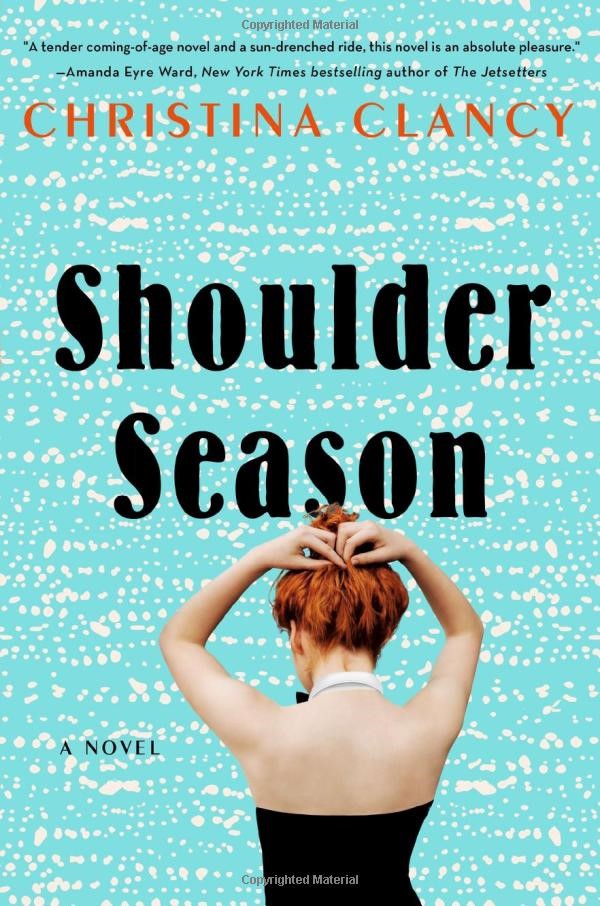
Three reasons. One, Christina Clancy’s novel Shoulder Season is set in East Troy and Lake Geneva, an area of Wisconsin where I spent time during my growing-up years. Two, the novel’s main character takes a job as a Playboy Bunny at the Playboy Club in Lake Geneva, Wisconsin; I wondered “What would that be like?”* And three, I attended a writer’s residency at Write On, Door County in April, and Christina Clancy was my roommate for part of my stay. She is a kind, funny, and interesting person, who generously gave me a copy of her novel Shoulder Season before she left.
What is this book about?
Shoulder Season is a coming-of-age story that takes place around 1980. Nineteen-year-old Sherri Taylor is an orphan. Her mother, after a lengthy illness, has recently died, and her father has been dead for several years. After caring for her terminally ill mother, Sherri wants to leave East Troy, her hometown. She craves fun and adventure and an escape from grief. She also needs to earn a living. Sherri’s best friend convinces her to interview for a job as a Playboy Bunny. Sherri, much to her surprise, gets the job and fun and adventure. But being a Playboy Bunny is difficult and at times demoralizing work. Left without family and alienated from her best friend, loneliness, confusion, and insecurity cloud her judgment, and she makes choices that lead to heartache.
What makes this book memorable?
Shoulder Season grabbed me from the first page and didn’t let go. Clancy’s story-telling skills compelled me to repeatedly wonder: What’s going to happen next? And how is it all going to shake out in the end? I was never disappointed.
Clancy’s main characters are well-developed with shades of nuance. Like real people they have strengths, weaknesses, insights, and blind spots. And she has taken care to develop secondary characters that are engaging also. We care about her characters, even if we don’t always like them all the time. If her novel were a movie, I’d say it has great casting from the leading roles to the supporting and minor roles.
Clancy’s power of description and setting bring East Troy, the Lake Geneva Playboy Club, and other locations in her novel to life. I grew up near East Troy and Lake Geneva and often visited those areas. I saw Journey play in East Troy in the early 1980s. Clancy nails the feel of those places during the early 80s. She smoothly weaves setting and story together, each element adding to the power of Sherri Taylor’s journey into adulthood.
Shoulder Season is a moving coming of age story for adults. Without ever becoming sappy or sentimental, Clancy’s beautiful prose takes readers on an emotional ride with Sherri Taylor as she struggles to follow her dreams, while at the same time taking readers back to their youth when they too were filled with dreams and so much was possible.
[* As a teenager, I’d heard about Hugh Heffner and his magazine, his playmates of the month, and his Playboy Clubs. The Playboy magazine came to our house every month. My parents hid it, but my siblings and I sometimes “read” it. Well, actually, I often did read the short stories because they were very good, better than the syrupy romantic stories that appeared in the women’s magazines my mother bought; although, as a teenager with starry-eyed romantic notions, I read those too. I came of age in the late-1970s, and I also remember hearing about Gloria Steinem and her undercover assignment as a Playboy Bunny.]
[I’ve read many good books in the past few months. I’m reviewing some of them in a series of blog posts. So, if you’re looking for a summer read, maybe you’ll find a book to enjoy in one of my book review posts.]
Why did I read this book?
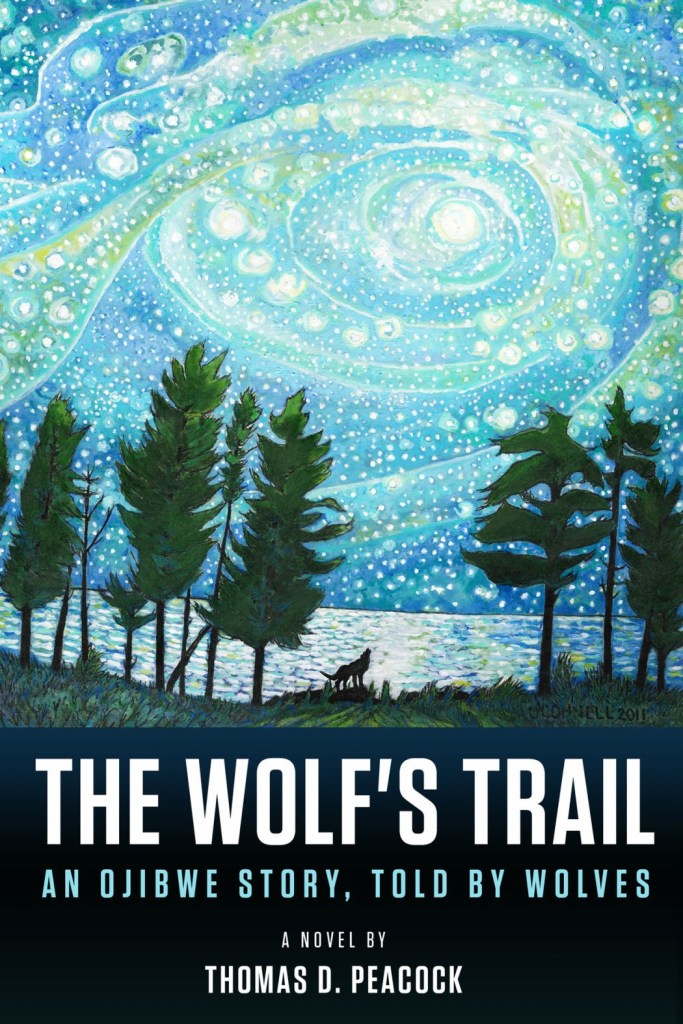
Three reasons. First, Thomas Peacock’s novel, The Wolf’s Trail is the 2023 One Book Northland community read, so it’s displayed in local bookstores. I like visiting bookstores, so the novel and I were bound to meet up. Second, I love the book’s cover, created by James O’Connell, an artist from Madison, Wisconsin. O’Connell’s cover art reflects the soul of Peacock’s novel. Third, the story is narrated by a wolf, which intrigued me.
What is this book about?
The Wolf’s Trail is a series of connected stories within a larger story. Zhi-shay, the Uncle wolf, is an old, wise wolf who “talks story” with the pups about creation, love, family, survival, and the Anishinaabe people. The stories are told to help the young wolves learn about the history of their world, the relationships between all living creatures, the nature around them, and the cycle of life and death. It’s the story of the importance of passing on wisdom, of passing on the wolf’s story; and through the wolf’s stories, the passing on of the Anishinaabe’s story.
What makes this book memorable?
Zhi-shay is a quintessential story teller. He is kind, wise, generous, humorous, reflective, and honest. His lessons are sometimes joyful and sometimes sorrowful, but they are all worthy of reflection. Each time I had to set the book aside, I longed for the time when I could pick it up again and sit with the wolf pups and listen to Zhi-shay, the Uncle wolf.
Peacock’s book is a beautifully written Native American literary narrative that does what powerful fiction should do: It builds bridges of understanding between people, and it expands a person’s view of the world. Without preaching to the reader, the book is a meditation, a guide for a better way to be in the world as we pass through our days on earth.
[Other Native American literature that I’ve read in the last couple of years and loved:
[I’ve read many good books in the past few months. I’m going to review some of them in a series of blog posts. So, if you’re looking for a summer read, maybe you’ll find a book to enjoy in one of my book review posts.]
Why did I read this book?
I bought Rin Tin Tin: The Life and the Legend in 2011 after listening to an interview of Susan Orlean on Minnesota Public Radio. (Click on the blue font to hear her talk about the book. She gives a good interview.)
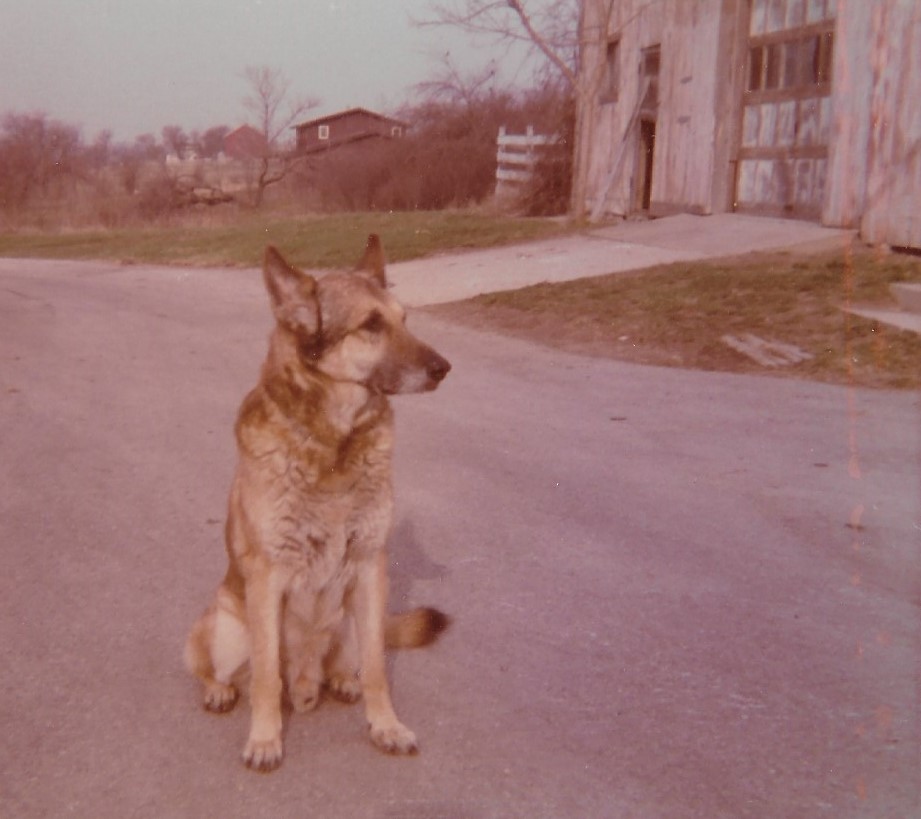
I’d never seen a Rin Tin Tin movie or TV show, but I’d heard of the famous Rin Tin Tin because he was often referenced in popular culture. Rin Tin Tin’s story appealed to me for two reasons. One, I like reading about the movie industry, especially the history of its beginnings. And two, I grew up with a German Shepherd named Fritz, who was intelligent and kind, and at times heroic. Our Fritz could’ve been the Rin Tin Tin of the silver screen.
Sad to say it took twelve years before I lifted the book off my to-be-read pile of books. Sad because Susan Orlean’s book is a fascinating combination of three stories.
What is this book about?
It’s the story of a man and his love for an extraordinary dog. Orlean’s book follows the life of Lee Duncan who rescues Rin Tin Tin, a German Shepherd puppy, from a bombed out kennel in France during WWI. In a way Rin Tin Tin rescues Duncan, too, because Duncan, who had a tough childhood, is a wounded soul. Duncan brings Rinty, as the dog was sometimes called, home to America. With Duncan’s care and training, Rin Tin Tin becomes a Hollywood superstar during the silent film era. After Rin Tin Tin dies, Duncan continues to work with other German Shepherds who acted in movies and the television show The Adventures of Rin Tin Tin.
It’s the story of canine and human actors; animal trainers; and Hollywood executives and producers; many of whom become famous and rich (and sometimes bankrupt then rich again then broke again) during the early days of Hollywood and television. Orlean delves into the behind-the-scenes pitches, ideas, deals, and strategies that created and promoted the Rin Tin Tin movies, TV shows, and actors.
It’s the story of Orlean’s fascination, research, and commitment to the story of Rin Tin Tin. She is old enough to remember watching the TV show The Adventures of Rin Tin Tin with her older siblings and loving Rin Tin Tin. But she was only four years old during the last season of the show and remembers nothing about the show itself. She writes about the fascination she and her siblings had with a small Rin Tin Tin toy her grandfather kept on his desk, out of their reach. She remembers the day when, while researching another story, she came across the name Rin Tin Tin, which brought back a flood of memories and emotions about the famous German Shepherd from her childhood. In her book Orlean writes about why she wrote this book, how she did the research, and how the book changed her.
What makes this book memorable?
Orlean is an outstanding journalist, which shows in her dedication to research and her passion for accuracy. Hollywood moguls, however, are in the business of creating legends, and they often spin legendary stories, which light up our imaginations but may have little or no truth to them. Orlean worked to track down the veracity of the many stories that had been handed down about the people and animals in her book. When she can’t find facts to either corroborate or refute a story, she lets readers know. As a reader, I appreciate Orlean’s extra effort to get at the truth, rather than repeating information that may not be true.
It took Orlean ten years to research and write Rin Tin Tin. She was granted access to the vast collection of documents saved by Lee Duncan and other people featured in the story. She interviewed as many people as she could who were connected to the story of Duncan and Rinty. Some of her research included traveling to the places she wrote about, like movie and TV locations where Rin Tin Tin films were shot, and Paris where Rin Tin Tin is supposedly buried in an elegant, verdant pet cemetery.
When Orlean writes about people in her books, she does so in a fair and balanced way, making them neither heroes nor villains. This is something about Orlean’s writing I came to appreciate when I read The Library Book (2018). [I read this nonfiction book a couple of years ago. It would make another excellent summer read.]
I grew up with a German Shepherd. Fritz was born in 1958, and I was born in 1959. After reading Orlean’s book about Rin Tin Tin, I asked my mother why she and my father decided to get a German Shepherd. I wondered because my mother was born in 1940, so too young to have seen the Rin Tin Tin movies. And when The Adventures of Rin Tin Tin ran on TV, she was a teenager, so too old to care about a kid’s show. Without a moment’s hesitation, she answered, “Because they were very smart dogs.” That made sense because Rin Tin Tin’s TV escapades made German Shepherds very popular in the 1950s. So my mother, who didn’t watch Rin Tin Tin as an actor, would’ve heard about the breed’s intelligence and loyalty. And while some German Shepherds have aggressive natures, many like Fritz, are loving and kind.
Orlean’s artful weaving of the stories of Duncan and Rinty, the early days of Hollywood, and her journey to uncover the mystique of Rin Tin Tin makes for an engaging narrative.
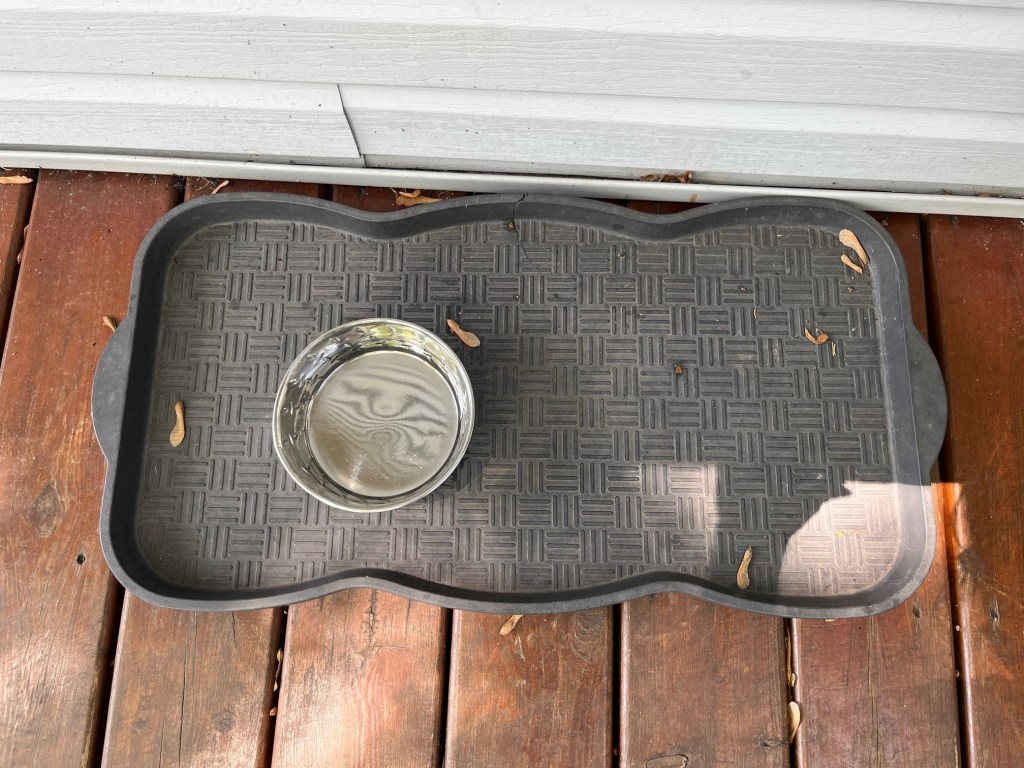
The dog’s water dish has gone missing. My husband has looked everywhere for it, and he announces he can’t find it anywhere.
I’m reading, trying to finish a book before we need to pick up his father and take him out to eat.
Not being able to find the stainless-steel water dish with a nonskid rubber bottom has flummoxed my spouse. He says, “This is bizarre.”
Not to me: In my world things have always occasionally gone missing, but most of the time the objects have returned. I’ve learned to take a deep breath, stop looking for the missing item, and trust it will reappear when it’s ready.
Over twenty years ago, I lost my purse. I searched the house and the car but couldn’t find it. I decided I must have forgotten it at work. I drove back to work and searched for my purse. I asked if anyone had turned it in. No luck. I returned home and cancelled my credit cards, which was the easy part. Going to the DMV to replace my driver’s license would have been a joyless, time-consuming task. I needed to cook supper, so I went into my bedroom to change out of my dress clothes. I shut the door behind me and there, hanging on the hook on the back of the door, was my purse. At that moment I remembered having hung it on the hook, a place I’d never before put my purse.
For years I played where-in-the-Sam-Hill-are-my-car-keys with myself. I’d come into the house with groceries or kids or both. The keys in my hand would get stuffed in a pocket or laid on a random surface somewhere in the house. A few hours later or the next day, the hunt for the keys would begin. After one particularly stressful search, I made a hard-and-fast rule for myself: I must either hang the keys on the hook in the hallway or put them in my purse. It’s been years since I’ve done a frantic search for my car keys.
My husband continues his search. I try to ignore the lost-water-dish ruckus. The book I’m reading is very good. Besides, I believe the dish will turn up, but only if he stops looking for it.
He wonders if someone stole it. I doubt someone would come onto our deck and take a dog’s water dish. Then for a moment, I think maybe a fox took it, which is even more preposterous, but more amusing to contemplate. I keep reading (the book is very good). He keeps searching and grumbling.
I try to ignore him because I know the dish will show up somewhere. Years of experience has taught me this. And when I find a lost object, I remember having put it there — but only after I’ve found it. However, this time I’m certain I’m not to blame for the missing item. And to my husband’s credit, he doesn’t ask me if I’ve done something with it. (Which would be a valid question, and I know it.)
The book is so good, and I’m reaching the end, a very interesting and poignant climax. But I realize I’m not going to enjoy the ending without interruption, so I get up and join the search party.
I look in the same places he has looked: the counter, the floor, the dishwasher. Then I go out on the deck and look at the dog’s tray. No water dish. I don’t know what makes me do it, but I walk about ten feet to the edge of the deck. Next to two plants waiting to be put into the ground is the dog’s water dish. Only then do I remember.
I pick up the dish and go back into the house. “I found it,” I say. “It was by the plants at the edge of the deck.”
“How did it get there?”
Not wanting to waste water, I used the old water in the dish to give the plants a drink. I don’t know why I set it next to the plants (which I’ve never done before) instead of refilling it and returning it to the tray. I must have been distracted, probably by one of the dogs in the yard.
“I have no idea,” I say. I’ve seen my fair share of spy thrillers and decide the explanation is on a need-to-know basis. Does he really need to know my forgetfulness caused him a few minutes of puzzlement? Not at all.
He doesn’t say anything more, and I imagine he believes Cabela somehow pushed it over there because lately she’s been banging her dishes about a bit with her clumsy feet.
Later, I wonder if my husband really suspects me of having moved the bowl, but to his credit, he doesn’t mention it. (It would be a valid suspicion, and I know it.)
[In case you’re wondering, I was reading This Is Going to Hurt by Adam Kay. The book is nonfiction. Kay tells stories from his years as a doctor, before he quit to pursue a career as a comedian and a writer for TV and movies. Doctors from all over the world have written to tell him that his experiences as a doctor mirror their experiences as doctors. If you’re a doctor, you’ll probably like the book because you’ll appreciate that someone gets you and understands what the job is like. If you’re not a doctor, you should read the book because you’ll gain insight into a profession that we might all assume we understand because we go to doctors, but we really don’t.]
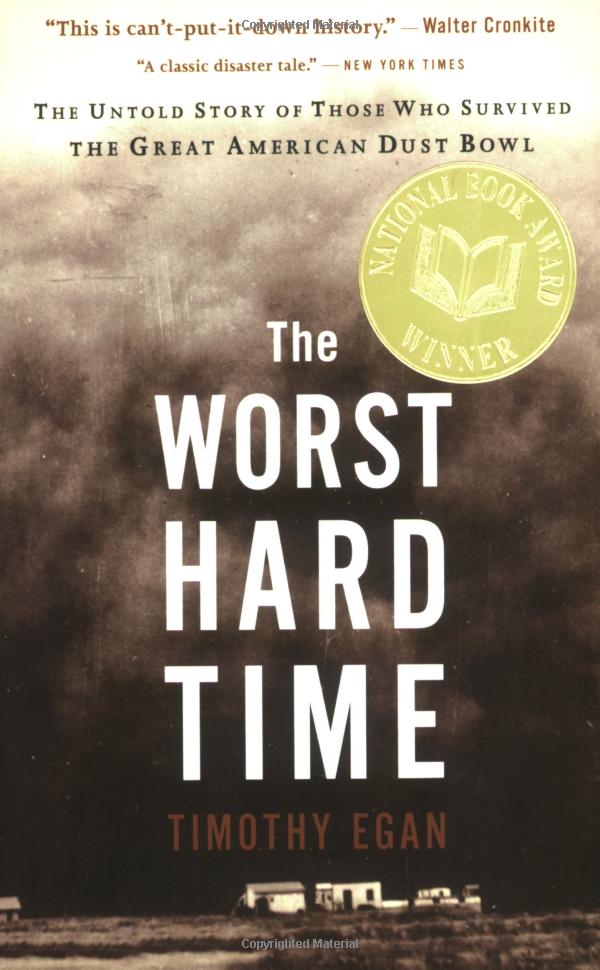
The Worst Hard Time by Timothy Egan is about the Dust Bowl of the 1930s. It tells the story of an ecological disaster of epic proportions caused by greed triumphing over reasonable behavior.
Before white people arrived on the American High Plains (the setting of Egan’s book) the tall grasses and buffalo had thrived for centuries upon centuries in a symbiotic-type relationship that allowed them to survive bitter cold, searing heat, and cycles of rain and drought. Then white people drove Native Americans off the plains and killed buffalo by the millions to ensure Native Americans wouldn’t have a food source.
Next came ranchers who raised cattle on the grasslands where the buffalo once roamed. But cattle, unlike buffalo, struggled to survive the extreme heat, cold, and drought. And when the prices of beef dropped or weather killed their cattle, many ranchers went bankrupt.
Then came farmers who believed they could grow wheat on the High Plains. At first there was enough rain and the price of wheat was high, so farmers borrowed more money and tore up more grassland, chasing higher and higher profits. But like a pyramid scheme, their dreams of wealth tumbled when wheat prices dropped precipitously and drought wrapped its hands around the neck of the High Plains and refused to let go. Wheat died in the fields, and farmers couldn’t pay their bank loans.
Ranchers and agricultural specialists warned against the unchecked removal of the grasslands because they understood the temperamental moods of the High Plains. The prairie is a place of wind, and so the winds, drought, and bare fields whirled like a dog chasing its tail, wearing itself out, completely spent. In a couple of decades, American farmers destroyed an ecosystem that had thrived for thousands of years.
Most of Egan’s book describes the horrific dust storms that raged over the plains, lifting millions of tons of topsoil and depositing it hundreds of miles away. He interviewed people who lived through the fierce, stinging storms. He retells their harrowing stories of survival, despite displaced dirt that filled their nostrils, mouths, and eyes, buried their possessions, killed their loved ones, and destroyed their livelihoods and communities.
Why is this book important?
People have changed the earth’s temperature, and they can’t just say, “It’s cyclical. It’s a phase.” Human behavior is accelerating the warming of the earth. During the Dust Bowl, many people blamed the ecological collapse of the High Plains on the drought. They refused to believe their stripping of the grasslands was the real issue. But other people knew better because droughts had come and gone many times and the grasses held the soil in place, just how nature designed it to work.
Yesterday the air quality where I live registered 182 on the AQ Index. That’s in the red zone, labeled unhealthy. And a thirty-acre wildfire started burning in the Boundary Waters Canoe Area Wilderness in northern Minnesota. It’s the first wildfire in the beginning of what appears to be a season of drought in Minnesota. We had lots of snow this winter, but the spring rains haven’t come. And there will be more fires. But the smoke that tanked our air quality yesterday came from one of the Canadian fires.
A smoky haze filled the sky, and the acrid smell stung my nostrils. I kept the windows and doors closed, but I could still smell the smoke in my house. I canceled plans to take my grandkids to a big outdoor park in a neighboring town. Physical activity is not advised when the AQ Index is in the red zone. We went to the library instead, but I could smell smoke inside the library too.
I thought about families who lived during the Dust Bowl. The babies and children and the young and old who died of dust pneumonia. How people and animals caught in a dust blizzard sometimes suffocated on dirt. How everyday women and men tried to defeat mounds of dust, shoveling it out of their homes, barns, driveways, and roads. How they covered every crack in their houses with tape or paper and hung damp sheets and blankets over windows and doorways to stop the dust. But each night while they slept, dust seeped into the house and cloaked them in grime.
Yesterday when I looked at the skies hemmed in with brown smoke, I felt claustrophobic, and my sinuses hurt. I wondered how people coped day after day, month after month, year after year with tons and tons of dirt. Of course, not all of them did. Some left, some died, and some lost their minds. I don’t think I could have handled the Dust Bowl.
Today the AQ Index dropped out of the red zone, through the orange and yellow zones, and by the afternoon entered the good green zone. But what will happen as the earth continues to heat up? There will be more wildfires. Will the air be filled with brown smoke every day?
If anyone has any doubt about how quickly greedy, ignorant humans can destroy a habitat, read The Worst Hard Time. It’s a well-written, well-researched book. And although it’s sad to read about the disaster of the Southern Great Plains and its tragic impact on the people who lived there, it’s an important story.
I have about one hundred pages of the book left to read, so I don’t know how it ends yet. It’s 1935, five years into the story, and drought still strangles the High Plains. Black Sunday, the worst storm of the Dust Bowl, has just occurred. And finally, the politicians in Washington, D.C. have decided they need to act. I don’t know how people worked to solve the Dust Bowl disaster, but I’m optimistic there was a workable solution. I hope to finish Egan’s book tonight.
I’m not so optimistic about today’s politicians in Washington, D.C., and their willingness to handle climate change.
I’m reading Last Circle of Love because I met Lorna Landvik, for a second time, at an author’s book talk in April. Lorna is a kind, funny person, and I enjoy listening to her talk about life and writing. When I met her for the first time in 2019, I bought her book Your Oasis on Flame Lake, and I thoroughly enjoyed the characters and their stories. In April, I bought Last Circle of Love, believing I would like it just as much or even more. Turns out I like this book even better. It’s a heartfelt story with interesting and diverse characters who come to life and pull at my heart with their stories..
What is this book about?
The women who belong to the Naomi Circle at All Souls Lutheran have just attended a luncheon at the Prince of Peace. Everything about the Prince of Peace is larger, shinier, newer, more opulent, and richer. But what really bothers the women from All Souls is the glitzy, full-color, professional-looking recipe book the women at Prince of Peace will be selling. The Naomi Circle of women are discouraged because they need a good fundraising idea to help keep All Souls’ doors open.
Someone jokes that the Naomi members should write a book called the ABCs of Erotica. The idea for their book isn’t meant to be pornographic, but rather romantic. The women and men who write pages for the book write about loving gestures, kindness, understanding, and sharing that have brought them closer to their loved ones. Of course, the Naomi Circle of women worry that some church members may think the book will be pornographic, but Pastor Pete, relatively new to the church and more open-minded than the last pastor, gives support to the women to explore the idea.
Will the ABCs of Erotica be the fund-raising savior All Souls needs? Or will the idea divide the church members, causing some to join Prince of Peace Church? Will Pastor Pete be hailed as forward thinking or sent packing?
Why is this book important?
It’s a cozy story with important themes. Many of the main characters are in their sixties, seventies, and eighties, and Landvik portrays them as real people with hopes, dreams, desires, and goals — people who want to embrace life, just like they did when they were young. In Landvik’s story, old people are complicated and vibrant, still trying to figure out life and what’s next for them. They are interesting.
While Last Circle of Love is set in a small fictitious town in Minnesota, the story is filled with a diversity of people and themes about diversity, such as sexual orientation, ageism, and sexism. Landvik’s gentle tale counters intolerance, anger, and ignorance with themes of love, acceptance, open-mindedness, and forgiveness. She delivers an important message with a spoonful of sugar. But more importantly with her novel, she accomplishes what a good story should. Even though we are entertained by mostly upbeat characters and a light-hearted plot, the story makes us think about important issues.
I follow Lois Roelofs’ blog: Write Along with Me, Blogging as a Retired Nurse. Lois is a wonderful writer, and I enjoy reading her blog. When I started following her blog, she was already a widow, having lost her husband, Marv Roelofs. I also knew she was writing a book because she would occasionally blog about the book’s progress. When her book was published in the spring of 2023, I wanted to read it because I knew it would be well written and because Marv’s story about how he chose to live with his terminal diagnosis is an important one. I’m over half way through Marv Taking Charge, and it is a well-written, informative, and touching story.
What is this book about?
In January 2018, while vacationing in Arizona, Marv receives a call from his pulmonologist, who tells him he has lung cancer, small cell, the very aggressive type. The doctor explains to Marv that he needs to start chemo right away. Marv answers, “I’m not interested in treatment,” then hands the phone to his wife, Lois, who is a nurse.
The doctor makes it clear to Lois that Marv’s cancer is terminal, but that he must start chemo right away in order to have a chance of more time. Marv doesn’t change his mind, and he and Lois continue their vacation in Arizona. When they return home, Marv is enrolled in hospice care. Then he and Lois set about living their lives. They visit family and friends, and they do the everyday activities they’ve always enjoyed. Marv has a lot of good days, but Lois also writes about the difficult times.
Why is this book important?
Many people, like Marv, will learn they have a terminal illness, and they will face decisions about how they want to live the rest of their lives. Currently, most terminally ill cancer patients are treated with chemo and radiation, not because treatment will provide a cure, but because it may extend their lives a few months. However, those extra months often come with a decreased quality of life because chemo and radiation are harsh treatments with potentially severe side effects. Marv chose quality of life over quantity, then he and Lois made the best of the days they had left together.
Cancer is talked about with words like fight and battle, and patients are described as courageous. However, Lois, agreeing with Atul Gwande, who wrote Being Mortal, says terminally ill patients should be asked what is important to them.
Marv’s answer to that question was to live out his days without the side effects of medical treatments that were not going to save his life.
[Lois Hoitenga Roelofs book Marv Taking Charge is available here.]
Robert’s Rules is J. F. Riordan’s third book in her award-winning North of the Tension Line series. In 2022, I read North of the Tension Line and The Audacity of Goats, the first two books in the series. [Click on blue titles to read my reviews.] The fourth book in the series, A Small Earnest Question, waits for me on my bookshelf. And Throwing Bears for George, the fifth book, is due to be released in April 2024.
Like a gourmet chocolate bar, which I eat square by square over the course of a week, I have rationed Riordan’s books, reading one then waiting several months before reading another one. Even though I’m pacing myself, I hope Riordan will write a sixth book.
I’m almost halfway through Robert’s Rules, and it’s as wonderful as the first two books. My favorite kind-hearted, charming characters (and a couple of not-so-favorite, mean-as-snapping-turtle characters) are back. Some characters from the previous books have expanded roles, and a new character, Oliver Robert, an accountant from Milwaukee, has come to Washington Island to be Fiona’s assistant. I wonder if Oliver’s going to be an asset or a liability.
Fiona, the newly elected town chairman, faces budget shortfalls at a time when the Island’s harbor needs dredging and the fire department needs money for equipment and staffing. Fire Chief Gil, concerned about safety, threatens to resign if his budget isn’t increased. In the middle of the Island’s financial woes, Fiona and her boyfriend, Pete, have a falling out.
Ben is bullied at school, but won’t tell anyone. Ben’s father, Pali believes he should move his family to the mainland so Ben can learn the ways of the world beyond Washington Island, even though they all love life on the Island. Ben’s bully, Caleb, is a deeply unhappy and angry child.
Caleb’s mother, Emily, the know-it-all, busy body interferes in everyone’s business. Jim, the DNR ranger, still carries a torch for Fiona. The diabolical Stella has gotten over her embarrassment after losing the election to Fiona and has begun a Twitter campaign of innuendo to sabotage Fiona. Roger still enjoys yoga and his coffeehouse Ground Zero, but he needs to find a way to discourage all the yoga tourists who come to practice at his coffeehouse.
And mysteriously woven throughout the stories of Riordan’s characters, is the chilling voice of a new person whose identity hasn’t been revealed yet. However, we learn in the prologue that the character is fascinated by fire.
So far Robert’s Rules has all the interesting characters, masterful storytelling, and beautiful prose found in Riordan’s first two books of the series.
[I’m forever grateful to Honest Dog Books of Bayfield, Wisconsin, for hosting J. F. Riordan on a Zoom presentation during COVID. And I’m forever thankful that in my need to be connected to writers during COVID, I tuned into Zoom talks to hear many fine authors talk about their amazing books, many of which I bought, read, and enjoyed!]
Swanson (l) and Nystrom (r). At age 94, after writing Ford Tramps, Swanson made a motor car trip to Alaska and toured the 49th state.
In 1924, Seegar Swanson and Elliott Nystrom, both twenty years old and friends since elementary school, decided to take a year off and tour the perimeter of the United States, making sure to visit the four corners of the country: Maine, Florida, California, and Washington. They saved money for their trip and bought a 1919 Model T Ford touring car for $125. They left Ashland, Wisconsin, in the late summer of 1924, and returned to their hometown in 1925. The trip took about a year because they worked at different jobs along the way. Also, Swanson points out, more than once, that the top speed of their Model T was 25 mph, if the roads were good.
Along the way Swanson and Nystrom kept a log of their experiences and expenses and took many photographs. Additionally, they wrote long letters home. After Swanson and Nystrom finished their journey, Swanson attended Northland College in Ashland. In 1936, he became the editor of the Superior Evening Telegram and later on he worked at the Duluth News-Tribune. After a long career in journalism, he retired at seventy-two. At the age of ninety, when he started writing Ford Tramps, he had his detailed resources and years of writing experience. He spent three years writing his book, and his hard work and dedication paid off because Ford Tramps is a well-told story that captures the mood of the country and its people in the mid-1920s and gives readers a glimpse into the daily lives of ordinary Americans and the places they lived.
Published in 1999, Ford Tramps is out of print, so if you want to buy a copy from Amazon, it will be used and it will cost between $56.26 and $154.63. Thriftbooks has one copy listed for $59.99. I paid under $20 per book when I bought two copies in 2000. I gave one to my father, and I kept the other.
My father read Ford Tramps right away and loved it. I cracked open my copy in March 2023. It’s amazing how fast twenty-three years can drive by. And if I hadn’t read a blog about autocamping in the 1920s written by Chris Marcotte, my copy of Ford Tramps would still be parked on my bookshelf.
I wish I’d read Ford Tramp years ago, when my father was still alive so we could’ve talked about the book and why we liked it. Even though we never had that conversation, I’m going to tell you why I think he enjoyed the book so much.
He liked it because Swanson’s descriptions of the 1919 Model T bring the car to life. The Model T that Swanson and Nystrom drove had three pedals on the floor and a lever by the door side of the driver’s seat that controlled the transmission, and it had a lever on the steering wheel that controlled the throttle. A complex coordination between feet and hands was needed to shift gears. Machines fascinated my father. He loved being a part of them, manipulating them, controlling them, understanding them, and pushing them to their limits. He drove cars and motorcycles, and he flew planes. Just as Swanson and Nystrom had to learn the personality of their Model T and what it could and couldn’t be asked to do, my father took pride in mastering his cars, motorcycles, and planes.
He liked the book because the Model T broke down on the road, and its tires often went flat. Swanson and Nystrom played nursemaid to the Model T, learning what they could fix themselves or rig up until they could afford a mechanic. My father, a savvy mechanic, would’ve reveled in the Model T’s challenges. Sure, when the car broke down, he would’ve sputtered and cursed. Then he would’ve put the Model T in its place and back on the road. He owned his own garage where I once heard a customer with an old sports car ask him, “What if you can’t get a part?” My father answered, “I’ll rig something up, and it’ll work.” That 1919 Model T would’ve been putty in my father’s hands.
He liked the book because he was in his 60s when he read it, but he could be young again, on a vicarious adventure from the comfort of his couch where his standard poodle and his greyhound curled up near him. In 1955, he was eighteen when he moved from a small unincorporated town in northern Wisconsin to the big city of Milwaukee, hoping to make his way in the world. My father never took a road trip like Swanson and Nystrom, but in a small way, he liked to travel and experience new places and meet new people. Swanson and Nystrom met many interesting and kind people while working odd jobs and autocamping. Swanson’s writing breathes life into these men and women, allowing readers to work beside them in an orchard picking crops or sit with them around a cookstove as they share stories and food with other autocampers.
My father liked the book because Swanson included many photographs, maps, log entries, expense accounts, and receipts. It was fun to see what food, lodging, camp fees, car repairs, and other necessities cost in the mid-1920s. Swanson and Nystrom also reported how much they were paid doing manual labor. My father, an avid photographer, took photos when he traveled. After he had his film developed, he would show you ten pictures of the same vista, then ten pictures of the same museum display, then ten pictures of the same man who took him out fishing on a charter boat. My father considered maps to be among the most useful items in his life. He used them when driving to someplace unfamiliar, and he used them to plan his flights from one airport to the next. As a pilot he kept a log of all his flights, and as a businessman he kept expense accounts and receipts.
My father liked the book because the Ford Tramps spent time in his beloved state of Arizona. He moved to Arizona when he was forty, and he thought his adopted state was amazing. Swanson and Nystrom marveled at the Petrified Forest, amazed that trees had turned to stone. The pair debated between seeing a bullfight in Mexico or seeing the Grand Canyon, with both of them favoring the bullfight. The Grand Canyon won out because in Mexico, bullfights were only held as part of major holiday celebrations, and it was too long a wait for the next holiday. Some things are meant to be. Swanson and Nystrom fell in love with the Grand Canyon, agreeing it was, as Nystrom remarked, “The greatest thing we’ve seen so far.” They stayed for five days. They hiked to the bottom of the canyon and swam in the Colorado River. They hiked along the rim in both directions, and they attended a Native American ceremony. One afternoon they took shelter in their Model T during one of the desert’s quick moving and furious storms accompanied by lightning that seemed to touch the ground and thunder that redoubled its intensity as it echoed off the canyon walls. My father never tired of watching desert storms roll through Tucson.
I’m at the point in the book, when Swanson and Nystrom have just crossed into California. Even in 1925, in an effort to contain harmful pests, California border patrol officials stopped cars to make sure people weren’t carrying fruit into the state. The Model T was searched from top to bottom because Swanson and Nystrom admitted to having a handful of oranges that they’d been given in Florida. Embarrassed, but having nothing else to hide, they were allowed to enter California. I have eighty-eight pages left to read, and Swanson and Nystrom are about to visit Yosemite Park. I’m sorry my journey with them will soon come to an end.
Someone suggested I sell my copy of Ford Tramps, pointing out my investment in the book had at least tripled. I’m not selling my copy, but if I did I could list it as “like new” because it’s only been read almost once, and I haven’t spilled any coffee on it. I wish I had my father’s copy of the book, but I wouldn’t sell his copy either. However, I would’ve been willing to share one of the copies with someone else. My father would’ve liked that, too.
I discovered a nice surprise under the jacket cover.
[Bloganuary is hosted by WordPress. A new topic is presented each day during January. I’m a day behind. And I missed some days, but I was writing other stuff.]
Yes, all of them, even the books I don’t remember.
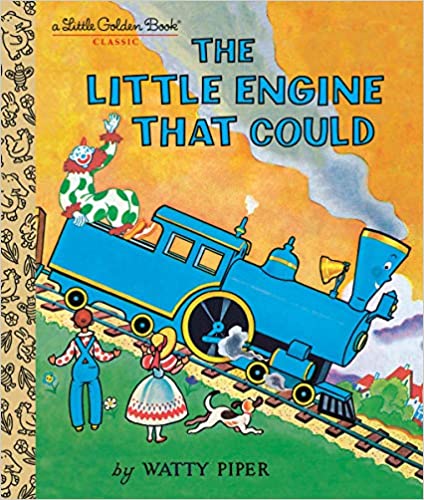
The first book I loved was “The Little Engine That Could.” It was my favorite bedtime story. My mother once tried to convince me to choose another story for her to read, but I became Little Blue Engine chugging away, steadfastly keeping the course up the mountain, refusing all other stories until my mother gave in and read it. I finally understood her point of view after I had children and had to read “Green Eggs and Ham” a bajillion trillion times.
Grandma Olive believed in books. She was a teacher and gave us books for birthdays and Christmas. She was also the organist and choir director at the Presbyterian Church, so the books usually had a religious theme. She lived eight hours away, and I think she suspected my parents were lackadaisical in the religious education of her grandchildren. She was right to be suspicious. Before every trip up north, my mother reminded us not to mention that we only went to church when we visited Grandma Olive. But I liked those children’s Bible stories too. On Sunday mornings while my parents slept in, my sisters and I created a circle of books by opening them, standing them on edge, and lining them up cover to cover. We climbed inside, pretending we were “Three Men in a Tub,” and recited the Mother Goose rhyme. Then because it was Sunday, I read Bible stories to my sisters, secretly hoping Grandma Olive could sense our piety.
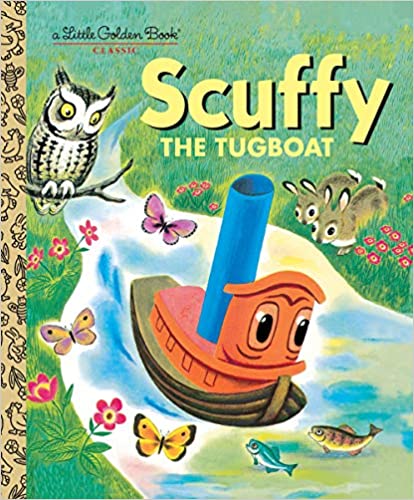
Nana Kitty believed in books. She had a set of encyclopedias from the 1950s on a petite bookshelf in her doll-sized living room. Those volumes contained the world, from Argentina to Yugoslavia, from Aardvark to Zebra, from Mercury to Pluto. I sat on her sofa and played alphabet roulette, reading about Queen Victoria one time and Canada another time. Nana also had a handful of Little Golden Books. My favorite was Scuffy the Tugboat. After Nana died, I ended up with some of the Little Golden books, including Scuffy, which I sometimes read to my grandchildren.
When I was in elementary school, my mother refused to buy me a pair of black patent leather shoes. I was a tomboy and she believed I would wreck them before I could outgrow them, so she considered them a waste of money. But my mother believed in books. Every time I came home from school with a book order form, which was two or three times a year, she let me order three or four books. She never told me they were a waste of money, even when money was tight. Each time my books arrived and the teacher gave me my stack held together with a rubber band, I smelled their newness then hugged them to my chest. I had wanted patent leather shoes, so I would fit in with the patent-leather-shoe girls. But my shoes were never going to make a difference. The books, however, were great friends who took me to new worlds.
In fourth grade I read biographies. The library at Pleasant View Elementary had a series of biographies. Eventually, I read them all–Marie Antionette, Catherine the Great, Alexander Graham Bell, Florence Nightingale, Edith Cavell, Jenny Lind, Marie Currie, and others whose names I can’t remember. While I wanted to sing like Jenny Lind, the person I most admired was Madam Marie Currie. She was determined to get an education despite living through political upheaval and at a time when women didn’t routinely attend college. Between the biographies, I read Alfred Hitchcock and the Three Investigators mysteries, and Nancy Drew mysteries.
On Christmas morning there were always some books and new pajamas under the tree. My third favorite part of Christmas day (after the unwrapping and eating) was to climb into bed wearing my new jammies and read my new book. When I was in seventh grade, my mom bought me a complete, unabridged, two-volume set of Sherlock Holmes. She knew I liked mysteries. During Christmas break, I sat in a stuffed armchair with a dictionary tucked beside me and Sir Authur Conan Doyle’s wily detective and his sidekick on my lap. At first, I needed to look up lots of words, but before long I could read Doyle’s stories with only an occasional turn to the dictionary. I was Little Blue Engine, chugging away, up the mountain of new words. I felt so proud that my mother bought something so grown-up for me.
I read through high school and college. During most of my twenties, when I read for fun, it had to be a book written by a British author before 1900. I’ve been a reader my whole life, fiction and nonfiction. I always have a book on my nightstand and a book on the end table. I often have a book in my purse, and in a pinch I have a nook app on my phone with some witty, heart-throbbing regency romances by Jennifer Tretheway, books that are so much fun they are worth a second read.
Once I learned to read, I never stopped. I have a lot of books on my to-be-read pile, but that doesn’t stop me from buying new ones. Will I ever get them all read? Well, “I think I can–I think I can–I think I can–I think I can.”