Day 12—Christmas Surprise Earrings, Circa 1999.

Diamonds are difficult to photograph.

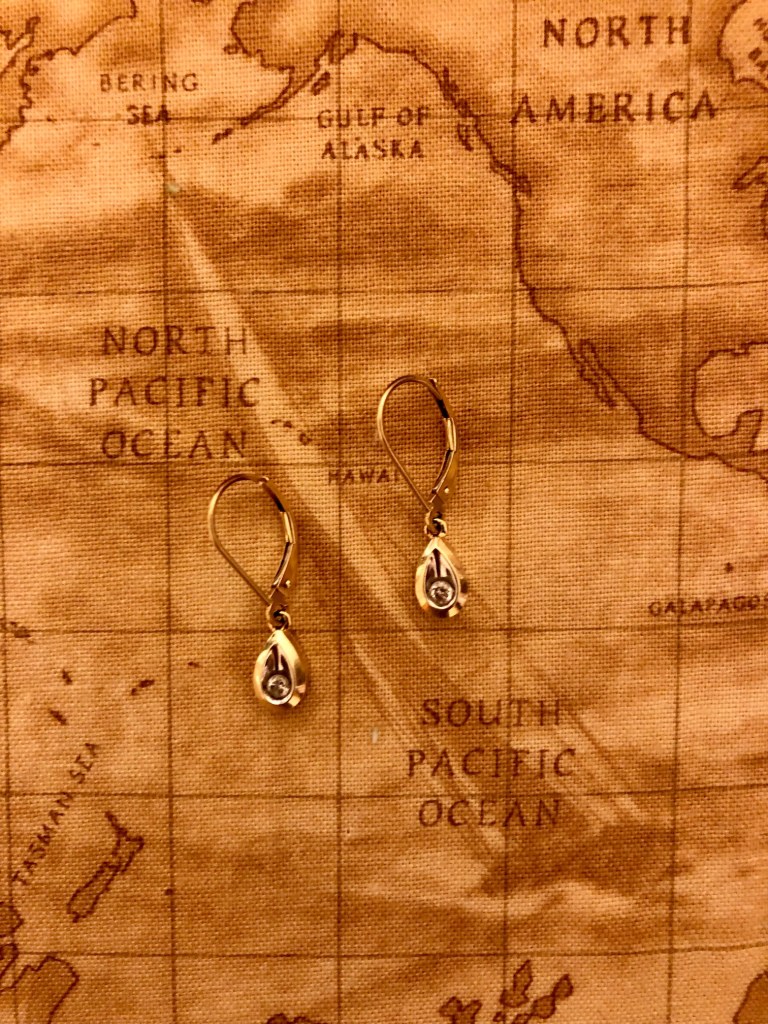
I opened my last gift, a small box that had been tucked under the tree in the back. Inside a pair of “mama-bear” diamond stud earrings winked at me.

I had long wanted a pair of diamond earrings, but the reality is two diamonds cost more than one, like double the price. I didn’t want to settle for tiny diamonds because I wanted them to catch and throw light. But I didn’t want diamonds so big they looked fake. I had wanted mama-bear-sized diamonds, which were still in a fairy tale beyond my budget.

I gushed, and told my husband they were perfect. But I worried they cost more than our Christmas budget allowed. He’d won the money on a football pool. He’d guessed, correctly, the outcomes of more football matchups during the season than anyone else. And he used the money he won to buy me diamond earrings.

“I’m sorry they’re kind of small,” he said.

“Are you kidding?” I laughed. “I was just thinking they’re so big.”

I put on my new earrings. My husband gave up his winnings to buy me a special gift. I think of my diamond studs as my O. Henry earrings.

Day 11—Winter Earrings

I wasn’t looking to buy earrings. (Ho, ho, ho.) I was just looking at the rack, passing time while my mother shopped for clothes in a boutique in Harbor Springs, Michigan.

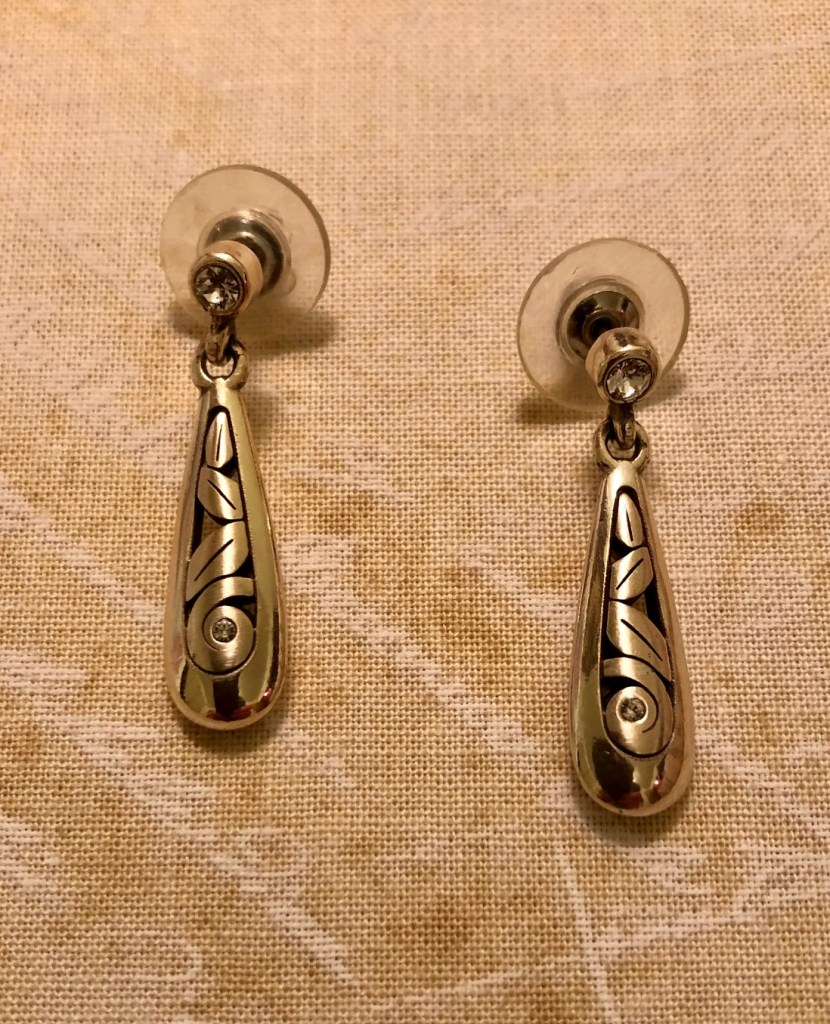
But when I saw these silver-colored drop earrings with hints of black peeking through the cutwork, and set with white crystals, I changed my mind. At just under $30, my wallet agreed.

But my mother and I arrived at the checkout counter at the same time, and she bought them for me.

I call these my winter earrings because they make me think of snowflakes, silver bells, and icicles.

They pair nicely with a black-and-white winter sweater my mother bought me for Christmas in 2018, three months after she bought me the earrings.

This year I hope to wear the earrings and the winter sweater while sharing Christmas dinner with my mother.

Overlooking Lake Michigan, Christmas Eve morning, 2018

Day 9—My Earring Gets a Bruise.

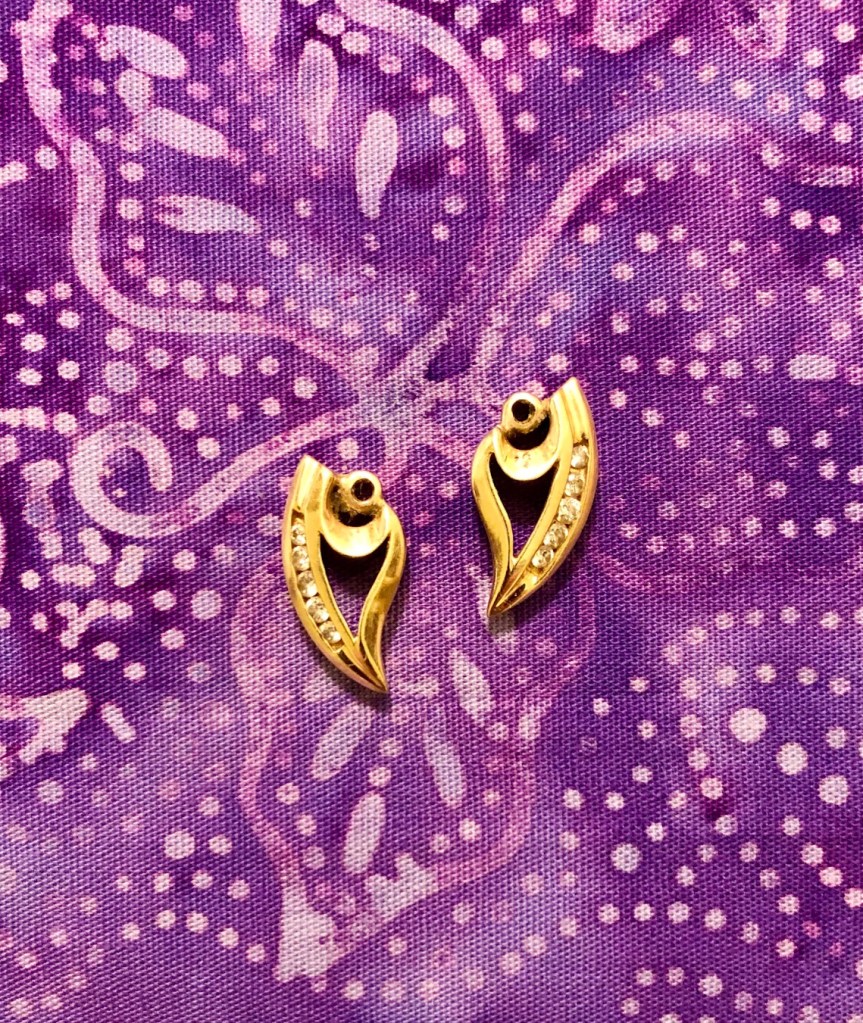
Today’s earrings were a gift from my son, circa 1991. He doesn’t remember selecting them for me because he was about five and a half, but he did go to the jewelry store with me.

I’d gone to the store to have a watch battery replaced. While I talked to the jeweler, my son stood by a stand of earrings and slowly turned the display.

“Mom,” he said, “you should buy these. They’re pretty.”

I turned to look and started to tell him I wasn’t buying earrings. But he was right, they were pretty.

Very pretty. Fourteen-karat gold. Inexpensive, considering.

“They’d look pretty on you,” he said. He wanted me to have them.

I bought them.

A couple of months later, I bruised one of the earrings.

I’d cradled the handset of a rotary phone between my shoulder and my ear, never thinking I could damage the earring because it was small.

When anyone had complimented me on these earrings, I’d smile and tell them my son bought them for me.

The bruised side of my earring

Now, I’d been careless with his gift.

I tried to buy another pair, but the jeweler couldn’t get another pair.

I asked if it could be repaired, but the jeweler said trying to fix it would make it worse.

I looked at the tiny dents located on one side of the earring.

Facing a mirror, I put on the earring and twisted it until the indentations were facing the floor. I looked into the mirror—I couldn’t see the damage, so no one else would.

I still wear them. They’re still pretty.

My small son wanted me to have them, so abandoning them was never an option.

Day 7—Earrings and Associations

Today’s earrings came from my mother. She received them as a gift from a friend who’d taken a trip to Fiji. My mother wore them a few times, but they’re not her style.

My mother, her friend, and I have spent time together, going to Mackinac Island, eating meals together, watching fireworks from a deck on Lake Michigan. So, a few years after my mother received these earrings, she gave them to me.

I haven’t worn them since the pandemic started in 2020. They aren’t wear-with-a-pair-of-blue-jeans-and-a-T-shirt earrings. But today I think I pulled it off. I wore a navy-blue turtleneck, a pale blue sweater and blue jeans. And when I left the house in the afternoon rain, I wore a dark-blue rain jacket with a sophisticated yet subtle tone-on-tone print. The earrings and rain jacket could be soulmates. (If you’re wondering, Anna Wintour never worries when I talk fashion.)

These earrings remind me of a ride in the backseat of a rented midsized sedan from Kohler, Wisconsin, to Milwaukee in July 2010.

I sat in the middle of the backseat because it was my turn to sit in the middle. And because no one cared about my moderate claustrophobia.

As I slid into the center of the seat, I remembered a surgeon’s advice before I had an MRI: “Close your eyes before you enter the tube and don’t open them.”

My mother drove out of the parking lot. I tilted my head back and closed my eyes. I asked my sister-in-law, who sat to my right, to tell me about her scuba diving trip to Bali.

I asked why she wanted to learn to scuba dive. She has lived in Arizona all her life.

I asked her how she learned. Pools were involved.

I asked her about the dangers. There’s a lot that can go wrong on a dive.

I asked her about the world under the waves.

For fifty miles, a blue-green ocean teaming with exotic fish, coral reefs, and scuba divers screened on my eyelids. For every question I asked, she wove a narrative taking me out of the middle of that backseat. I kept my eyes closed.

These earrings remind me of Fiji, my mother, and her friend.

These earrings remind me of Bali, my sister-in-law, and fifty miles of scuba diving adventures.

I know Fiji is not Bali. My sister-in-law hasn’t met my mother’s friend. These earrings didn’t exist in July 2010.

Doesn’t matter. Neurons forge our networks of memories.

Every time I wear these earrings, I return to my happy place in the waters of Bali among fish and reefs and divers—a place I’ve never been.

Day 6—Traveling Teardrop Earrings

I bought these earrings in Tucson, Arizona, in 2003. I went with my husband and sons to visit my mother and stepdad in Phoenix and my father and siblings in Tucson.

These earrings have traveled to Rhode Island, Iowa, Illinois, North Dakota, Minnesota, Wisconsin, Indiana, Hawaii, and Canada. These are hockey earrings. They’ve seen my youngest son play lots of hockey games in many cities. I have a rule about jewelry when I travel—only one pair of earrings and one necklace. These are the earrings that almost always made the cut.

I’ve worn these earrings more than any other pair of earrings I own, so maybe that makes them my favorite pair. As my mother would say, “You can wear them with blue jeans or an evening dress.”

I wore this pair to Winnipeg, Canada, to a hockey tournament. On Saturday morning, I was waiting in the car for my husband to come out of the hotel, so we could head to the rink.

After he got in the car, he said, “Do you feel naked?”

“What?” I hadn’t forgot to put on my pants. (This was long before COVID-19 and pants-less Zoom meetings and endless jokes about people forgetting to wear pants.)

He laughed and asked again, “Do you feel naked?”

“What do you mean?” I asked.

He extended a closed fist toward me then opened his fingers. Nestled on his palm were my teardrop earrings.

“I thought you might want these, so you didn’t feel naked,” he said.

“Yes, thanks.” I lifted my earrings off his palm and leaned over to kiss him before dressing my bare earlobes.

He had remembered that I had once said I felt naked if I forgot to wear earrings when I left the house.

I’ve never forgotten that he remembered.

Day 5—Sleepy Thoughts on COVID and Earrings

I almost didn’t write today’s post about earrings. I received my COVID-19 booster yesterday evening at 5:15, and today I had aches, low-grade fevers, and major fatigue. Last March when I had my second shot, I was so tired for two days that even getting out of bed to go to the bathroom was exhausting. Today was better than last time, but I still needed four substantial naps. I tried to imagine what it would feel like to have a serious case of COVID.

I chose today’s earrings this morning but didn’t put them on until 6:15 this evening when I started writing this blog. I can’t wear earrings when I sleep.

Today’s pair are Black Hills Gold, a pink-colored rose encircled by golden leaves. I bought them around 1990 with birthday money my father gave me. Every year he’d send me birthday money, and I’d buy something for myself. I couldn’t tell you what else I bought over the years, but I remember thanking him for these earrings.

My father passed away in September 2016 from a heart attack, but dementia had begun to stalk him. If he were alive, he’d be in a nursing home and probably isolated by surges of COVID.

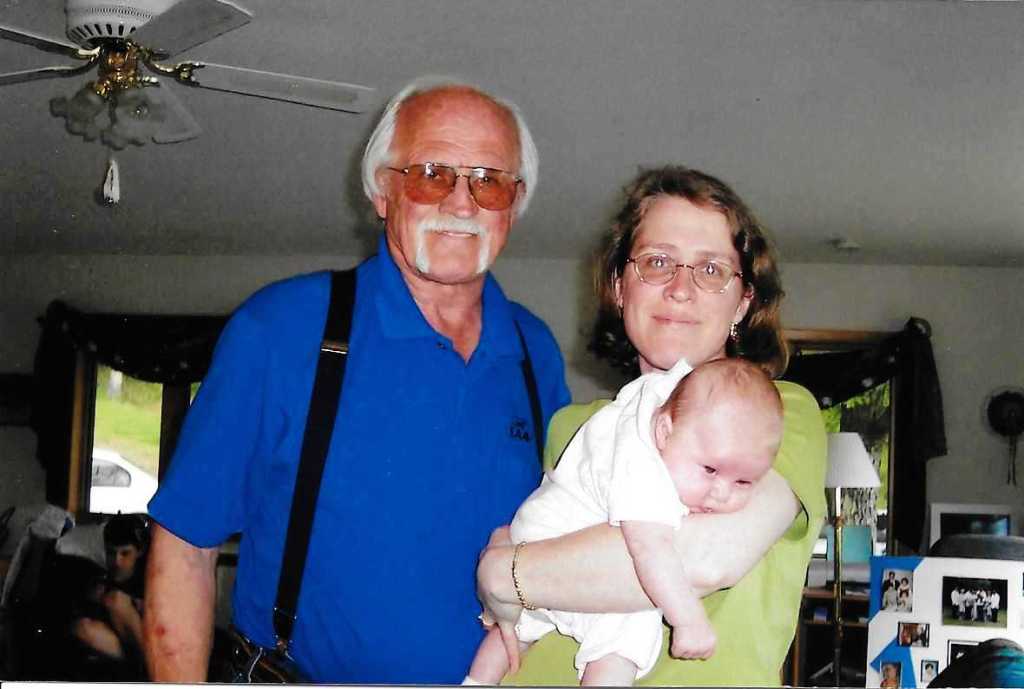
My dad, me, and my cousin’s baby, May 2005

Yesterday on my way to the vaccine clinic, I listened to a story on public radio about sailors who are stuck on cargo ships that can’t get into port. And when they finally do, the sailors aren’t given shore leave because they aren’t vaccinated. The nightly news reports on hundreds of ships stalled in the ocean, but I haven’t heard them talk about the sailors on the ships.

The public radio journalist interviewed a maritime chaplain who comforts crew members stranded on ships. These people can’t see their families, can’t get off a ship to wire money home, can’t walk down a sidewalk. I’m embarrassed to say, I never thought about the people on those ships. One sailor’s wife is divorcing him because she hasn’t seen him in so long. These sailors don’t have the freedom to get off the ship, and they don’t know when they’re going home. I remembered a history lesson about the impressment of American sailors being one of the causes of the War of 1812. I wonder how little a sailor’s life at sea has changed over the last few hundred years.

When I arrived home, I told my husband, “I can’t believe I never thought about the people on those ships. How could I not think about them?” The focus is always on the cargo.

Today was a difficult day. Feeling lousy makes me feel blue, and I spent the day—when I was awake—close to tears.

But . . .

I’m thankful for my vaccines.

I’m thankful I remember the earrings I bought with birthday money from my father.

I’m thankful public radio aired a story about sailors stuck on ships.

I’m thankful that my biggest worry about COVID is being laid low by a vaccine.

Day 2—Second Choice Earrings, Circa 1985

My husband bought these earrings for me—sort of.

I had picked out a pair of small, thick gold hoops with a smooth surface.

The jeweler at our local mall knew what I wanted, so my husband picked them up and paid for them. Wrapped in shiny silver paper and a white bow, my husband presented them to me. Surprise! What nice earrings! Thank you!

The real surprise, however, came when I tried on the earrings. The thin wire threaded through my pierced ear with ease. Next, the wire was supposed to slip into a small hollow opening at the back end of the hoop. I tried for five minutes to get the slender wire into the opening and failed because I could not see behind my ear. Trying to use a mirror was hopeless.

“I can’t wear these,” I told my husband. “I can’t get them closed.”

I took them back to the jeweler, who said I could exchange them for another pair of earrings. So, instead of the sleek, smooth finished hoops I had liked, my second-choice earrings had a hammered finish I did not like. In addition, they were more expensive, although still in our budget.

My husband razzed me about pulling a bait and switch, so I could get a more expensive pair of earrings. I protested and explained again about not being able to close the first pair. “I’m kidding,” he said. I did not tell him that I did not like the second pair as much as the first pair. After all, they were a gift from him.

My husband and I have been married for thirty-six years, and I’ve had these earrings about that long. They are a pair of go-to earrings—the kind I can wear with any outfit. I have come to like them much better than the first pair I chose.

Flowers in a Summer of Pandemic Lull and Surge

Lake Michigan

July 27, 2021. I left my home on the western shores of Lake Superior to visit my mom on the eastern shores of Lake Michigan. It’s a nine-hour trip across northern Wisconsin, through the Upper Peninsula, and over the Mackinac Bridge.

The delta variant, snaking its way around the South, hadn’t seemed to arrive in the North.

My last trip to Mom’s was three weeks earlier. My next trip was supposed to be at Christmas when snow and ice bloom and high winds roar off the lake.

I decided to visit again because the pandemic canceled last year’s Christmas plans. And I’m not hopeful about this year’s plans.

I came by myself, leaving my husband and dogs at home. I wanted to spend time alone with Mom. We shared stories, ate Indian and Thai takeout, and walked her dog along Lake Michigan in warm, Technicolor evenings.

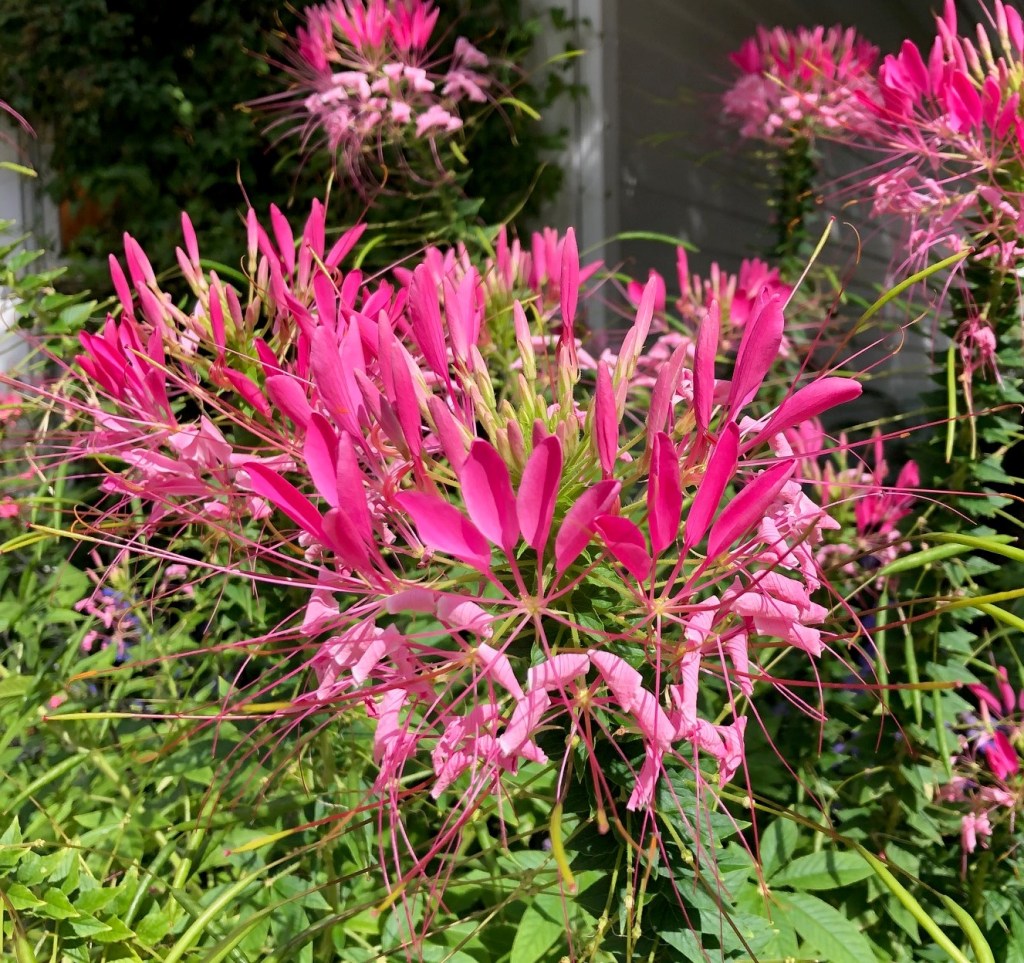
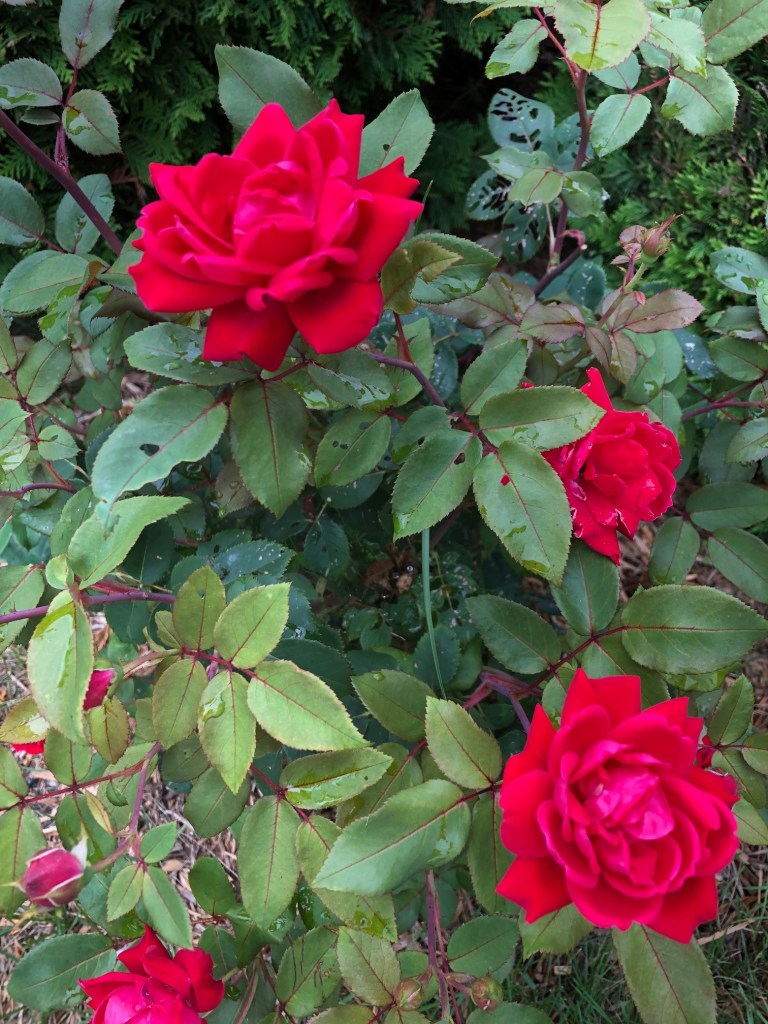
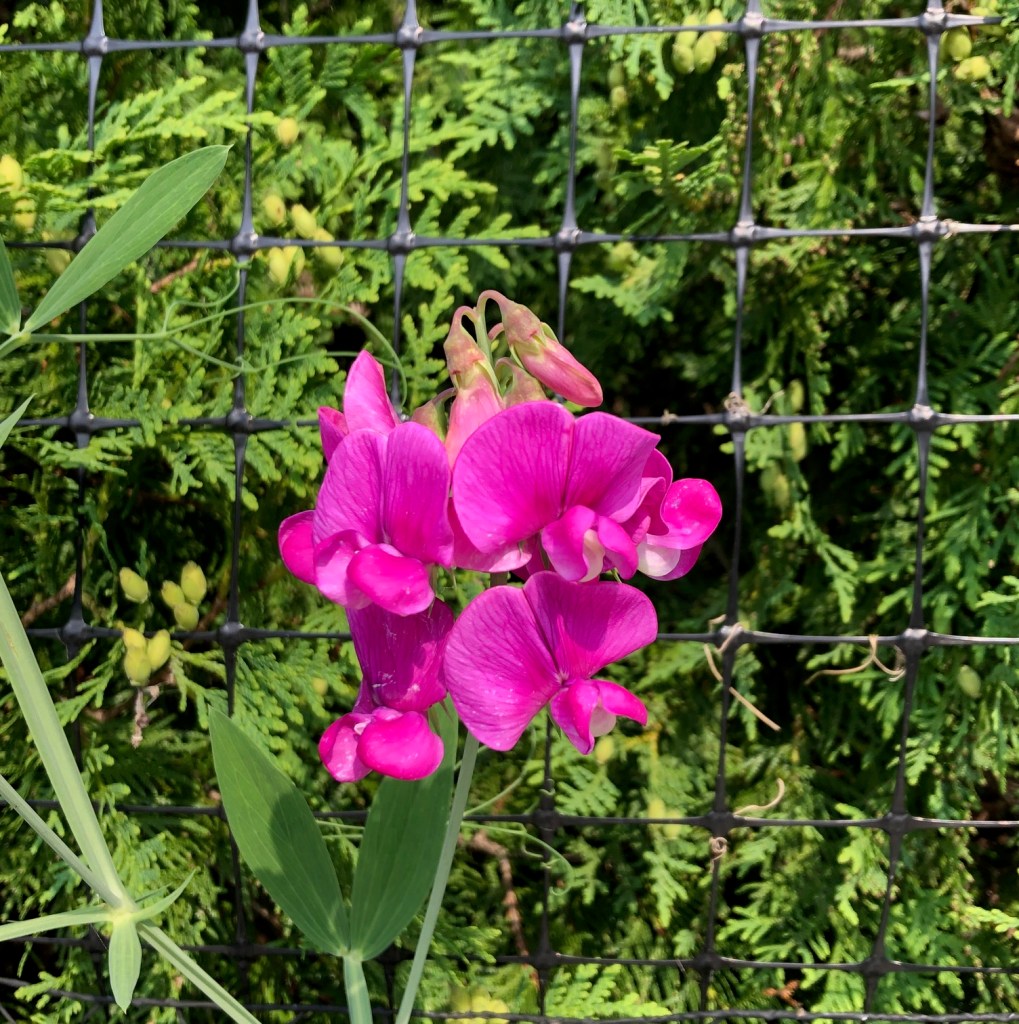
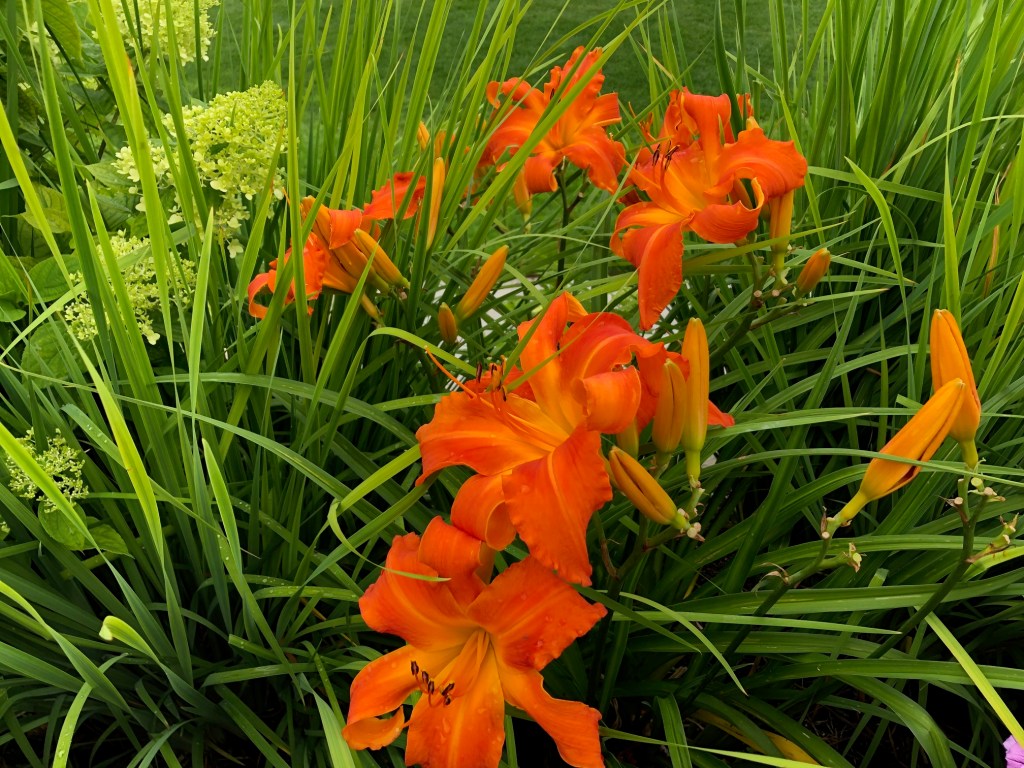
And I took pictures of flowers, lots of pictures. The characteristics of light in the Harbor Springs-Petoskey-Charlevoix area are different than the characteristics of light in the Duluth-Superior area. I wonder if it’s because the sky reflects the different colors of the two lakes. I wonder if it’s because the latitude of Petoskey is slightly over 43 degrees, and the latitude at the western tip of Lake Superior is about 46.6 degrees. Doesn’t sound like much, but that’s a difference of 207 miles. Whatever the reason, I get a Land-of-Oz feeling when the sun is shining at Mom’s.

Flowers are everywhere in Harbor Springs, Petoskey, and Charlevoix–in yards, in front of shops, along city streets, hanging from lamp posts. Flowers greet residents and welcome tourists with vibrant oranges, blues, reds, pinks, purples, yellows, whites, and greens.

Some gardeners plant only two or three colors together, but many mix all the the colors together and it works. If I tried to dress in the same array of colors, people might call me eccentric.

A friend and I once noticed how nature can toss together a salad of greens (lime, forest, army, olive, sage, emerald, fern, pea, mint) and throw them across the landscape and none of them will clash.

In the mornings, Mom and I ran her errands and went for rides. When she entered shops, I spent little time inside with her. I’d go back outside and take pictures of flowers, lots of pictures.

The vaccination rate for her county is about 61% for people who’ve had at least one shot. The recommendation has been for unvaccinated people to wear masks. Less than almost no one wore a mask. Statistically, about 39% of the people should’ve been wearing masks.

I know some math.

I provide daycare for my grandkids.

My grandkids are too young to get vaccinated.

I wore a mask and stayed away from people.

I ate takeout.

And I took pictures of flowers, lots of pictures.

Sunday Afternoon at Brighton Beach

Sunday, August 8, Duluth, Minnesota

I take my grandkids to Brighton Beach once or twice a summer. It’s one of the beaches we visit every year. Today I take them because it’s the last day Brighton Beach will be open to the public for a year, maybe two. The Lakewalk will be extended, Brighton Beach Road will be relocated, and the shoreline will be restored. I wonder how much it will change. I hope “restoring the shoreline” doesn’t mean depositing wide swaths of immense jagged rocks on the beach that become a barrier which hinders kids from pitching stones in the water and from gamboling on the ancient lava formations along the shore.

Charlie, who’s almost three, has never been to Brighton Beach. Evan, who’s almost five, says he’s never been there. I remind him that I took him last summer. When I turn on Brighton Beach Road, he says, “Oh yeah, I’ve been here.” Clara and Michael, ten and eight, are seasoned visitors.

It’s a grey, breezy day (code for sustained winds of 16 mph). But it’s 64 degrees, so we don’t have to worry about hypothermia.

After parking and unbuckling, the kids pour out of the van and run toward the shore. Before they disperse, I bark a request, “Everyone up on that smooth rock. I want a picture of you all together.” A few clicks later, they’re off in four different directions. I stick with Charlie. I don’t want him to fall off a bank of rock and into the water.

“Charlie,” I say, “let’s throw rocks in Lake Superior and fill it up.”

“We can’t fill that up,” he says. Sometimes my dry wit is too parched for him.

But Charlie tries. For forty minutes, he picks rocks, shoves them in his pockets, walks to the water’s edge, and with lopsided degrees of accuracy, throws them in the water. Normally, he smiles and laughs easily, but absorbed by this task, his face scrunches with seriousness the whole time.

Clara, Michael, and Evan run and leap from one smooth lava formation to another. I yell, “Not so close to the water” and “slow down.” The wind and roar of the waves hitting the shore make it difficult for them to hear me. They toss a few rocks, but they’ve outgrown the thrill of flinging rocks in the water.

Clara and Michael comb through rocks on the beach, looking for agates. Evan keeps walking on the rock formations. My head is on a swivel as I watch all three of them while watching Charlie throw rocks, making sure he doesn’t fall in the water with one of his tosses.

There are three kids at the beach, around seven to nine years old. Evan’s been watching them, following them while keeping some distance. The next time I look up to locate each grandkid, I see the three kids forming a follow-the-leader line. Evan watches and at the last moment, he joins in as the caboose. A few minutes later, he’s talking with one of the kids.

Later, before we leave, Evan says, “I was making friends.” He’s almost five and he misses friends. There are no kids his age in his neighborhood. He remembers daycare and having friends before the pandemic. “Yes, you made friends,” I say. “That’s nice.” But he’s forlorn. He knows the new friendships are fleeting.

Shortly before we leave, Clara and Michael return to the rocky outcroppings. Clara stands near the edge and flirts with the surf breaking on the rocky shore, letting the water spray her but scurrying backwards when bigger waves break.

Michael runs and leaps along the rugged terrain. I stuff the urge to yell at him to stop. I’ve already issued too many warnings: “Slow down! Don’t get too close to the edge! Stay out of that puddle of water—you’ll soak your feet!”

My admonishment about the deep puddle of water was given to Evan right after one of his new friends walked through it with his tennis shoes while his dad watched. That dad must’ve thought I was hampering my grandkid’s fun. But when you watch kids who aren’t your own, the stakes are higher.

After forty-five minutes at the beach, I gather up my mostly-dry grandkids and we get in the van. “I suppose you’re all too cold for ice cream,” I say. None of them are too cold for ice cream. It’s a delicious way to end the afternoon.

[For more information about the plans for Brighton Beach: WDIO News: Story about Brighton Beach closing.]

Come Again Now

[“Come Again Now” was published Minnesota’s PBS Stations on their webpage Moving Lives Minnesota: Stories of Origin and Immigration on April 17, 2021.]

FRANK AND ROSE MEET

Frank and Rose Youngquist, wedding photo, September 1898

            About 1892, Frank Youngquist left Stillwater to work as a blacksmith in Gordon for Musser-Sauntry, a logging company with interests in Minnesota and Wisconsin. In 1897, Rose Yost left her parents’ farm in Columbus, Minnesota, to work at the Smith Hotel in Gordon, owned by her sister and brother-in-law, Aggie and Jim Smith.

            Frank, 32, handsome, brown-haired, and blue-eyed, met Rose, 29, pretty, dark-haired, and brown-eyed, at the Smith Hotel where he lived. They fell in love and married on September 21, 1898, in Hennepin County, which gave them an opportunity to visit family in Minnesota before returning to Gordon.

FRANK’S MINNESOTA CONNECTION

            Before Frank’s and Rose’s lives intersected in Gordon, they grew up 32 miles from each other in Minnesota. Frank’s father, Johan Youngquist, came from Sweden to Minnesota in 1868, and settled in the Stillwater area. A year later Johan’s wife, Eva, arrived with their four young children, including 2-year-old Frank. They would have four more children.

            Johan’s family probably emigrated because of economic hardships. Sweden’s rapid population growth in the 1800s diminished job opportunities and caused farmland shortages. Crop failures in 1868 and 1869 deepened economic woes, pushing more Swedes to seek opportunity in America. After reading letters from family, who spoke highly of their lives in Minnesota, many Swedes chose to settle there.

            Johan, Eva, and their children prospered as laborers, farmers, blacksmiths, lumberjacks, and business people. The railroads and lumber industry provided plenty of opportunities for immigrants. Five of Frank’s seven siblings spent most of their lives in Minnesota, and his parents lived there until they died.

ROSE’S MINNESOTA CONNECTION

            Rose’s parents, Yost Yost and Agatha Gassman, emigrated from Switzerland around 1854. Yost and Agatha, both Catholic, might have left Switzerland because of religious unrest during the 1800s. Yost lived in the Canton of Lucerne, which became embroiled in religious tensions between Catholics and Protestants after the Jesuits, reinstated by Pope Pius VII in 1814, returned to Switzerland.

            Yost and Agatha married in Rochester, New York, in 1855. A year or two later, they moved to Columbus, Minnesota, to homestead 160 acres. They raised seven children, all born on their farm. One son became an engineer for the Great Northern Railway, working on the mail train out of St. Paul. The other son ran the farm when Yost retired. Their five daughters all married, but only one remained in Minnesota. Yost served as a town clerk and justice of the peace in Columbus. From 1864 to 1866, he served in the Minnesota Cavalry, Hatch’s Battalion, Company E, and was stationed on the Dakota-Minnesota frontier. He and Agatha are buried in St. Joseph’s Catholic Cemetery in Wyoming, Minnesota.

TRAGEDY STRIKES

            In 1910, after twelve years of marriage and four children, Frank and Rose, still living in Gordon, died a month apart, Frank, 44, on October 18, and Rose, 41, on November 17.

            Frank lingered four months before dying of tuberculosis. He wished to be buried in Stillwater at the Fairview Cemetery with his father and two brothers. Frank had lived over half his life in Minnesota, and his mother and some family members still resided there. After Rose died from heart failure, she was buried next to Frank. Their children, George, 11, Elmer, 9, Leslie, 8, and Lola, 4, stayed in Gordon. Aggie and Jim Smith, Rose’s family, looked after them.

GEORGE’S COMFORTING TRADITION

George Youngquist with his wife Olive and Frank, their first child, circa 1940

            Perhaps because of a mysterious, debilitating illness George had when he was about 1½, he was close to his parents. The illness left him unable to walk, so his father forged railings in his blacksmith shop and attached them to the walls of their home. Encouraged by his parents, George pulled himself up and held the railings. He regained strength and learned to walk again. However, as a young schoolboy, his illness left him unable to run and play with other children. To entertain George, Frank taught him blacksmithing skills after school. George cherished the time with his father. Thirty-some years later, a doctor told George that he had had polio.

            From the 1930s until 1979, because George never forgot his parents’ love and kindness, he drove 120 miles from Gordon to Fairview Cemetery in Stillwater, Minnesota, to visit their graves either on or near every Memorial Day. By the time George and his family arrived, any Memorial Day services were over. But in the hushed cemetery with spring unfurling, George remembered his parents.

            Whenever George had company, he always bid farewell to his visitors by saying, “Come again now.” Perhaps, each year when he left the cemetery, he imagined his parents telling him, “Come again now.” And he did until he lost his eyesight in the winter of 1979, two-and-a-half years before he passed away just shy of his 82nd birthday.

[More Moving Lives posts written by other writers can be read at Moving Lives Minnesota: Stories of Origin and Immigration.]