I almost didn’t write today’s post about earrings. I received my COVID-19 booster yesterday evening at 5:15, and today I had aches, low-grade fevers, and major fatigue. Last March when I had my second shot, I was so tired for two days that even getting out of bed to go to the bathroom was exhausting. Today was better than last time, but I still needed four substantial naps. I tried to imagine what it would feel like to have a serious case of COVID.
I chose today’s earrings this morning but didn’t put them on until 6:15 this evening when I started writing this blog. I can’t wear earrings when I sleep.
Today’s pair are Black Hills Gold, a pink-colored rose encircled by golden leaves. I bought them around 1990 with birthday money my father gave me. Every year he’d send me birthday money, and I’d buy something for myself. I couldn’t tell you what else I bought over the years, but I remember thanking him for these earrings.
My father passed away in September 2016 from a heart attack, but dementia had begun to stalk him. If he were alive, he’d be in a nursing home and probably isolated by surges of COVID.
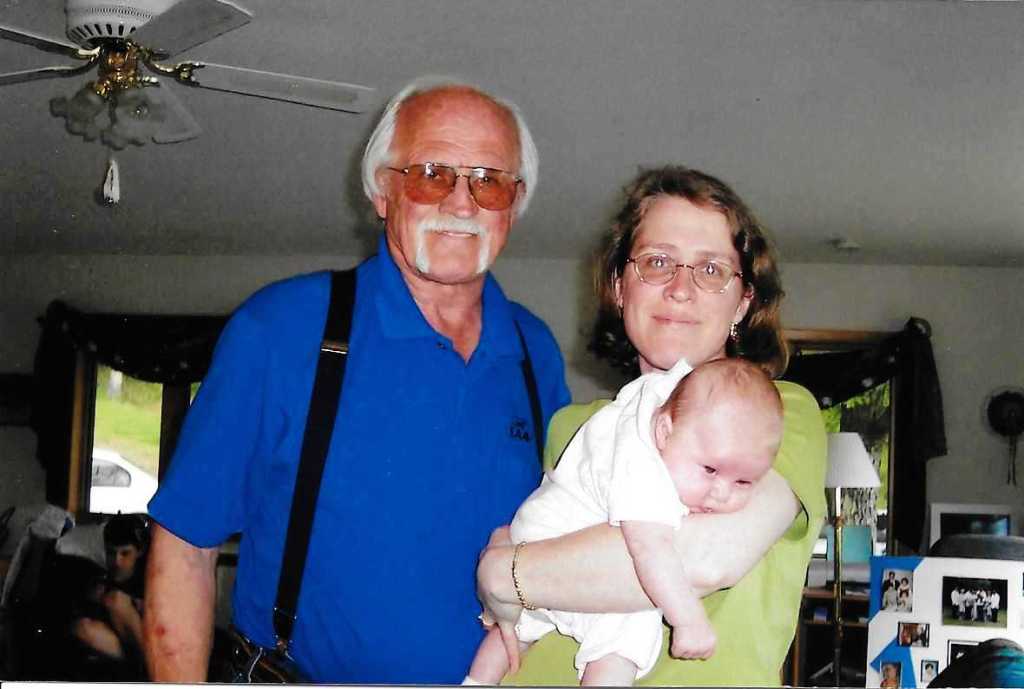
My dad, me, and my cousin’s baby, May 2005
Yesterday on my way to the vaccine clinic, I listened to a story on public radio about sailors who are stuck on cargo ships that can’t get into port. And when they finally do, the sailors aren’t given shore leave because they aren’t vaccinated. The nightly news reports on hundreds of ships stalled in the ocean, but I haven’t heard them talk about the sailors on the ships.
The public radio journalist interviewed a maritime chaplain who comforts crew members stranded on ships. These people can’t see their families, can’t get off a ship to wire money home, can’t walk down a sidewalk. I’m embarrassed to say, I never thought about the people on those ships. One sailor’s wife is divorcing him because she hasn’t seen him in so long. These sailors don’t have the freedom to get off the ship, and they don’t know when they’re going home. I remembered a history lesson about the impressment of American sailors being one of the causes of the War of 1812. I wonder how little a sailor’s life at sea has changed over the last few hundred years.
When I arrived home, I told my husband, “I can’t believe I never thought about the people on those ships. How could I not think about them?” The focus is always on the cargo.
Today was a difficult day. Feeling lousy makes me feel blue, and I spent the day—when I was awake—close to tears.
But . . .
I’m thankful for my vaccines.
I’m thankful I remember the earrings I bought with birthday money from my father.
I’m thankful public radio aired a story about sailors stuck on ships.
I’m thankful that my biggest worry about COVID is being laid low by a vaccine.
I had picked out a pair of small, thick gold hoops with a smooth surface.
The jeweler at our local mall knew what I wanted, so my husband picked them up and paid for them. Wrapped in shiny silver paper and a white bow, my husband presented them to me. Surprise! What nice earrings! Thank you!
The real surprise, however, came when I tried on the earrings. The thin wire threaded through my pierced ear with ease. Next, the wire was supposed to slip into a small hollow opening at the back end of the hoop. I tried for five minutes to get the slender wire into the opening and failed because I could not see behind my ear. Trying to use a mirror was hopeless.
“I can’t wear these,” I told my husband. “I can’t get them closed.”
I took them back to the jeweler, who said I could exchange them for another pair of earrings. So, instead of the sleek, smooth finished hoops I had liked, my second-choice earrings had a hammered finish I did not like. In addition, they were more expensive, although still in our budget.
My husband razzed me about pulling a bait and switch, so I could get a more expensive pair of earrings. I protested and explained again about not being able to close the first pair. “I’m kidding,” he said. I did not tell him that I did not like the second pair as much as the first pair. After all, they were a gift from him.
My husband and I have been married for thirty-six years, and I’ve had these earrings about that long. They are a pair of go-to earrings—the kind I can wear with any outfit. I have come to like them much better than the first pair I chose.
July 27, 2021. I left my home on the western shores of Lake Superior to visit my mom on the eastern shores of Lake Michigan. It’s a nine-hour trip across northern Wisconsin, through the Upper Peninsula, and over the Mackinac Bridge.
The delta variant, snaking its way around the South, hadn’t seemed to arrive in the North.
My last trip to Mom’s was three weeks earlier. My next trip was supposed to be at Christmas when snow and ice bloom and high winds roar off the lake.
I decided to visit again because the pandemic canceled last year’s Christmas plans. And I’m not hopeful about this year’s plans.
I came by myself, leaving my husband and dogs at home. I wanted to spend time alone with Mom. We shared stories, ate Indian and Thai takeout, and walked her dog along Lake Michigan in warm, Technicolor evenings.
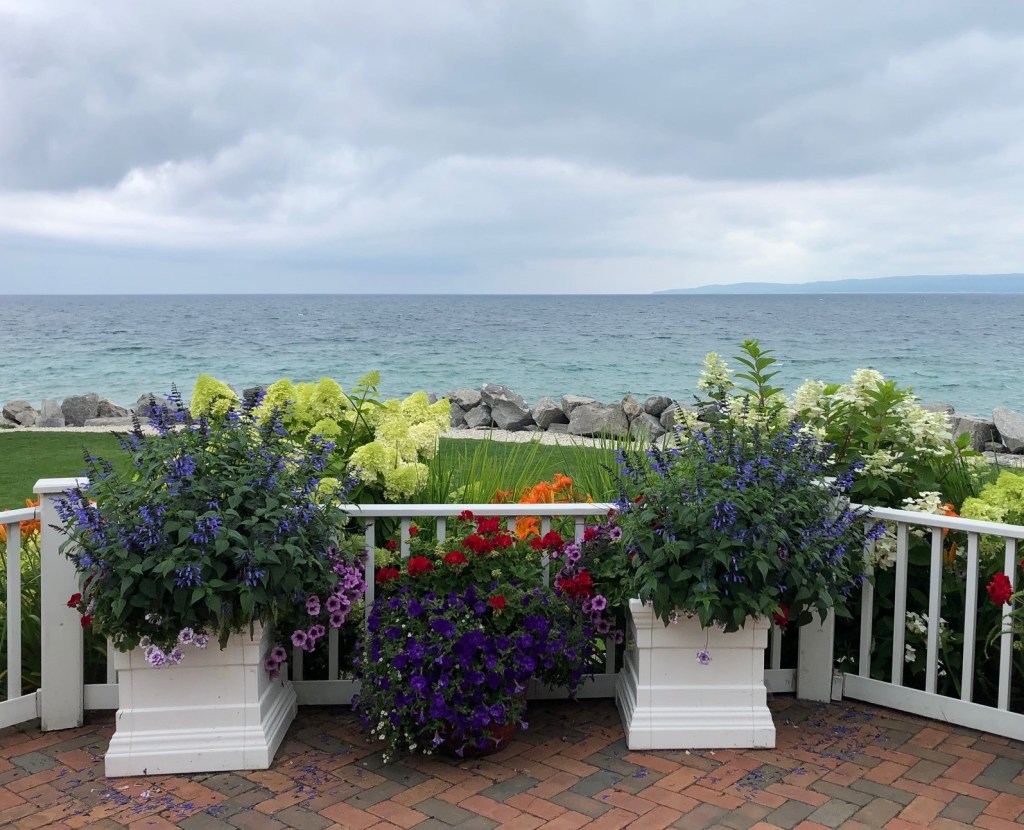
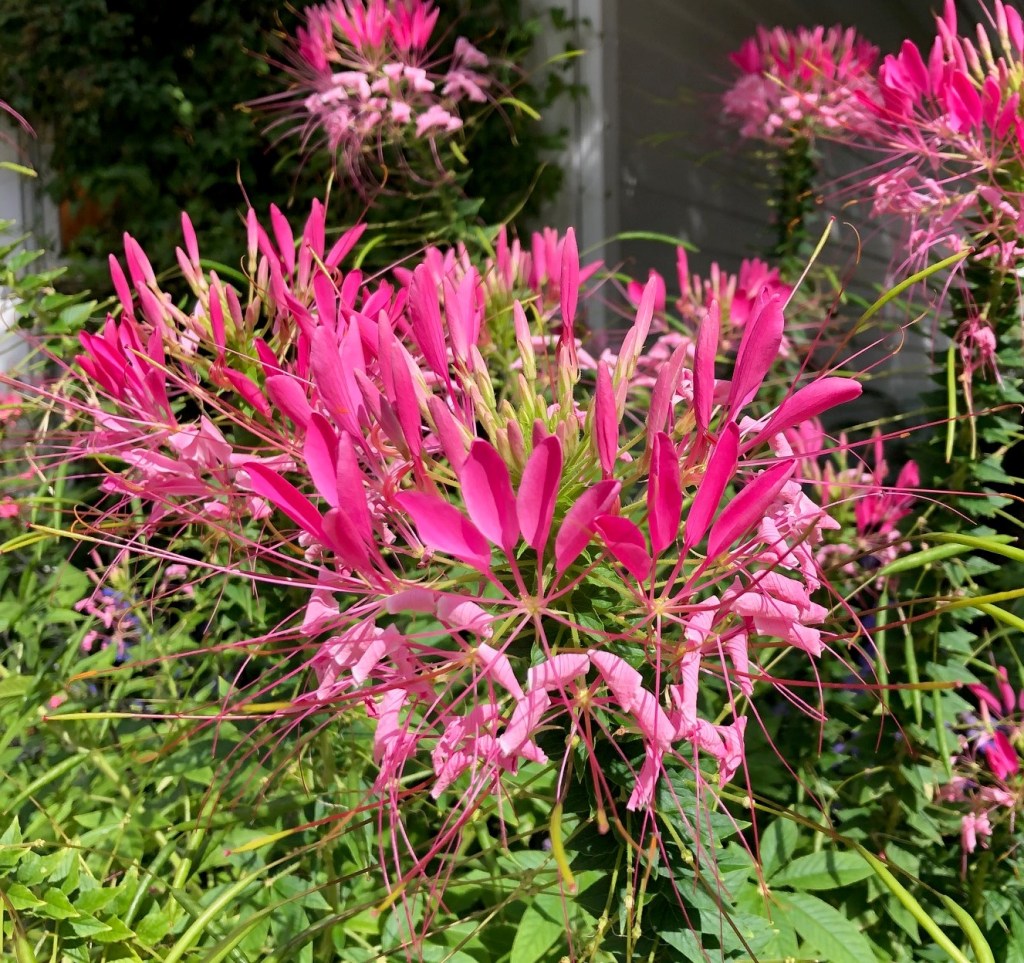
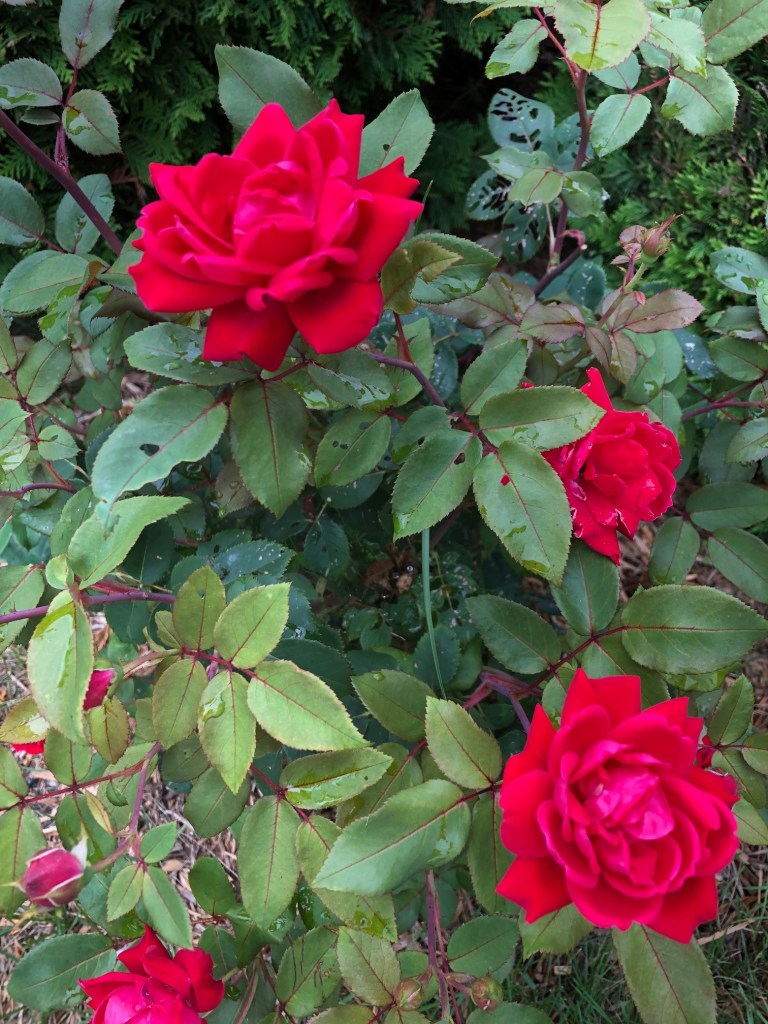
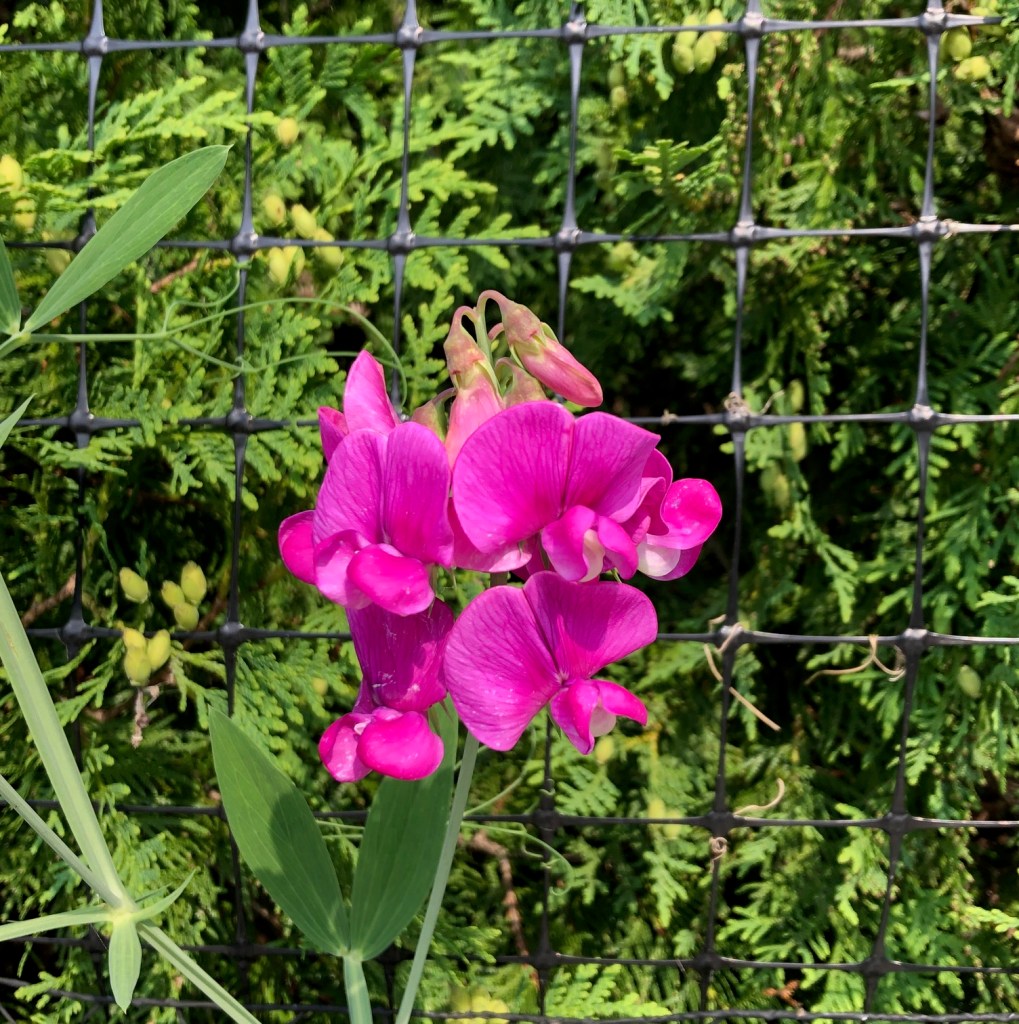
And I took pictures of flowers, lots of pictures. The characteristics of light in the Harbor Springs-Petoskey-Charlevoix area are different than the characteristics of light in the Duluth-Superior area. I wonder if it’s because the sky reflects the different colors of the two lakes. I wonder if it’s because the latitude of Petoskey is slightly over 43 degrees, and the latitude at the western tip of Lake Superior is about 46.6 degrees. Doesn’t sound like much, but that’s a difference of 207 miles. Whatever the reason, I get a Land-of-Oz feeling when the sun is shining at Mom’s.
Flowers are everywhere in Harbor Springs, Petoskey, and Charlevoix–in yards, in front of shops, along city streets, hanging from lamp posts. Flowers greet residents and welcome tourists with vibrant oranges, blues, reds, pinks, purples, yellows, whites, and greens.
Some gardeners plant only two or three colors together, but many mix all the the colors together and it works. If I tried to dress in the same array of colors, people might call me eccentric.
A friend and I once noticed how nature can toss together a salad of greens (lime, forest, army, olive, sage, emerald, fern, pea, mint) and throw them across the landscape and none of them will clash.
In the mornings, Mom and I ran her errands and went for rides. When she entered shops, I spent little time inside with her. I’d go back outside and take pictures of flowers, lots of pictures.
The vaccination rate for her county is about 61% for people who’ve had at least one shot. The recommendation has been for unvaccinated people to wear masks. Less than almost no one wore a mask. Statistically, about 39% of the people should’ve been wearing masks.
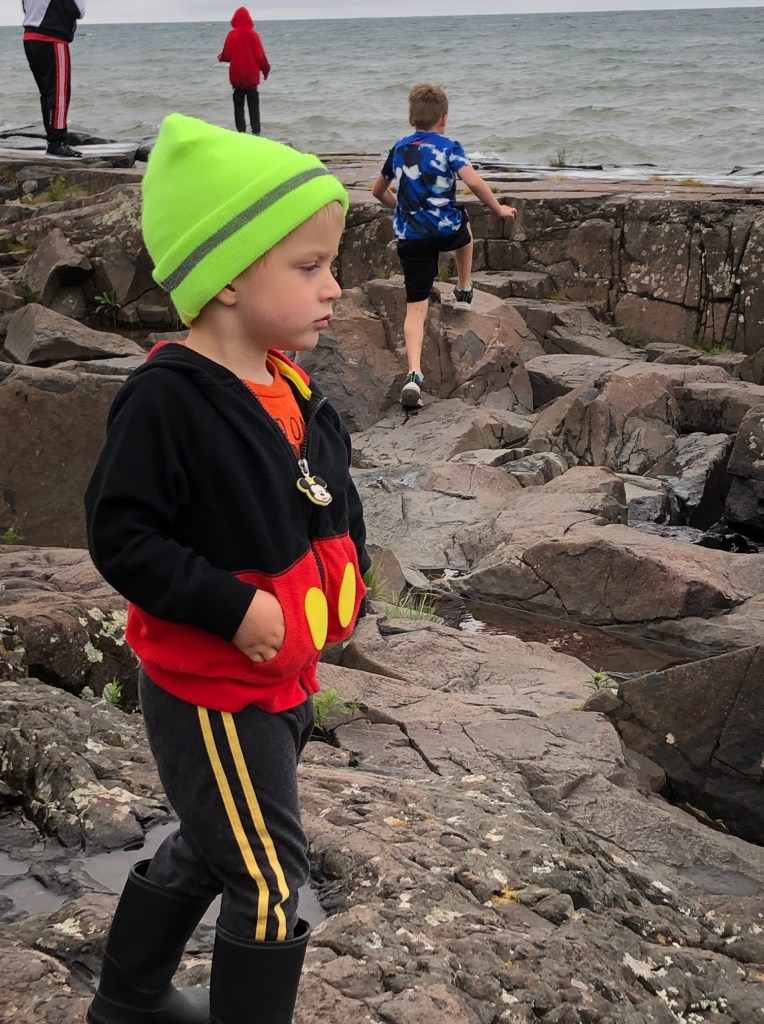
I take my grandkids to Brighton Beach once or twice a summer. It’s one of the beaches we visit every year. Today I take them because it’s the last day Brighton Beach will be open to the public for a year, maybe two. The Lakewalk will be extended, Brighton Beach Road will be relocated, and the shoreline will be restored. I wonder how much it will change. I hope “restoring the shoreline” doesn’t mean depositing wide swaths of immense jagged rocks on the beach that become a barrier which hinders kids from pitching stones in the water and from gamboling on the ancient lava formations along the shore.
Charlie, who’s almost three, has never been to Brighton Beach. Evan, who’s almost five, says he’s never been there. I remind him that I took him last summer. When I turn on Brighton Beach Road, he says, “Oh yeah, I’ve been here.” Clara and Michael, ten and eight, are seasoned visitors.
It’s a grey, breezy day (code for sustained winds of 16 mph). But it’s 64 degrees, so we don’t have to worry about hypothermia.
After parking and unbuckling, the kids pour out of the van and run toward the shore. Before they disperse, I bark a request, “Everyone up on that smooth rock. I want a picture of you all together.” A few clicks later, they’re off in four different directions. I stick with Charlie. I don’t want him to fall off a bank of rock and into the water.
“Charlie,” I say, “let’s throw rocks in Lake Superior and fill it up.”
“We can’t fill that up,” he says. Sometimes my dry wit is too parched for him.
But Charlie tries. For forty minutes, he picks rocks, shoves them in his pockets, walks to the water’s edge, and with lopsided degrees of accuracy, throws them in the water. Normally, he smiles and laughs easily, but absorbed by this task, his face scrunches with seriousness the whole time.
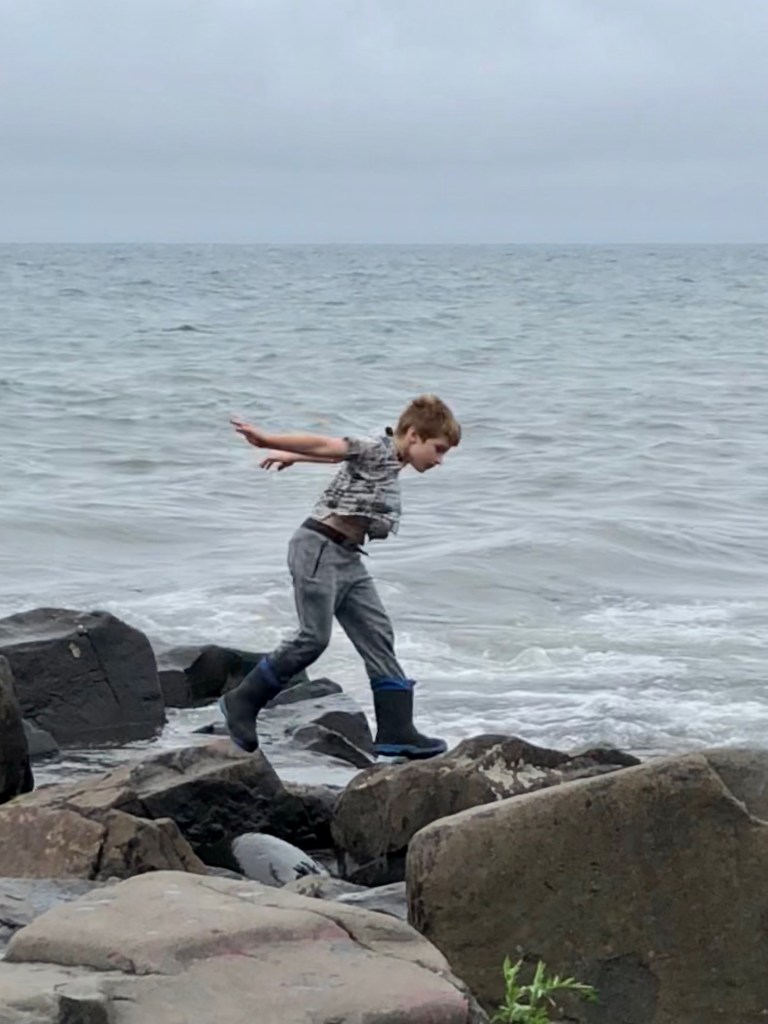
Clara, Michael, and Evan run and leap from one smooth lava formation to another. I yell, “Not so close to the water” and “slow down.” The wind and roar of the waves hitting the shore make it difficult for them to hear me. They toss a few rocks, but they’ve outgrown the thrill of flinging rocks in the water.
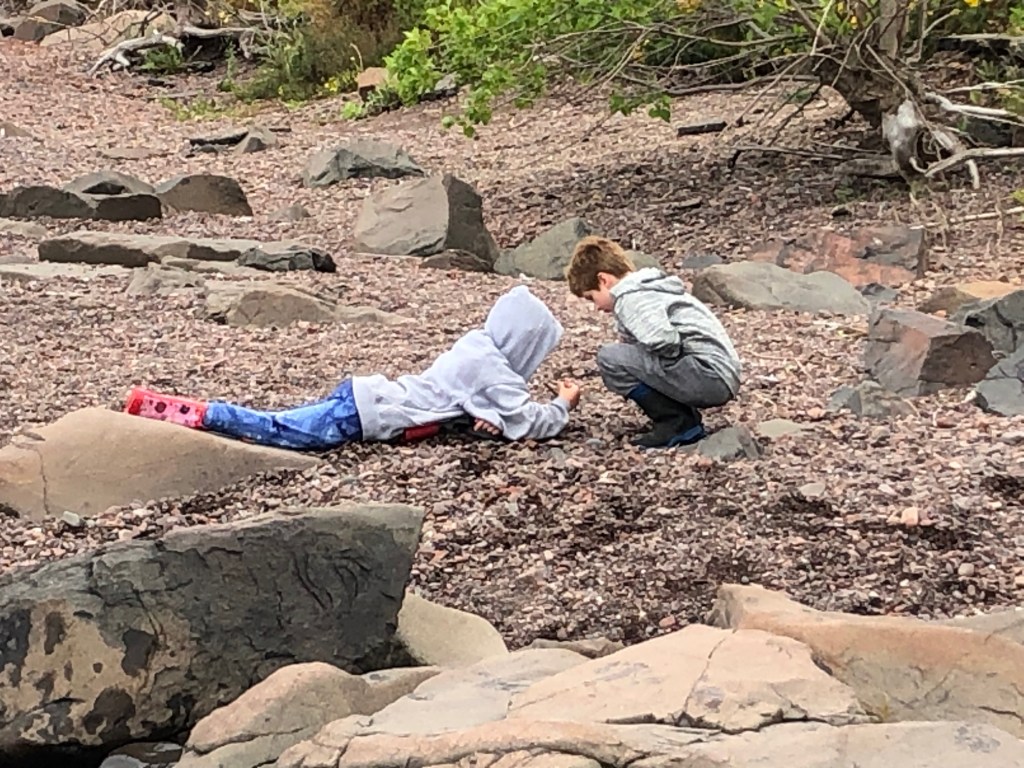
Clara and Michael comb through rocks on the beach, looking for agates. Evan keeps walking on the rock formations. My head is on a swivel as I watch all three of them while watching Charlie throw rocks, making sure he doesn’t fall in the water with one of his tosses.
There are three kids at the beach, around seven to nine years old. Evan’s been watching them, following them while keeping some distance. The next time I look up to locate each grandkid, I see the three kids forming a follow-the-leader line. Evan watches and at the last moment, he joins in as the caboose. A few minutes later, he’s talking with one of the kids.
Later, before we leave, Evan says, “I was making friends.” He’s almost five and he misses friends. There are no kids his age in his neighborhood. He remembers daycare and having friends before the pandemic. “Yes, you made friends,” I say. “That’s nice.” But he’s forlorn. He knows the new friendships are fleeting.
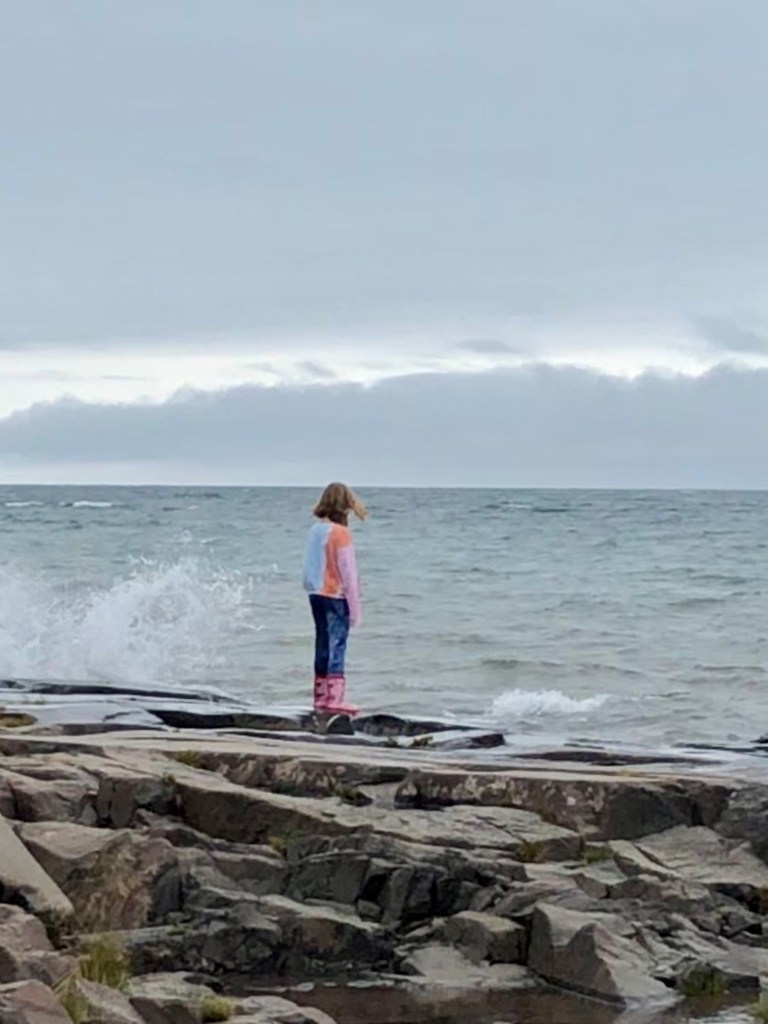
Shortly before we leave, Clara and Michael return to the rocky outcroppings. Clara stands near the edge and flirts with the surf breaking on the rocky shore, letting the water spray her but scurrying backwards when bigger waves break.
Michael runs and leaps along the rugged terrain. I stuff the urge to yell at him to stop. I’ve already issued too many warnings: “Slow down! Don’t get too close to the edge! Stay out of that puddle of water—you’ll soak your feet!”
My admonishment about the deep puddle of water was given to Evan right after one of his new friends walked through it with his tennis shoes while his dad watched. That dad must’ve thought I was hampering my grandkid’s fun. But when you watch kids who aren’t your own, the stakes are higher.
After forty-five minutes at the beach, I gather up my mostly-dry grandkids and we get in the van. “I suppose you’re all too cold for ice cream,” I say. None of them are too cold for ice cream. It’s a delicious way to end the afternoon.
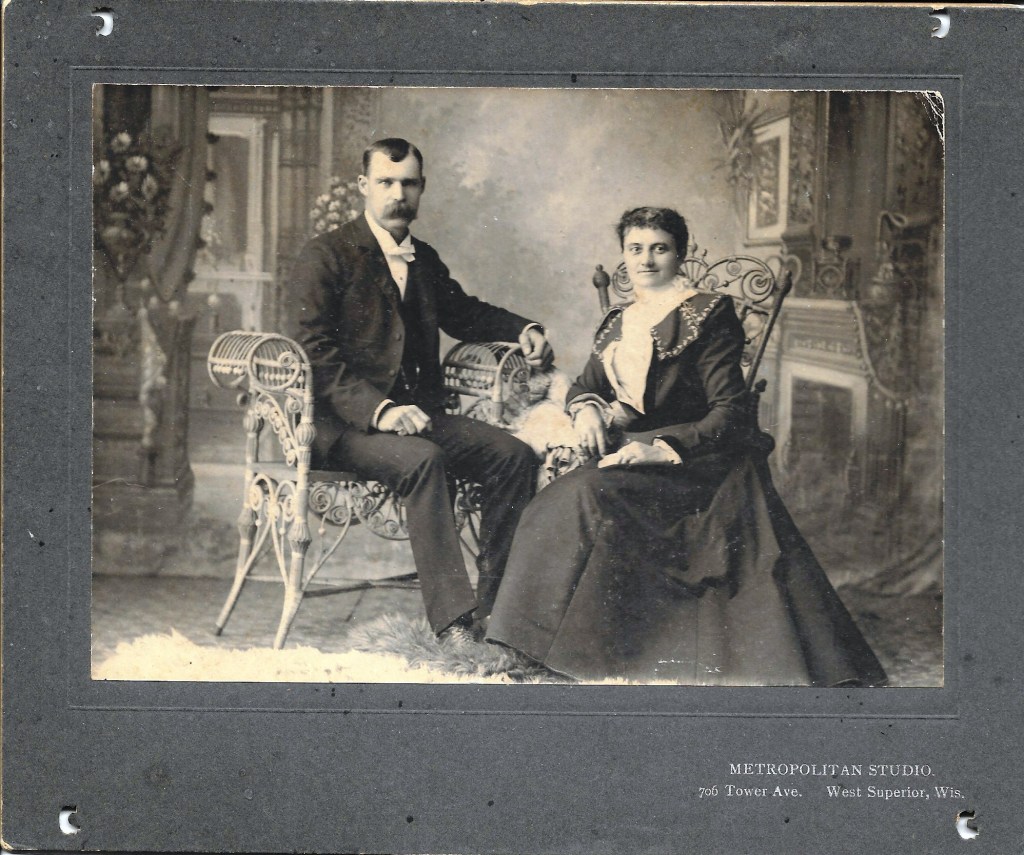
Frank and Rose Youngquist, wedding photo, September 1898
About 1892, Frank Youngquist left Stillwater to work as a blacksmith in Gordon for Musser-Sauntry, a logging company with interests in Minnesota and Wisconsin. In 1897, Rose Yost left her parents’ farm in Columbus, Minnesota, to work at the Smith Hotel in Gordon, owned by her sister and brother-in-law, Aggie and Jim Smith.
Frank, 32, handsome, brown-haired, and blue-eyed, met Rose, 29, pretty, dark-haired, and brown-eyed, at the Smith Hotel where he lived. They fell in love and married on September 21, 1898, in Hennepin County, which gave them an opportunity to visit family in Minnesota before returning to Gordon.
FRANK’S MINNESOTA CONNECTION
Before Frank’s and Rose’s lives intersected in Gordon, they grew up 32 miles from each other in Minnesota. Frank’s father, Johan Youngquist, came from Sweden to Minnesota in 1868, and settled in the Stillwater area. A year later Johan’s wife, Eva, arrived with their four young children, including 2-year-old Frank. They would have four more children.
Johan’s family probably emigrated because of economic hardships. Sweden’s rapid population growth in the 1800s diminished job opportunities and caused farmland shortages. Crop failures in 1868 and 1869 deepened economic woes, pushing more Swedes to seek opportunity in America. After reading letters from family, who spoke highly of their lives in Minnesota, many Swedes chose to settle there.
Johan, Eva, and their children prospered as laborers, farmers, blacksmiths, lumberjacks, and business people. The railroads and lumber industry provided plenty of opportunities for immigrants. Five of Frank’s seven siblings spent most of their lives in Minnesota, and his parents lived there until they died.
ROSE’S MINNESOTA CONNECTION
Rose’s parents, Yost Yost and Agatha Gassman, emigrated from Switzerland around 1854. Yost and Agatha, both Catholic, might have left Switzerland because of religious unrest during the 1800s. Yost lived in the Canton of Lucerne, which became embroiled in religious tensions between Catholics and Protestants after the Jesuits, reinstated by Pope Pius VII in 1814, returned to Switzerland.
Yost and Agatha married in Rochester, New York, in 1855. A year or two later, they moved to Columbus, Minnesota, to homestead 160 acres. They raised seven children, all born on their farm. One son became an engineer for the Great Northern Railway, working on the mail train out of St. Paul. The other son ran the farm when Yost retired. Their five daughters all married, but only one remained in Minnesota. Yost served as a town clerk and justice of the peace in Columbus. From 1864 to 1866, he served in the Minnesota Cavalry, Hatch’s Battalion, Company E, and was stationed on the Dakota-Minnesota frontier. He and Agatha are buried in St. Joseph’s Catholic Cemetery in Wyoming, Minnesota.
TRAGEDY STRIKES
In 1910, after twelve years of marriage and four children, Frank and Rose, still living in Gordon, died a month apart, Frank, 44, on October 18, and Rose, 41, on November 17.
Frank lingered four months before dying of tuberculosis. He wished to be buried in Stillwater at the Fairview Cemetery with his father and two brothers. Frank had lived over half his life in Minnesota, and his mother and some family members still resided there. After Rose died from heart failure, she was buried next to Frank. Their children, George, 11, Elmer, 9, Leslie, 8, and Lola, 4, stayed in Gordon. Aggie and Jim Smith, Rose’s family, looked after them.
GEORGE’S COMFORTING TRADITION
George Youngquist with his wife Olive and Frank, their first child, circa 1940
Perhaps because of a mysterious, debilitating illness George had when he was about 1½, he was close to his parents. The illness left him unable to walk, so his father forged railings in his blacksmith shop and attached them to the walls of their home. Encouraged by his parents, George pulled himself up and held the railings. He regained strength and learned to walk again. However, as a young schoolboy, his illness left him unable to run and play with other children. To entertain George, Frank taught him blacksmithing skills after school. George cherished the time with his father. Thirty-some years later, a doctor told George that he had had polio.
From the 1930s until 1979, because George never forgot his parents’ love and kindness, he drove 120 miles from Gordon to Fairview Cemetery in Stillwater, Minnesota, to visit their graves either on or near every Memorial Day. By the time George and his family arrived, any Memorial Day services were over. But in the hushed cemetery with spring unfurling, George remembered his parents.
Whenever George had company, he always bid farewell to his visitors by saying, “Come again now.” Perhaps, each year when he left the cemetery, he imagined his parents telling him, “Come again now.” And he did until he lost his eyesight in the winter of 1979, two-and-a-half years before he passed away just shy of his 82nd birthday.
I’ve fallen in love. My heart’s desire is a two-by-three-foot rag rug. It’s striped with crisp aqua greens and purple-tinged blues ranging from pale grey to dark cobalt. It’s a star-crossed love affair. Not because my husband doesn’t like the colors, he does, but because even though the rug won’t clash with our kitchen décor, it also won’t blend with it. “This is gorgeous,” I say, “but it doesn’t go with our kitchen.”
Still, the rug captivates my heart. My husband and I are in a home décor shop in Harbor Springs, Michigan, only a few blocks from the shores of Lake Michigan. We came to visit my mother who lives in Petoskey. Trying to be helpful, my husband points out other rugs. I spurn each one—too thin, too thick, too big, too small. And when a rug has the correct specs and compliments our kitchen décor, I say, “Too boring.”
I know I’m taking the bold rug home with me because it’s a color wheel for Lake Michigan. When we drove to Petoskey on July 3, the water in Little Bay de Noc, fed by Lake Michigan, was aqua green, the color of tropical ocean waters lapping at sandy beaches, the color of the aqua green in the rug I’m holding in my arms. As my husband drove along the curve of the bay, he said, “It looks like a tropical beach.” If I’d taken pictures of the water that day and omitted the deciduous and coniferous trees of the Upper Peninsula, I could’ve posted the pictures and claimed I was at a Caribbean resort. In a couple of days when we return to Wisconsin, the skies will be cloudy and grey, and the water, reflecting the sky, will mimic the deep purplish-blue color on my new rug.
Sippy Cup Art
I adore the rug because it reminds me of trips to Petoskey to see my mother. The first time I went was in 1992. Since, I’ve made the trip with my sons; a beloved friend, who passed away in 2018; my husband; and alone. The rug is a memory of my visits to Petoskey on the eastern shores of Lake Michigan.
Two days after laying the rug on the kitchen floor, my grandson sheds his Crocs on the corner of it. The rug and purple Crocs become art on my floor. I take a picture with my cellphone and text it to family and friends with the caption, Croc Art.
A few days later, my youngest grandson either drops or tosses a sippy cup from his highchair. Serendipity. I take another picture and text it to family and friends with the caption, Sippy Cup Art.
Yesterday my dog lay down on the rug. Another picture. Another round of texts with the caption, Poodle Art.
Poodle Art
It’s a game now with two rules. One, I don’t put objects on the rug—I have to notice something that ends up on it. With four grandkids, who visit often, and my two dogs, I never have to wait long. Two, I decide if an object on the rug is art-worthy. (Poodle Art was an iffy choice, but I don’t need much encouragement to take pictures of my dogs.)
The rug, like Lake Michigan, color shifts in different lighting. It makes me smile. It feels good under my bare feet. And it lays near the backdoor, so it doesn’t provoke envy from the mossy-colored rag rug in front of the sink.
Before the pandemic, I wouldn’t have taken up with a nonconforming accessory, even if the colors enchanted me. But after a year and a half of strange events, I’m going with what moves my heart.
[Author’s notes:Alas, my cellphone camera doesn’t capture the vibrancy of the rug. My mother lives within view of Lake Michigan, and I live a few blocks from Lake Superior. When we visit each other, we enjoy each other’s Great Lake. Vote for your favorite picture by clicking on “Leave a reply” and casting your vote in the comment box. I purchased the rag rug at Finishing Touch in Harbor Springs, Michigan, at 237 East Main Street.]
[“Puppy by Impulse” was published in June 2021 by Itasca Community College, Grand Rapids, Minnesota, in their annual magazine Spring Thaw.]
“Standard poodles, black, males and females, eight weeks, available January 2, $300.” My husband started reading these ads to me after a vacation to Tucson where he’d met my father’s three standard poodles, Tyrone, Lady and Gabby. After a second visit to Tucson and meeting Daisy, my father’s newest poodle, my husband’s reading of the ads intensified. The colors and prices varied, but not his need to inform me that somewhere nearby, someone was selling poodles. My husband, who loves dogs, wanted one.
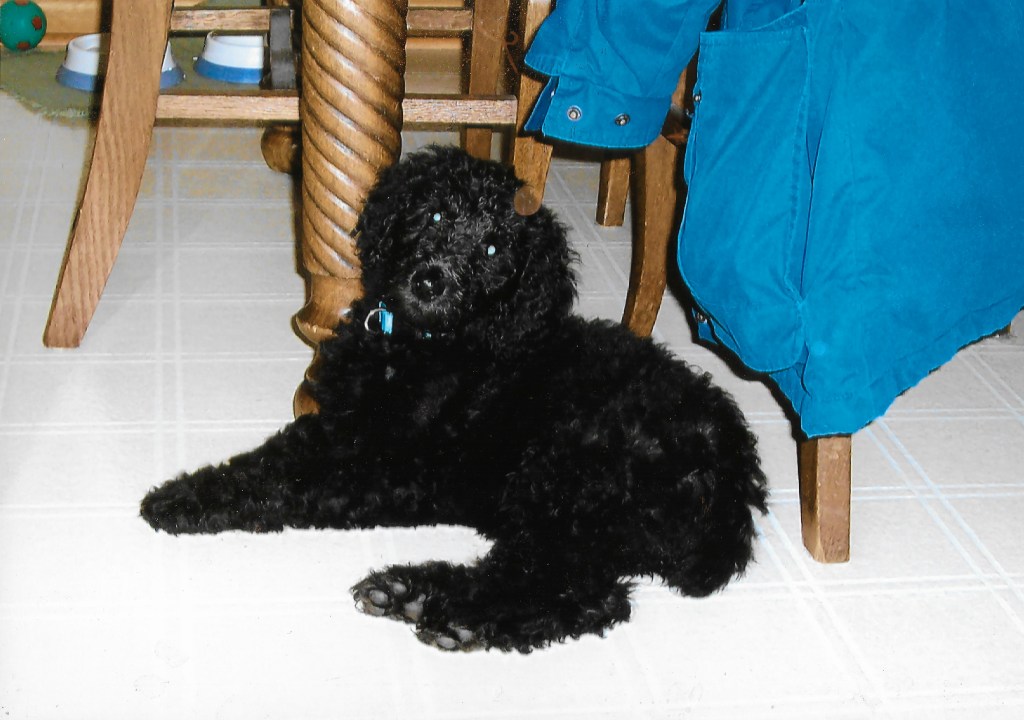
Bailey, shortly after coming to live with us. January 2006
I ignored him.
“That’s cheap,” he said, “a real bargain.”
“We have Buffy. I don’t want two dogs.”
“Buffy would have a buddy,” he said. In the past at this point, my husband had always said: I’m not saying we should get one right now. I’m just reading the ad. He was off script.
“Ha,” I said. “You mean our dog who wags her tail when she meets another dog, then tries to bite it when it gets close?”
“I’m sure she’d be nice to a puppy,” he said.
“Buffy is almost fourteen. She doesn’t want a puppy.”
I left the room and thought about canceling the newspaper.
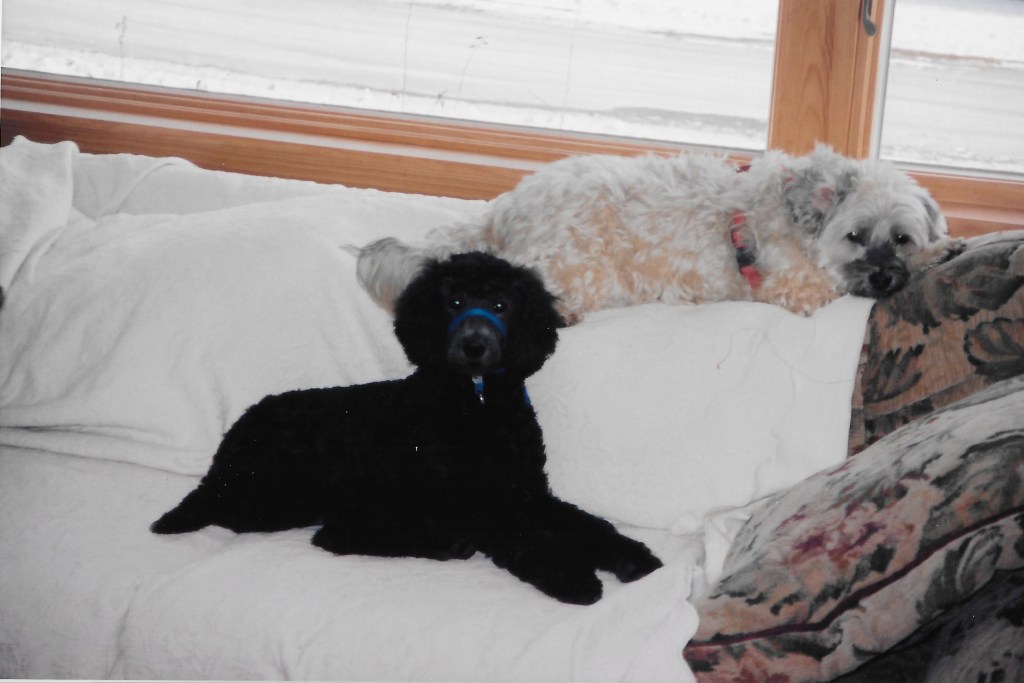
Buffy decided Bailey could stay. Buffy, who was fourteen, would lay near Bailey, but wouldn’t play with her. Winter 2006
*****
We stayed home New Year’s Eve because our youngest son played hockey, and we were on a budget. My husband moped.
“I’m probably the only one stuck at home,” he said.
“I ran into John and his son at the video store. He and his wife aren’t going out either.” John’s son played hockey with our son.
“There’s nothing on TV.” The remote was getting a workout.
“Do you want to watch the movie I rented?” I asked. “It’s an action flick.”
“No,” he answered, “I’m going to bed.” It was before midnight.
*****
On New Year’s Day, he was still moping—disconcerting to me because moping wasn’t his style. He’s a wake-up-cheery kind of guy. Heck, he’s a cheery-all-the-time kind of guy. I wondered if not getting a puppy was more upsetting than spending New Year’s Eve at home.
“Where’s the ad about the $300 poodles?” I asked. Did I just say that?
My forty-seven-year-old husband leapt out of his funk and found the ad. Yup, I’d said it.
His sudden mini-midlife crisis, which addled my reasoning, seemed like it could be cured by buying a puppy. Better a puppy than an expensive red sports car. Besides, I knew he’d never settle for a sports car, not if he could have a poodle.
“If you call now,” he said, “maybe you can see the puppies tomorrow and get first pick.”
I backpedaled. “I’m just going to ask the breeder some questions.”
That statement swiftly morphed into We’re getting a puppy! by my husband and sons. Even I caught puppy fever, but my excitement burned bright like a shooting star then fizzled into a blackhole. But after raising their hopes, I couldn’t bring myself to tell my husband and sons I had second thoughts about a puppy. I forgot our anniversary once—wasn’t a problem. But if I changed my mind about the puppy—that was possibly husband-gets-a-new truck territory in order to get myself out of the doghouse. Despite having an English degree, I still had enough financial savvy to understand a puppy was the cheaper option.
My teenage sons, Josh and Tim, had never asked for a dog, as we’d always had one, but they’d never had a puppy. Jelly Bean, a coal-black German shepherd-Labrador retriever, was two when our first child was born. And Buffy, a small terrier-poodle mix, was two when we adopted her. I imagined my sons giving me the stink eye at future family gatherings as they reminisced about the puppy they were promised but never got. I pictured the day each son would bring home his future wife who’d look at me as if saying, So, you’re the reason my fiancé has trust issues. I kept my puppy misgivings to myself and called the breeder.
“We can see the puppies tomorrow,” I said, after getting off the phone. “They have five females and five males. They’re all black.” We decided to get a female.
“What are we going to name it?” Josh asked.
“Pearl,” I said. I was the sponsor of the okay-we’ll-get-a-puppy crazies, and I knew I’d be the primary caregiver, so I claimed naming rights.
“No way,” Josh said.
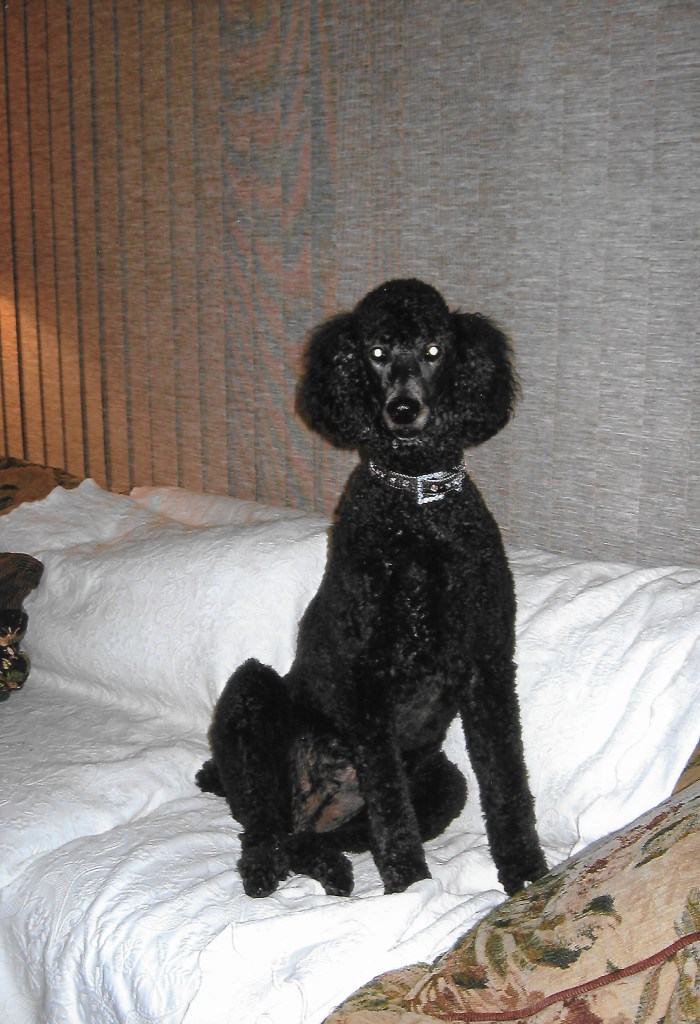
Bailey wearing the Swarovski crystal collar my mother bought her. Summer 2007
“Black pearls are lustrous and beautiful,” I said. “And no matter which dog we pick, it’s going to be black.”
“That’s a dumb name,” Tim said.
“I’m not going to stand outside and yell Pearl,” my husband said. “You have to think about what it’s going to sound like to yell the name out loud.”
I had. “It’s a strong one-syllable word, the kind of name dog trainers recommend.”
“Pearl is an old-lady name,” Tim argued.
“Poodles are sophisticated,” I countered. “I can picture one wearing pearls.”
Every name my husband and sons suggested, I rejected, and they refused to call the puppy Pearl.
“How about Bailey?” I asked. I prepared for another round of rejections, but they liked it. Now, we had a name for the puppy, which I still didn’t want.
*****
The next day my sons and I went to look at the poodles that were priced at three times the amount my husband and I would’ve spent going out on New Year’s Eve. My teenage sons were we are willing to get in a car and drive 180 miles with our mom excited. My husband was it isn’t fair I have to work and can’t go with disappointed. I was why did I open my big mouth remorseful.
With the prudence of a settler heading west in a covered wagon, I packed the SUV with a borrowed crate, old towels, a couple of blankets, a roll of paper toweling, a garbage bag, a dish, and some water.
“Now remember,” I told my sons, “we’re going to look. If things don’t seem right, we aren’t just getting a puppy anyway.”
“Okay,” they said.
“I mean it,” I said. “The place could be a dump. We can’t get a dog from a bad home. Who knows what kind of problems we’d have?”
“Okay,” they said. It was the okay spoken by a child who isn’t listening, a child who knows whatever is being said will have no bearing on what’s going to happen.
“The dogs could be mangy and unfriendly, even vicious,” I said.
“Okay,” they said, dragging out each syllable.
Yeah, right. Too late. I’d set the act of buying a puppy in motion, and like a runaway train hurtling down a mountain, I couldn’t stop it. No one goes to look at a litter of puppies and walks away empty-handed. It’s Einstein’s lesser-known theory of puppy relativity. Still, I hoped to avoid getting a puppy. The 90-mile trip to northern Minnesota gave me time to stew in a pot of regret. Potty training. Accidents. Chewing. Walks in all kinds of weather. Grooming. Vet bills. Obedience training.
Ninety miles later, we arrived at the breeder’s home. It wasn’t looking good. As I pulled into the driveway, a picturesque family farm materialized before me. The fields draped with fresh white snow evoked visions of horse-drawn sleighs filled with laughing people and proud poodles out for a jaunt on a crisp winter’s day. I could even hear the darn bells jingling. A cheerful clapboard farmhouse sat on the western edge of the field. The only part missing was an artist with an easel capturing all that scenic beauty on a canvas, for which some wealthy city dweller would gladly pay top dollar and hang on the wall of an ostentatious, 4,000-square-foot, seldom-used “cabin.”
I hoped the inside of the house could save me. Nope. No improvement there. Three big, affectionate dogs greeted us, not a whisper of a growl or a moan of discontentment among them. A regal silver standard poodle, who turned out to be the proud father, gently placed his paws on Josh’s shoulders and licked his face. The dogs were clean and neatly groomed. The breeder said, “Sit,” and three furry butts hit the floor.
I surveyed the room and realized it belonged to the dogs. Outdated but clean, well-preserved linoleum covered the floor. Big double-hung windows lined the walls, giving the dogs panoramic views of the farm. Cozy, plump dog beds bordered the wall opposite the door. And, a short breezeway led to the main house where the dogs spent time with their people. The dogs were cared for and loved.
An ample, sturdy-built kennel occupied the corner of the room. Mother poodle, happy to have a reason to escape her ten busy pups, hopped over a short barrier and came to greet us. Her puppies, each a jet-black ball of wiggles, jumped against the barrier. “Hey, Mom, where you going?” they squealed.
My last hope rested with the puppies. Perhaps they would cower in fear or show signs of hostility. The puppies let me down. Turned loose for our inspection, they ran to us with wagging tails. Both boys crouched down to play with the yipping, wriggling, nipping puppies. The only problem was choosing one. Our soon-to-be puppy solved the problem—she picked Josh. She scrambled into his arms and licked his face. “This one,” he said.
I paid the breeder, and Josh strode out of the house holding our new puppy like a trophy. After letting her piddle, we put her in the crate in the back of the SUV and started for home.
“Something stinks like crap,” Tim said. We were just twenty miles down the road.
I stopped. Our puppy had pooped in the crate. While I cleaned it, the boys walked her, and she dutifully piddled. I put her back in the crate and drove on.
“It stinks like crap again,” Tim said. We’d only gone another twenty miles, but our puppy had pooped again.
“Nerves,” we said.
Once more, I cleaned the crate and the boys walked our puppy, who piddled. I started to put her in the crate.
“I’ll hold her,” Tim said.
Another twenty miles and I heard retching.
“Mom, she threw up,” Tim said.
I pulled over and looked at my son, who was wearing his hockey warm-up suit. Vomit covered his lap. He tried to keep it from dripping on the floor. I braced for the snarky words I knew were coming and heard him say, “Poor little girl. You’re just a little baby, aren’t you?” He continued to coo at our puppy.
I wanted to ask, Who are you and what have you done with my fifteen-year-old son? But I didn’t. At that moment I knew my reserved, grumpy teenager still had his soft heart. Trying to keep the tears in my eyes, I grabbed some paper towel and silently cleaned puppy vomit off my son and the seat. Josh walked our puppy, who piddled again.
“Maybe we should put her back in the kennel,” I said, thinking she couldn’t have much left in her to excrete.
“I’ll hold her,” Tim said. I grabbed the blanket, folded it, placed it in his lap, and put our puppy on it.
Bailey (R) loved dogs. Buffy never played with her. But after Buffy died in 2008, we bought Cabela (L), a chocolate standard poodle. Baily was overjoyed when we brought Cabela home. Bailey pranced and smiled, as if to say, “You brought me a puppy, thank you, thank you, thank you!” She and Cabela played immediately. September 2008
We made it home without any more messes. Josh carried our puppy into the house and put her on the kitchen floor. She did a circle dance, squatted, and piddled. Tail wagging, she pranced over to greet my husband, who bent down and scratched the ears of his little bargain.
And what a bargain she was. Our next trip was to the pet store for all the necessities: puppy food, treats, a stylish collar and leash, a dog bed, cuddly toys, and teething bones. Trips to the vet, puppy-socialization class, and obedience training followed. But rather than an expensive bargain, I soon began to think of Bailey as an investment in love, paying unlimited dividends.
[Bailey became ill in February 2011 and passed away. Cabela looked for her for days. In April 2011, we bought Ziva, a blue standard poodle. Ziva and Cabela became friends.]
Split Rock Lighthouse stands along the western shore of Lake Superior, atop a soaring cliff. Dressed in cream-colored brick and elegant trim more fitting for a grand house in a genteel neighborhood, it once worked as a watchman holding a luminous light, warning ships about rocky shores at its feet.
My grandchildren at Split Rock Lighthouse, late October 2017
It’s a crisp late-October morning. The last day of the season before the lighthouse shutters for the year. From an expansive autumn-blue sky, sunshine washes the landscape in gold. The temperature wanders just north of forty-five degrees. The air breathes softly.
My granddaughter, six, and grandson, four, are with me. It’s their first visit to the lighthouse. Because it’s a weekday and almost the last day the lighthouse will entertain visitors for the year, we are nearly alone on the grounds.
We climb the twisting steps of the lighthouse, just the three of us. We are quiet, and with nothing to arrest my attention, other than the shuffle of feet on the stairs, I travel decades back in time.
My father, my sisters, and I climb the stairs. My father has come to see the Fresnel lens, and we are his pupils. Some of his words wend down the tower: France, prisms, refraction, illumination, fog, storms. But his lesser words are swallowed by the voices of other tourists. His face points up toward the lens; my sisters and I are in tow behind him.
My granddaughter leads the way, followed by my grandson, then me. I’m the caboose, better, I think, to catch them if they slip. I’m not interested in touting the wonders of the Fresnel lens. I leave them to their thoughts as they ascend the stairs, and I return to mine.
At twelve, I’m content to let my father’s explanations about the lens waft past my ears. I imagine the lightkeeper climbing the stairs during a howling storm to ensure the beacon shines across roiling waves of the frigid lake. I fancy the lightkeeper manning the signal house to ensure the horn bellows over icy waters while dense fog unfurls across an eerily still lake. I remember my father’s words about Lake Superior, mostly spoken to my frightened mother as he would fly us over a corner of the lake, “You’ll die of hypothermia before you’ll drown.” I ponder the number of sailors the lighthouse spared from freezing to death before they could drown.
I’ve no idea if my fancies about a lightkeeper’s duties are accurate, but I measure life as a lightkeeper’s daughter against life with my father.
Sometimes my father is a martinet. My siblings and I endeavor to read his barometric pressure and side-step his thunderclouds. We learned early to listen carefully.
He’s an extraordinary mechanic. His hands tinker, build, tune, modify, rig, experiment, adapt. Cars, trucks, motorcycles, planes, appliances. All engineering feats, great and small, captivate him. He wants us to be enthralled. But my fascination is for the people who lived and worked at the lighthouse on the prodigious cliff. I crave the stories of people. Lake Superior, which, if it had the chance, would freeze me to death before swallowing me, enchants me. My father doesn’t notice my attention has wandered because he’s hammering the tour guide with his knowledge of the brilliant lens.
“Oh, wow,” my grandson says, exhaling the words as a brief, but reverent Gregorian chant. He’s caught his first glimpse of the Fresnel lens gleaming in sunlight spilling through the windows. He stops and stares. The echo of his chant swirls around the tower.
Years ago, my father expressed his amazement of the lens with descriptions of its design and function. My grandson captures his admiration in two words. But at this moment, although they’ll never meet, they’re tethered together across four generations, both of them mesmerized by a triumph of engineering designed to mitigate the angry moods of the lake. I see my father through the eyes of my grandson’s wonderment, and he becomes a curious four-year-old boy, instead of an ill-tempered adult. And I ponder what he might have said about the enormous, glistening lens had he seen it as a four-year-old boy. Their shared veneration softens prickly memories of my father. I can’t picture him as a little boy and be angry with him at the same time.
With the massive lens above me, I stand at the top of the lighthouse, peering out at Lake Superior and hear my father’s voice, She’ll freeze you before she’ll drown you.
[I was inspired to write this account about my grandfather, George, after reading one of Chris Marcotte’s blogs at chrismarcottewrites. Chris writes about the history of the everyday lives of people, bringing their stories to life in a way that lets the reader connect to people in the past. She incorporates information from newspapers in her blog. After reading Chris’s article, “The Best Thing Since Sliced Bread,” I remembered both my grandpa’s dislike of store-bought bread and his admiration for an electric clock.]
Grandpa George would never have uttered the phrase “the best thing since sliced bread.” Detesting store-bought bread, he’d have thought it was a poor standard by which to measure some new technology that impressed him. I can imagine a conversation with a customer at his gas station going something like this:
George’s Standard Oil Station, circa 1930s. He owned and ran this station from 1928 until 1979.
Customer: Heard you and Olive bought one of those new color TVs. The best thing since sliced bread. Wouldn’t you say, George?
George: You’re setting the bar pretty low. Sliced bread isn’t a second best to anything.
Fortunately, Grandma Olive baked a good loaf of bread. Over George and Olive’s forty-five years of marriage, they had, at one time or another, one foster son, three children, George’s brother, Olive’s parents, their daughter and her children, and me living with them. Olive baked a lot of bread.
George’s first auto garage with gas pumps, circa 1920s
George, born in 1899, might’ve been old fashioned about his bread, but he welcomed other technology. In 1913, when George was fourteen, the first car arrived in his hometown. He’d learned blacksmithing, so he shod horses before he changed car tires. But, by 1920, George knew cars were his future. He and his cousin Frank embraced innovation and opened an auto garage with gas pumps, a business George owned and ran until 1979.
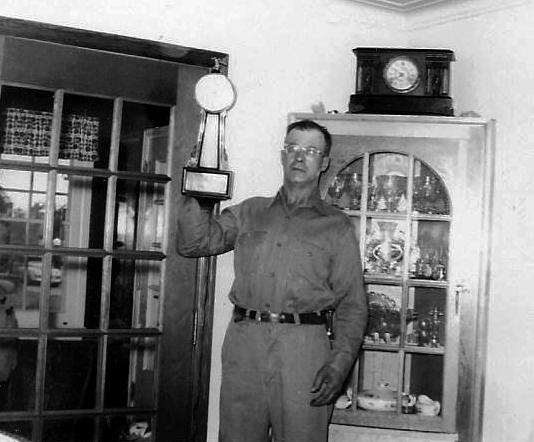
George appreciated smaller innovations too. In the early 1950s, a relative, who was dear to George, gave him an electric clock, the first one he ever had in his house. The clock hung on the wall in the living room where he watched his TV. He not only cherished the clock because of the giver, but he relied on it. He checked his pocket watch against the electric clock daily, believing it was more reliable than the mechanical clocks in his home.
George and the first electric clock in his home. Excited by this new technology, he had the moment preserved with a photograph.
Like most of us, George both praised and disparaged new advancements. He gave a thumbs up to cars, gas pumps, TV, electric clocks, a modern kitchen, washing machines, and planes (taking a trip to Italy in his 70s), but he gave a thumbs down to sliced bread. And he didn’t like store-bought desserts either, for which I’m grateful. During the three years I lived with my grandparents, I enjoyed scrumptious homemade cookies; divine chocolate cakes; pies baked with fresh fruit; light, heavenly angel food cake; and moss cake, a rich, nutty confection made with the egg yolks leftover from making the angel food cake.
Because of my grandparents’ influence, I make my own desserts. But I don’t bake bread. Sorry, Grandpa!
“Nana, where are you?” Charlie, two-and-a-half, calls out from the living room.
“I’m in the kitchen.” I’m surprised he doesn’t see me because the kitchen and the living room have a semi-open design.
“Nana, where are you?” he repeats.
I assume he didn’t hear me. “I’m right here.” I turn around and realize he isn’t talking to me.
He’s holding a Little People person by a Little People house. It’s the Little People person who’s calling into the house, looking for his nana.
Charlie’s playacting, but he’s borrowing from real life. If he doesn’t see me immediately when he arrives in the morning, he yells, “Nana, where are you?”
Next, the Little People person, still peering into the Little People house, asks, “Where are you, puppy, where are you?”
I’m drawn into Charlie’s world of make-believe. I search through the bin of figures, looking for the Little People dog. I can’t find him. But I find the Little People sheep. “Here’s a sheep for your farm,” I say. Behind him is a Little People barn.
Charlie grabs the sheep, laughs, and says, “Puppy!” He’s willing to suspend reality in his theatrical world. I roll with him. He returns to his production company where he’s a scriptwriter, a director, and an actor playing all the parts. I sit on the floor, a few feet away from him, like an extra in a movie. He takes no notice of me.
He’s on to the next scene. “This is my bed,” he says, laying the Little People person, who represents him, on a lime-green bed in the second-story bedroom of the plastic house. He picks up two other Little People and brings them face to face. Imitating smooching sounds, he refers to them as Mom and Dad. How sweet.
Next, he says, “Bupba’s back,” signaling his grandpa has entered the scene. Then he picks up a small red toy—Spiderman has joined the show, saying, “Grab your ee-ee.” Not wanting to interrupt a director’s creative process, I don’t ask what motivates Spiderman’s concern for a blankie.
After a few minutes, I rise off the floor and return to the kitchen, leaving Charlie immersed in his playacting. His world of dialogue, actors, and shifting scenes continues for another twenty minutes.
I’m glad I saved some of the toys his dad and uncle played with when they were boys.
Before we had grandkids, my husband, when cleaning the basement, would ask, “Can we get rid of these old toys?”
“No,” I’d say.
“What are you saving them for?”
“Grandkids”
“What if we don’t have grandkids?” he’d ask.
“What if we do?”
And we do—four of them, ages nine, seven, four, and two-and-a-half. And they all play with the toys I saved. This morning two-and-a-half-year-old Charlie has morphed them into his world.
In about ten years, the dialogue with my husband will start anew. He will ask, Can we get rid of these old toys?
No, I will answer.
What are you saving them for?
Great-grandkids.
What if we don’t have great-grandkids? he’ll ask.
What if we do?
Already, I imagine them on my living room floor, directing their own Little People productions.