My sister and me, a few months before our trip to Pulaski Park
[Bloganuary is hosted by WordPress. A new topic is presented each day during January.]
My earliest childhood memory? That would be the morning my younger sister (2) and I (3) took pity on my sleeping mother, left the house early in the morning, and walked a handful of blocks to Pulaski Park in Milwaukee. Mom was tired. Who wouldn’t be with two busy toddlers around the house? So, we didn’t wake her up and ask her silly questions like, “Can we go to the park?”
We also didn’t worry about getting dressed. My sister and I each wore a stylish combination of cotton training pants and summer pajama tops. During a hot Milwaukee summer, we didn’t bother with pajama bottoms.
Pulaski Park was our favorite because Nana Kitty took us there when she came to visit. She put each of us on a swing and pushed us up, up, up, into the always robin’s-egg-blue sky. And, our best, most favorite part? Nana sang “Puff the Magic Dragon” to us while she pushed us on the swings.
It was my favorite song. And on that morning, it was my idea to go to the park. If my nana couldn’t take us, I would take us. I wanted to go to the park because I wanted to sing “Puff the Magic Dragon” just like Nana did, even though I didn’t know all the words like she did.
I held my sister’s hand, and we walked down sidewalks, waited at stoplights, and crossed streets without getting hit by a car. We walked on the path into the park and crossed a concrete bridge over a small creek. I helped my sister into the swing, and I pushed her up, up, up, into the always robin’s-egg-blue sky. I sang some of the words from “Puff the Magic Dragon.”
A woman who was at the park, pushing her child on a swing, asked me, “Where is your mother?”
“In bed,” I replied. “I’m taking care of my sister.” I smiled. I felt proud as I pushed my sister into the sky and sang about Puff, the childhood friend of Little Jackie Paper.
And that’s where my memory stops, and my mom’s memory begins.
When my sister and I were older, Mom told us how our trip to the park ended. She woke up shocked and panicky to find we weren’t anywhere in the house. But she had a good idea where we went. She put our German Shepherd, Fritz, into the car and drove to Pulaski Park. So relieved to find us there, she hugged and kissed us over and over again.
A couple of weeks later, Mom woke up and my sister and I were gone—again. We’d gone back to Pulaski Park on our own—again. Mom and Fritz came to get us—again. But the second time, Mom was so upset to find us there, she gave us spankings!
[Bloganuary is hosted by WordPress. A new topic is presented each day during January.]
I don’t know if I’m brave because I’ve never been in a situation requiring bravery. I could offer insignificant bits of times when I’ve been microscopically brave, but those examples are dust and easily blown away. However, there are stories of bravery among my family, mostly it’s the kind of bravery needed to get through the beating life sometimes hands a person.
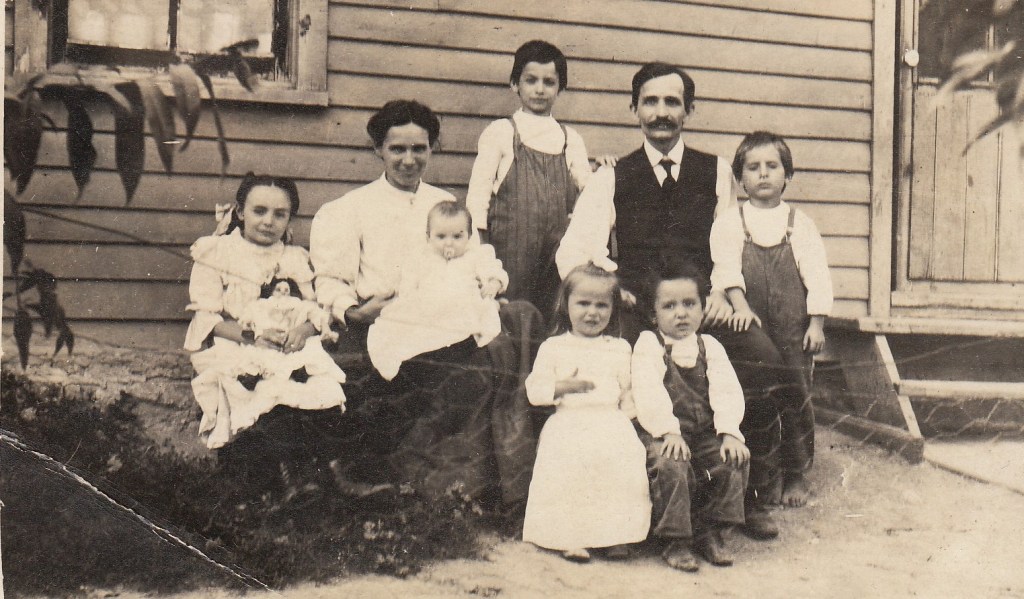
My great-grandfather Joseph, in the vest and tie, died of typhoid fever in 1922. His wife Mary is holding my Nana.
My great-grandparents Mary and Joseph, both orphaned young, traveled from New York City to West Bend, Wisconsin, on different orphan trains when they were small children, most likely with notes pinned to their clothing, listing their names, their destination, and the names of their new families—who they met for the first time at the station. Later, Mary and Joseph fell in love and married. But Joseph died young, leaving Mary with seven children and one on the way.
Grandpa George and Grandma Olive with their first child, my father.
My grandpa George and his three younger siblings became orphans at 11, 10, 8, and 3. They went to live with an aunt and uncle. But young George felt it was his responsibility to provide for his siblings, so he went to work at a copper mine. While riding in a wagon and holding a container of kerosene between his legs to keep it upright, some kerosene slopped on his legs and caused serious burns because George didn’t tell anyone until he got out of the wagon. His aunt put her foot down, refusing to let him work at the mine. He was, after all, only 11, and she and his uncle had the means to welcome the four orphans into their brood of children. Later, George started a business, married, and had three children. For the rest of his life, he quietly helped people in need. In his old age, he lost his sight, and to keep busy he cracked pecans, filling jars with nuts to give to family and friends.
Grandpa Howard as a young man
My grandpa Howard fought in World War II for four-and-a-half years. He was shot in the leg while fighting in Italy, and for that bullet he was awarded a Purple Heart. I don’t know if Howard ever carried a wounded soldier to safety or saved his fellow soldiers from enemy fire. He never talked about the war that gave him two permanent souvenirs: a limp and nightmares. The limp was constant, and the nightmares were frequent. The war wrecked his first marriage. He became estranged from his children. And he drank heavily until he became sober in his late 50s, eventually helping other alcoholics.
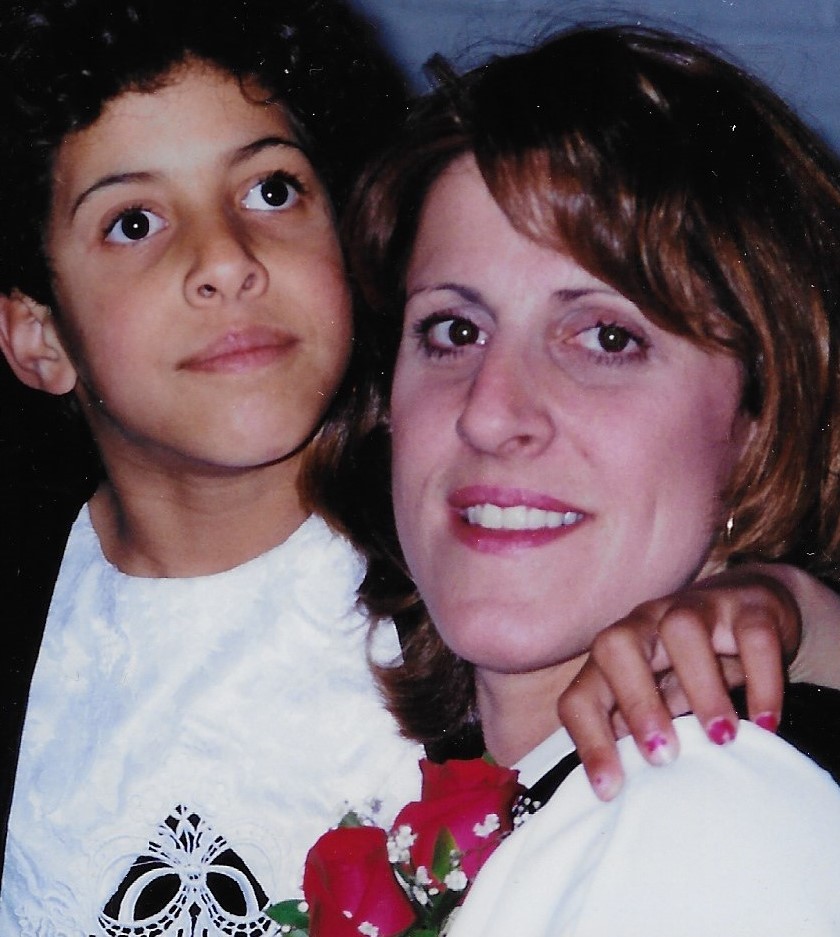
My beautiful sister and her beautiful daughter, circa 1994
My sister has a special needs child who almost died from seizures at three months old. My sister was brave on that night and has been brave many times since. Doctors told her that her daughter suffered brain damage and would probably never walk or talk or feed herself or learn to use the toilet. My sister spent as much time with her infant daughter as she could, stimulating her, talking to her, moving her limbs. Now an adult, my niece walks, talks, uses the bathroom, swims, plays soccer, and much more. Was it my sister’s love and bravery? Or the neuroplasticity of an infant’s brain? Or a combination? Because of my niece’s cognitive disabilities, she still struggles, and my sister is still brave.
Someday, I will probably need to be brave. And I hope my family stories will give me courage.
[“Show and Tell to Remember” was originally published by the Bacopa Literary Review 2022. It earned an honorable mention for humor.]
Inside my dress pocket, I had the best thing for show and tell. In 1964, I was new at Pleasant View Elementary, and having started in October instead of September, I was an outsider. My kindergarten classmates were going to be impressed. The popular girls would envy me and ask me to jump rope with them during recess. The cute boys would elbow each other and try to sit by me at snack time. My pretty teacher, with bouncing brown hair that flipped up in a long continuous curl around her neck, would look at me with approval.
“Vickie,” the teacher said, “it’s your turn.”
I snapped out of my daydream, rose from the floor, and stood next to the teacher who sat in a chair. My dress was clean, my saddle shoes were polished, and my unruly hair was combed into pigtails. It was my moment. I slipped my hand into my pocket.
“I brought a balloon,” I said. “Each one comes in its own wrapper.” My classmates leaned forward. My teacher turned toward me for a better view. I opened the package and pulled out the balloon.
“Let me see that,” my teacher said. Her hand clutched the balloon and its wrapper. She told me to sit down then called on the next student.
My face burned. At five and a half years old, I had enough sense to know I had done something wrong. But what? I wanted to ask for my balloon back, but I didn’t dare.
Me, circa kindergarten
After show and tell, I saw my teacher on the phone and heard her say my name. I was in trouble, but I didn’t know why. Too embarrassed to ask her what I had done wrong, I waited for a punishment, which in my imagination grew in magnitude as the afternoon dragged on. My graham crackers and milk didn’t sit well in my stomach, and naptime wasn’t restful. Usually, I rode the bus home, but at the end of the day, my teacher told me my mother would pick me up. My classmates left without me.
Mom arrived shortly after the buses rolled away. The teacher invited her to sit in the chair next to her desk but told me to wait in the hallway. They would talk about me, find me guilty—of what I didn’t know—and punish me forever. It had to be bad, very bad, but they didn’t talk long.
“Where did you get the balloon?” Mom asked after we got in the car.
“From your dresser.” Lying would’ve made it worse. My mother always seemed to know the answers to the questions she asked me.
“Don’t go in my dresser again. Or your dad’s dresser. Understand?”
I nodded in agreement. That was it. Not a word about punishment. No “wait until your father gets home.” This confused me because Mom had been called to school. My classmates said nothing about my show-and-tell offering either, and my dreams of popularity remained buried in the playground sandbox.
Because of the eerie silence that followed my kindergarten show and tell, I never forgot about it. It wasn’t until I was a freshman in high school that I realized I had taken a condom to school, and that Mom had said nothing more about the “balloon” because she didn’t want to explain condoms to her five-year-old daughter.
After I figured it out, I never asked, “Hey, Mom, remember when I thought I took a balloon to kindergarten for show and tell and the teacher called you?” Like any other teenager, I didn’t want to talk about birth control or sex with a parent. The where-do-babies-come-from talk Mom and I had when I was nine, still made me squirm with embarrassment.
After I had children, I appreciated that my kindergarten teacher and Mom handled my show-and-tell blunder with the calmness of an air traffic controller communicating with a pilot as he makes his final approach to a busy airport during a raging thunderstorm. But they never knew how much I suffered that afternoon.
Years later, I wondered if Mom might have been embarrassed because my teacher called her to school to discuss why her five-year-old daughter had a condom in her pocket. If Mom was mortified, she hid it well. She was twenty-four and had three daughters ages, five, four, and one. She may have been more horrified by the wasted condom than my taking it to school. Our family didn’t have the kind of lifestyle where condoms grew on trees.
Having graduated in 1958, Mom was six years out of St. John’s, a catholic high school, from which she almost didn’t graduate. She had written an essay scolding the pope and the Catholic Church for banning the use of birth control by its members. If she had, instead, written an essay describing her struggles with her Catholic faith and questioning the existence of God, the nun who taught the religion class may have said, “God expects his followers will experience a crisis of faith now and then. Keep praying.” But questioning the pope’s stance on birth control was sacrilege.
The school threatened to withhold Mom’s diploma, but she refused to rewrite her essay. She stood ready to see her high school diploma burned at the stake for the right of women to use birth control without fearing God or Hell or nuns who taught religion classes.
But Mom was also practical: She called the Wisconsin Department of Education, who made it clear to the school’s administrators they could give Mom an F in religion, but they couldn’t deny her a diploma because the state didn’t require a religious class for graduation.
For Mom, having to talk to my kindergarten teacher about my birth-control-show-and-tell balloon was probably child’s play. She had already taken on the pope and the Catholic Church and St. John’s High School and a perturbed nun. Besides I went to a public school, and no one threatened to keep me from graduating kindergarten.
[The Bacopa Literary Review 2022 can be ordered by clicking here. To read the complete list of winners and honorable mentions in humor, fiction, creative nonfiction, and poetry, click here.]
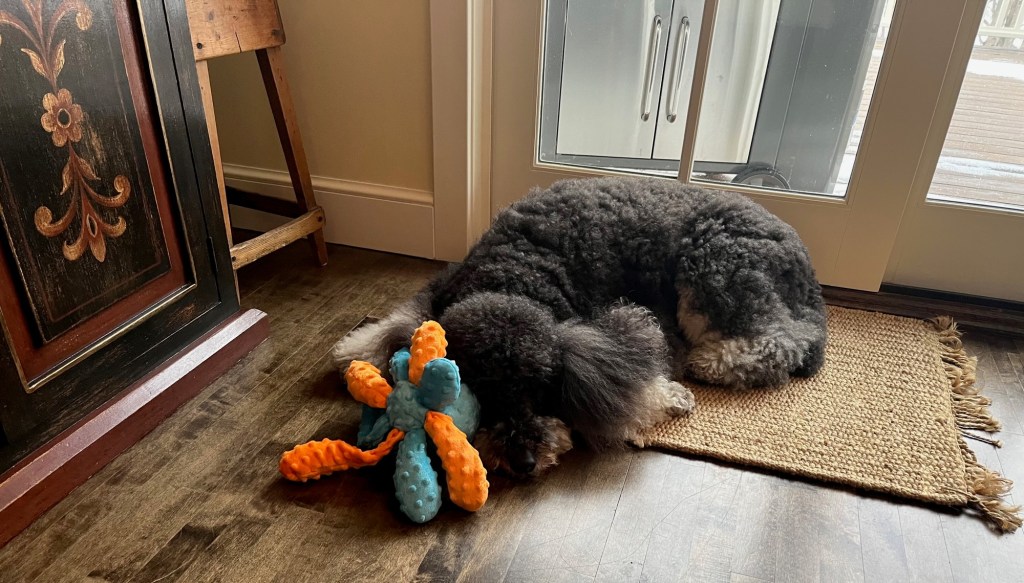
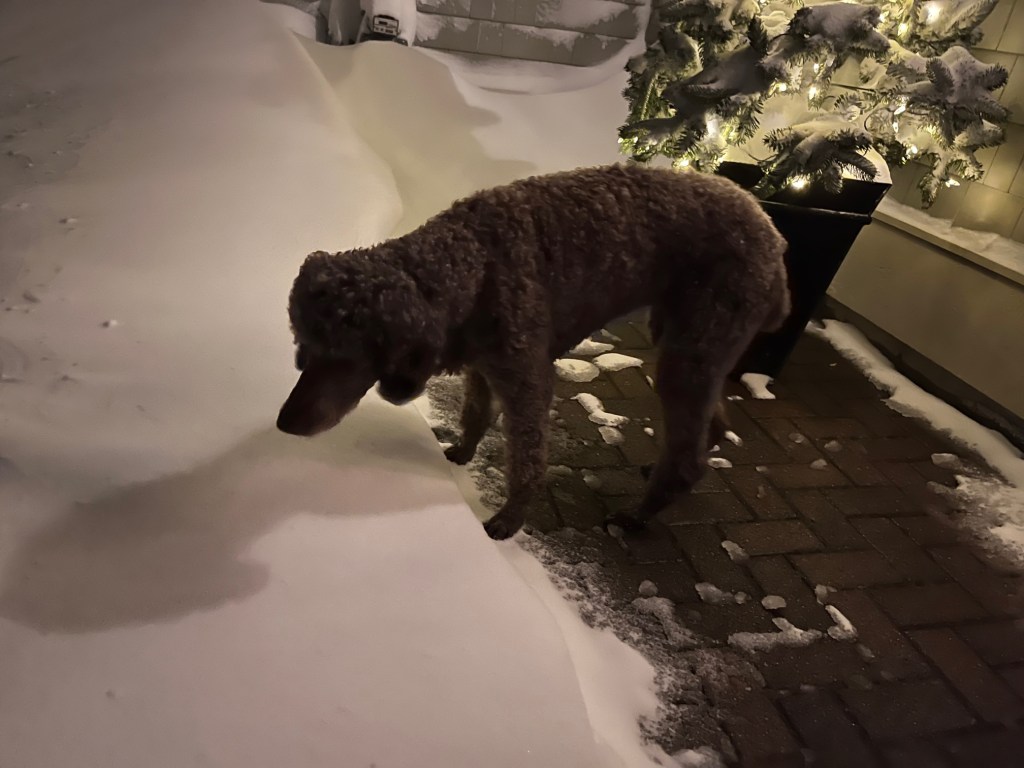
A dusky morning in Michigan, Ziva and Cabela, December 25, 2022
Christmas morning used to be about the children. I would hope they’d sleep in longer than they did on school mornings, but they’d wake up and be ready to open their presents before any school-morning alarm clock would’ve rung.
This Christmas morning it was my two dogs, Cabela and Ziva, who woke me up around six o’clock. They weren’t interested in presents–they wanted to go outside in the windy, windy snowstorm and pee. After we came back inside, my mother’s dog, Bogey, wanted to go outside, so back out I went, but I left Cabela and Ziva in the house.
I never take all three dogs outside at the same time. Doesn’t matter what the weather is like or what time of day it is. Bogey tries to run down the back hill through some bushes, hoping to reach the golf course and look for golf balls. He’s not put off by the snow. He plants his nose into the white fluff and comes up with a golf ball. He can smell them under the snow. And Cabela tries to exit the front yard and trot down the road. I have no idea where she thinks she’s going, but something wild in the air calls to her. I can’t chase Bogey and Cabela at the same time in different directions. Bogey won’t listen unless I’m right next to him, saying, “Stay here.” Cabela can’t listen because she’s mostly deaf. Ziva never tries to leave the yard. She keeps her eye on me.
After the dogs had a chance to make yellow snow, I decided to do some writing. The other humans were still sleeping and Bogey went back to bed. I turned on my computer and sat at the kitchen table. My dogs began pacing around the kitchen on the hardwood floors, clickity clack, clickity clack. It’s amazing how loud dog nails clicking on a wooden floor sound when a house is predawn silent. While pacing, both dogs stopped periodically and looked at me, as if to say, “Let’s go back to bed.” I tried to ignore them, but they can be relentless. They wanted to be with me, but they didn’t want to lay on the hardwood floor, not when there were couches to sleep on.
I gave up on writing and joined the dogs in the living room. I curled up on a large stuffed chair with a soft ottoman. Cabela and Ziva commandeered opposite ends of the couch, and we all went back to sleep for an hour. Then I got up, but my dogs kept sleeping.
I gave Bogey his Christmas present, a colorful stuffed octopus. He played with it for a bit, then napped with it on the kitchen floor. With all three dogs in the house fast asleep, I made coffee.
I’m in Petoskey, Michigan, just thirty miles south of the Mackinac Bridge. We came over on Wednesday, threading the needle between stormy weather in northern Wisconsin and stormy weather across the Upper Peninsula. It was a smart choice. We had nice driving weather for our nine-and-a-half-hour trip. It was, however, bitter cold, which my dogs didn’t appreciate during their potty breaks.
On Thursday the temperature in Petoskey rose to 35°, the sun shone, and the Lake Michigan winds kept their breezy nature tucked away. My husband and I took my mom out for a drive in the morning because she wanted to do some shopping. After we dropped her off, my husband and I went to lunch and did some shopping, buying gifts for her, a bread pan for me, and caramel corn for him. Although a winter’s day, it was beautiful for walking in and out of shops in downtown Petoskey. I reminded my husband about the last time we had such beautiful weather for pre-Christmas shopping in Petoskey. Shortly after nightfall, temperatures sank; thick, wet snow blanketed trees, power lines, and the ground; and winds whipped into gale force strength. We lost power at 2:30 in the morning.
Cabela
Once again, the nice weather we had on Thursday was the calm before the storm. By 7:00 p.m., the wind revved up its motor, the temperature dipped fifteen degrees, and the snow flew in horizontally off Lake Michigan. Fortunately, we haven’t lost power, but the water in the toilets sloshes back and forth and side to side like we’re on a ship in rough seas.
Each time I take the dogs outside, including walking my mom’s poodle, Bogey, I bundle up from head to toe–hat, goggles, down coat, long underwear, and boots. Yesterday morning I walked Bogey, and we had to trudge through knee-high snowdrifts. He likes to walk to the cul-de-sac to poo. He has a favorite spot. Sometimes as we walked the wind would gust, stopping me in my tracks and shoving me a step or two backwards. Later in the evening after dark, we repeated our trek through knee-high snow drifts, the wind pushing us around again. I thought about Jack London’s story “To Build a Fire.” I have a fine sense of the dramatic. But mostly, I wondered why anyone would set out for a long walk in subzero temperatures or blowing blizzards. I wasn’t going any place where I couldn’t see house lights.
Ziva
The snowstorm bellowed all through the night, and the winds blew harder. This morning the snow is lighter, but the winds continue to roar off Lake Michigan. This weather front isn’t forecasted to loosen its grip until after Christmas Day.
So, it’s inside entertainment. I’ve watched a little bit of football, lost two games of cribbage, finished a five-hundred piece jigsaw puzzle, and I’ve done some reading and writing. Last night my mom and I watched Flawless, a movie starring Demi Moore and Michael Caine, which we both liked a lot. Today I wrote this blog while sitting in a second-story window seat, watching the white caps on Lake Michigan, listening to the whooshing winds, and being chilled by the cold air leaking through the windows. The winds are gusting at 45 mph. The snow is still falling. And because I’m very cold now, this blog must be done. I need a cup of hot cocoa with whipped cream.
Last week a snowstorm moved through our area, and school was cancelled three days in a row. I took care of my youngest two grandsons for two of the days, which included a sleepover.
After the first day of the storm, there was a lull in the evening before part two of the storm hit. So, on a beautiful, warm winter evening dressed in fresh snow, my grandsons bundled up in their outerwear, and my husband gave them headlamps to strap around their hats. I leashed the dogs, and we went for a walk.
My happy grandsons ran down the sidewalk, mesmerized by the bouncing lights shining from their headlamps. They laughed and played games as they ran. My dogs and I trailed behind. The dogs ignored their antics, but I remembered my sisters and I as young children and our fascination with flashlights. We’d heist a flashlight from the kitchen junk drawer and hide it in our bedroom. After dark, we used it to create animals with our fingers on the walls of our bedroom. We had such fun–until my father, days or weeks later, opened the junk drawer to find his flashlight missing when he needed it.
My father’s voice would boom: “Where’s my damn flashlight?” My sisters and I would exchange glances, then fetch it from the bedroom and place it in his hand.
“I can’t have a damn thing around this house!” he’d spout. My father, a master of hyperbole, turned every problem that impacted him into an all-or-nothing event.
In reality, there were only two things my father couldn’t have around the house–flashlights and tape measures. Considering he was a mechanic with an amazing array of tools in his garage and a junk drawer full of household tools, he could’ve fared worse. My father’s booming voice didn’t deter us. Eventually, we’d hijack the flashlight again, always with a plan to return it before he noticed it was missing, a plan that usually failed.
At some point we discovered tape measures were fun, not because we measured stuff, but because the metal tape could be pulled out and locked in place, then with a flick of a finger, unlocked. And ZING, twenty feet of metal tape would dash into its case with satisfying speed and a snappy sounding CHING. Of course, we often forgot to return the tape measure.
One day, one of us, I think it was me, pulled the metal tape out too far. Nothing we tried would fix it. Next time my father boomed, “Where’s my damn tape measure?” we wouldn’t be able to retrieve it and put it in his hand, unless we handed it to him with its innards spilling onto the floor.
We did the only sensible thing we could think of–we placed the broken tape measure in a paper bag and carried it into the field of tall grass behind our backyard. We left it there, hoping no one would find it.
I don’t remember if my father or mother ever found the bag. And I don’t remember what happened the next time my father boomed, “Where the hell is my tape measure?” I asked my sisters and they didn’t remember the event, although they were part of the caper and cover up.
Sometimes I think I have a vague memory of it being discovered, but that my father made no bigger deal out of it than to repeat his usual “I can’t have a damn thing around here” lament, a tirade that probably lasted only a minute or two because being a busy guy, he had other things to do. He also had tape measures in his garage.
My father could at best be described as a curmudgeon, but for all his bluster, he was sentimental. Once we all grew up and moved out, I wonder if he ever went to his junk drawer and felt a bit sad to find both his flashlight and tape measure undisturbed.
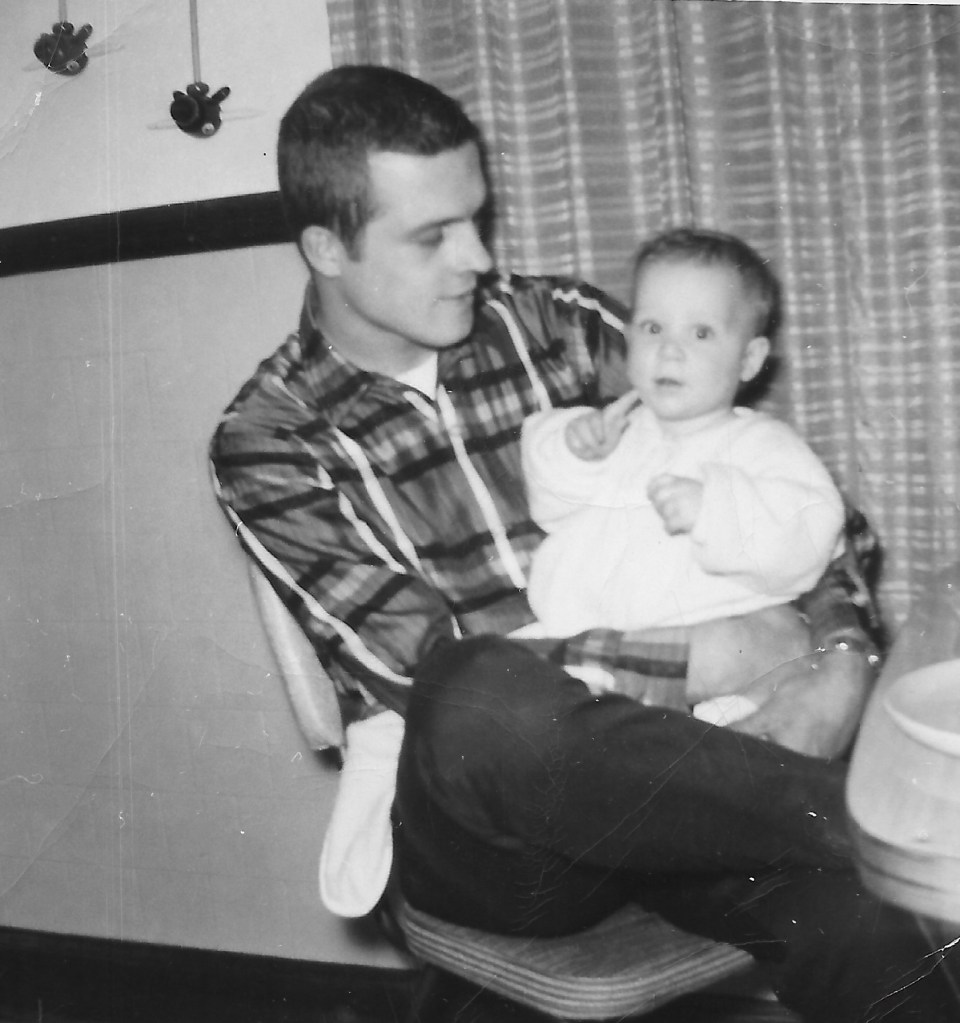
Dad and me, before I started playing with his flashlights and tape measures. Dad was 22 years old, and I was ten months old.
Watching my joyful grandsons with mini flashlights strapped to their heads made me smile, and I offered up some words to my father who passed away six years ago. Dad, I know our love of your flashlights and tape measures drove you crazy, but thanks for being a good sport about it–in your own way. And I told him that my grandsons are crazy about flashlights and tape measures, and if they lived with him, he’d find those things going missing once again.
Persimmon Tree published my flash essay “Women’s Choices” in the Short Takes section of their winter edition. The Short Takes theme for the winter publication is Resistance and Resilience. All the selected poems, artwork, essays, fiction, and music reflect that theme.
To read the rest of “Women’s Choices” click here: Short Takes: Resistance and Resilience. You will need to scroll down about halfway through the selections.
The Spider, most likely a species of cellar spider, September 2022
This is the spider I could not kill. It spun its web along the outside curb of the shower in the finished basement of my mother’s house.
When my husband and I visit my mom, we stay in that basement, an elegant suite with a large bank of windows, a beautiful bathroom, a spacious living room, and a large bedroom.
But I’ve killed other spiders, many times, in that same place. I can’t fathom where they come from or why they like the spot on the outside curb of the shower in the elegant basement.
I discovered this spider a couple of days after my mother had quadruple bypass surgery in September. But I did not grab a piece of tissue paper, I did not squish it, and I did not flush it down the toilet. The spider in the bathroom and my mother in the hospital reminded me of an O. Henry story called “The Last Leaf.”
The leaves
In the story a young woman with pneumonia believes she will die. Dailey, she watches leaves drop from a vine outside her window and believes when the last leaf falls, she, too, will expire. And so, because I read a story forty years ago, the spider stayed. I wanted to believe as long as the spider existed, my mother would recover.
I visited my mother in the hospital. I walked her dog at home. And when I took a shower, I was mindful of the spindly spider. Its existence or extinction would not impact my mother’s recovery. But I remembered the old painter in “The Last Leaf” who paints a leaf so realistically on the wall outside the dying woman’s window, it fools her and she recovers.
And so, the spider stayed. Not because I believed it would guarantee my mother would get better, but because it was all that I could control.
My mother is three months into her recovery, and doing well. I’m not sure about the spider. But the last time I saw it in October, it still commanded the corner along the outside curb of the shower in the elegant basement.
My husband likes pumpkin pie. I do not. For more than twenty years we cooked a traditional Thanksgiving dinner for a big group of people. But not pumpkin pie. Someone else always brought pumpkin pie. I baked a cake or cheesecake.
This year we’re having a nontraditional Thanksgiving dinner. No turkey, no stuffing, no mashed potatoes, no pumpkin pie. There will be four of us. We’re having a roast, baked potatoes, and green beans (not mixed with cream of mushroom soup). I’m making a chocolate peanut butter chip cake. My husband is happy to skip the turkey and other fixings, but he mentioned twice that he was going to miss the pumpkin pie. Yesterday, I decided to bake him a pumpkin pie before Thanksgiving.
I called Aunt Coralee. She bakes smack-down, grand-champion, blue-ribbon, best-of-show pies. I asked her how she makes pumpkin pie. She starts with a homemade crust. Her crusts are flakey, tender, rich and golden brown, and if her pie filling mysteriously evaporated, her crust could carry the day on its own. I told her that was an art form I did not have time to master. She told me to buy a premade crust at the store. All I had to do was unroll it and put it in the pie pan. No rolling pin required. I could do that. She told me to use canned pumpkin and follow the recipe on the back of the label. I could do that, too. Off to the store, I went.
My second call to Aunt Coralee was from the grocery store. “Do you bake your pie in a glass or tin pan?” I asked. She uses glass or ceramic. “Cool,” I said because I had a glass pie dish that I used for quiche.
“Don’t forget the whipped cream,” Aunt Coralee said.
“Thank you, thank you, thank you.” I’d thought about whipped cream in produce, but breezed by the dairy cooler in pursuit of refrigerated pie crust. “If you want to see a grown man cry, just hand my husband a piece of pie without whipped cream,” I said. Aunt Coralee and I had a good laugh–everything’s funnier in a grocery store when you’re buying ingredients to bake a pie you’ve never made before.
Back home I unrolled the pie crust and placed it in the glass pie pan. I mixed the filling and poured it into the crust. Baking time: fifteen minutes at 425° then thirty to forty minutes at 350°. Thirty to forty minutes! That’s a big spread of time, like across a few time zones. The instructions said the pie would be done when a knife inserted into the center came out clean.
After thirty-five minutes at 350°, I did the knife test. It came out clean, except for three tiny, wee specks of pumpkin. That had to be considered clean, but the center of the pie was jiggly. I baked it another five minutes. Then tested again. Just a few tiny, wee specks of pumpkin, but still jiggly in the center. I was up to forty minutes but decided the pie needed five more minutes. When the timer binged, I pulled the pie from the oven and set it on the stove. The center was still a little jiggly. I called Aunt Coralee for a third time.
I worried the pie wasn’t done but also worried I’d cooked it too long. Aunt Coralee assured me it would be fine, that I couldn’t really overcook the pumpkin by adding an extra five minutes. But she explained the center of a custard pie will be jiggly when it’s done cooking and will set up as it cools. The pie did look lovely as it cooled and the center set up.
After work my husband discovered his pumpkin pie on the stove, he smiled, and stated the obvious, “You made me pumpkin pie. Thanks.” He kissed me on the cheek. Smart guy.
Next year I’m going to make him another pumpkin pie. I’ll stop baking it when the knife comes out clean, and I’ll remember the center will be jiggly. And even though I won’t eat a slice, I’ll admire it as it cools on the stove.
[This essay was published in Red Cedar Review, Volume XXIV in the fall of 2022. Red Cedar Review is published by the University of Wisconsin-Eau Claire through its Barron County Campus. It’s a print- only journal, and its editors and staff consider art, prose, and poetry from northern Wisconsin residents.I decided to post this essay in honor of Thanksgiving because when I reflect on my childhood, I’m very thankful for our old farmhouse and our wonderful neighbors.]
The Old Farmhouse, late 1960s or early 70s
Wrapped in thin white clapboard, the two-story farmhouse built in 1907 was 57 years old when my parents, my two sisters, and I came to live there in October 1964. It looked older to my five-year-old mind, much older, in the way a person of thirty or forty seems very old to a small child. My parents sold their duplex in Milwaukee where rows of houses sat a handshake apart, fronted by sidewalks and busy streets lined with parked cars. They moved their dysfunctional marriage and children to a country road with a smattering of houses fronted by rural mailboxes and a narrow road, on which no one parked. From age five to seventeen, I lived there with my parents, two sisters, and a brother, born in 1967.
A week after we moved into our farmhouse, a knock rattled the front door that opened into our large kitchen, the kind where a farmer’s wife could cook a hearty meal to feed her husband, their children, and the farmhands all in one shift. Mom was working in the kitchen while my sisters and I played on the floor. She was twenty-four. Her face, scrubbed clean of makeup and her chestnut-brown hair pulled up into a pony tail, made her look far too young to be the mother of three small girls. She gave birth to me, the oldest, when she was eighteen.
Mom opened the old wooden door and on the other side of a modern aluminum screen door stood John Giese, Sr., whom we’d soon come to refer to as “Old Man Giese,” distinguishing him from his son, John Giese, Jr.
The Giese barn
Old Man Giese stood on our front stoop, clutching two dead chickens by their feet, one in each hand. He and his three grown children, John Jr., Mildred, and Leona, lived across the street in a white farmhouse as ordinary as ours. But the Giese farmhouse, surrounded by fields to be planted and harvested; by cows and chickens to be fed and tended; by cherry trees, blackberry bushes, and current bushes bearing fruit to be picked and preserved, appeared grand. Our farmhouse, surrounded by two acres of mowed grass then acres of overgrown farmland, looked tired. Giese’s bright red barn stood proud in contrast to our barn layered with various shades of washed out red, which made it appear mostly pink.
“Ma’am,” began the old gentleman, for although he wore a frayed cap and shabby blue denim overalls, he exuded a dignity the two dead chickens and his working clothes couldn’t erase. Old Man Giese was the first real farmer I ever met. My previous knowledge of farmers came from watching Mr. Green Jeans on Capitan Kangaroo, and in my five-year-old mind, Old Man Giese was the opposite of Mr. Green Jeans in every way.
Mom, a city girl, gawked at his welcoming gift of two dead chickens. She knew nothing about cleaning them.
Fritz sitting by our pinkish-colored barn, early 1970s, a couple of years before he passed away
“Your dog,” Old Man Giese continued, “killed my chickens.”
Fritz, our six-year-old German shepherd, lay on the family room floor and made no move to join the conversation.
“I’m so sorry,” Mom said. “Can I pay you for the chickens?”
“No, just keep the dog off my farm, ma’am.” Old Man Giese put his back to us. A lifeless chicken in each hand, he descended our front stairs and returned to his farm. He never called on us again, and a few years later he, too, would be dead, gone to join his wife who died before we arrived.
Mom, relieved she wouldn’t have to clean chickens but mortified Fritz might have killed them, shut the door and strode into the family room. “No chickens,” she yelled at Fritz. “Never again.” He understood and stayed away from the Giese farm, but he still ran loose, up and down the country roads, chasing female dogs in heat.
That evening at dinner, she told Dad, “At first I thought the chickens were an apology for his cows chomping on our lawn the morning after we moved in.” But the chickens had been an indictment, not an apology.
In our new neighborhood, Fritz had committed the first faux pas, setting the standard by which my family’s behavior could be explained. When my parents fought in the middle of warm summer nights, their shouts crawling in and out of open windows, the neighbors could say, What do you expect? Their dog kills chickens. When my sisters and I threw apples at passing cars, but the parents of two older, well-behaved children, from down the road got a visit from the police, their parents could say, They can’t control their dog either. When Dad sped down the country road or set off cherry bombs in our yard, the neighbors could say, What do you expect from a man who lets his dog ignore good-neighbor etiquette?
Our existence in the neighborhood was like a hoppy beer—an acquired taste. Some people come to love the taste of hops, but others can’t force it past their taste buds. Most of the families up and down our sparsely populated road came to accept us, and we were welcomed into their homes and yards. Only two families never warmed to us, not bad considering our parents’ occasional nocturnal fights, dad’s shenanigans, and our string of dogs that never stayed home.
Dad, despite his bad-boy-James-Dean manner, was handsome and charming. An excellent mechanic, he was always willing to lend a hand to neighbors and offer them a beer. Mom was hard-working and friendly, and if she borrowed a cup of sugar or a roll of toilet paper, she always repaid her debt. My siblings and I stopped throwing apples at cars, and we behaved ourselves so no one had to call the police on us again. We were polite or Mom would’ve walloped us or grounded us for life, depending on the prevailing winds of her mood that day. Most of the neighbors decided we were okay.
And the Gieses? They didn’t hold Fritz’s chicken incident against us. After all, their cows had grazed in our front yard the day after we’d moved in. Old Man Giese and his son fixed their fence, and the cows stayed home. Fritz defied fences, but he obeyed Mom’s command and stayed out of their yard and away from the chickens, easy for him because they didn’t own dogs. To prove there were no hard feelings, when my siblings and I were old enough to cross the road, the Gieses gave us an open invitation to play in their yard, to eat fruit from specific trees and bushes, and to cross their fields in winter to ice skate on the frozen river running through their property.
None of Old Man Giese’s children had youngsters of their own. Looking back, I believe they enjoyed seeing us run through their yard, roll down the hill by their barn, and eat the fruit they grew. I believe they smiled when they heard our voices on the winter wind, echoing through the trees as we skated on the frozen waters just behind their fields. And I wonder what they thought, when as a teenager, I sat on a large tree stump near the barn and talked to their cows, who gathered by the fence, eager for gossip about my teenage troubles.
[I want to thank the editors and staff of Red Cedar Review for selecting my essay for their Fall 2022 issue. The ending of this essay is slightly different from the version that appears in their 2022 issue. I added the last two sentences because I felt the ending was too abrupt. As a writer, I often see ways to improve something I’ve written, even after it has gone to press.]