Christmases at the Old Farmhouse

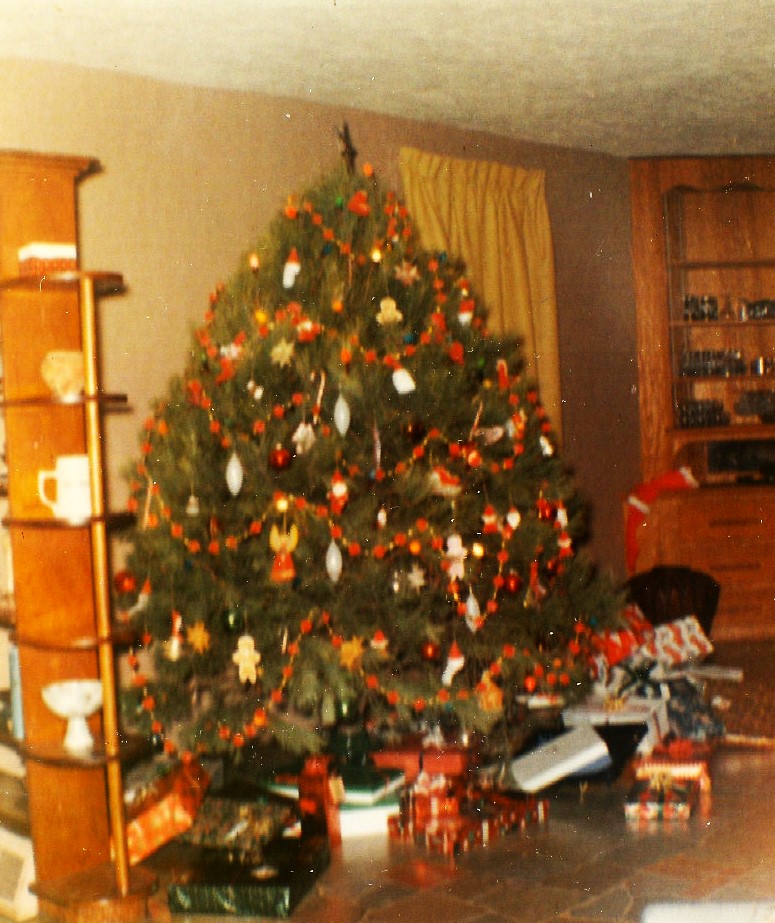
One of mom’s trees before she started putting them in front of the mirrored wall in the living room. Unfortunately, I have no pictures of the later Christmas trees.

At Christmas time when I was a child, my mother transformed our old farmhouse into a magical place. Fresh boughs of evergreen, sprayed with canned snow and trimmed with white twinkle lights, nestled on the mid-shelf of the corner hutch in the dining room. The soft glow of pastel-colored icicle lights outlined the large picture window in the living room. A tall, portly Christmas tree festooned with old fashioned ornaments and C7 lights stood in front of a mirrored wall, which made it appear as if we had two trees. Mom always bought a real tree. She would ask the attendant to hold tree after tree, while she walked around each one. The tree had to look good from all sides, and the trunk had to be straight. Once she sent my father to pick out the tree, but only once. Father’s tree spurred a loud conversation and a few tears.

Mom baked loads of homemade cookies, filling round tins with Mexican wedding cakes, sugar cookies, peppermint meringues, gingerbread men, and spritz cookies. In the days before Christmas, I skimmed cookies, sneaking one now and then from a tin then rearranging the remaining ones to fill the empty space.

The weekend before Christmas Mom took us to the American Soda Water Company, a place filled with bottles of the tastiest soda in so many delicious flavors, such as grapefruit, grape, strawberry, cherry, orange, root beer, cream, lime, cherry cola, black cherry, and more. She pushed the cart in which she had placed a wooden case that held twenty-four bottles. My siblings and I buzzed around the aisles plucking our favorite flavors and some of our father’s favorites. After we filled the case, mother placed another empty case on top of the full one. We would leave the store with four cases of soda, enough to see us well into the New Year because we weren’t allowed more than two or three a week. But we pilfered the occasional bottle of soda. Eventually, only empty bottles remained in the wooden cases, and Mom returned them to the soda company and collected her deposit, a nickel a bottle.

Winter at the farmhouse. The only animals we ever owned were dogs and cats. But it had been a working farm at one time. The buildings in the background belonged to neighbors.

On Christmas eve, my siblings and I nestled under our covers and tried to sleep. And when I couldn’t, I peered out the small window at the side of my bed and searched the starry sky, hoping to spot Rudolph’s red nose. However, by the time I was six, thanks to a know-it-all neighbor boy who was three years older than me, I knew there was no Santa Claus. Still, wanting to believe, I looked for Santa’s sleigh in the sky, and when I spotted red lights on a commercial jet heading to Billy Mitchell Airport, I would pretend it was Jolly Old St. Nick with Dasher and Dancer, Prancer and Vixen, Comet and Cupid, and Donner and Blitzen, all led by Rudolph and his shiny nose.

Eventually all was quiet in the house, my siblings and I softly snoring and dreaming of Christmas morning. At this time, my mother’s shift as Santa’s elf would begin. It took her hours to wrap presents for her four children. She couldn’t do this ahead of time because she needed her Christmas bonus from Marc’s Big Boy where she worked as a waitress, which she received just a few days before Christmas. Bonus money in hand, she drove to the store and paid off the layaway balance on our gifts, which she hid in the trunk of her car until Christmas Eve when her children were all fast asleep. Each package she wrapped with bright cheerful paper and tied up with ribbons or decorated with bows. She artfully arranged them under the tree as if she were staging a scene for the Gimbels storefront window in downtown Milwaukee. Then in the wee hours before dawn she slipped into bed for a few hours’ sleep.

We had strict orders not to wake my parents too early. This meant we weren’t to get out of bed until about eight o’clock. But sometimes before dawn, we might tiptoe down the stairs and into the living room to see the presents under the tree. We kept our distance, not wanting to break the mystical spell of the Christmas tree tending to our gifts tucked under its boughs. And we didn’t want to get into trouble with our parents. We tiptoed back up the stairs and climbed back into our beds. Waiting.

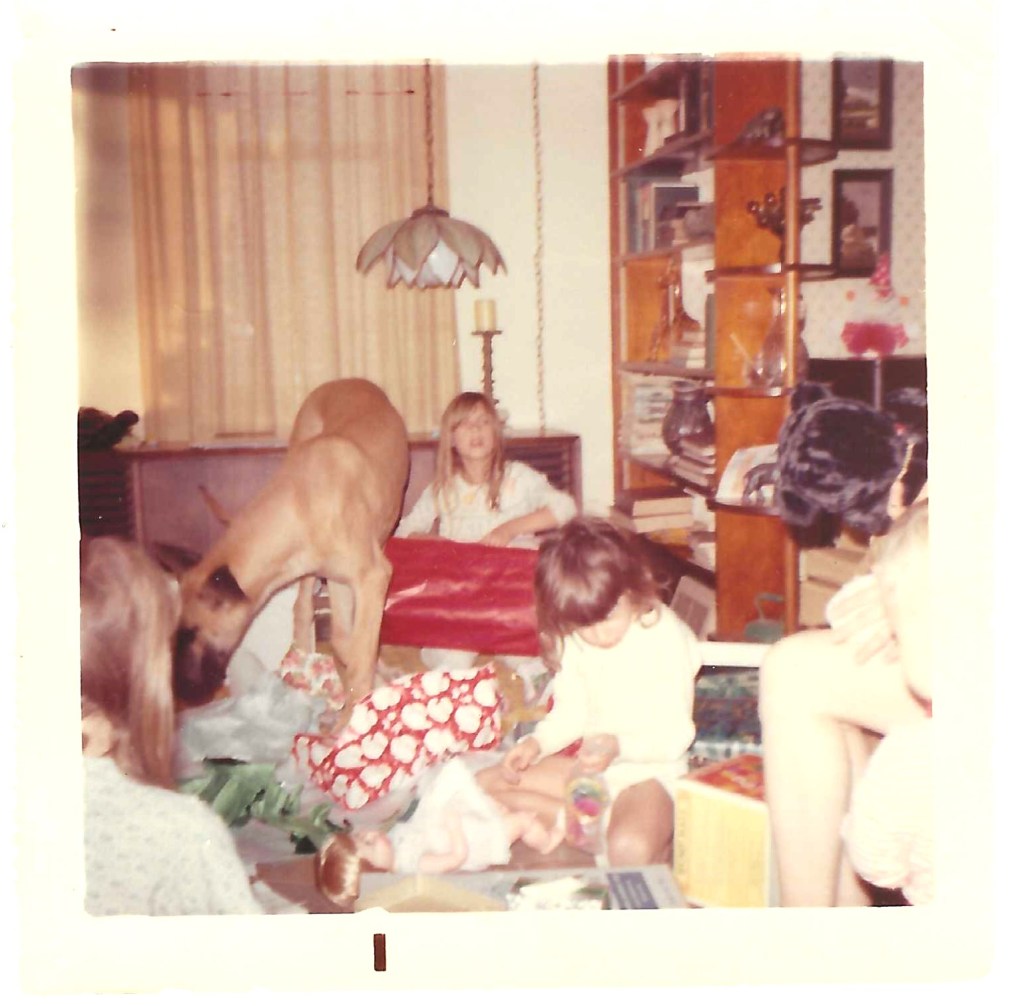
Christmas morning, circa 1969

Christmas morning never disappointed. We opened our presents one at a time because my parents wanted to see us enjoy each of our gifts. Mom was a wonderful Santa. There were always some toys from our lists, but each year she surprised us with wonderful presents we hadn’t even known we would want. Puzzles, games, art supplies, books, pajamas, and clothes spread across the floor as we unwrapped our gifts.

Once the wrapping paper was cleaned up and breakfast had been eaten, our job was to stay out of the kitchen and out of Mom’s way as she began to cook Christmas dinner, a feast of turkey, stuffing, sweet potatoes, mashed potatoes, gravy, and green bean casserole, all cooked to perfection. Later we would be asked to set the dining room table, and after dinner we helped wash and dry the dishes. But Christmas morning and afternoon belonged to us, a time to play with our new toys and games.

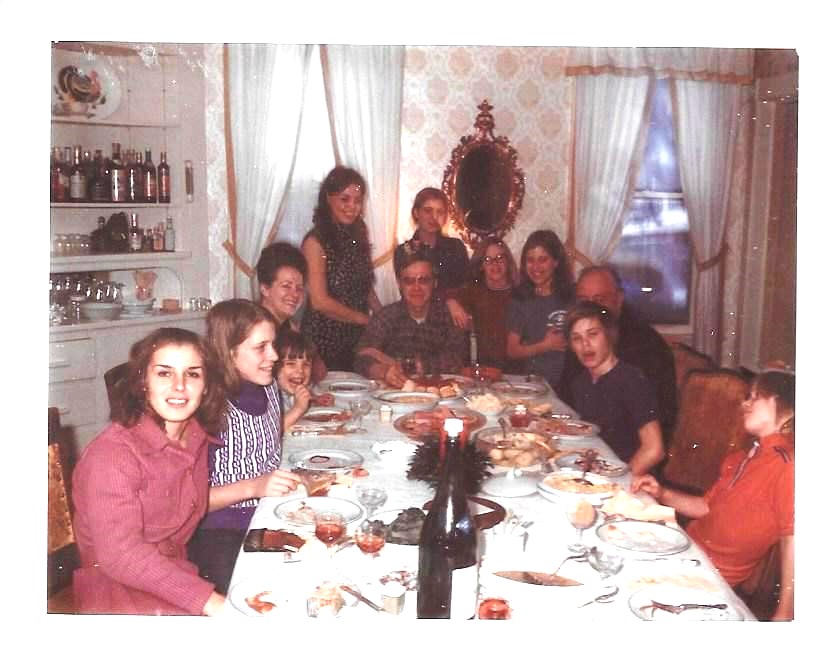
In mid-afternoon Uncle Freddy and Auntie Pat arrived with our three cousins (Brian, Dee Dee, and Lisa) and Nana Kitty. We ate at an elegant, second-hand burl wood dining table covered with a crocheted cloth my mother bought at an antique store. Before we filled our plates, someone said grace, giving thanks for our feast. Then began the passing of the dishes and the filling of the plates. With twelve people seated around the table, this took some time. It was fair game to interrupt any conversation with “Could you please pass me the . . . ?”

Christmas dinner. From the left and clockwise: Auntie Pat, me, Steve, Nana, Mom, Uncle Fred, Kimberly, Dee Dee, Suzanne, Grandpa Howard (who had recently married Nana) Brian, and Lisa. My father took the photo, circa 1972.

At the end of the day, when the dishes were done, when the company was gone, except for Nana who stayed to babysit us, my parents would meet up with friends at a local theater to see a movie. It was the perfect end to a perfect day. My siblings and I would fold up the crocheted tablecloth, exposing the thick pad that protected the dining table, and set up our new art supplies. We painted or sketched or wove hot pads while Nana visited with us. We snacked on cookies and soda. At bedtime we put on our new Christmas jammies. As we drifted off to sleep, we knew before we could do it all again, we had to wait 365 days. A lifetime to a child. A snap of the fingers to an adult.

Christmas Past and Present and Future

Christmas gives me the blues. I miss the magic of childhood Christmases spent with my siblings, and I miss the magic of Christmas mornings I spent with my young children. I miss family and friends who have passed away, and the special Christmas traditions we had. Because nothing stays the same, nostalgia can be heart-wrenching.

So, I’m weaving some new traditions into some old ones.

When I was in my twenties, my mother-in-law took me to my first ballet, along with my two sisters-in-law. It was December, so of course, we went to The Nutcracker. I loved it. For two hours enchanting music, graceful dancing, sparkling costumes, and magical sets swept me away to another world. Attending The Nutcracker with my mother-in-law became a tradition for a handful of years.

This year I took my twelve-year-old granddaughter, Clara, to see The Nutcracker, her first ballet. My mother-in-law would be happy to know I’m reviving her tradition.

Clara and I were dressed in the past and present. I wore a pair of old garnet earrings given to me by a friend, a black-and-red plaid sweater given to me by another friend, and a string of pearls given to me by my mother. I carried a black purse my sister had sent me. Clara wore a black skirt I’d bought her, black leggings, and a cream-colored sweater with a brown geometric design that her grandmother had worn when she was young. We were wrapped in the beauty of the present and the comfort of the past.

The ballet started at two o’clock, so we left the house at one o’clock. Because it’s a short drive to Symphony Hall, we arrived early. Happily, we discovered a foosball table in the lobby. This might be an odd place for a game table, but Symphony Hall is next to a college hockey arena. (An air hockey game would’ve been more appropriate, but they are noisy, like the ear-splitting clack-clack of a pickleball game.) There was no foosball table when I went to the ballet with my mother-in-law. But she would have approved. She liked quiet adventures. In her seventies she painted her nails with canary-yellow and key-lime-pie-green nail polish. She changed the spelling of her first name. She asked me to take her to see Willie Nelson. She went to see The Pirates of the Caribbean with me.

My granddaughter reached the foosball table first. She dropped the ball down the side chute and pushed and pulled on the handles. “Want to play?” I asked. “Sure,” she said. A small smile tickled the corners of her mouth.

Dressed in our semi-elegant, mostly black clothes and coats, we stood opposite one another. We cranked handles and spun our foosball players. Trash talking was minimal. We focused, each of us giving 110% to our plastic, featureless foosball athletes. The game went back and forth with the lead changing many times, but in the end, I prevailed by one goal. I wanted to do a Chariots of Fire victory stride, but well . . . I was wearing pearls.

The lights reflected in the window make it appear as if the sky has lights that illuminate the Aerial Lift Bridge.

It was after 1:30, but the ushers still weren’t taking tickets. I wondered why there were so few people in the lobby. But then a ship came through the canal, and the staff, Clara, and I walked out onto a balcony to watch it glide into the harbor. No matter how many vessels we locals see enter the canal, we never tire of watching them chug under the lift bridge and into the harbor to take on a load of cargo. After the ship passed by, the staff, Clara, and I returned to the warmth of the lobby.

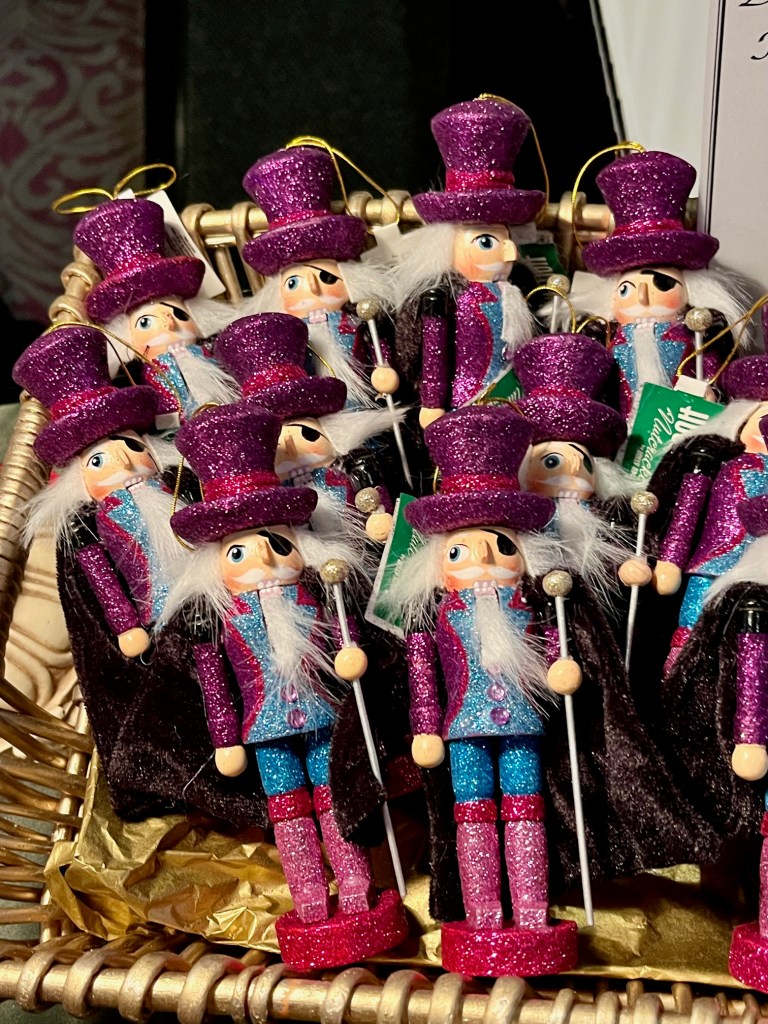
The ushers still weren’t taking tickets, and I got a strange feeling. After I talked to one of the staff, I found out the ballet actually started at three o’clock. Clara and I had been an hour early. We had time to whittle away, so we explored the lower level of the building. We sat in lobby chairs and watched people walk by. We checked out The Nutcracker merchandise. I bought Clara a light-up wand made of optical fibers and myself a pair of socks decorated with nutcrackers.

Finally, the auditorium doors opened, ushers handed us programs, and we found our seats.

Shortly after three o’clock, the lights in the auditorium dimmed, the orchestra began to play, and the curtain rose. My Christmas blues were chased away by pirouettes and leaps, jumps and high kicks all performed by dancers in colorful costumes. Some of the old tradition of the ballet I’d seen with my mother-in-law remained, but it was given a new twist. Instead of being set in the Victorian-style home where Clara’s family and Drosselmeyer gather on Christmas Eve, the set had been transformed into a train station. The ballet was still set in the early 1900s, but the dancers, other than the lead ballet performers, were dressed as street vendors, travelers, lumberjacks, and gingerbread cookies. I have to admit that at first I missed the version I’d seen with my mother-in-law. But the ballet was so good. And clinging to the past too tightly brings a sense of melancholy. Nothing stays the same. So, I let it go and wove the night’s new traditions in with the old.

If life were A Christmas Carol, my mother-in-law would have been Fred, the ever-cheerful nephew of Ebenezer Scrooge. She knew how to keep the spirit of Christmas in her heart all year long and how to rise above characters like Scrooge. (Circa 1935, I chose this photo for the cover of the book I helped my mother-in-law write about her life because it captured her personality so well.)

After rounds of curtain calls and clapping until our palms hurt, Clara and I exited the auditorium. We left the bright lights of the lobby behind and walked out into the dark, cold night. We stuffed our chilled hands into our mittens. Beneath our stylish coats, our hearts were warm.

And for a while my Christmas blues were banished. Maybe next year we will go to the symphony or a Christmas play, then the following year back to The Nutcracker. It’s good to look to the future.

I Wish I Could Take You with Me

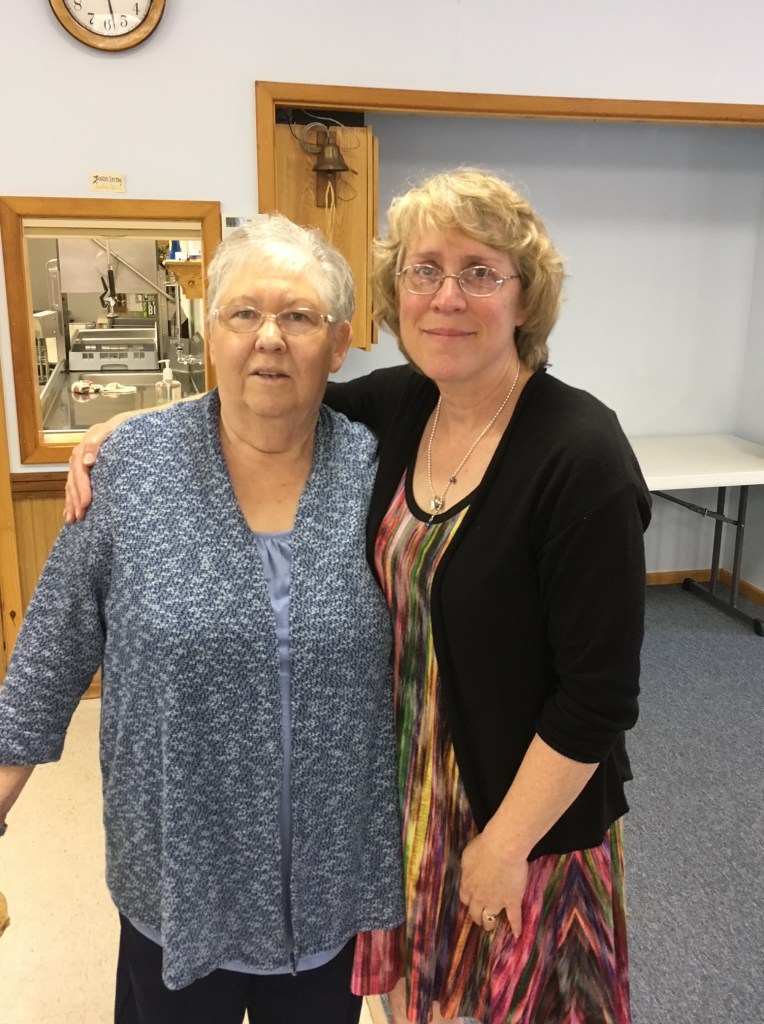
Sandi (l) and me (r), July 2017

It’s late afternoon on August 18, 2018. My friend Sandi and I have escaped her pre-fab house and her unstable caretaker, who is out running errands, but we cannot escape her stage IV cancer. That sits with us in the car. Sandi fancies we are the movie friends Thelma and Louise, trying to outrun it all.

Fifteen minutes earlier, I’d come to show her the quilts I’d finished piecing before taking them to the machine quilter. She’d started them for her son and grandson but was too sick to finish them. As I was leaving, she said, “Wait, I’m coming with you.”

A dazzling sun hangs in a spacious cloudless sky. I wear sunglasses because the tinted windows in my van aren’t dark enough to subdue the afternoon’s harsh glare. I don’t ask if I’m Thelma or Louise – I’ve never seen the movie – but my sunglasses are similar to the ones Louise wears in the promotion stills. The movie is one of Sandi’s favorites.

Sixteen days from now Sandi will die, but today she’s full of mischief and life, if one doesn’t look too closely. She refused more chemo, so she has hair. She’s thinner, but far from frail. She’s quick with a smile and a laugh, but moves slowly.

During the drive, we joke and laugh, making light of our escape from the caretaker, whom we call Nurse Ratched.

My friend taps her perfectly manicured and sparkly-red painted nails on the console between our seats and says, “I wish I could take you with me.”

I stop talking. Silence mingles with the cold air blowing from the vents on the dash.

I have no words. But within one beat of my heart, I know that her words are the most profound expression of love I’ve ever received. And, I have no words.

She speaks first. “But your husband wouldn’t like it.”

Still, no words.

We both know she doesn’t want me to die.

I truly believe she has said this to no one else. Yet, I have no words.

Ordinary chitchat begins again.

After dropping off her quilts, we return to her home. The caretaker is back, silently seething. We left her a note, but that didn’t matter. The caretaker believes if she controls all of Sandi’s end-of-life decisions, Sandi will live longer.

My friend settles into her easy chair. I kiss her cheek and whisper in her good ear, “I’m going to go.” The caretaker, a dark cloud, will become a thunderhead if I stay.

“That’s probably best.” Sandi whispers too.

I kiss her cheek again, and murmur, “I love you. I’ll see you tomorrow.”

“I love you too,” she says.

I tell myself I’ll watch Thelma and Louise after Sandi is gone, but I don’t believe I ever will. Thelma and Louise drove off a cliff together. In sixteen days, Sandi will leave without me, a Thelma without her Louise. Or perhaps a Louise without her Thelma.

I never asked her, “Which one am I?”

[This flash essay was originally published by Persimmon Tree in their “Short Takes” section in Summer 2023. I’ve posted it here because while I think about Sandi everyday, there are certain times of the year when she plays in my memories throughout the whole day. ]

Playing Cribbage with Clara on an Old Board

The cribbage board connecting generations

I taught my twelve-year-old granddaughter, Clara, how to play cribbage. The first two rounds we played were full-disclosure games because we laid our cards face up on the table. It’s the easiest way to teach someone to play. I taught her strategies for tossing cards into the crib, how to maximize her chance for a better hand, and how to peg points while preventing her opponent from doing the same. I taught her how to count the pairs, runs, and combinations of fifteens. Cribbage is a complicated game, but that’s what makes it fun.

I learned to play cribbage when I was nineteen years old. I was a bartender in a small unincorporated town, population 350. One of my customers asked me to play cribbage. I told him I didn’t know how. “Well,” he said, “you’re going to have to learn because when customers come in and it’s slow, they’re going to expect you to play.”

I’d grown up eight hours away in a metropolitan area, and I’d never heard of cribbage.

The customer grabbed the cribbage board and a deck of cards off a ledge from behind the bar. “I’ll teach you,” he said. He placed the pegs in their starting holes and shuffled the cards. I carried over a barstool and sat down in front of him but stayed behind the bar. After all, should another customer have shown up, I might’ve had to pour a beer, mix a whiskey-7, or pop a top on a soda. He taught me well, and I played many games of cribbage with him and other bar patrons, especially on quiet winter days and nights.

Shortly after Clara and I started our third game, I asked, “Do you want to play without us seeing each other’s cards?”

“Sure!” She smiled and her eyes sparkled, excited that Nana felt she was ready to be in charge of her own hand. She did well and quickly caught on to counting her hands, but luck plays a part in cribbage, and I had better cards. Yet none of that mattered. We laughed and celebrated our high-scoring hands. We laughed and mocked our low-scoring hands, saying, “two, four, and there ain’t no more,” or “I got nineteen.” (Nineteen equals nothing because it’s not possible to score nineteen points in a cribbage hand.) I almost skunked her in one of the games, but she managed to avoid the stink of getting beat by 31 points or more. And we laughed about that too. Both of us like to play cards and board games, but neither of us is bothered by losing. There is always another game to be played.

Clara and I played on the same cribbage board I used when I taught my grandma Olive to play cribbage. I have two other boards, but I liked knowing that Clara and I were touching the same pegs and moving them along the same holes on the same board Grandma Olive and I used forty-five years ago.

When I was eighteen, I moved in with my grandparents, George and Olive, and lived with them for almost three years. Grandma Olive and I didn’t always agree about how I should live my life. She believed I should sing in the church choir and attend Sunday sermons. She believed I should be present at the dinner table for breakfast, lunch, and supper. She believed I should be home before midnight. She believed I should have a better class of friends. She believed I should iron my shirts instead of wearing them wrinkled.

I believed Sunday mornings were for sleeping in. I believed if a friend said, “Let’s go swimming” or “Let’s play tennis,” skipping lunch or dinner was no big deal. I believed being home by midnight was for Cinderella. I believed my friends were wonderful. And I believed the heat from my body would smooth out most of the wrinkles in my shirts.

But I loved Grandma Olive, and I knew she loved me and worried about me. And because neither of us liked conflict, our disagreements were soft-spoken, thirty-second exchanges of point and counterpoint, in which neither of us would change our minds. Then I would leave the room. And she would exhale a heavy sigh.

When I wasn’t working or with my friends, I liked spending time with Grandma in her kitchen. She taught me how to make an angel food cake (lots of sifting and gentle folding) and Amish sugar cookies (pressed with the bottom of a cut-glass crystal sugar bowl). She taught me how to play Shanghai rummy, which used two decks of cards and had increasingly complicated hands of sets and runs, which players had to attain to score points.

Grandma often heard me talk about playing cribbage with customers when I bartended. “I wish I knew how to play,” she would say, so I bought a cribbage board. One evening as we finished up the supper dishes, I offered to teach her how to play. I can still picture her standing in her slightly remodeled 1940s kitchen, wearing her patterned apron trimmed in red rickrack, one of its pockets bulging with an ever-present handkerchief. She teared up, smiled, and said, “Oh, yes!”

Grandma Olive loved me even if drove her crazy, and I loved her even if she didn’t understand my generation.

Grandma Olive with me on her lap and Grandpa George with my sister on his lap, 1960. Seventeen years later I would move in and teacher Grandma how to play cribbage.

I lived with my grandparents for nearly three years. I thought I was easy to have around, and in many ways I was. But looking back, I realize that my grandparents, especially Grandma Olive, worried about me. They’d already raised three children, so having their eighteen-year-old granddaughter come to live with them during their golden years wasn’t ideal. Grandpa, who was never a talker and still worked at his gas station six days a week, would remain an enigma to me. But Grandma and I came to know and appreciate one another, most of time.

So sometimes when the baking and cooking and dishes were done, Grandma Olive and I would sit at the old wooden kitchen table covered in oilcloth and play Shanghai rummy or cribbage. We talked and laughed, and forgot about our disagreements, neither of us caring if we won or lost the game.

A few years after I moved out of my grandparents’ house, Grandpa George died, and Grandma Olive developed dementia. She and I couldn’t play cards anymore.

Comes a time when there isn’t another game to be played.

Machines from the Past

My grandsons and the silent typewriter

“Hey, boys,” comes a lively greeting from a tall, white-haired man, whose cheery voice emanates from an equally upbeat face that gives the impression it has spent a lifetime brimming with friendliness. The man, who is at least as old as I am, is dressed in a pair of jean shorts and a casual blue shirt that matches the color of his fun-loving, twinkling eyes.

My six- and four-year-old grandsons have just entered the assistant lighthouse keeper’s home in Two Harbors, Minnesota. The jovial man, however, isn’t the assistant keeper. He is a tourist, like us, visiting the lighthouse grounds, which are now a museum.

He points toward the corner of what would’ve been a small sitting room. “What’s that, boys?” he asks my grandsons. I haven’t crossed the threshold yet, so I can’t see what he points at.

Without skipping a beat, my six-year-old grandson answers, “That’s a typewriter.”

“Wow,” the man says, now looking at me. “Most kids don’t know that!” He reminds me of my father who would’ve put this kind of question to anyone, young or old, in a museum, hoping the person wouldn’t know the answer, giving him the opportunity to burst into a history lesson. In the absence of strangers, my father would quiz me, “Do you know what this is?”

I smile at the man, and as an explanation, I say, “Their nana is a writer.” But this isn’t why my grandson knows a typewriter when he sees one. None of my grandchildren have seen me use one. I do my writing on a laptop. Although I wrote plenty of college papers on a typewriter, I can’t say I miss it. I made too many mistakes and smeared thick globs of whiteout on typos, which resembled miniature frescos when they dried, but without any artistic flair.

I’m not sure why I blurt out, “Their nana is a writer,” but something in the tall man’s happy manner makes me happy, so I say it because writing makes me happy. I’m already thinking about our encounter as something to write about.

So, why does my six-year-old grandson know that the machine with rows of letters is a typewriter? Because I like to take my grandkids to small museums. A month ago we visited the Old Firehouse and Police Museum. On the second floor in an old office displayed with artifacts, he pointed to a typewriter sitting on a wooden desk and asked, “What’s that?” I explained what it was and how it worked, and that the fire chief used it to type reports about the fires they fought.

The white-haired man moves on to another room in the assistant keeper’s house turned museum. My grandsons and I look at the typewriter. “Can I touch it?” one of them asks. My first impulse is to say no. Instead, I look at the typewriter. I don’t see a do-not-touch sign. If I had, I would’ve said no. In my family there are two kinds of people: those who can’t ignore signs and those who feel they are merely suggestions. But I’m flirting with a technicality because I know museum curators don’t want visitors touching artifacts.

I think back to the mid-1990s when I took my father and my two sons to the same fire and police museum that I recently visited with my grandkids. Inside the museum was an old fire truck, with a hand crank used to start its engine. I came upon my father turning the crank, which was located right below a sign that said: DO NOT TURN THE HAND CRANK.

“Dad,” I said, “you can’t do that. Look at the sign.” I wondered if he thought the engine might roar to life.

“Well, they left the crank here,” my father said, as if the presence of the crank negated the command: DO NOT TURN THE HAND CRANK. The old hand-crank fire truck was still there when I took my grandkids, but the sign was gone and so was the hand crank. I don’t think my father was the only person who turned that crank. He was a mechanic nearly all of his life, and the urge to tinker with mechanical objects never left him.

My grandsons and I are still staring at the typewriter. I think about my father and his belief that signs weren’t meant for him. He routinely ignored handicapped parking and speed limit signs. When he taught me to drive, he said that I could take curves at twenty miles over the posted limit. I stare at the typewriter, thinking about the fingers from the past that pushed its keys, sending thin metal bars with raised letters clacking to an inked ribbon, leaving black words on white paper. My grandsons stare at the typewriter as if it’s a mystical object, but I have no idea what they are thinking.

“You may touch it,” I say, “but very gently, like this.” And, I brush my fingers like feathers across a few keys. There is no one to tell me, “You can’t do that.” There is no one I can answer back to by saying, “Well, there isn’t a sign.”

I add, “Do not push down on the letters.”

Each grandson takes a turn, stroking a few keys softly, like they are a newborn’s forehead. Sensing they’ve been granted a special privilege, they are silent. Neither of them pushes down on a key. But I imagine they think about what it would feel like and how the typewriter would react if they did.

Suddenly, I understand something about my father and the old fire truck and its hand crank. He wanted to feel that crank turn. Perhaps, because he’d never had the opportunity. By the time he was born in 1937, hand-crank cars were a thing of the past. But his father, who opened a gas station and repair shop in 1920, would’ve worked on cars with hand cranks. Perhaps, my father wanted to touch something that linked him back in time to his father.

After all, I enjoyed touching the typewriter keys and wondering about the lighthouse keepers and the documents they typed. Perhaps, in their off-hours, they wrote novels or stories or poems about the solitary life of lighthouse keepers and the stormy moods of Lake Superior.

We move on from the typewriter, looking at a way of life from the early 1900s. An old stove waits for someone to start a fire in it and cook a meal in cast iron pots. Old dishes sit on a scarred table, waiting for a meal to be served upon them. An ancient washing machine waits for someone to load it with soiled clothes. Oil lamps wait to be lit after the sun sets, and an old stuffed chair waits to be filled by a weary person at the end of the day.

Over and over my grandsons ask, “What’s this?” And I explain. Over and over their hands reach to touch an object, and I say, “Don’t touch.” I point to the signs saying, Please, Do Not Touch, which had been absent by the typewriter, but are now everywhere. And each time they withdraw their hands. I can’t ignore an actual sign asking, Please Do Not Touch.

But I’m glad there wasn’t a sign by the typewriter, and I wonder if my dad would’ve pushed the keys.

Holding On, Letting Go, and Hugging a Tree

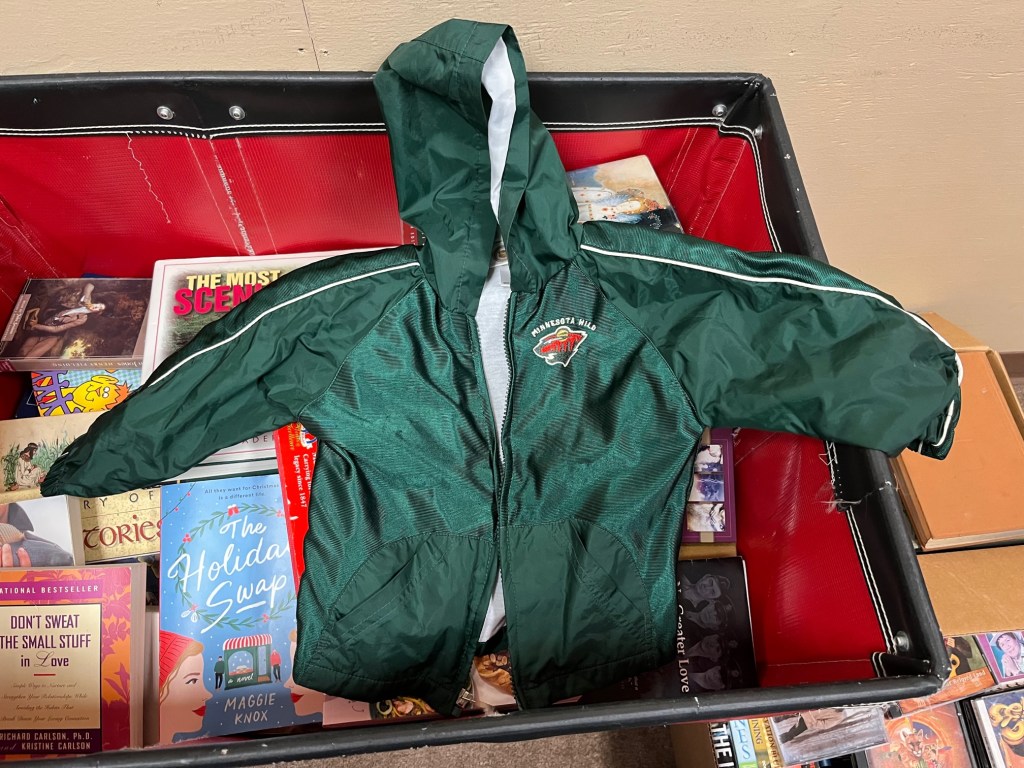
The jacket makes its return to the Goodwill, January 2023

I bought the deep-green Minnesota Wild windbreaker at Goodwill for $3.99. Its 2T size was perfect for my grandson Michael, who was two years old at the time. I kept it at my house as a spare jacket because where I live the weather changes faster than a runway model. Michael wore the jacket on misty days and sunny-but-cool breezy days and gray chilly days when the sun refused to show its face. When needed, he pulled up the hood and slipped his hands into the pockets, hiding his ears and hands from the cold.

When Michael outgrew the jacket, I saved it for Evan who wore it until he outgrew it. Then, I saved it for Charlie who wore it until a year ago when he told me, “I’m too big for this.” I had run out of grandchildren, but I kept the jacket. Throughout the year, I thought about donating it back to Goodwill, but it held memories. My grandsons wore it to the library, to parks, and on walks. When they ran and played, the windbreaker’s waterproof material serenaded them with a crinkly tune.

I’m somewhere between my mother and father on the what-to-purge-and-what-to-keep scale. My mother saves very little. A few years ago, I asked her where the instructions were for her bike lock because I needed to reset the combination. Her answer: “I threw that out.” When I complained, she snapped, “I can’t save everything.” She claims she doesn’t want to make her children clean and sort through piles and piles of possessions. But really? Even small amounts of clutter unsettle her.

Very little exists from my mother’s childhood, but I think that’s because her family had very little. What happened to the other bits and pieces from her youth? I don’t ask. Perhaps her mother threw them away, or perhaps my mother did. Sometimes memories connected to objects are painful, a place one wants to walk away from, not revisit.

In contrast, my father saved a lot of stuff: old newspapers, if an article interested him; letters, including the ones I sent him; his childhood artifacts; his pilot logbooks; trinkets of all sorts; and bits and pieces of mechanical objects because he never knew when he might need that specific part or screw or nut and bolt. He wasn’t a hoarder, and we could walk through his house without fear of being consumed by his possessions, but his garages, closets, and spare rooms were filled with his history, both the small and momentous moments. He would’ve saved the instructions for the bike lock.

My father also kept old issues of Trade-A-Plane, a publication printed on yellow paper, where pilots could buy and sell airplanes and their parts. When the Trade-A-Plane came in the mail, he would dodge his responsibilities and read every classified ad, even if he wasn’t looking to buy or sell because, as he would say, “You never know.” He had lengthy telephone conversations (at a time when long-distance was expensive) with other pilots about planes, even if no buying or selling took place.

Frustrated, my mother once asked him why he needed to save every Trade-A-Plane, and he said, “Well, you never know.” He might want to look up something in one of them. Sounds ridiculous that with decades of old issues, he would be able to find something specific from years ago. Maybe he could have, maybe he couldn’t have, but he was comforted by their presence. They held memories of the planes he bought and sold and dreams of the planes beyond his reach. When he needed to buy a pair of wings for his Cessna 196, he called the airplane junkyards that advertised in the paper. He found a set of wings in New Jersey and had them shipped to Milwaukee.

My father saved the letters his father wrote to his mother in 1937 when she was pregnant with him and in the hospital on bed rest. Her pregnancy had become difficult, and if an emergency developed, the doctor didn’t want her to be an arduous forty-mile drive from the hospital. My father was born on November 24, 1937, and his parents saved a copy of Life magazine from that week, along with the cards family and friends sent on the occasion of his birth. My father treasured all of it. He had a vein of sentimentality that ran deep through his curmudgeonly bedrock. After he died, I inherited these keepsakes, and I cherish them.

The letters my grandfather wrote to my grandmother while she was in the hospital hold the ordinariness of daily life, recounting the weather, what he ate, how much gas he sold at the station, how deer hunting season was progressing, and when he would be coming to visit her. But with each mundane line, I imagined my grandfather writing around his fears about his young wife and child, praying for them to be well and hoping for them to come home soon. Always he signed his letters, “Lots of love, George.” In one letter he wrote about his day and mentioned he’d gone “to sleep without his bed companion.” It was the only personal line in all of his letters – subtle, but filled with longing to have his wife and child home and to be a family. This would’ve been important to my grandfather who was orphaned when he was eleven years old.

I can leaf through that Life magazine from 1937 and know I’m reading the same pages my father and his parents once read, learning what was newsworthy the week their first baby was born. When I read it, I found an article about Dy-Dee doll, “the most popular doll in the world” because she wet her diapers. My mother-in-law received a Dy-Dee doll for Christmas in 1937. The doll was all the rage, and she never forgot Santa left one for her under the Christmas tree. That 1937 issue of Life is a keeper because it connects me to my father and my mother-in-law, making it something I save. My children will have to throw it away.

I understand why my father kept the letters and artifacts of his childhood. I still have the teddy bear Santa brought me for my first Christmas in 1959. In my forties, I put Teddy in a plastic garbage bag. He had holes in his neck and crotch, and most of his fur had worn off. I tried to throw him away, but I couldn’t. After I pulled Teddy out of the garbage, I told my son, “I just can’t let him go.” And my son, who embraces minimalism to the point of nothingness, said, “Somethings you just need to keep.” So, Teddy sits in my closet on a stack of quilting material. I have my yearbooks and old report cards. I have photographs and a scrapbook. I have toys and clothes and artwork that belonged to my children. I have a pair of onyx owls from Nana and a colorful laughing porcelain Buddha from Grandma Olive. I have an antique hutch filled with glassware. I save all the instructions for every appliance and bike lock I buy. But I sympathized with my mother about Dad’s Trade-A-Plane obsession.

And so, after hanging in a closet for a year, the size 2T Minnesota Wild windbreaker became like my father’s old issues of Trade-A-Plane, no longer useful. Because I wanted others to make happy memories with the jacket, and because having too much clutter in my house unsettles me, it was time to let go. I placed the jacket in the wooden clothes bin at Goodwill. Having heard the door open, a young woman with a broad smile approached me and asked if I needed a receipt. I told her no, and she went back to sorting donations. I turned to leave but I couldn’t, so I grabbed the jacket and laid it on a bin of donated books and took a picture. That helped. It’s what my father would’ve done. He was the champion of taking pictures of everyone and everything. In his later years, he always tucked a small camera in his shirt pocket.

I lifted the jacket off the books, but I wasn’t done yet. I felt compelled to tell its story, so I stepped into the large sorting room, and the young woman asked, “Can I help you?”

I held up the officially licensed NHL windbreaker with the Iron Range Red, Forest Green, Minnesota Wheat, and Harvest Gold “wild animal” logo that appears to be a bear or a wildcat or a wolf. (When asked, the Wild organization will only refer to it as a “wild animal.”) And I told the young woman the story of the jacket’s full-circle journey from Goodwill, through three grandsons, and back to Goodwill.

I felt like an old person telling a story that a young person isn’t particularly interested in hearing, but she smiled, said it was a good story, and thanked me for sharing. I’m fairly certain she meant it. On my way out of the sorting room, I dropped the jacket back into the clothing bin and hoped that soon some child’s parent or grandparent would buy it.

A few weeks later Evan and Charlie came for a sleepover, and we took my dogs for a walk. None of us thought about the windbreaker because it was a clear, cold winter’s night, and we wore snow pants and heavy jackets, knit hats and insulated mittens. We passed the west side of the park, and Evan pointed to a tree and asked, “Do you remember when we circled around this tree last summer?” I didn’t remember, but I said yes because it was important to him. On that particular day, he might have been with his mother at the park, but that’s the slipshod nature of memory. Perhaps that’s why we keep physical remnants from our past. And on that clear, cold winter’s night with stars sparkling above us and a moon peering down at us, I remembered the Minnesota Wild windbreaker I’d given away.

Evan climbed the snowbank by the road, hugged the tree, and said, “This tree holds all my old memories.” He might grow up to be the kind of person who will save every issue of the Trade-A-Plane, all his Nana’s cards and letters, and the instructions for a bike lock. Or perhaps not. But at the agèd year of six, Evan already treasures his memories. And he understands the ability of an object to hold his heart.

Book Review: Rin Tin Tin: The Life and the Legend by Susan Orlean

[I’ve read many good books in the past few months. I’m going to review some of them in a series of blog posts. So, if you’re looking for a summer read, maybe you’ll find a book to enjoy in one of my book review posts.]

Why did I read this book?

I bought Rin Tin Tin: The Life and the Legend in 2011 after listening to an interview of Susan Orlean on Minnesota Public Radio. (Click on the blue font to hear her talk about the book. She gives a good interview.)

I’d never seen a Rin Tin Tin movie or TV show, but I’d heard of the famous Rin Tin Tin because he was often referenced in popular culture. Rin Tin Tin’s story appealed to me for two reasons. One, I like reading about the movie industry, especially the history of its beginnings. And two, I grew up with a German Shepherd named Fritz, who was intelligent and kind, and at times heroic. Our Fritz could’ve been the Rin Tin Tin of the silver screen.

Sad to say it took twelve years before I lifted the book off my to-be-read pile of books. Sad because Susan Orlean’s book is a fascinating combination of three stories.

What is this book about?

It’s the story of a man and his love for an extraordinary dog. Orlean’s book follows the life of Lee Duncan who rescues Rin Tin Tin, a German Shepherd puppy, from a bombed out kennel in France during WWI. In a way Rin Tin Tin rescues Duncan, too, because Duncan, who had a tough childhood, is a wounded soul. Duncan brings Rinty, as the dog was sometimes called, home to America. With Duncan’s care and training, Rin Tin Tin becomes a Hollywood superstar during the silent film era. After Rin Tin Tin dies, Duncan continues to work with other German Shepherds who acted in movies and the television show The Adventures of Rin Tin Tin.

It’s the story of canine and human actors; animal trainers; and Hollywood executives and producers; many of whom become famous and rich (and sometimes bankrupt then rich again then broke again) during the early days of Hollywood and television. Orlean delves into the behind-the-scenes pitches, ideas, deals, and strategies that created and promoted the Rin Tin Tin movies, TV shows, and actors.

It’s the story of Orlean’s fascination, research, and commitment to the story of Rin Tin Tin. She is old enough to remember watching the TV show The Adventures of Rin Tin Tin with her older siblings and loving Rin Tin Tin. But she was only four years old during the last season of the show and remembers nothing about the show itself. She writes about the fascination she and her siblings had with a small Rin Tin Tin toy her grandfather kept on his desk, out of their reach. She remembers the day when, while researching another story, she came across the name Rin Tin Tin, which brought back a flood of memories and emotions about the famous German Shepherd from her childhood. In her book Orlean writes about why she wrote this book, how she did the research, and how the book changed her.

What makes this book memorable?

Orlean is an outstanding journalist, which shows in her dedication to research and her passion for accuracy. Hollywood moguls, however, are in the business of creating legends, and they often spin legendary stories, which light up our imaginations but may have little or no truth to them. Orlean worked to track down the veracity of the many stories that had been handed down about the people and animals in her book. When she can’t find facts to either corroborate or refute a story, she lets readers know. As a reader, I appreciate Orlean’s extra effort to get at the truth, rather than repeating information that may not be true.

It took Orlean ten years to research and write Rin Tin Tin. She was granted access to the vast collection of documents saved by Lee Duncan and other people featured in the story. She interviewed as many people as she could who were connected to the story of Duncan and Rinty. Some of her research included traveling to the places she wrote about, like movie and TV locations where Rin Tin Tin films were shot, and Paris where Rin Tin Tin is supposedly buried in an elegant, verdant pet cemetery.

When Orlean writes about people in her books, she does so in a fair and balanced way, making them neither heroes nor villains. This is something about Orlean’s writing I came to appreciate when I read The Library Book (2018). [I read this nonfiction book a couple of years ago. It would make another excellent summer read.]

I grew up with a German Shepherd. Fritz was born in 1958, and I was born in 1959. After reading Orlean’s book about Rin Tin Tin, I asked my mother why she and my father decided to get a German Shepherd. I wondered because my mother was born in 1940, so too young to have seen the Rin Tin Tin movies. And when The Adventures of Rin Tin Tin ran on TV, she was a teenager, so too old to care about a kid’s show. Without a moment’s hesitation, she answered, “Because they were very smart dogs.” That made sense because Rin Tin Tin’s TV escapades made German Shepherds very popular in the 1950s. So my mother, who didn’t watch Rin Tin Tin as an actor, would’ve heard about the breed’s intelligence and loyalty. And while some German Shepherds have aggressive natures, many like Fritz, are loving and kind.

Orlean’s artful weaving of the stories of Duncan and Rinty, the early days of Hollywood, and her journey to uncover the mystique of Rin Tin Tin makes for an engaging narrative.

[Link to the silent film Clash of the Wolves starring Rin Tin Tin. Link to full-length movie The Return of Rin Tin Tin (1947) with Robert Blake. Episodes of The Adventures of Rin Tin Tin can be found on YouTube, also.]

Riding the Range on a Snapper Comet

This was only part of our yard. We had land on the other side of the white house, the other side of the curved driveway, and behind the barn and white garage. The hill on which the Snapper became my bucking bronco was just to the left of the barn.

My husband and I live on a small hill. Because of this, we’ve always figured our yard had to be cut with a push mower, but recently we needed to hire a lawn service. Three guys showed up. One maneuvered the weed whacker. One swung a leaf blower. And one drove the riding lawn mower — a zero-turn, wide-cut machine that hugged the hills like a sure-footed mountain goat. I watched with glee, nearly jumping up and down, almost clapping my hands together, wanting to ask if I could take the mower for a spin. I thought, “If we buy one of those zero-turn, wide-cut, mountain-goat mowers, I can cut the grass too.” I used to ride my father’s mower like it was a newly-tamed mustang, and I was a free-wheeling cowgirl.

I was eight years old when I started mowing the 2.2 acres that was our yard, a ponderosa compared to the narrow city lot we moved from when I was five. My dad pIopped me on his 1960s Snapper Comet and taught me how to start, shift, and stop it.

I wasn’t to cut the large rocks that grew behind the barn and garage because they ground lawn mower blades like cowpokes chomping chewing tobacco. I got careless once, and Dad needed to replace the blade. I got careless a second time, and I bent something more serious on the lawn mower. But dad was an excellent mechanic, so he ordered parts and fixed the Snapper.

My father, who could be impatient in many things, was surprisingly calm about my attempt to mow rocks. But after he had to fix the lawn mower a second time, I scoured the back field for rocks, like a ranch hand on the lookout for a stray calf. We lived in southeastern Wisconsin, and thousands of years ago some geological force seeded the earth with large rocks, and every spring several of them would manage to bloom. When the rocks grew too tall, my father would dig them out, place them in a small trailer, and haul them to an overgrown field with a miniature tractor not much bigger than the Snapper.

When I cut the hill by the barn I pretended I was riding a bucking bronco in a rodeo. Because I was so light, I would stand and lean toward the hill to keep the mower’s four wheels on the ground, defying its urge to throw me. I conquered that hill — the only thrill in our otherwise flat yard.

Today, placing an eight-year-old child on a riding lawn mower to cut the grass by herself might be considered child endangerment, but I loved riding the red-and-white Comet, turning in tighter and tighter squares until the whole yard was clipped. No one seemed to think it was unusual — not my mother, not the neighbors, and not me. Besides our Snapper Comet, manufactured in the late sixties, was a pony compared to the muscular draft-horse riding lawn mowers of today.

When my father and mother moved to Tucson in 1977, they didn’t take the Snapper Comet with them. No need to cut the desert sands. My parents divorced in 1983, but my father remained in Tucson. After I married and had children, my father returned to Wisconsin for a couple of weeks every summer. He visited me, other relatives, and friends.

Years later on one of my father’s visits to Wisconsin, he found the same model as our 1960s Snapper Comet at a garage sale and bought it. I didn’t ask him why he bought a riding lawn mower to take home to Tucson, where he lived at an airpark without a blade of grass. But he did have a big garage, so he had plenty of space to store it.

But I looked at the Comet and remembered my bronco riding on the hill by the barn — a hill that seems so small now. I wondered if my father looked at that Comet and thought about teaching his daughters to mow the lawn. I wondered if he thought about the 2.2 acres and the farmhouse where his children mostly grew up, a time when we were all together, before several moves and a divorce separated all the things he held dear.

So now, my husband and I have a riding lawn mower savings account. Next spring we’re buying a zero-turn, wide-cut machine that hugs the hills like a mountain goat. I’m going to learn how to operate it. I’m going to cut the hills — at least once. There will be some who say I should stay off the draft horse. But my father, if he were still alive, wouldn’t be one of them. He’d tell me to hop on up. He’d teach me how to start, shift, and stop it. He’d help me shout, “Yippie-i-oh, Yippie-i-ay! Rawhide!”

Tina Turner Died Today

Sunset Beach, Fish Creek, Door County, 2023

I loved her voice and the way she danced and strutted across the stage, giving every song her all. She was power and elegance and talent.

As kids my sisters and I loved Ike and Tina Turner’s version of “Rolling on a River.” We loved how they started the song out “nice and easy” because as Tina said, “we never, ever do nothing nice and easy” then halfway through they rocked the song like a river bursting over its banks.

We called Milwaukee’s Fun-Loving WOKY at 920 on your AM dial. They took requests. So we asked, “Can you play ‘Rolling on a River’ the way Ike and Tina Turner sing it?”

“Sure,” someone at WOKY said. After all, they were Fun-Loving.

Instead they played “Rolling on a River” by Creedence Clearwater Revival. Disappointed, we called again and again, asking for the “nice and easy” version. But we were kids, and we pissed them off with our insistence they get our request right. They told us they wouldn’t play Ike and Tina Turner’s version because they’d just played the CCR version.

We gave it a rest. But we called every couple of days, asking to hear “Rolling on a River” by Ike and Tina Turner. Fun-Loving WOKY at 920 on your AM dial never honored our request. After a couple of weeks we gave up.

Today I didn’t need to call a request line to hear Tina Turner sing “Rolling on River.” I’ve got YouTube. I watched three different versions of Tina sing and dance to the best version ever of “Rolling on River.” And I was twelve years old again.

Ike and Tina Turner live in 1971 singing “Proud Mary.”

Tina Turner live in the Netherlands in 1996 singing “Proud Mary.”

Tina Turner live in 1999 singing “Proud Mary” with Elton John on piano and a duet with Cher.