Nana Kitty

My nana died in 2003, but she still inspires me.

As a mother, Nana received mixed reviews from her children. But as a grandparent, Nana had a marvelous second act, a comeback. And isn’t that what being a grandparent is about? A do-over, a second chance, a revival?

Nana inspired me because she survived shit. Her father died of typhoid fever in 1921 when she was seven. He left behind seven children and a pregnant wife before the social safety nets of Franklin Roosevelt’s New Deal. Nana grew up poor and hungry. When she turned twenty-one in 1936, she voted for Roosevelt.
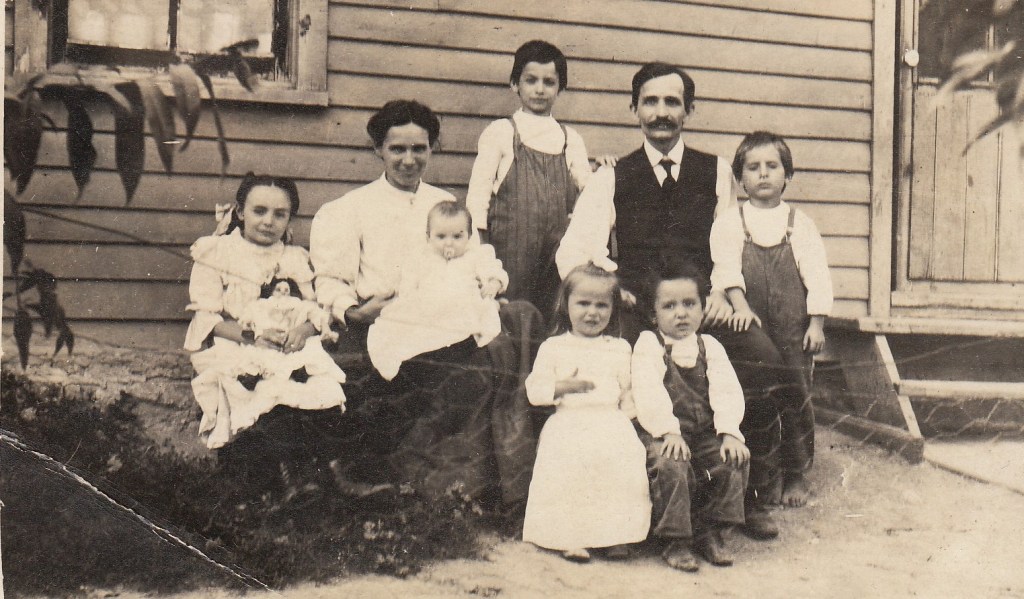
Nana Kitty is sitting on her mother’s lap. Mary and Joseph, Nana’s parents, would have two more children. But the eighth one was born after Joseph died from typhoid fever.

After she turned nine, she worked summers picking beans in the fields around West Bend, Wisconsin. When I was nine, I picked dandelions. Seven months after the stock market crash of 1929, she graduated from eighth grade. She yearned to go to high school, but her mother told her she had to work. Shortly before she retired from waitressing at sixty-eight, she applied to Milwaukee Area Technical College. She worked toward her GED, tutored students in math, and took college-level courses in English and psychology all at the same time. She was sixty-nine when she earned her GED. I was a college student.

Nana lived by one of her favorite maxims, “A penny saved is a penny earned.” On a low-come wage, she saved change until she and her first husband had enough money to move from their low-income neighborhood and buy their own home, the smallest house in a middle-class neighborhood. She wanted her children to have a better life than she had. She was widowed at forty-seven, but she worked hard to keep her house and pay off the mortgage.

Nana inspired me because she loved each of her seven grandchildren, which included my three cousins, with a passion. She forgave our mistakes and bad behavior and defended us against our common enemies—the parents. To her each of us was special and beautiful and interesting. She gave us lots of hugs, kisses, and Cracker Jacks. She played Button, Button, Who’s Got the Button? and Cat’s Cradle with us. She told us stories and sang to us. She danced with us in her kitchen. She loved Bobby Darin and 50s rock-n-roll. Her favorite dance was The Twist, which she danced at my wedding.

Nana always had time for a phone call. I memorized her number before anyone else’s. If I called and was upset, she listened. I once tested the limits of Nana’s ability to listen by following her around her house, describing the scene-by-scene detail of a movie I’d watched and loved. Like a typical ten-year-old, I thought every detail of a story was significant. At some point, I realized I was boring her and that she kept leaving rooms, hoping I wouldn’t follow. I began testing her limits. I waited for her to say, enough already. If she had, I wouldn’t have blamed her. But she didn’t. I’d love to say I have the same patience with my grandchildren when they prattle on about a movie or video game, but I don’t. I find a way to change the subject. But I didn’t admire Nana because she could do what I could do. I admired her because she could do what I couldn’t do.

Nana Kitty helping my sister and me (far left) with a puzzle. My cousin watches.

Nana loved me even when I behaved like a brat. When I was about eight, I wanted her to buy me a troll doll from a drugstore. I whined and cajoled and dropped a few tears until she folded. She took me back into the store and bought me the doll. She wasn’t happy. She couldn’t afford to be frivolous with her money. She bought us Cracker Jacks because they cost a quarter. The troll doll cost over a dollar. “You’d better not lose that doll,” she snapped. After we walked back to her house, I asked her for a comb and a few bobby pins. I spent the rest of the afternoon rearranging the troll’s purple hair in one hairdo after another. Nana was no longer angry with me. Over the years, I would tell her, “I still have the troll doll with the purple hair.” I wish I could still tell her I have it.

I live by many of Nana’s favorite sayings. (Although I didn’t warm to some of them until I was older.)

1. The early bird gets the worm. (I told her I didn’t want worms.)

2. Early to bed and early to rise makes a man healthy, wealthy, and wise. (I was a night owl.)

3. Silence is golden.

4. You win more flies with honey than vinegar. (I told her I didn’t want to be nice to people who were mean to me.)

5. If you can’t say something nice, don’t say anything.

6. A penny saved is a penny earned. (I’ve learned to be a better saver.)

7. Waste not, want not.

Nana’s birthday is January 22. If she were alive, she’d be 107 years old. Funny thing—sometimes, for a moment, I think, I should call Nana. And then I remember, she’s gone. So, I talk to her without a phone.

[Written in response to #bloganuary prompt #6: Who is someone that inspires you and why? For more information click on: Bloganuary.]
Christmas in Michigan–Christmas Day, Past and Present

December 25, 2021

Christmas Day Past—

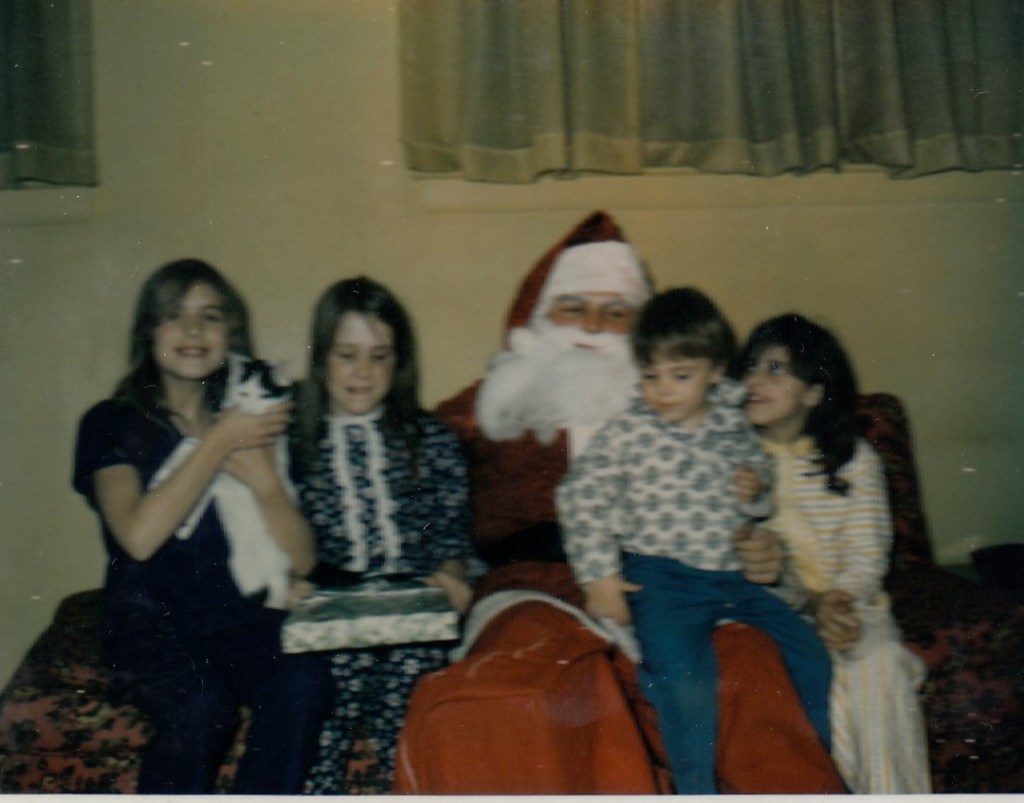
My sisters, my brother, and I enjoy a visit from St. Nick. (I’m holding the present.) The cat was not a present. He was a stray we adopted and named George, after our grandpa.

After the longest night of the year loosened its grip and gave way to Christmas morning, my siblings and I had to wait for my parents to get up before opening gifts. Sometimes we snuck downstairs to peek at the tree surrounded by wrapped boxes then snuck back upstairs. This made waiting more difficult, but we knew that to open even one present before they got up would rob them of the joy of seeing our rapturous faces as we opened our gifts. We also knew we’d be in BIG trouble. It was always a late night for them. “The bundle of toys” they brought home in sacks needed to be wrapped and ribboned and tagged times four.

We were fortunate that Christmas morning never disappointed—not even the year my mother told me before Christmas that she couldn’t find Charlie McCarthy, the ventriloquist’s dummy I’d asked Santa for. She and I had to suspend our willing suspension of disbelief regarding Santa for that conversation. Turns out lots of aspiring ventriloquists had asked Santa for a Charlie McCarthy doll. My mother told me she’d try to get me one after Christmas. But even before Christmas morning, my shiny dream of becoming a ventriloquist lost its luster. I told her to forget Charlie.

My mother was good at buying gifts on behalf of Santa. Every year a smorgasbord awaited under our tree. We each received an outfit and a pair of pajamas. I loved going back to school after the holidays dressed in new clothes. And climbing into bed on Christmas night in a new pair of soft pajamas that were still fuzzy because they hadn’t been washed dozens of times was divine. We each received a special toy or two that we’d asked Santa for. He also brought us board games, art projects, and books. Santa wanted us to stay busy during Christmas break.

We had to open our gifts slowly because my father didn’t want to miss a single Kodak moment. He liked to take photos. When he got a Polaroid camera, we had near instant photo results, but this slowed down the gift opening because we were thrilled by watching ourselves materialize before our eyes.

Each of us had a spot on the floor to pile our gifts as we opened them. After all the gifts were opened, I felt like a princess with a pile of riches. I also felt guilty. The gifts my parents received took up little room on the coffee table in front of them, such a small cache of swag. But worst of all they hadn’t received one toy or game or art project. I’d contemplate all they’d given me in the name of Santa, then look at the gift I’d given them—always something handmade at school. A Christmas tree constructed from a toilet paper roll and cotton balls. An imprint of my hand in plaster of paris. A silhouette of my profile. A Styrofoam ball decorated with ribbon and sequins to hang on the tree. I didn’t buy my parents gifts until I turned sixteen and had a job and a driver’s license. It wasn’t until I was a parent that I understood it was more fun to see my children opening gifts, and that I treasured the gifts they made for me more than anything that came from a store.

Christmas Day Present—

On this Christmas morning the youngest one among us is 23. No one snuck out of bed to look at wrapped presents under the tree. (Maybe because they were stacked on a desk.) I got up early because my dogs wanted to go outside. No one was in a hurry to see what Santa brought. We ate breakfast and visited. My sister and one of her sons went to Mass at ten o’clock. No one minded. Waiting wouldn’t short-circuit our wiring. We didn’t open gifts until eleven-thirty.

My mother is still good at buying gifts, but no one pretended they were from Santa. I loved the warm shirt she bought me. I’m of the age where any object meant to keep me warm in the frozen North makes my heart toasty. She gave me a humorous book that pokes fun of British mysteries. I love humor and British mysteries. (Your Guide to Not Getting Murdered in a Quaint English Village by Maureen Johnson & Jay Cooper)

My nephew, distributing gifts off the desk. Bogey, before he gets his pink flamingo.

No one got toys—except Bogey, my mother’s seven-year-old poodle. My husband and I bought him a stuffed pink flamingo. He played with it and played with it, shaking it by the leg, tossing it in the air, and making it squeal. I think he looked at the gifts in front of us humans and felt sorry for us because not one of us had a stuffed toy with a squeaker. He’s too young to understand that not one of us wanted a squeaking flamingo. But we sure enjoyed watching him play with his new toy.

[Words in quotes are a nod to “A Visit from St. Nicholas.”]

Christmas in Michigan—A Tale of Two Eves

December 24, 2021, 10:30 p.m.

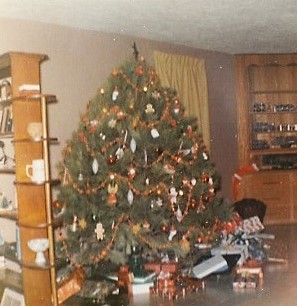
Christmas tree, 1966

The night before Christmas, when I was a child, I would gaze out a small rectangular window and scan the sky for Santa’s sleigh. I watched ’til I spotted a red flashing light tracking far above the snow-covered earth. I would declare it was Rudolph leading Santa’s sleigh. (But I knew it was an airplane “so lively and quick” headed to Billy Mitchell Airport ten miles away.) Pretending that Santa’s reindeer would soon be “prancing and pawing” on the roof, I’d snuggle under the covers and close my eyes. Sleep was elusive because visions of Christmas morning danced in my head.

In Michigan this Christmas Eve, before I drifted off to sleep, I read The Quiller Memorandum, a spy thriller from 1965. Quiller, a British agent, brings Nazis to justice and prevents Hitler-loving neo-Nazis from starting a war. None of the characters had twinkling eyes or merry dimples. Not a one “was chubby and plump” or “a right jolly old elf.” It didn’t matter—sleep wasn’t elusive. Because neither the Nazi-chasing agent nor visions of Christmas morning danced through my head.

Although, the idea of people idolizing a person with totalitarian aspirations, should give me something to dread.

[Words in quotes are a nod to “A Visit from St. Nicholas.”]

Day 21—Earrings for the First Snow of the Season

It was snowing when I went to bed last night, so this morning I stopped by the kitchen window to see how much had fallen.

Two inches blanketed the ground, a white fluffy comforter covering green lawns and leftover leaves that fell too late for mulching or raking.

Chickadees darted from the cedar tree to the feeder and back. My dogs, Cabela and Ziva, stood by the backdoor, waiting to go out. I thought about which earrings I’d wear today. But dogs first, earrings second.

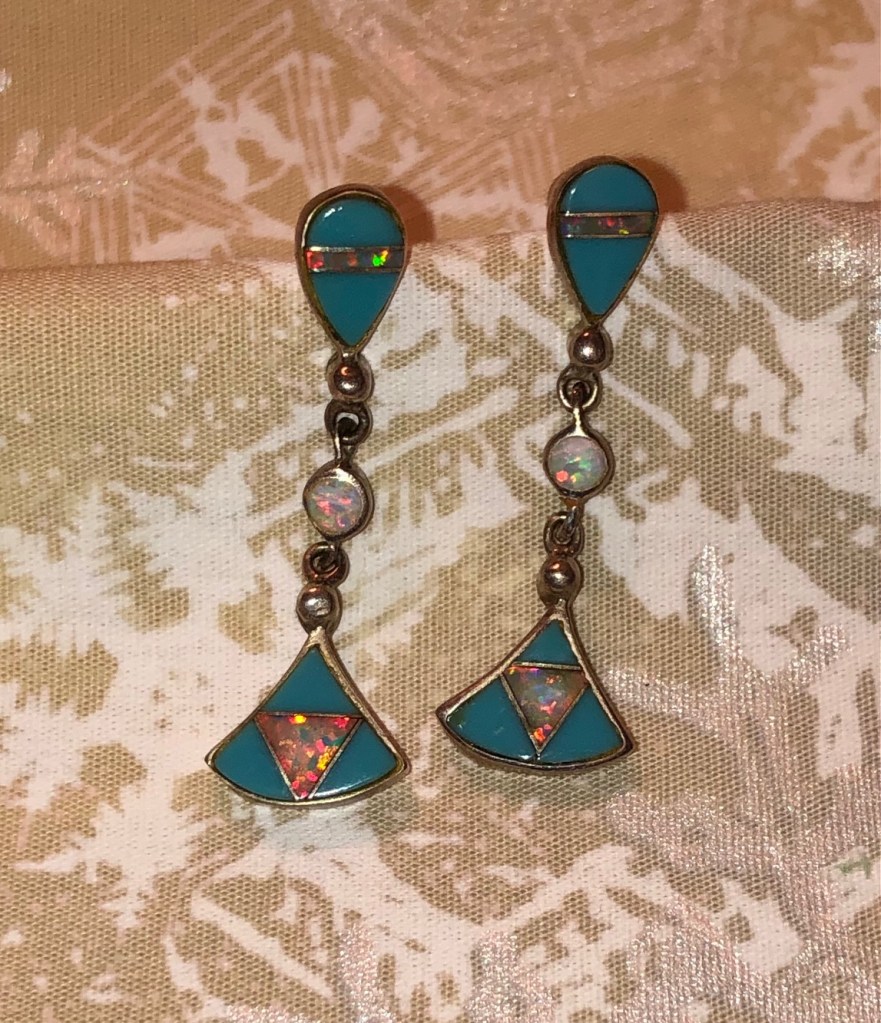
Ten years ago, I bought these earrings at a bead shop in Duluth, Minnesota. Today I chose them to compliment the new snow and the gray clouds rolling overhead.

If I were a child, I would’ve skipped the earrings. I would’ve bundled myself in snow pants, mittens, boots, a jacket, and a hat.

I would’ve built a snowman,

Wrapped a scarf around his neck,

Stuck two sticks in his midsection for arms,

Pilfered charcoal from the garage for his eyes,

Called through the backdoor for my mother to bring a carrot for his nose,

Placed an old hat on his head.

I would’ve looked at the snowman,

Talked to him,

Wishing him to come to life.

Today I had a cup of coffee then selected a pair of earrings to wear to the grocery store.

Ziva
Cabela

Day 8—Beach Glass Earrings

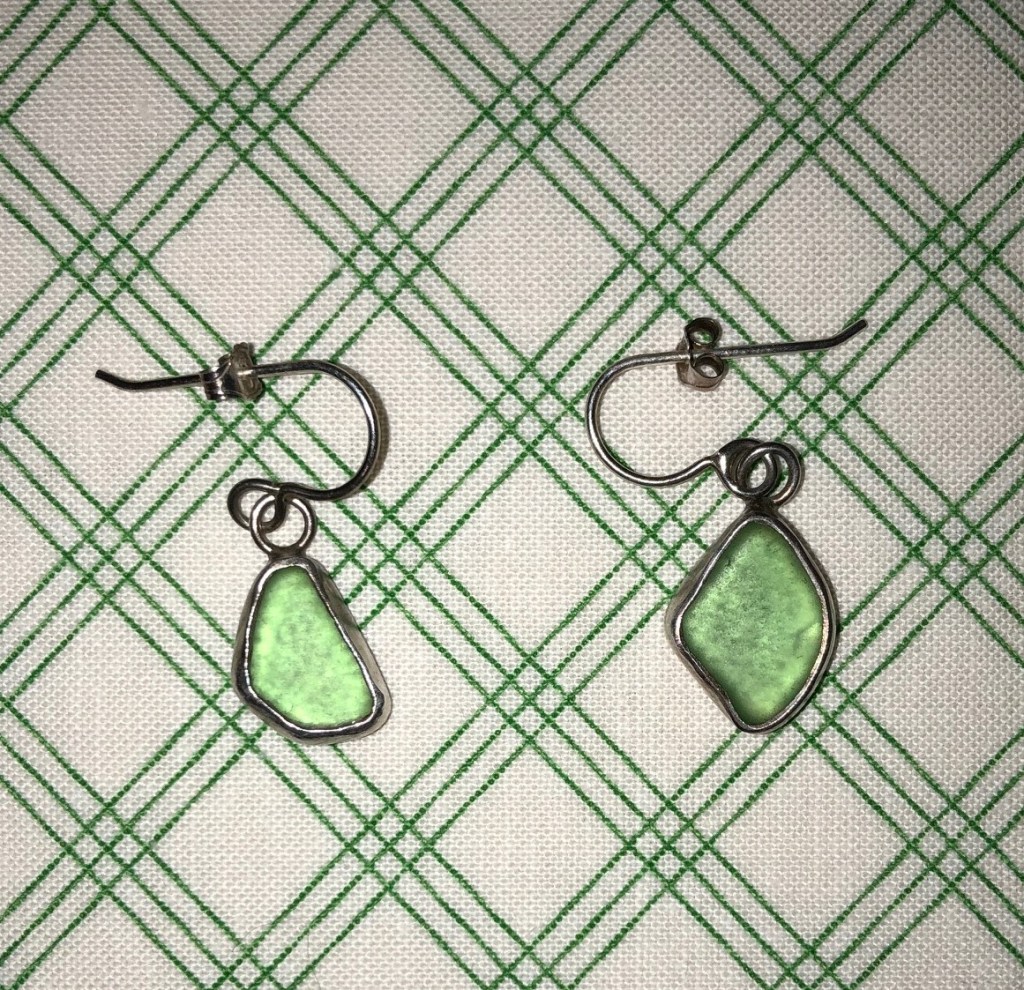
Today’s earrings are made from green beach glass and surrounded by silver. The earrings are fraternal rather than identical twins. You take beach glass as you find it—the surf will never spit up a pair of matching smooth frosted pieces of glass.

Beach glass fascinated me when I was a child. I had a stash of several green, white, and brown pieces in an old cardboard cigar box that held other small treasures. I liked tiny treasures—the kind of stuff my mother didn’t like cleaning out of my pockets or the washing machine.

I sometimes wonder where all the tiny treasures from my youth went.

I bought these earrings in early 2020 at the Dovetail Café & Marketplace in Duluth, a couple of months before the COVID-19 lockdown. I had recently discovered the Dovetail and enjoyed meeting friends there for coffee or lunch. I even read a story at one of their open mics then enjoyed a wonderful evening listening to other storytellers and poets.

These days I mark a lot of events as either before or during COVID.

I’m looking forward to adding after COVID.

Come Again Now

[“Come Again Now” was published Minnesota’s PBS Stations on their webpage Moving Lives Minnesota: Stories of Origin and Immigration on April 17, 2021.]

FRANK AND ROSE MEET

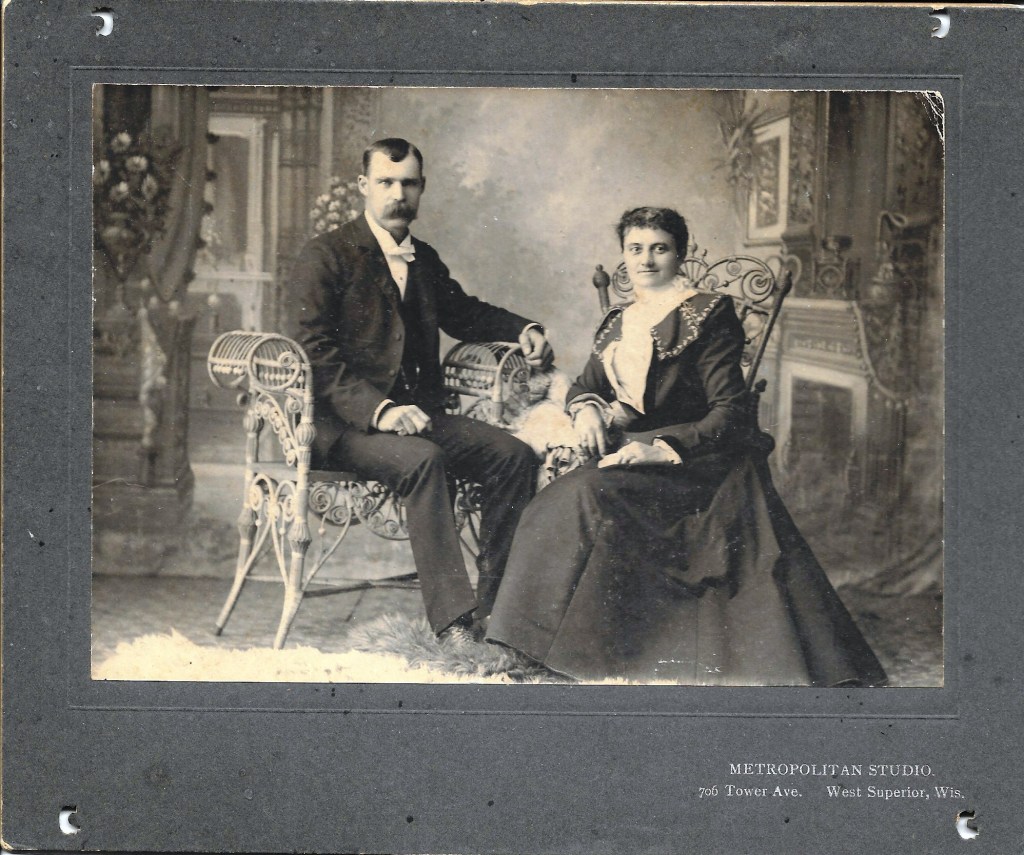
Frank and Rose Youngquist, wedding photo, September 1898

            About 1892, Frank Youngquist left Stillwater to work as a blacksmith in Gordon for Musser-Sauntry, a logging company with interests in Minnesota and Wisconsin. In 1897, Rose Yost left her parents’ farm in Columbus, Minnesota, to work at the Smith Hotel in Gordon, owned by her sister and brother-in-law, Aggie and Jim Smith.

            Frank, 32, handsome, brown-haired, and blue-eyed, met Rose, 29, pretty, dark-haired, and brown-eyed, at the Smith Hotel where he lived. They fell in love and married on September 21, 1898, in Hennepin County, which gave them an opportunity to visit family in Minnesota before returning to Gordon.

FRANK’S MINNESOTA CONNECTION

            Before Frank’s and Rose’s lives intersected in Gordon, they grew up 32 miles from each other in Minnesota. Frank’s father, Johan Youngquist, came from Sweden to Minnesota in 1868, and settled in the Stillwater area. A year later Johan’s wife, Eva, arrived with their four young children, including 2-year-old Frank. They would have four more children.

            Johan’s family probably emigrated because of economic hardships. Sweden’s rapid population growth in the 1800s diminished job opportunities and caused farmland shortages. Crop failures in 1868 and 1869 deepened economic woes, pushing more Swedes to seek opportunity in America. After reading letters from family, who spoke highly of their lives in Minnesota, many Swedes chose to settle there.

            Johan, Eva, and their children prospered as laborers, farmers, blacksmiths, lumberjacks, and business people. The railroads and lumber industry provided plenty of opportunities for immigrants. Five of Frank’s seven siblings spent most of their lives in Minnesota, and his parents lived there until they died.

ROSE’S MINNESOTA CONNECTION

            Rose’s parents, Yost Yost and Agatha Gassman, emigrated from Switzerland around 1854. Yost and Agatha, both Catholic, might have left Switzerland because of religious unrest during the 1800s. Yost lived in the Canton of Lucerne, which became embroiled in religious tensions between Catholics and Protestants after the Jesuits, reinstated by Pope Pius VII in 1814, returned to Switzerland.

            Yost and Agatha married in Rochester, New York, in 1855. A year or two later, they moved to Columbus, Minnesota, to homestead 160 acres. They raised seven children, all born on their farm. One son became an engineer for the Great Northern Railway, working on the mail train out of St. Paul. The other son ran the farm when Yost retired. Their five daughters all married, but only one remained in Minnesota. Yost served as a town clerk and justice of the peace in Columbus. From 1864 to 1866, he served in the Minnesota Cavalry, Hatch’s Battalion, Company E, and was stationed on the Dakota-Minnesota frontier. He and Agatha are buried in St. Joseph’s Catholic Cemetery in Wyoming, Minnesota.

TRAGEDY STRIKES

            In 1910, after twelve years of marriage and four children, Frank and Rose, still living in Gordon, died a month apart, Frank, 44, on October 18, and Rose, 41, on November 17.

            Frank lingered four months before dying of tuberculosis. He wished to be buried in Stillwater at the Fairview Cemetery with his father and two brothers. Frank had lived over half his life in Minnesota, and his mother and some family members still resided there. After Rose died from heart failure, she was buried next to Frank. Their children, George, 11, Elmer, 9, Leslie, 8, and Lola, 4, stayed in Gordon. Aggie and Jim Smith, Rose’s family, looked after them.

GEORGE’S COMFORTING TRADITION

George Youngquist with his wife Olive and Frank, their first child, circa 1940

            Perhaps because of a mysterious, debilitating illness George had when he was about 1½, he was close to his parents. The illness left him unable to walk, so his father forged railings in his blacksmith shop and attached them to the walls of their home. Encouraged by his parents, George pulled himself up and held the railings. He regained strength and learned to walk again. However, as a young schoolboy, his illness left him unable to run and play with other children. To entertain George, Frank taught him blacksmithing skills after school. George cherished the time with his father. Thirty-some years later, a doctor told George that he had had polio.

            From the 1930s until 1979, because George never forgot his parents’ love and kindness, he drove 120 miles from Gordon to Fairview Cemetery in Stillwater, Minnesota, to visit their graves either on or near every Memorial Day. By the time George and his family arrived, any Memorial Day services were over. But in the hushed cemetery with spring unfurling, George remembered his parents.

            Whenever George had company, he always bid farewell to his visitors by saying, “Come again now.” Perhaps, each year when he left the cemetery, he imagined his parents telling him, “Come again now.” And he did until he lost his eyesight in the winter of 1979, two-and-a-half years before he passed away just shy of his 82nd birthday.

[More Moving Lives posts written by other writers can be read at Moving Lives Minnesota: Stories of Origin and Immigration.]

Refracted

Split Rock Lighthouse stands along the western shore of Lake Superior, atop a soaring cliff. Dressed in cream-colored brick and elegant trim more fitting for a grand house in a genteel neighborhood, it once worked as a watchman holding a luminous light, warning ships about rocky shores at its feet.

My grandchildren at Split Rock Lighthouse, late October 2017

It’s a crisp late-October morning. The last day of the season before the lighthouse shutters for the year. From an expansive autumn-blue sky, sunshine washes the landscape in gold. The temperature wanders just north of forty-five degrees. The air breathes softly.

My granddaughter, six, and grandson, four, are with me. It’s their first visit to the lighthouse. Because it’s a weekday and almost the last day the lighthouse will entertain visitors for the year, we are nearly alone on the grounds.

We climb the twisting steps of the lighthouse, just the three of us. We are quiet, and with nothing to arrest my attention, other than the shuffle of feet on the stairs, I travel decades back in time.

My father, my sisters, and I climb the stairs. My father has come to see the Fresnel lens, and we are his pupils. Some of his words wend down the tower: France, prisms, refraction, illumination, fog, storms. But his lesser words are swallowed by the voices of other tourists. His face points up toward the lens; my sisters and I are in tow behind him.

My granddaughter leads the way, followed by my grandson, then me. I’m the caboose, better, I think, to catch them if they slip. I’m not interested in touting the wonders of the Fresnel lens. I leave them to their thoughts as they ascend the stairs, and I return to mine.

At twelve, I’m content to let my father’s explanations about the lens waft past my ears. I imagine the lightkeeper climbing the stairs during a howling storm to ensure the beacon shines across roiling waves of the frigid lake. I fancy the lightkeeper manning the signal house to ensure the horn bellows over icy waters while dense fog unfurls across an eerily still lake. I remember my father’s words about Lake Superior, mostly spoken to my frightened mother as he would fly us over a corner of the lake, “You’ll die of hypothermia before you’ll drown.” I ponder the number of sailors the lighthouse spared from freezing to death before they could drown.

I’ve no idea if my fancies about a lightkeeper’s duties are accurate, but I measure life as a lightkeeper’s daughter against life with my father.

Sometimes my father is a martinet. My siblings and I endeavor to read his barometric pressure and side-step his thunderclouds. We learned early to listen carefully.

He’s an extraordinary mechanic. His hands tinker, build, tune, modify, rig, experiment, adapt. Cars, trucks, motorcycles, planes, appliances. All engineering feats, great and small, captivate him. He wants us to be enthralled. But my fascination is for the people who lived and worked at the lighthouse on the prodigious cliff. I crave the stories of people. Lake Superior, which, if it had the chance, would freeze me to death before swallowing me, enchants me. My father doesn’t notice my attention has wandered because he’s hammering the tour guide with his knowledge of the brilliant lens.

“Oh, wow,” my grandson says, exhaling the words as a brief, but reverent Gregorian chant. He’s caught his first glimpse of the Fresnel lens gleaming in sunlight spilling through the windows. He stops and stares. The echo of his chant swirls around the tower.

Years ago, my father expressed his amazement of the lens with descriptions of its design and function. My grandson captures his admiration in two words. But at this moment, although they’ll never meet, they’re tethered together across four generations, both of them mesmerized by a triumph of engineering designed to mitigate the angry moods of the lake. I see my father through the eyes of my grandson’s wonderment, and he becomes a curious four-year-old boy, instead of an ill-tempered adult. And I ponder what he might have said about the enormous, glistening lens had he seen it as a four-year-old boy. Their shared veneration softens prickly memories of my father. I can’t picture him as a little boy and be angry with him at the same time.

With the massive lens above me, I stand at the top of the lighthouse, peering out at Lake Superior and hear my father’s voice, She’ll freeze you before she’ll drown you.

I know, I answer, but, still, I love her.

An Electric Clock Outdoes Sliced Bread by a Country Mile

[I was inspired to write this account about my grandfather, George, after reading one of Chris Marcotte’s blogs at chrismarcottewrites. Chris writes about the history of the everyday lives of people, bringing their stories to life in a way that lets the reader connect to people in the past. She incorporates information from newspapers in her blog. After reading Chris’s article, “The Best Thing Since Sliced Bread,” I remembered both my grandpa’s dislike of store-bought bread and his admiration for an electric clock.]

Grandpa George would never have uttered the phrase “the best thing since sliced bread.” Detesting store-bought bread, he’d have thought it was a poor standard by which to measure some new technology that impressed him. I can imagine a conversation with a customer at his gas station going something like this:

George’s Standard Oil Station, circa 1930s. He owned and ran this station from 1928 until 1979.

Customer: Heard you and Olive bought one of those new color TVs. The best thing since sliced bread. Wouldn’t you say, George?

George: You’re setting the bar pretty low. Sliced bread isn’t a second best to anything.

Fortunately, Grandma Olive baked a good loaf of bread. Over George and Olive’s forty-five years of marriage, they had, at one time or another, one foster son, three children, George’s brother, Olive’s parents, their daughter and her children, and me living with them. Olive baked a lot of bread.

George’s first auto garage with gas pumps, circa 1920s

George, born in 1899, might’ve been old fashioned about his bread, but he welcomed other technology. In 1913, when George was fourteen, the first car arrived in his hometown. He’d learned blacksmithing, so he shod horses before he changed car tires. But, by 1920, George knew cars were his future. He and his cousin Frank embraced innovation and opened an auto garage with gas pumps, a business George owned and ran until 1979.

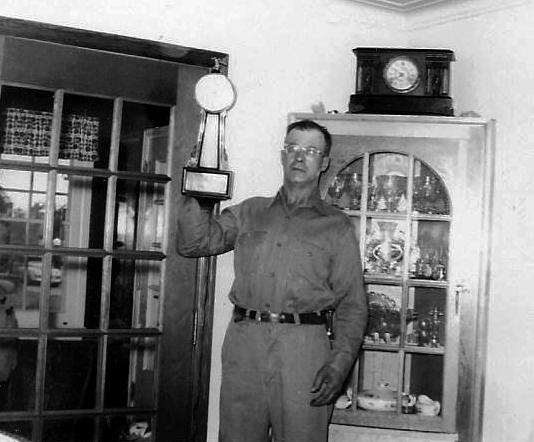
George appreciated smaller innovations too. In the early 1950s, a relative, who was dear to George, gave him an electric clock, the first one he ever had in his house. The clock hung on the wall in the living room where he watched his TV. He not only cherished the clock because of the giver, but he relied on it. He checked his pocket watch against the electric clock daily, believing it was more reliable than the mechanical clocks in his home.

George and the first electric clock in his home. Excited by this new technology, he had the moment preserved with a photograph.

Like most of us, George both praised and disparaged new advancements. He gave a thumbs up to cars, gas pumps, TV, electric clocks, a modern kitchen, washing machines, and planes (taking a trip to Italy in his 70s), but he gave a thumbs down to sliced bread. And he didn’t like store-bought desserts either, for which I’m grateful. During the three years I lived with my grandparents, I enjoyed scrumptious homemade cookies; divine chocolate cakes; pies baked with fresh fruit; light, heavenly angel food cake; and moss cake, a rich, nutty confection made with the egg yolks leftover from making the angel food cake.

Because of my grandparents’ influence, I make my own desserts. But I don’t bake bread. Sorry, Grandpa!

A Cracker Jack of a Story

[“A Cracker Jack of a Story” earned an honorable mention in the Indianhead Writers’ 2019 Contest for nonfiction. It was published in the anthology Many Waters: St. Croix Writers Stories and Poems in October 2020]

Nana Kitty

My nana, a petite woman, had merry eyes and a high-wattage smile. Her face was framed with large curls of chestnut brown hair. She played games with us and sang to us. She took us to parks and pushed us on swings. She turned on the radio in her kitchen and danced with us, her moves livelier than the orange and yellow pattern prancing across her linoleum floor. Occasionally, we walked ten blocks with her to the grocery store, and she kindly let us carry the bags of groceries back to her house, all ten blocks.

Sometimes she bought us Cracker Jacks. Nana was a widow on an egg-and-toast budget, and she counted her pennies like Silas Marner, but Cracker Jacks were cheap and came with a toy surprise. For Nana, who worked as a waitress at a pancake joint in downtown Milwaukee, it was a bargain.

Nana was a reader but rarely read to us. Instead she regaled us with stories, and like all story tellers, she retold them, like her Cracker Jack story. So, when she gave us Cracker Jacks, she gave us the story too.

I can close my eyes, smell the sweet and salty Cracker Jacks, and recall Nana and myself sitting on her front stoop . . .

As she starts her story, I open my box.

“One day, when I was a little girl,” Nana says, “my brother Jake brought me some Cracker Jacks.”

I start nibbling caramel corn.

“I sat on our front steps, eating my treat,” she says.

I tip my box, letting caramel corn and peanuts fill my left hand, which I have cupped into bowl.

“I savored each piece,” she says. But my brother could’ve done more for us than bring us Cracker Jacks now and then. He only gave my mother a dollar a week.”

*****

When she was a child, Nana’s family became Tobacco Road poor. Her father died of typhoid fever. He left behind seven children and a pregnant widow, who donned a black dress and never recovered from her grief. Shortly after her father died, a representative from the West Bend Aluminum Company, where he’d worked, delivered a life insurance check to his widow. It was a lot of money, but not enough to care for the family long term. Nana’s mother handed the check to Jake, her oldest son. He wanted to buy a gas station. It was 1922. He told his mother, “I can support the family. The automobile is on the rise. Our family will be on the rise.” Jake was half right. He made lots of money, but only he rose. Jake broke his promise to help the family. Instead he bought crisp white shirts, snazzy suits, and a new car. He lavishly courted girls. When he landed a beauty from a well-to-do family, he bought a grand house and fancy furniture.

******

I squeeze the short sides of my box, creating a circular opening at the top. I peer into it.

“It took me a good part of the morning to eat those Cracker Jacks,” Nana says.

I tilt my box to the left and look, then tilt it to the right and look.

“Finally,” she continues, “the only thing left was my toy surprise.”

I set my box on the stoop next to me. With my free hand, I grab the bottom of my T-shirt, pulling it out and up, forming a cloth bowl. I dump the Cracker Jacks from my left hand into my T-shirt bowl.

“Slowly, I opened the toy package,” Nana says. “It was a diamond ring! I’d never seen anything so sparkly. It fit my finger perfectly.”

I grab my Cracker Jacks and pour some of them into my T-shirt bowl. I look in the box again and see the package that holds my toy surprise.

“I went to play,” she says. “I felt like a princess.”

I hold off retrieving my toy surprise and start nibbling again. My favorite part of the story is coming. It involves Mean Mildred.

“Mildred,” Nana says, pressing her lips together before spitting out the name, “noticed my diamond ring and asked to see it.”

I put a piece of caramel corn on my tongue. I don’t chew. The caramel coating melts in my mouth.

“I didn’t want to, but I took off my ring and let Mildred see it,” she says. “That r-a-t ran off with it!”

In Nana’s world, calling someone a rat is so bad that when she calls Mildred a rat, she says she has to spell it. I wonder if this is because Nana is Catholic. My mother was Catholic but married a Presbyterian, so we’re not much of anything.

“Why didn’t you keep the ring on your finger and just let her look at it?” I’ve asked this question many times. I pick a Spanish peanut out of my T-shirt bowl and rub it between my thumb and finger to remove the red skin.

“I never thought she’d steal it,” Nana says. “The r-a-t refused to give it back.”

I ask the same question I asked the first time I heard this story, “Why didn’t you tell your mom or her mom?

“Her family was rich and important.”

“But it was your ring.” I say this every time—I know my part in the telling of the story.

“No one was going to care about my troubles. I was poor and lived on the wrong side of town in an old log house,” Nana says. “That house had no bathroom, no electricity, and no running water.”

Each time Nana tells this story, I want it to end differently. In my version Mean Mildred’s mother marches Mildred to Nana’s house and makes her daughter return the ring.

Nana starts another story, and I reach for my toy surprise at the bottom of my box.

*****

When I was young, I believed Nana’s story about the diamond ring. I was joyful when she found the ring in her box, sad when Mean Mildred stole it, and angry when Nana was powerless to get it back.

As I grew older, I came to doubt Nana’s story. All the rings I’d ever found in my Cracker Jacks were made of cheap metal and plastic gems. I wanted to ask, “How could a real diamond ring get inside a box of Cracker Jacks?” But didn’t. I wanted to tell her, “You were so young—you just thought it was a diamond ring.” But I didn’t.

I didn’t because half a century later, she still mourned the loss of her ring. The unspoken part of her story was her life might have been different if she hadn’t lost her “diamond” ring. For Nana that moment stamped a lifetime of struggles in concrete: going hungry, picking beans in the fields when she was nine, being told she couldn’t go to high school, marrying a man who became an alcoholic and couldn’t hold a steady job. But Nana survived. She scrimped and saved and bought the smallest house in a middle-class neighborhood. She worked in the cafeteria at a Catholic school to pay for a proper education for her two children. She put meals on the table and paid the mortgage while her husband drank and was, at times, out of work.

In 2012 Cracker Jacks celebrated their 100th anniversary of toy surprises by giving away thirty winning tokens that could be traded in for real diamond rings valued at $1,000 each. But Nana had passed away. If she’d been alive, she’d have said, “That’s nothing! When I was a girl, I found a real diamond ring in my Cracker Jacks!” And, she’d have told her story again.