A Cracker Jack of a Story

[“A Cracker Jack of a Story” earned an honorable mention in the Indianhead Writers’ 2019 Contest for nonfiction. It was published in the anthology Many Waters: St. Croix Writers Stories and Poems in October 2020]

Nana Kitty

My nana, a petite woman, had merry eyes and a high-wattage smile. Her face was framed with large curls of chestnut brown hair. She played games with us and sang to us. She took us to parks and pushed us on swings. She turned on the radio in her kitchen and danced with us, her moves livelier than the orange and yellow pattern prancing across her linoleum floor. Occasionally, we walked ten blocks with her to the grocery store, and she kindly let us carry the bags of groceries back to her house, all ten blocks.

Sometimes she bought us Cracker Jacks. Nana was a widow on an egg-and-toast budget, and she counted her pennies like Silas Marner, but Cracker Jacks were cheap and came with a toy surprise. For Nana, who worked as a waitress at a pancake joint in downtown Milwaukee, it was a bargain.

Nana was a reader but rarely read to us. Instead she regaled us with stories, and like all story tellers, she retold them, like her Cracker Jack story. So, when she gave us Cracker Jacks, she gave us the story too.

I can close my eyes, smell the sweet and salty Cracker Jacks, and recall Nana and myself sitting on her front stoop . . .

As she starts her story, I open my box.

“One day, when I was a little girl,” Nana says, “my brother Jake brought me some Cracker Jacks.”

I start nibbling caramel corn.

“I sat on our front steps, eating my treat,” she says.

I tip my box, letting caramel corn and peanuts fill my left hand, which I have cupped into bowl.

“I savored each piece,” she says. But my brother could’ve done more for us than bring us Cracker Jacks now and then. He only gave my mother a dollar a week.”

*****

When she was a child, Nana’s family became Tobacco Road poor. Her father died of typhoid fever. He left behind seven children and a pregnant widow, who donned a black dress and never recovered from her grief. Shortly after her father died, a representative from the West Bend Aluminum Company, where he’d worked, delivered a life insurance check to his widow. It was a lot of money, but not enough to care for the family long term. Nana’s mother handed the check to Jake, her oldest son. He wanted to buy a gas station. It was 1922. He told his mother, “I can support the family. The automobile is on the rise. Our family will be on the rise.” Jake was half right. He made lots of money, but only he rose. Jake broke his promise to help the family. Instead he bought crisp white shirts, snazzy suits, and a new car. He lavishly courted girls. When he landed a beauty from a well-to-do family, he bought a grand house and fancy furniture.

******

I squeeze the short sides of my box, creating a circular opening at the top. I peer into it.

“It took me a good part of the morning to eat those Cracker Jacks,” Nana says.

I tilt my box to the left and look, then tilt it to the right and look.

“Finally,” she continues, “the only thing left was my toy surprise.”

I set my box on the stoop next to me. With my free hand, I grab the bottom of my T-shirt, pulling it out and up, forming a cloth bowl. I dump the Cracker Jacks from my left hand into my T-shirt bowl.

“Slowly, I opened the toy package,” Nana says. “It was a diamond ring! I’d never seen anything so sparkly. It fit my finger perfectly.”

I grab my Cracker Jacks and pour some of them into my T-shirt bowl. I look in the box again and see the package that holds my toy surprise.

“I went to play,” she says. “I felt like a princess.”

I hold off retrieving my toy surprise and start nibbling again. My favorite part of the story is coming. It involves Mean Mildred.

“Mildred,” Nana says, pressing her lips together before spitting out the name, “noticed my diamond ring and asked to see it.”

I put a piece of caramel corn on my tongue. I don’t chew. The caramel coating melts in my mouth.

“I didn’t want to, but I took off my ring and let Mildred see it,” she says. “That r-a-t ran off with it!”

In Nana’s world, calling someone a rat is so bad that when she calls Mildred a rat, she says she has to spell it. I wonder if this is because Nana is Catholic. My mother was Catholic but married a Presbyterian, so we’re not much of anything.

“Why didn’t you keep the ring on your finger and just let her look at it?” I’ve asked this question many times. I pick a Spanish peanut out of my T-shirt bowl and rub it between my thumb and finger to remove the red skin.

“I never thought she’d steal it,” Nana says. “The r-a-t refused to give it back.”

I ask the same question I asked the first time I heard this story, “Why didn’t you tell your mom or her mom?

“Her family was rich and important.”

“But it was your ring.” I say this every time—I know my part in the telling of the story.

“No one was going to care about my troubles. I was poor and lived on the wrong side of town in an old log house,” Nana says. “That house had no bathroom, no electricity, and no running water.”

Each time Nana tells this story, I want it to end differently. In my version Mean Mildred’s mother marches Mildred to Nana’s house and makes her daughter return the ring.

Nana starts another story, and I reach for my toy surprise at the bottom of my box.

*****

When I was young, I believed Nana’s story about the diamond ring. I was joyful when she found the ring in her box, sad when Mean Mildred stole it, and angry when Nana was powerless to get it back.

As I grew older, I came to doubt Nana’s story. All the rings I’d ever found in my Cracker Jacks were made of cheap metal and plastic gems. I wanted to ask, “How could a real diamond ring get inside a box of Cracker Jacks?” But didn’t. I wanted to tell her, “You were so young—you just thought it was a diamond ring.” But I didn’t.

I didn’t because half a century later, she still mourned the loss of her ring. The unspoken part of her story was her life might have been different if she hadn’t lost her “diamond” ring. For Nana that moment stamped a lifetime of struggles in concrete: going hungry, picking beans in the fields when she was nine, being told she couldn’t go to high school, marrying a man who became an alcoholic and couldn’t hold a steady job. But Nana survived. She scrimped and saved and bought the smallest house in a middle-class neighborhood. She worked in the cafeteria at a Catholic school to pay for a proper education for her two children. She put meals on the table and paid the mortgage while her husband drank and was, at times, out of work.

In 2012 Cracker Jacks celebrated their 100th anniversary of toy surprises by giving away thirty winning tokens that could be traded in for real diamond rings valued at $1,000 each. But Nana had passed away. If she’d been alive, she’d have said, “That’s nothing! When I was a girl, I found a real diamond ring in my Cracker Jacks!” And, she’d have told her story again.

From Journal Entry to Flash Essay

[Below is my journal entry from May 8, 2020, after discovering bunnies had eaten all my tulip buds but one. The journal entry was published by Passenger Journal’s Pandemic Diaries on May 12, 2020. I later developed the journal entry into a flash essay called “Tulips Beheaded.”]


Journal Entry May 8

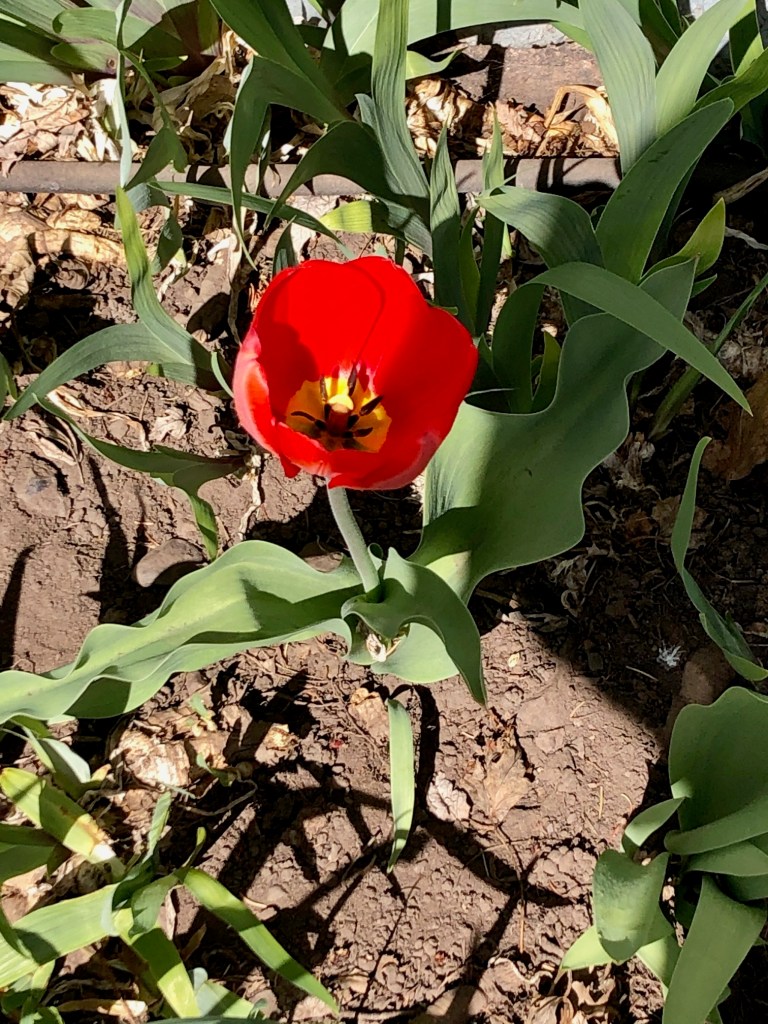
Only two daffodils bloomed, but the tulips showed great hope. Yesterday I counted nine tulip buds that were ready to burst open in red. This morning I walked to the back garden and found one red tulip with its petals fully opened to the sun. It caught my eye with its vibrant red. I looked at the other buds to see how close to blooming they were. Gone. All. Gone. Sheared off by some animal’s guillotine teeth. Probably some overly cute bunny. This has happened in past years, and this year we have lots and lots of bunnies in the neighborhood, so I wasn’t surprised to see my tulips decimated. What’s different is that I wanted to have a good, wailing cry. But I stuffed my tears because if I started, I wondered if I’d stop. 

Tulips Beheaded

Only two daffodils have bloomed, but the tulips show great promise. I count nine tulip buds ready to open and reveal their dressy reds, the color of tunics worn by the Queen’s Guard at Buckingham Palace. My tulips will stand watch in a humble stretch of garden nestled behind my house, allowing them to avoid cold spring winds advancing from Lake Superior. Because of the coronavirus and stay-at-home orders, I await the triumphant return of my tulips with enthusiasm.

The Lone Survivor

The following afternoon I return to my garden. A solitary red tulip, its petals open to the sun, stands at attention. I look toward the other tulip buds to see if they will soon join their companion. Gone. All gone. Only eight headless stems remain, each encircled by pointed leaves that failed to protect them, their buds sheared off by some animal’s guillotine teeth, most likely one of the hordes of rabbits pillaging the neighborhood.

I want to have a wailing cry. But I stuff my tears because decapitated tulips are nothing to cry about during a pandemic that has caused so much havoc. If I start crying, I wonder if I’ll stop.

An image of Elmer Fudd singing, kill the rabbit, kill the rabbit, from the cartoon parody of a tragic opera interrupts my thoughts. Fudd, performing an aria about killing his prey, sings what I feel. I sing with him, kill the rabbit, kill the rabbit. But Fudd is lampooning tragic opera. The parody strikes a chord with me because rabbits will not die by my hand. Tragic opera is about fatal flaws, vengeance, and remorse, and I can do without the remorse.

With kill the rabbit still echoing in my head, my brain retrieves the song “Circle of Life” from my memory bank. The tunes spar in my head. I smile at my dark humor, but the rabbits have won. Spring has been late in coming, and the rabbits are hungry.

I hope they enjoyed their fillet of tulip buds.

Elmer Fudd pops back into my head, singing, kill the COVID, kill the COVID.