On Friday morning I woke up with several goals in mind. I needed to wash some blankets and area rugs. I planned to cook an enchilada casserole using some homemade enchilada sauce a friend gave me. And I wanted to submit my 45,600-word collection of short stories to the 2024 Iowa Short Fiction Awards.
I have been working on a collection of short stories since January 2019, when I wrote my first short story, one I actually completed from start to finish. I submitted the story to a local contest, and it won first prize.
But I had a lot to learn.
For the next four years, I kept writing stories and essays. I started a blog. I took writing classes and attended writing seminars. I went to hear authors speak about their writing. I subscribed to writing magazines and read them. I read books on the craft of writing. I shared my drafts with writing groups, friends, and family members who were willing to give me feedback. I read lots and lots of books, novels and memoirs, short stories and essay collections. I was always a reader, but I kicked it up to a new level. And I revised “finished” stories based on my new insights.
I have submitted stories and essays to journals and contests, and I have nearly two hundred rejections to prove it. But some of my stories and essays have been published, and a handful have won or placed in contests. A year ago I did some math and discovered my acceptance rate was almost fifteen percent, but I don’t get published in the higher-ranking literary journals.
The writer’s bio I send with my submissions usually contains the words: “She is working on a collection of short stories.” Because a writer’s bio is written in the third-person, it feels like I’m talking about some other person, way over there, sitting at the other end of the room. But putting the words about writing a book of short stories in my bio was a contract with myself. That I wouldn’t just say it — I would do my best to make it happen. And my story collection grew.
On Friday morning the only thing I had left to do was finalize the order in which my stories would appear in my book. I paced like a traveler on a platform, waiting for an overdue train. I put the dishes away, made oatmeal, paid the power bill, and did a load of washing. I waited for my husband to go to work, so I could concentrate without interruptions, then I waited for feedback from one of my readers regarding which seven stories she felt were the strongest. I had asked four different readers to choose their top seven stories. The goal in arranging a short story collection is to start and end strong, and sprinkle other strong stories throughout the collection.
I knew which story would be the engine and which one would be the caboose, but I agonized over how to arrange the rest of the cars in my train of stories. I finally told myself, “Stop being ridiculous. If the judges don’t choose your story collection, it won’t be because they felt you should have put “Silent Negotiations” before “Elmer Wilson’s Viewing.”
I took a deep breath and folded over in the ragdoll yoga pose. After all, I didn’t even need to write a query letter to accompany my submission, and I didn’t have to pay a reading fee. Just a minimum of 150 pages, double spaced, with one-inch margins, preferably as a PDF file. Geez, I just needed to relax.
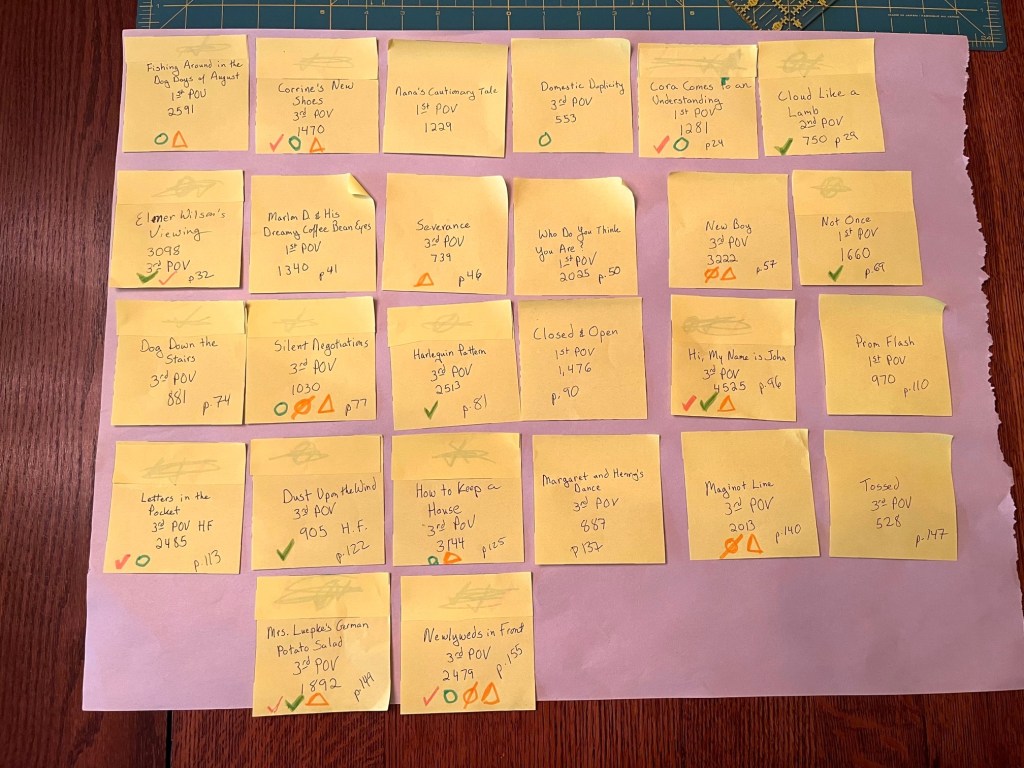
A short while later, I received my last reader’s list of favorites. Using Post-its on a large piece of newsprint, I moved story titles around until I was happy with their sequence. I copied and pasted the stories into one document then reviewed it. I filled out the electronic submission form and uploaded my file. After a slow inhale, I clicked submit, then exhaled. My stories had left the station on their first adventure. I won’t hear about them until January 2024. In the meantime, I will keep reading and learning and writing.
In the afternoon I washed the blankets and rugs, then I made the chicken enchilada casserole for supper. It was marvelous, and to celebrate my first book submission, I paired the casserole with a Bell’s Oktoberfest beer.
Now my bios will include: “She has finished her first short story collection and is submitting queries to publishers,” or something like that — it might need a few revisions.




 Writing Near the Lake