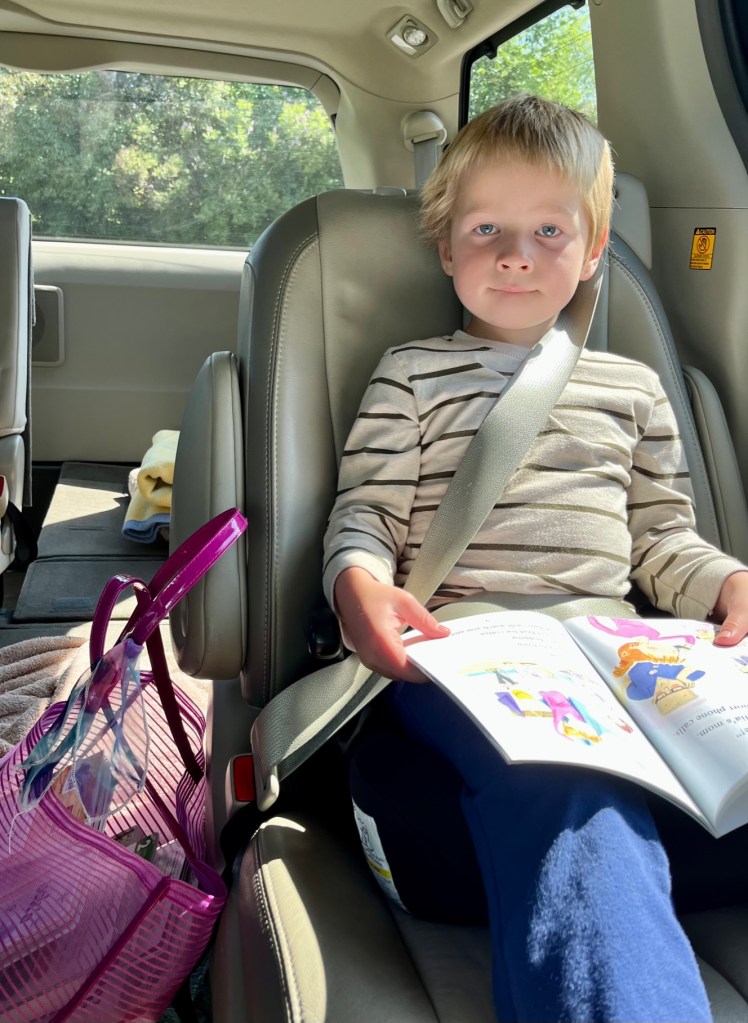
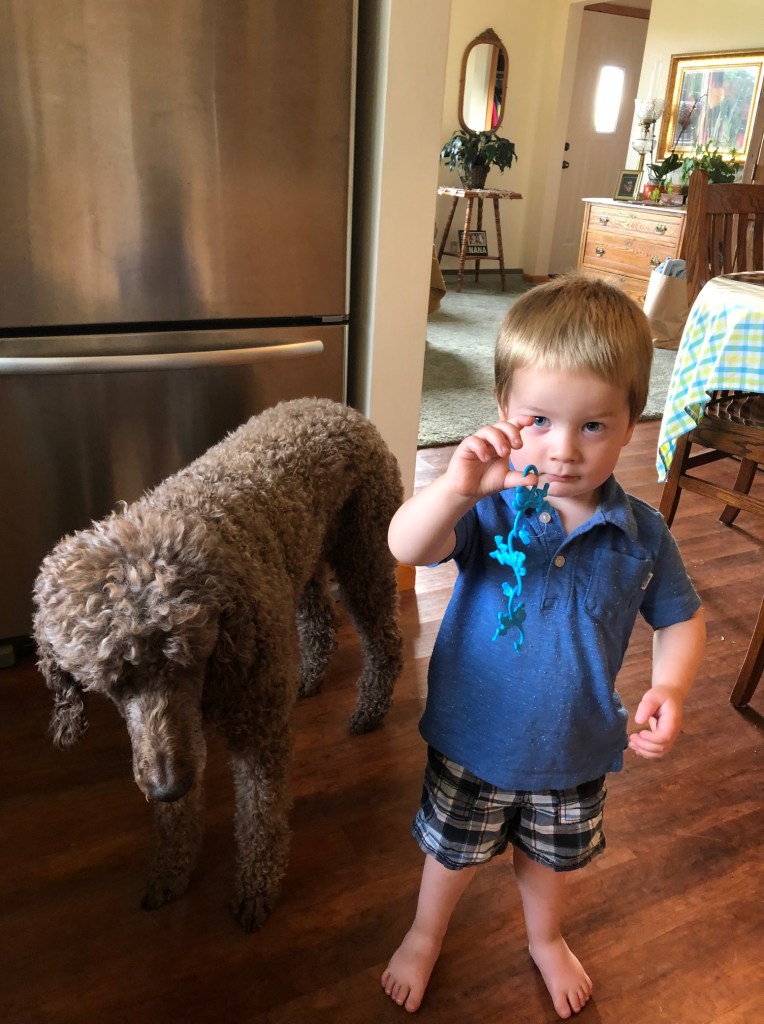
“Nana, you have an infinity of dishes,” says Evan, who is nearly six; who tosses words into the air and pairs them with unlikely partners; who strings together metaphors like a bohemian necklace; who loves puns, making up his own then laughing and asking—Do you get it?
A punster, a mixer of words, a stringer of metaphor, he should be a writer, and I tell him so. He answers, “But I can’t write any words.” I remind him he’s starting school, he will learn.
For a moment the infinity of dishes that tracks through my kitchen from cupboard to table to counter, waiting to be stacked in the dishwasher or hand washed, depending on their taxonomy, gives me pleasure because Evan’s linguistic artistry gives me pleasure.
Crisp autumn days are my favorite time to walk my dogs. I watch the shifting scenes of autumn: trees turning shades of red, orange, and yellow; leaves dropping gently to the ground—then days of high melodrama when howling winds and heavy rains come to rip the once-vibrant leaves from their stems, stripping the trees bare.
As the rich autumn shades—all warm hues on the color wheel—replace the cool hues of green, autumn wraps me in nostalgia, carrying me back in time to my youth. I’m warmed by memories of raking leaves into circular paths resembling the yellow brick road; of walking through the woods with oak, hickory, and maple trees awash in fall colors; of gathering acorns and hickory nuts while a blanket of dried leaves crunched under my feet.
I’ve been in Petoskey, Michigan, since Tuesday, and I’ve been walking Ziva, my dog who came with me, and Bogey, my mother’s dog. Petoskey, nestled on the eastern side of Lake Michigan, is beautiful anytime of the year, but October is my favorite time to visit. The weather, scenery, and vegetation are a blend of southeast Wisconsin, where I grew up, and northwest Wisconsin, where I live by Lake Superior. Coming here is like returning to the fields and woods of my youth, while almost feeling like I haven’t left home because Lake Michigan keeps me from missing Lake Superior.
On Tuesday and Wednesday, sunshine, warm breezes, and fall colors filled the days, and the dogs, my sister, and I walked the country roads in my mother’s neighborhood. My sister went home yesterday, but I’m still here with my mom and the dogs. Today, the rain and wind arrived, pulling autumn-colored leaves from the trees. The dogs and I still walked, but we timed our strolls between shifts of rain. Bogey has a raincoat, but Ziva would rather get wet than wear one. I could’ve carried an umbrella, but the strong winds would have turned it inside out.
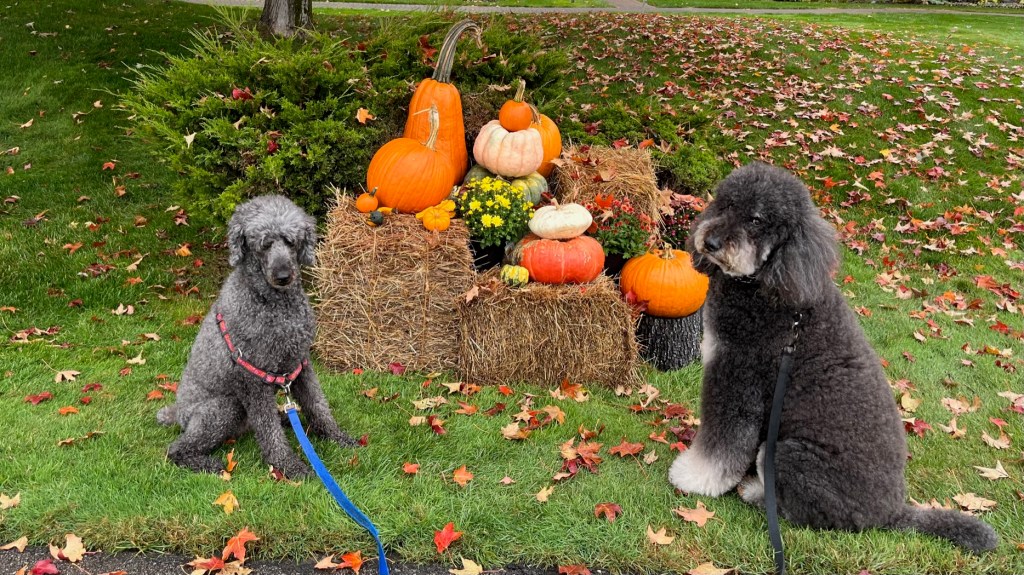
On our second walk of the day, I had the dogs pose by a vignette of pumpkins, squash, mums, and hay bales arranged by one of my mom’s neighbors. I’m going to have a 5 x 7-inch photo made and frame it, a reminder of a gray but lovely autumn day when two big-hearted dogs kindly let me take their picture on a blustery day.
A Delicate Balancing Act by Kimber Fiebiger; downtown Mankato; made me think about the writer’s life
The Deep Valley Book Festival is set in Mankato, Minnesota, a charming town tucked in by rolling tree-covered hills and edged by the Minnesota and Blue Earth Rivers. This is the first book festival I’ve ever attended. My daughter-in-law and I drove down on Friday afternoon, a warm sunny day that premiered some stunning fall colors.
After we checked into the River Hills Hotel–a cozy and clean establishment with a friendly clerk–we headed to downtown Mankato for a walk then dinner. It was quiet for a Friday night, but I imagine if the Mankato Mavericks had been playing, the streets would’ve been skating with hockey fans. We had a good meal at the Pub 500. Our waitress was friendly and efficient. She carded my daughter-in-law, but she didn’t card me! Of course, that’s probably because I didn’t order a drink; otherwise, I’m sure she would have. I had a delicious fish taco.
On Saturday morning we arrived at the book festival just before nine o’clock, and we planned to stay until it ended at 4:30. We were motivated by the hourly drawings for books and the opportunity to hear author Curtis Sittenfeld talk about her writing.
We made sure we stopped at all the tables, sometimes briefly, other times lingering to listen to writers speak about their books, which included children’s and YA literature, fantasy, mystery, thriller, romance, historical fiction, memoir, nonfiction, and poetry.
A book festival is filled with writers, but they are there to sell their books. There are no writing classes. The local library had a table, and Content, a bookstore from Northfield, Minnesota, also had a table. I noticed two publishers who were selling books by authors they represented. I asked one publisher if they were a traditional publishing house–they weren’t. The representative of the company said they like an author to put up fifty percent of the cost of publishing his or her book. I didn’t ask the other publisher about their business model.
Authors work hard at a book festival. They sit or stand for hours and talk about their books to people who look, smile, and listen, but often leave without buying a book. I bought two children’s books, two novels, and a nonfiction book. My daughter-in-law bought some books too. We plan to exchange our books with each other.
We finished touring the festival around noon. We sat and each of us started reading a book we had purchased. I read Facets of Death by Michael Stanley, a fast-paced Detective Kubu story that captured my attention, a good thing because I won another Detective Kubu story, A Carrion Death in a drawing being held by the author. My daughter-in-law read Bingo Barge Murder by Jessie Chandler, which she enjoyed, saying it was humorous.
When reading made us hungry, we left to have lunch at Applebee’s, then went for a walk. But we soon returned to the book festival to check the small white board to see if we had won any books–we hadn’t.
The book festival was held at the WOW! Zone, an interesting place for a book festival. The WOW! Zone has a bowling alley, a game arcade, and food. It was noisy, but fortunately, most of the booksellers were tucked into the restaurant that had been converted into a makeshift venue, and so the noise wasn’t too bad. We wanted to read more because we had almost two hours to pass before Curtis Sittenfeld’s talk. Seating in the WOW! Zone was limited, so we ended up at a table in the bowling ally and read to the rumble of rolling bowling balls and clattering pins. But when I’m reading a good book, background noise fades away.
By three o’clock, I was tired and we had a four-hour drive home. But I had heard Curtis Sittenfeld speak on a Zoom talk and enjoyed listening to her, so I didn’t think about cutting out early. Sittenfeld began by saying that she has done hundreds of talks all over the country, but this was her first time giving a book talk in an arcade. The audience laughed with her because we understood. Most of us had spent the whole day or part of the day at a book festival held in an arcade. Sittenfeld was kind, charming, informative, and entertaining. The hour flew by.
With our bags of books, my daughter-in-law and I headed home. We had new reading material, and we were ready for the upcoming winter.
Books I bought:
Facets of Death by Michael Stanley because after reading a paragraph, I liked the writing, so I took a chance that the story would also be good.
Tuckerbean in the Kitchen by Jill Kalz because the book festival was the same day as my grandson’s birthday. He turned six, and I think a story about dogs cooking will appeal to him. Plus the illustrations by Benton Mahan are adorable.
Eligible by Curtis Sittenfeld because she was there, and I wanted to have a book for her to sign. And because I’ve read American Wife by her and liked it, AND because Eligible is a modern retelling of Pride and Prejudice, which I love and have read three times. Plus I’ve seen three different movie versions of Austen’s enduring novel.
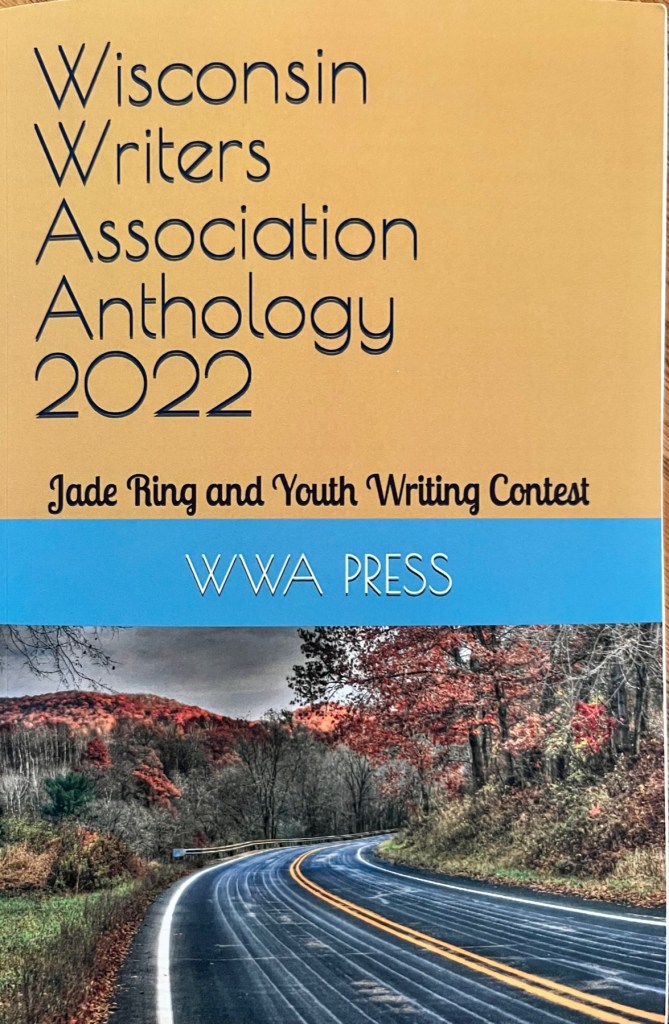
[This essay received an honorable mention in the Wisconsin Writers Association’s 2022 Jade Ring Contest. To read the works of other winners, see the links after the essay.]
Charlie broke my heart in 1971. Dressed in a top hat and tuxedo, and well-groomed with manicured nails and combed hair, he was debonair, even if his monocle made him look a bit stuffy. Always ready with a smart comeback, a smooth put-down, or a drop of wisdom, he was witty, candid, and self-assured. Charlie was a dummy, but I wanted him anyway.
The big problem—he was unavailable. Like all desirable men, he was taken. Women everywhere had lined up to have a chance with him. Seems like everyone wanted a wise-cracking fella who was perpetually dressed for the opera.
My mother broke the news to me. “Honey, I have to talk to you about your Christmas list.” I was twelve, so we had long ago stopped calling it “my letter to Santa.”
“I’ve looked everywhere.” Her voice shrunk as she spoke. “I can’t find a Charlie McCarthy doll.” She asked me to think of something else to add to my list. I did, but I don’t recall what it was. I could’ve asked for a hand puppet, but that would’ve been like having to settle for Eddie Haskell after hoping to date Donny Osmond. There was no substitute for Charlie.
I wanted to be a ventriloquist. I was going to be famous. I was going to be a star. And I couldn’t do it without Charlie. My daydream about becoming a celebrated ventriloquist was another chapter in my someday-I’ll-be-a-famous-singer-actor-or-dancer book of fantasies. I spent hours singing with Doris Day, Petula Clark, Dionne Warwick, and Barbara Streisand, pretending to be them. Sometimes I sang along with Johnny Cash, Frank Sinatra, Sammy Davis Jr., or Trini Lopez, pretending they had recognized me—a famous singer—in the audience and called me up on stage to sing with them. The exuberant audience, unable to contain their cheers and thunderous clapping, would rise to their feet moments before we had finished our duet.
Sometimes, I’d lay on the floral velour couch in the living room, the most elegant space in our farmhouse, and imagine myself a great actor giving spellbinding performances on stage or film. Or I would be Cyd Charisse, dancing, defying Newton’s laws of motion, giving men whiplash. When I wasn’t doing my famous talent stuff, I would travel to exotic places, win awards, and marry a leading man or a velvet-voiced crooner.
With Charlie I would’ve been more than a ventriloquist—I would’ve been funny! The see-saw, back-and-forth humorous banter between Charlie and Edgar Bergen captivated me. Bergen said things that came out of Charlie’s mouth. Through Charlie, Bergen insulted people and everyone laughed at Charlie. Through Charlie, Bergen flirted with women and everyone thought Charlie was adorable. Charlie sassed Edgar, his elder, and never got whapped alongside the head. My twelve-year-old mind found this setup very attractive. But reflecting on it now, I don’t think my mother would’ve whapped Charlie alongside his head.
After I learned Charlie wouldn’t be helping me on my way to ventriloquism fame, I crawled in the closet under the stairs. I sat with a box of hats, mittens, and scarves. I inhaled a mixture of musty wool and dust while tears rained down my cheeks. Charlie would never sit with me on the floral velour couch. I wouldn’t toss my voice into his throat. I wouldn’t watch our reflections in the mirrored wall as we practiced talking to each other. We might have sung along with Sinatra or Streisand, the three of us making harmony.
I was crushed. I was heartbroken. I was an overly-dramatic twelve-year-old. Oscar worthy, no doubt.
I’d like to say that I pined for Charlie and that Christmas Day was hollow without him and that I asked for him for my birthday in March. But I did none of that. I was over him before Christmas. I don’t remember what I got instead of Charlie, but it was the next best thing, and I’m sure I was happy with it. I ate my mom’s good cooking. I played board games with my sisters and cousins. And I read my new Nancy Drew mystery before I drifted off to sleep that night.
If Charlie hadn’t stood me up, truth is, I would’ve dumped him. Within a month or so, he would’ve been tucked away in my closet, along with my fantasies of winning an Oscar or a Grammy. I hope all the Charlies found better homes.
I never became a famous singer, dancer, or actor. I can’t carry a tune. I have no sense of rhythm. And in seventh grade, I learned I had terrible stage fright.
Funny, when I was twelve, I never imagined myself as a famous writer. I started writing after I retired, so I’m too old for silly fantasies now. But if I were twelve, I would win a Pulitzer Prize, I would make Oprah’s reading list every other year, and the New Yorker would call me and beg for one of my short stories.
[All the winners of the 2022 Jade Ring Contest can be read in the online Creative Wisconsin Magazine, along with other essays, poetry, and articles. If you wish to purchase a copy of the Wisconsin Writers Association Anthology 2022: Jade Ring and Youth Writing Contest, click here.]
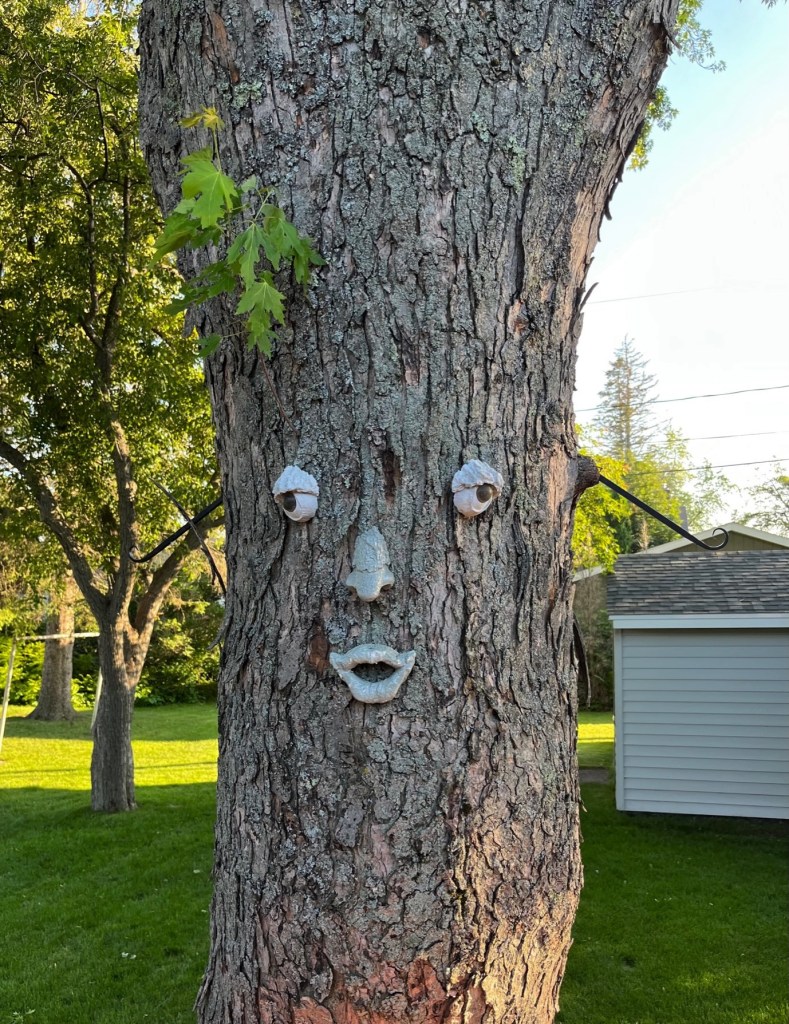
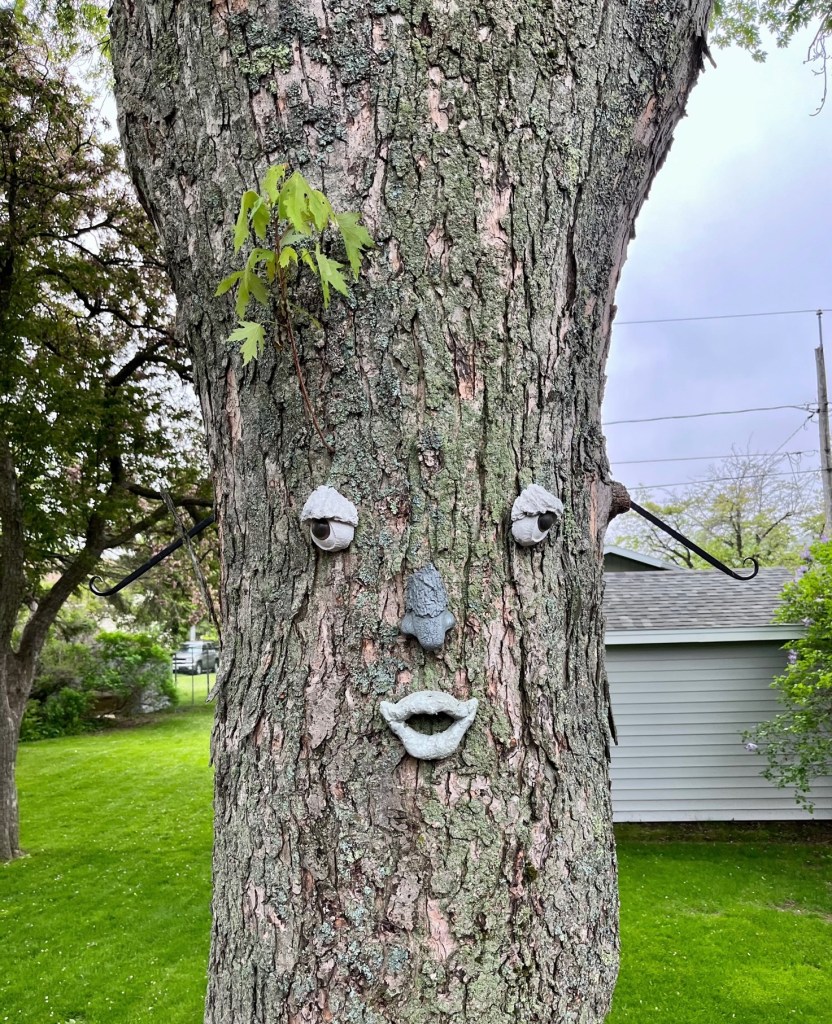
Yesterday Tree Guy lost his mouth. I noticed his missing smile last night when I let the dogs outside. I leaned over the deck, Tree Guy’s mouth lay on the ground in pieces, most likely KO’d by a squirrel.
Squirrels have been scurrying up and down Tree Guy’s trunk, busying themselves for winter. The Farmer’s Almanac has predicted a harsh winter for our area, designating it a “Hibernation Zone.” Sounds quaint, doesn’t it? Just eat a lot of food, then curl up for a long nap in a cozy place.
Tree Guy’s mouth won’t be repaired again. It’s in pieces and the back hanger is gone. I could probably find the metal loop, and my husband could fix the mouth—again, but it wouldn’t last because the interior substance is dry rotted. The shiny paint job on Tree Guy’s mouth is like an iridescent-paint job on an old car, covering copious amounts of Bondo—pretty to look at but not a long-term solution.
Losing his mouth has changed Tree Guy’s expression. While trying to determine if he looks contemplative or stern or forlorn, I’ve decided he looks mostly confused.
My husband and I agreed that while Tree Guy’s mouth won’t be fixed, we’ll leave him with his eyes and nose. He’ll still watch over the deck and smell his flower-basket earrings, but he won’t talk. Anyone wanting to know what he thinks will have to look into his eyes, windows to his inner sap. Tree Guy’s been part of our lives for over a decade, we’d rather lose him in bits than all at once.
I’ve pulled the nail from the tree where Tree Guy’s mouth hung and tossed his broken lips into the trash.
Tree Guy with his summer hairdo and refurbished nose
For those of you who may have missed the other Tree Guy posts, let me summarize: Tree Guy had a bit of a rough winter. In January he lost an eye during a snowstorm. When I found his eye and rehung it, I noticed his nose was gone. Through the rest of January, February, and March, I looked for Tree Guy’s nose, hoping to find it as the snow retreated, but fresh snow kept falling. Finally, at the end of March, my husband spotted the nose frozen in the snow. I tried to pick it up, but it was stuck in the snow’s frozen mantle. A few days later, with the precision of an archeologist, I dug it out. Good thing because it snowed the next day.
When I rescued Tree Guy’s nose, it needed a paint job. My husband took it to work, painted it gray, and rehung it in May. But the shade of gray blended in with the tree trunk. This bothered Tree Guy because he’s proud of his schnoz—he might lose it, but he never hides it. Of course, my husband understands Tree Guy because he’s the one who purchased Tree Guy and installed him on our maple tree. He has always watched over him. I’m the relative newcomer to the game of “How Is Tree Guy Doing Today?”
Tree Guy with the wrong paint job
I mentioned the too-dark-gray color to my husband, and he agreed. He already had plans to take the nose back to work and repaint it a lighter shade of gray. The second paint job is perfect, so there will be no fifty shades of gray noses.
It was a long, cold, snowy winter for Tree Guy. He worried about his eye then his nose. But he’s come through, and this spring he sported a new hairdo. He looks sassy with his asymmetrical patch of green, leafy hair. A tree expert told me that small shoots along a tree trunk, such as Tree Guy’s new hairdo, should be cut off. But I don’t have the heart. Tree Guy had a jittery winter. I get it. This winter I read about plagues, like tuberculosis, the Black Death, and syphilis. And I read Russian short stories, which are mostly bleak and fine companions to winter and stories about plagues. After reading the “The Nose” by Nikolai Gogol, I concocted a crazy theory that Kovalyov lost his nose because he had syphilis and that Gogol’s story was really about the syphilis epidemic before antibiotics, a time when some sufferers had their noses rot away. With each passing day of winter my crazy theory became more conceivable. I reread “The Nose” to see if I could make my theory work—I couldn’t. But I enjoyed the story even more the second time. I thought about researching my “The Nose”—syphilis theory online, but I didn’t want to get caught up in crazy nose-conspiracy theories.
Yes, Tree Guy has it all together again, and he’s sporting a new hairdo. And me, I ditched my theory about Gogol’s story “The Nose,” then I had two inches trimmed off my hair.
We’re enjoying summer while it’s here. After the Fourth, Tree Guy will get two flower-basket earrings, and I will go paddle boarding for the first time this season. (It was a cold, windy spring on the shores of Lake Superior.) Next winter Tree Guy will hope to keep his face intact, and I will read more Russian short stories.
On Sunday I made strawberry-rhubarb crisp. I’m not much into cooking these days because cooking causes dirty dishes. And I’m not into washing dishes. But I had three reasons for making the strawberry-rhubarb crisp.
One: Rhubarb is plentiful. If you have any growing in your garden, you know what I’m talking about. You ask people, “Say, could you use some rhubarb?” If they say no, you ask, “Are you sure? I’ve got plenty.” You bring bags of rhubarb stalks and set them on the lunch table in the breakroom or the coffee table in the church hall. I don’t grow rhubarb, but I never have to buy it in the grocery store (where I recently saw a tiny package of it for two dollars and change). I have connections. I know people desperate to share their abundance of rhubarb.
Two: I found a recipe for strawberry-rhubarb crisp in Southern Living that I could make in my Le Creuset Heritage Tart Tatin Dish. (I had no idea the dish had such a fancy name until I looked it up to get the name right.) I bought my Heritage Tart Tatin Dish because it was orange and sexy. These are, by the way, two good reasons to buy a kitchen implement. Another rule for buying a kitchen implement is that it should serve two purposes. (I’ve been known to break this rule, but only if the single-use implement will get lots of use, like my garlic press, lemon squeezer, or mango slicer.) Until last Sunday, I had only used the orange, sexy Heritage Tart Tatin a few times in the last ten years to make jalapeño corn bread. So, making the strawberry rhubarb crisp gave my dish dual-use status. It’s not just another pretty tart dish.
Three: My grandmother Olive made the best strawberry-rhubarb pie or any other kind of pie. I haven’t had a good piece of strawberry-rhubarb pie since I lived with her. I don’t bake pies. I cheat and make crisps because I don’t know how to make crusts. Grandma Olive made pie crusts from scratch, and they were as a pie crust should be–flakey, tender, and golden brown. She also knew her way around the fillings. She never made a pie with canned fruit filling. Baking a strawberry-rhubarb crisp was the closest I was going to get to Grandma Olive’s pie version.
The crisp turned out well. I served it with whipped cream or ice cream. The filling is equal parts strawberry and rhubarb, so it’s tart, even with the cup of added sugar. You have to like tart if you’re going to eat something made with rhubarb.
If you have your very own Le Creuset Heritage Tart Tatin Dish and you want to make the recipe from Southern Living, you’ll need to adjust the quantity of rhubarb and strawberries. I used three cups of each, instead of four because I was worried my tart dish wasn’t deep enough. (Please, no jokes about my shallow tart dish.) I didn’t reduce the amount of sugar or any other ingredient. Also, I didn’t have any chopped roasted salted Marcona almonds, so I used some chopped unsalted roasted almonds. That makes this a healthy recipe. (As long as we don’t mention the brown sugar in the oat topping and the cup of sugar mixed in with the fruit.)
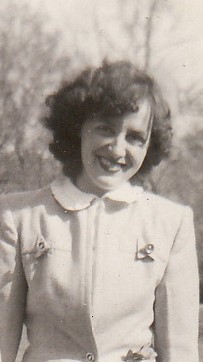
Grandma Olive with my sister and me (in the foreground)
When I served the strawberry-rhubarb crisp, I thought of Grandma Olive. I miss her. She and Grandpa had a big garden with their own patch of rhubarb and strawberries. I wonder how much rhubarb they tried to foist off on friends.
I saved this recipe, and I’ll make it once a year in the early summer. I don’t want to strain my rhubarb supplier.
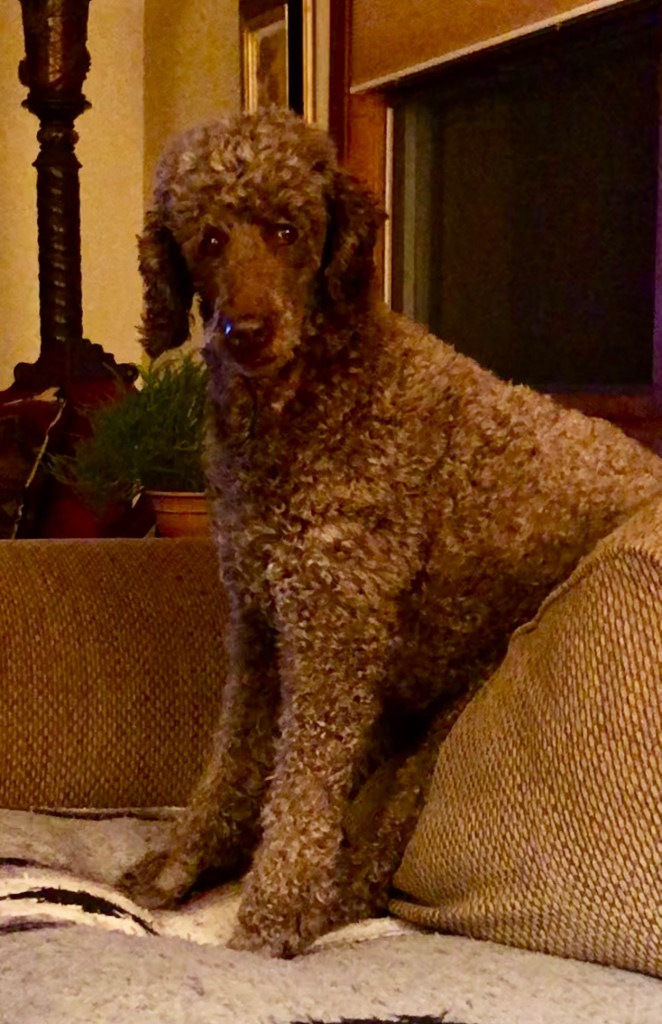
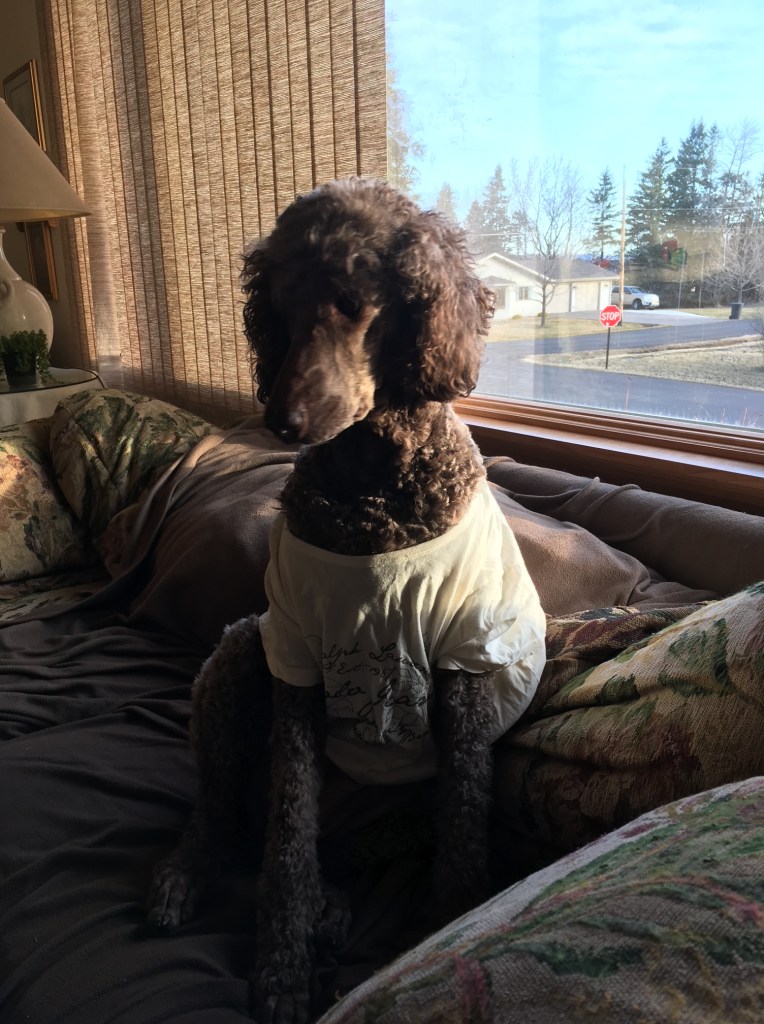
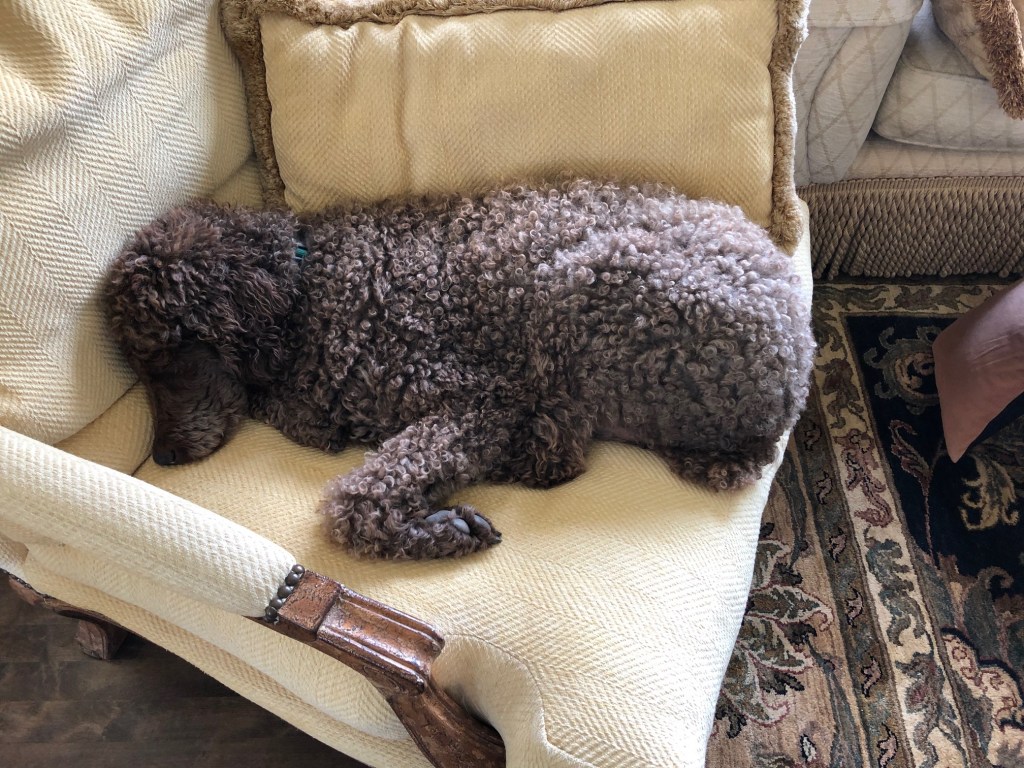
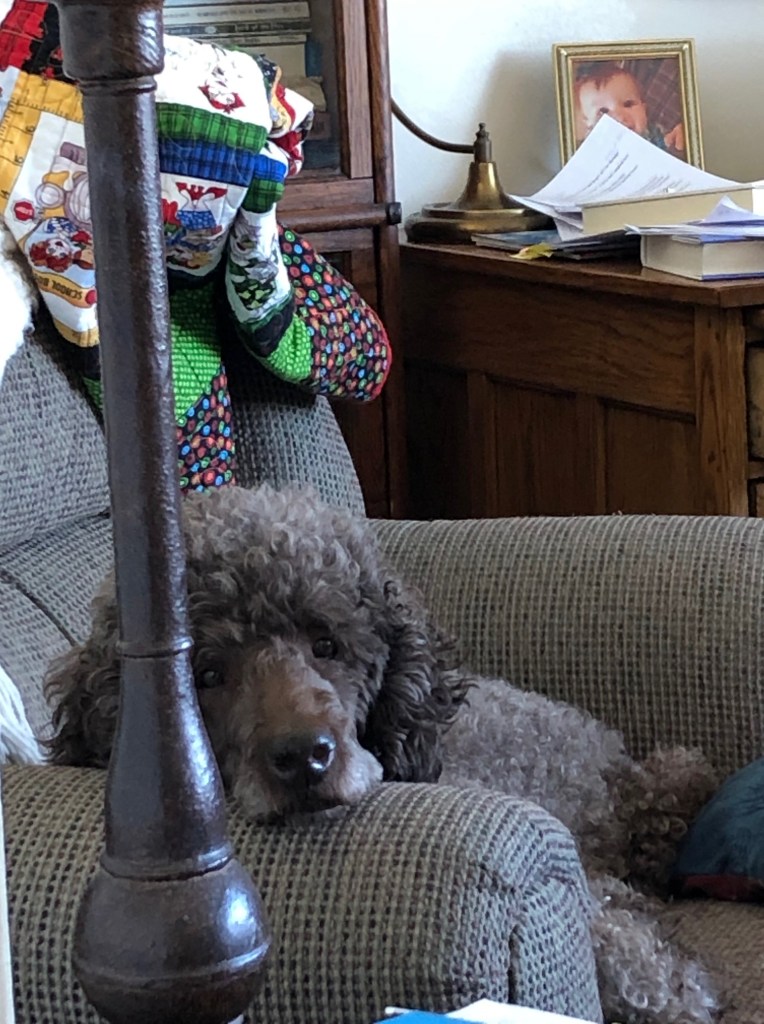
Today is Cabela’s birthday. She’s 14 years old. In dog years that’s about 83—if I calculate it based on the new formula. When I was young, I would’ve multiplied her age by 7, and she would’ve been 98. But today Cabela’s age is calculated using new math. She likes that.
Her full name is Cabela Grace. She was named after Cabela’s, the outdoor and sporting goods store, because we bought her near the store. Once, when she was a puppy— and having the crazies—she ran into the wall instead of down the hall. I added Grace to her name. She has many nicknames: Snickerdoodle, Range Rover, Ichabod, Sneaky Pete, Kadiddlehopper, and Our Bell or Bell, but never Bella.
When my son comes to visit, she likes to have a silent moment with him. He puts his face near hers, and she looks at him intently. Sometimes my son speaks to her, and sometimes it’s just a wordless exchange. He was the one who picked her up out of a small pen and held her. She nuzzled under his chin. He asked us to take her home. So, we did because who can resist an eighteen-year-old boy who adores a chocolate standard poodle puppy. I believe Cabela remembers her first snuggle with him. I will argue with any animal psychologist who says this couldn’t be possible.
Cabela was born on a farm an hour west of the Twin Cities in Minnesota. The couple who owned the farm raised dogs. Emmet raised Labradors, and Ruth raised standard poodles. They did not raise labradoodles. Hunters often bought Emmet’s Labradors. But sometimes a hunter bought one of Ruth’s poodles. Some hunters are smarter than others. Cabela would’ve made a good hunting dog. As a puppy she pointed at birds, had a soft mouth, and loved being outside in any kind of weather.
Ziva, Cabela’s half sister; same father, different mothers; December 2019
If Cabela were a literary character, she would be Bartleby the Scrivener. She’s stubborn and if she could speak, her catch phrase would be “I would prefer not to.” She prefers not to enter the vet’s examination room, but she does and she’s good and the vet loves her. She prefers not to stop eating her sister’s dog food, but she’ll stop if I take the dish away. She prefers not to move if she’s settled into a spot, but if I pick her up, she’ll go along with it.
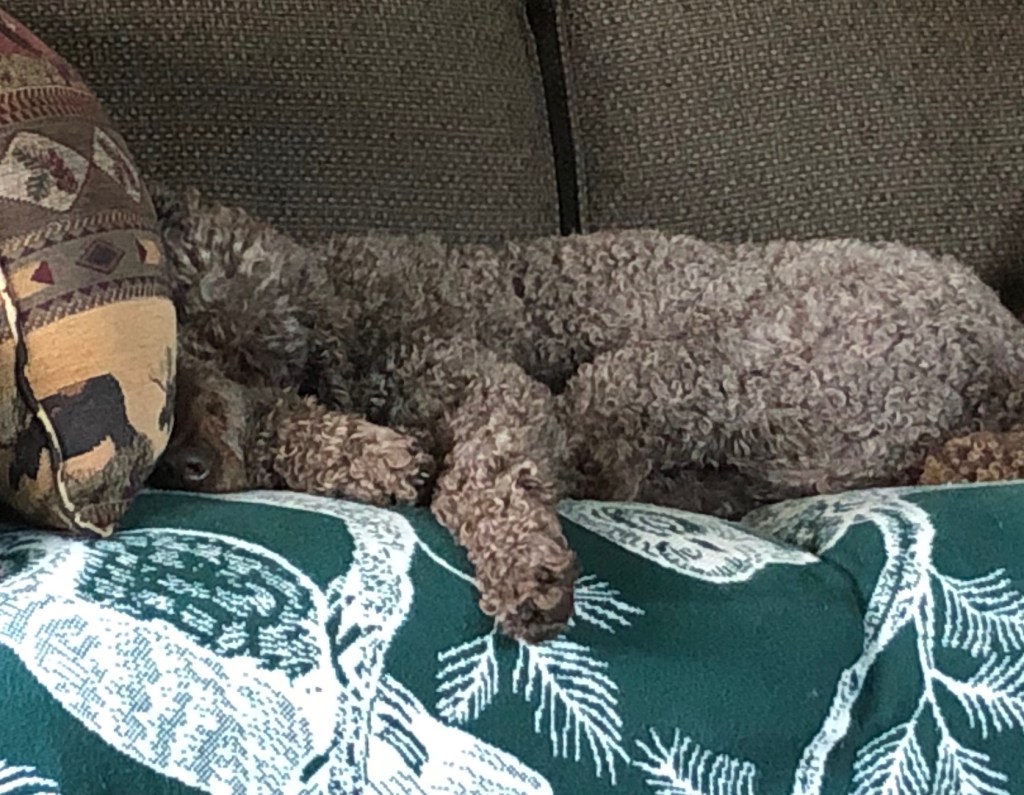
The vet once told me that Cabela had the heart rate of an athlete. “That’s because she is an athlete,” I said. Cabela used to do hot laps around the house when she got excited about a dog, a car, or a delivery truck that passed by. She’d run like a greyhound, circling the house four or five times. Or she would approach our pine tree and launch herself six feet into the air along the tree’s trunk. When she played fetch, we had to lob the ball up into the air, so it would bounce off the ground because she liked to leap up and catch it in her mouth. But like all athletes, the laps became fewer and slower and the leaps up the side of the tree become shorter and shorter. And last summer my husband and I decided we had to toss the ball low to the ground. Her old hips have sidelined her. She likes her walks short and her naps long.
Cabela has a signature look. She’ll give us the puppiest puppy eyes, raising one eyebrow, then the other, alternating them up and down, slowly, melting our hearts. This is how she asks to go outside or for a walk or a ride or for supper or a treat.
She’s a daddy’s girl. She’s a loving girl. She kind to her sister, Ziva, and she loves our grandchildren. She’s a good dog. And that’s what we should all hope to be at our best.
[This essay was published on Brevity Blog, June 6, 2022.]
A couple of weeks ago, within twenty-four hours, both Stephen King and my mom told me I needed an office for writing. I decided if Mom and Mr. King agreed about something, I needed to listen.
My office space along the wall
Of course, Mr. King was talking to me from the pages of his book On Writing. He advised me (okay, he was talking to all writers) to have a space of my own with a door that closes. He wrote Carrie and Salem’s Lot in the laundry room of a trailer, but there was a door that closed. He never mentions if he ever threw a load of dirty clothes in the washer. I would have washed and dried clothes and written between the cycles.
Then Mom called. I felt too blue to just put a smile in my voice and chitchat about weather and family and the latest movie she had seen. Spurred on by Mr. King urging me to have an office with a door and frustrated by the traffic patterns in my writing space, I was weepy about not having a quiet place of my own to write.
My office space in the living room had worked if I was home alone, but my amygdala had begun to associate it with interruption and chaos. The living room is a thoroughfare from one side of the house to the other. When my husband is home, he likes to stop off and chat as he motors through. My grandkids also play in the living room three days a week. They inhabit the space with toys and voices and nonstop movement. While playing, they chatter with delight and argue with rancor, all of it mall-level noise. So, it didn’t matter if my husband and grandkids weren’t in the house when I tried to write because my brain would anticipate interruption and commotion anyway, leaving me frazzled. Logically, I understood why I was antsy, but it’s not easy to calm down a fired-up amygdala.
Mom suggested I turn the spare bedroom, tucked at the front side of the house, into an office with a pullout couch. “You can take a nap on the couch when you’re tired, and you can use it as a bed when the grandkids sleep over.” I wondered what Mr. King would say about napping in one’s writing office.
Sloth on a Shelf: I write faster than he does!
I rejected the pullout couch solution, but Mr. King’s and Mom’s advice started me thinking. Over the next several days, I wandered in and out of my two spare bedrooms with a tape measure, sizing up the dimensions of the rooms and the furniture, arriving at a solution. I swapped a desk and dresser and bought a bookcase. For the first few days, I would wander into my new space and stare at it with wonder and love, the way I looked at my children when they were newborns.
It’s not a whole office, but I like it that way. It’s a little cramped, but when I sit at my desk, it feels like a hug, and in a pinch, the bed right behind me serves as a table. Mr. King says a writing office should probably be humble, so my space measures up. I can shut the door, so I’m not interrupted. And when the grandkids visit, they aren’t allowed to play in my room.
Remember how you always said, “The early bird gets the worm.” And I would answer back, “I don’t like worms” because I wanted to sleep until noon. I thought you’d like to know that now I rarely sleep past 6:00 a.m.
Remember how you always said, “Early to bed and early to rise, makes a man healthy, wealthy, and wise.” And I would answer back, “I don’t care” because I wanted to watch the late movie on TV. I thought you’d like to know that now I usually fall asleep before 10:00 p.m.
Remember how you always said, “You can win more flies with honey than vinegar” when I was spitting mad and wanted to tell someone off. And I would answer back, “Vinegar is what she deserves” because I desired payback. I thought you’d like to know that now I believe honey is a better tonic.
Remember how you always said, “Turn the other cheek.” And I would answer back, “If I do, someone will just slap the other one” because I was hurt and didn’t want to forgive. I thought you’d like to know that now I try to practice the other-cheek philosophy.
Remember how you always said, “A penny saved is a penny earned.” You were a widow scrapping by on a waitress’s earnings. But I wanted things, so once I badgered you into buying me a troll doll and another time a delivery pizza that you couldn’t afford. I thought you’d like to know I’m sorry, and that fifty years later I still have the doll. And the pizza didn’t taste good that night because I regretted my behavior before it was delivered. Best of all, I became good at saving money. You’d be proud.
Remember how you always said, “If you can’t say something nice, don’t say anything at all.” That was good advice. And I thought you’d like to know that after years of practice, I’ve gotten better. I could be such a wiseass when I was a teenager.
Remember how you always said, “Never trust a man who doesn’t like animals.” I embraced that advice. Some of the men I dated weren’t the best, but they all loved animals. My husband loves dogs. We have two. And he is the best.
Remember how you always said, “Silence speaks volumes.” I didn’t understand what that meant, but I never asked you to explain because I wanted you to think I was smart. I thought you’d like to know that now I get it. But I also know you didn’t mean that I should always be silent because you spoke up when it mattered.
Remember how you always said, “Wear clean underwear every day in case you get in an accident.” I never answered back because it made sense. As I got older, I discovered that piece of wisdom was a great source of comedic mockery. But I thought you’d like to know that it’s still stellar advice. And I bet the mocking comedians change their underwear every day because their mother or nana told them to.
With love,
Your granddaughter who is wiser because you always took the time to say . . .