
Solito: A Memoir by Javier Zamora, 2022
What is this book about?
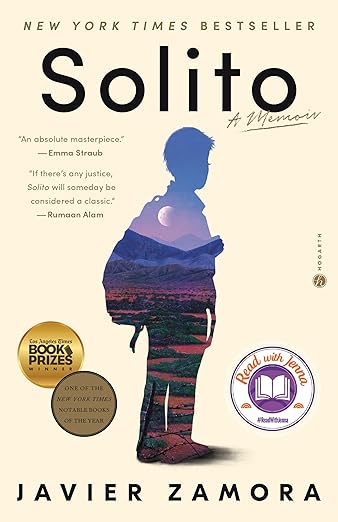
Javier Zamora tells the story of his emigration from El Salvador in 1999 when he was nine years old.
His parents are living in California. His father left when Javier was two years old, and Javier knows him only through old photos and the stories his relatives share. When Javier was five, his mother left El Salvador to join his father. Four years later they send for Javier to join them. He is excited to finally reunite with his parents, but he is also sad to leave his grandparents, his aunt Mali, and his friends.
Javier’s grandfather, as planned, escorts him from El Salvador through Guatemala then returns home before Javier enters Mexico. After his grandfather leaves, Javier continues his journey north with a small group of people consisting of three men, two women, a girl, and their coyote, who is supposed to escort them into the United States. Javier doesn’t know these people. He feels alone and abandoned, but he thinks about his parents waiting for him. He works at being invisible, silent, and well behaved. He doesn’t want to be seen as a burden. Marcelo, one of the men in their group, has been paid by Javier’s grandfather to look after Javier, but Marcelo mostly ignores him. It is Patricia, who is traveling with her twelve-year-old daughter, and Chino, a young man in his twenties, who look out for Javier, taking care of him as if he were family. Their journey takes much longer than originally planned, and without Patricia and Chino’s help, Javier probably would have died.
Why did I read this book?
I listened to Maya Shankar interview Javier Zamora in her podcast series A Slight Change of Plans. In the episode titled “I Survived the Unsurvivable,” Zamora speaks about his migration from El Salvador to the United States in 1999. He talks about how the experience had a profound impact on him. Zamora is a poet, but he wrote his memoir Solito, in part, to help him process the trauma he experienced in 1999. After listening to Zamora talk about his experience, I went to the library and ordered his book through interlibrary loan.
Why did I like this book?
This memoir is told from the viewpoint of a nine-year-old: Zamora tells what he knew and saw and heard at that time. He does not use his wisdom as an adult to comment about what it all means to him now. There is power in the way he chose to write about his experience. He lets us ponder the meaning and significance of what happened to him. He lets us think about what it means to be compelled to leave your homeland where you are in danger and travel to a land where you are not wanted. As readers we experience the frightening world of Javier’s long and uncertain migration as if we are nine years old and all alone among strangers.
This does not mean Zamora’s writing is simplistic. Even though he writes from the point of view of his nine-year-old self, he uses words, metaphors, and more complex sentences than he would have used if he wrote it when he was nine. Zamora’s mastery of description paints vivid scenes of the countries he travels through and breathes life into the people who accompany him. Solito is beautifully written, often with a lyrical quality.
What You Have Heard Is True: A Memoir of Witness and Resistance by Carolyn Forché, 2019
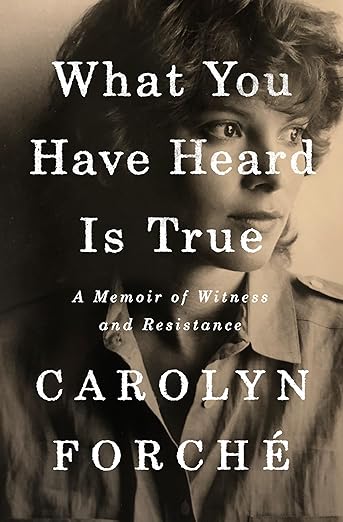
What is this book about?
In 1978, a man named Leonel Gomez drives from El Salvador to southern California to tell Carolyn Forché the story of his country El Salvador and to explain that he believes civil war will soon engulf the small nation. Gomez and Forché have never met, but Forché recently spent the summer with some of his relatives in Spain, and this is how Gomez knows about her. He has come to ask her to visit El Salvador to bear witness to what is happening in his country. She tells him that she is not a journalist and that there must be more qualified people to do what he is asking. He tells her that it’s not important she be a journalist. He has asked her for two significant reasons: she is a poet and she is an American.
Forché decides to travel to El Salvador and makes a handful of trips to the country between 1978 and 1980. Gomez is an enigma to Forché, as well as to many of his countrymen. But it’s clear that he is intelligent, wily, well read, and passionate about the plight of the poor and disenfranchised in El Salvador. Gomez takes her to see impoverished farmers and laborers, to visit political prisoners, and to meet both ruthless authoritarian leaders and members of the resistance movement. Some of the people Forché meets are Americans. She comes to understand that the United States is complicit in supporting the cruel and corrupt government of El Salvador. Many of the places Forché visits and many of the people she meets are dangerous, but Gomez wants her to take notes and to write about what she experiences. Forché fills journals, recording much of what she sees and hears. She writes poetry based on her experiences, and years later she will use her notes to write her memoir.
Why did I read this book?
Well, I almost didn’t.
I bought Forché’s memoir because she was part of the Rose Warner Reading Series at St. Scholastica in 2026. She read some of her poetry, which was wonderful. I read the first chapter of her book and liked it. She is a wonderful writer, and the story sounded interesting. But I put her book aside because I was already reading two other books, and I forgot about it. A few months later, I decided to donate some of my books to our library, and I added Forché’s memoir to the bag. I felt bad about this because I was giving up on what I believed would be a good book. But my To-Be-Read pile of books is a lofty stack. And I wondered, “Do I really need to read another book about a tragically sad historical event that proves once again how cruel human beings can be to one another in order to amass power and wealth?”
Then I read Solito. In his memoir Zamora briefly mentions that his father needed to leave El Salvador because the civil war made it dangerous for him. Zamora also mentions, as a brief aside, that the U.S. funded the corrupt, authoritarian Salvadoran government during the civil war that caused many El Salvadorans to flee horrific violence. Zamora never elaborates about the civil war or the politics of El Salvador. Remember, he tells his story from the point of view of his nine-year-old self, and he was only two when his father left in 1992, the year the civil war officially ended.
But Zamora’s scant reference was enough to pique my curiosity. Thankfully, I hadn’t donated Forché’s book yet. I pulled it out of the bag. When I finished Zamora’s memoir, I began Forché’s. And yes, I did need to read another book about a sad historical event that showed once again how cruel human beings can be to one another. Forché’s story about the El Salvador of 1978 resonates as it reminds us that we need to be better humans, a message that is just as important in today’s world.
Why did I like this book?
Forché, like Zamora, is a wonderful writer. She, too, uses her skills as a poet to create an often lyrical prose as her story reveals the uncertainty and violence of life in El Salvador during the 1970s and 80s. While reading What You Have Heard Is True, I realized I knew nothing about El Salvador, its brutal civil war, and the complicity of the U.S. in helping to perpetuate the atrocities of a violent authoritarian government.
I’m glad I read Carolyn Forché’s memoir. It sits on my bookshelf now, and I have no desire to donate it even though I’ve read it. Maybe several years from now, but it’s hard to get rid of a book that expanded my thinking and educated me about an important but overlooked part of history.

