
Who should read this book?
If you’re a writer with hopes of publishing a book, you should read The Untold Story of Books. You’ll learn something about the business end of publishing, not to be confused with stories about how authors come to have their books published. You’ll understand why it’s difficult to get books (even good ones) published, unless you self-publish. And if you do self-publish or have a book traditionally published, you’ll understand why most books, even good ones, don’t sell many copies.
None of this is meant to discourage you because if you love to write, you’re going to write. And if you love what you’ve written, you’ll probably want to share it with the world. But understanding how the business end of publishing works can be comforting. You’ll learn that rejection isn’t necessarily about your writing; it’s often about things that are very much out of your control. You’ll better understand the maze of business decisions publishers and authors make before and after a book reaches a wooden or digital shelf. (But this isn’t a how-to-market-your-book manual.)
And if you don’t write but love to read, you should read this book because it’s good to know how books have come into the world. Writers and readers alike are bound to have more than a few I-didn’t-know-that moments as they read this book.
Why did I read this book?
I’m a writer and my first collection of short stories, Silent Negotiations, will be published in February 2027 by Cornerstone Press at the University of Wisconsin-Stevens Point. So, when I discovered Castleman’s book, I bought a copy because I thought it would be interesting to understand something about the publishing business. Also, the book has the word history in the title, and I like reading about the history of almost anything.
What is this book about?
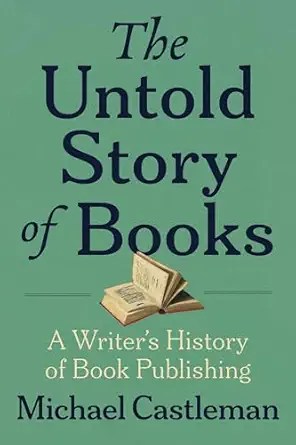
Michael Castleman has been a writer for over forty years. He has published nineteen books, most of them nonfiction. Throughout his career he has been fascinated by how the business end of publishing works. In his introduction he states: “When I attended writing conferences, instead of attending the how-to-get-published panels or standing in signing lines for A-list authors, I was among the few quizzing publishers: How do you determine print runs? Why don’t you advertise more? Publishers always expressed surprise: You’re interested in the business side? Few authors they dealt with were, unless it had to do with their royalties” (p. 14).
Castleman divides his book into three sections: The First Book Business, The Second Book Business, and The Third Book Business. In each of these three stages, it is a significant advancement in technology that changes the world of producing and selling books. In the First Book Business, Johannes Gutenberg’s invention of moveable type transforms the business of books because they no longer have to be copied by hand. The Industrial Revolution powered by steam engines spurs the Second Book Business by making the printing process much faster. And The Third Book Business rises with the digital age.
In a very readable manner, Castleman discusses what each stage has meant for authors, agents, editors, publishers, printers, distributors, booksellers, and book buyers. He describes the centuries’ old battle by authors and eventually publishers to have good, enforceable copyright laws, which includes today’s struggles with infringement by artificial intelligence. He also compares and contrasts self-publishing and traditional publishing, pointing out the pros and cons of both paths to publishing books.
Castleman’s book clearly delineates the difficulties of becoming a published writer, but he also describes his love of writing and the thrill of being a published author. I found comfort in reading his book even though the writer’s world isn’t always easy. But as my father would’ve said, “Oh well, it is what it is.”
I plan to read this book again shortly before my book comes out because I think it provides a sense of perspective for writers.

